China’s economy is no longer expected to overtake the US economy in size until mid century, if at all

What an ignorant post.

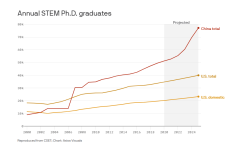
US cannot even persuade the brightest Chinese students to stay in the USA after their studies as they all go back to China.

In fact even the ones that had settled in USA even decades ago are now returning back to their homeland.

Indians may worship and dream of living in the USA but this does not apply to China.
Why would kids of CCP members stay in US? And why would rich chinos study in the US what's wrong with celestial higher educational system? Btw celestials that are not rich kids are coming here in droves dying to come here. How did you get to live in UK?
 
US will dominate 21st century. US has one major advantage over China - ability to attract talent. If US wants it can take away all the top cream of Chinese scientists, Engineers, Doctors and Scholars. All it needs to do is given them green card. 90% of them will move to US. US has the ability to import the best and brightest from anywhere anytime.
China has way more talents than US

微信图片_20250103105316.png
 
Why would kids of CCP members stay in US? And why would rich chinos study in the US what's wrong with celestial higher educational system? Btw celestials that are not rich kids are coming here in droves dying to come here. How did you get to live in UK?
Less and less

Since 2012, more than 80% of overseas Chinese students have opted to return – a big increase from about 5% in 1987 and 30.6% in 2007.Oct 16, 2024
 
China has way more talents than US

View attachment 92817

The US recruits from an 8B talent pool, China 1.4B.

Americans are simply more innovative and productive than Chinese. The US ability to unlock wealth is unmatched in human history.

China will lose its demographic dividend, and Chinas scale was the only way it could ever compete with the US, but China will ultimately fail to match the US over the long term.

The 21st century will be another American century.
 
The US recruits from an 8B talent pool, China 1.4B.

Americans are simply more innovative and productive than Chinese. The US ability to unlock wealth is unmatched in human history.

China will lose its demographic dividend, and Chinas scale was the only way it could ever compete with the US, but China will ultimately fail to match the US over the long term.

The 21st century will be another American century.
You take more dregs of the society around the world than talents. see the recent attacks?
 

Scientists leave the UK as China overtakes US as most favoured destination​


The US recruits from an 8B talent pool, China 1.4B.

Americans are simply more innovative and productive than Chinese. The US ability to unlock wealth is unmatched in human history.

China will lose its demographic dividend, and Chinas scale was the only way it could ever compete with the US, but China will ultimately fail to match the US over the long term.

The 21st century will be another American century.
Keep daydreaming.
 

Will China ever overtake the US economy?​

Nik Martin
07/15/2024July 15, 2024
China's ambition to be the world's largest economy has been dented by COVID-19, the real estate crisis and an aging population. Boosting growth will be the prime focus at an important Communist Party meeting.


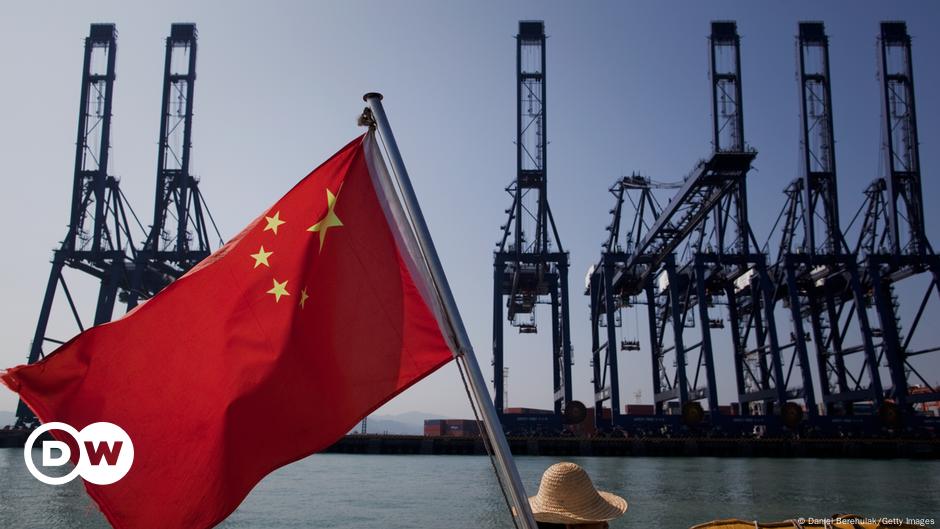
A Chinese flag flaps in the wind in front of cargo containers on the dock of a Chinese port
China is trying to become less reliant on exports by boosting domestic spendingImage: Daniel Berehulak/Getty Images
Advertisement

The idea of China's outstripping the United States to become the world's largest economy has been a fixation for policymakers and economists for decades. What will happen, they argue, when the US — one of the most dynamic, productive economies — is usurped by an authoritarian regime with a workforce of 750 million?

Predictions of when exactly China would steal the US's crown have come thick and fast ever since the 2008/9 financial crisis, which hampered growth in the United States and Europe for many years. Before what became known as the Great Recession, China saw double-digit annual gross domestic product (GDP) growth for at least five years. In the decade following the crisis, China's economy continued to expand by 6%-9% annually. That is, until COVID-19 struck.

China: Economic slowdown in focus at WEF's 'Summer Davos'​

1735874199600.png

01:39

As if the pandemic — which led to strict lockdown measures that brought the economy to its knees — weren't enough, the Asian powerhouse was also plunged into a real estate crash. At its peak, the property market was responsible for a third of China's economy. However, rules introduced by Beijing in 2020 put limits on how much debt property developers could take on. Many firms went bankrupt, leaving an estimated 20 million unfinished or delayed homes unsold.

Around the same time, declining trade relations with the West also weakened growth in the world's second-largest economy. Having encouraged China's ascendancy for decades, by the late 2010s, the US shifted to containing Beijing's economic and military ambitions, if only to delay the inevitable advance.

Has China's economy peaked?​

The apparent change of fortunes for the Chinese economy was so stark that a new term emerged about a year ago: "Peak China." The theory was that the Chinese economy was now burdened by many structural issues, such as a heavy debt load, slowing productivity, low consumption and an aging population. Those weaknesses, along with geopolitical tensions over Taiwan and a decoupling of trade by the West, sparked speculation that China's impending economic supremacy may be delayed, or never happen.


But Wang Wen from Renmin University of China's Chongyang Institute for Financial Studies told DW that the notion of Peak China was a "myth," adding that China's total economic output reached almost 80% of the US output in 2021.

Wang said that as long as Beijing maintained "internal stability and external peace," the Chinese economy would soon overtake the US. He cited the desire of millions of rural Chinese to move to urban areas, where earnings and quality of life were reportedly much higher.

"China's urbanization rate is only 65%. If calculated at 80% in the future, it means that another 200 to 300 million people will enter urban areas, which will generate a huge increase in the real economy," he said.

Productivity growth has 'disappeared'​

Other economists, however, believe that the issues that sparked the Peak China narrative were likely building for several years.

"The Chinese economy grew so fast in the early 2000s because of high productivity," Loren Brandt, economy professor at the University of Toronto, told DW, adding that productivity was responsible for about 70% of GDP growth during China's first three decades of reform, initiated in 1978.

"After the financial crisis, productivity growth just disappeared. It's now maybe one-quarter of what it was before 2008," the expert in the Chinese economy added.

China watchers had hoped that a key meeting of China's Communist Party this week would propose major stimulus measures to tackle the numerous short-term economic headwinds. But they now think Beijing will instead target growth in certain sectors, like advanced and green technology, while also boosting pensions and the private sector.

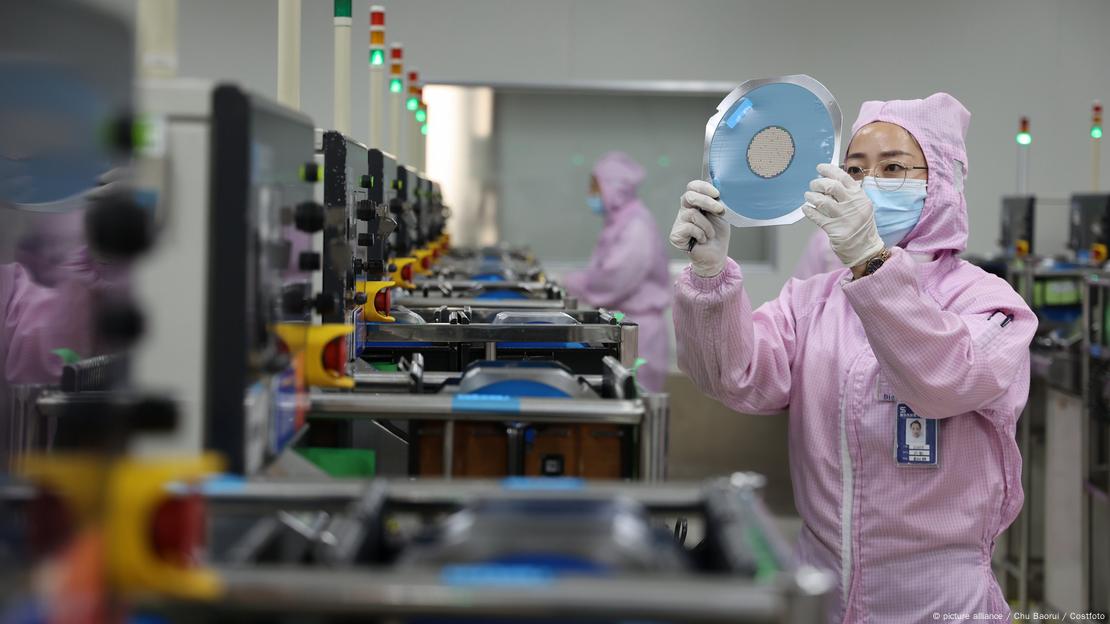
A worker in a purple suit inspects a circular disk at a semiconductor plant

Faced with US export curbs, China is ramping up its own chip manufacturingImage: picture alliance / Chu Baorui / Costfoto
China's total debts have widened to more than 300% of GDP. A large chunk is owned by local governments. Foreign direct investment has fallen for 12 months in a row, dropping 28.2% in the first five months of 2024 alone. Despite huge investments to ramp up production of new technologies, some of Beijing's trade partners are restricting Chinese imports.

"Here is an economy that has invested enormously in [research and development], people, and first-class infrastructure. But it is not being leveraged in a way that's helping to sustain growth in the economy," Brandt told DW.

Unintended consequences of Xi Jinping's power grab​

Beijing, under President Xi Jinping's rule, has also moved toward more centralization of the economy through state ownership of industries. China's leaders decided the next wave of growth would be built on the back of domestic consumption, allowing the country to be less reliant on foreign exports.

However, many social programs haven't kept pace with China's economic miracle. Consumers who can no longer rely on low-cost health care, education and more than a basic state pension, are wary of spending more of their savings. Their household wealth has dropped by up to 30% as a result of the property crash, Brandt said.

"[Decentralization] during the first two or three decades gave room for local governments to make decisions," he added. "China benefited enormously from the autonomy, freedom and incentives that they had, and the enormous dynamism from the private sector. These issues are going to be much harder to reverse, especially under the current leadership."

China fights back against EU tariffs​

1735874199607.png

02:04

In the late 2000s, the private sector made up close to two-thirds of the Chinese economy, but by the first half of last year, that share had dropped to 40%. The state-run and mixed-owned sector has grown much larger. While China now has the most firms listed in the Fortune magazine's ranking of leading global corporations, those companies are much less profitable than their US counterparts, averaging profit margins of 4.4% compared to 11.3% for US multinationals.

Advertisement

Is China the new Japan?​

The big fear is that all these factors could see China's economy go the way of Japan. After World War II, Japan experienced an economic miracle, marked by decades of high growth that caused a massive stock market and real estate bubble.

At its peak, Japan was predicted by some economists to overtake the US as the world's largest economy. Then in 1992, the bubble burst, fortunes were lost, and the economy went into a tailspin. Japan has since failed to make up for several decades of lost growth.

Chinese economists, meanwhile, point to the country's industrial production being larger than the US's. Last year's GDP growth at 5.2% was more than double the US growth rate. The Asian country's economy already surpassed the US in 2016 when measured in purchasing power parity (PPP).

"In the past 45 years, China's development has faced many economic problems," Wang told DW. "But compared with the depression 30 years ago, the high debt 20 years ago, and the housing crash 10 years ago, the current problem is not the most serious."

Edited by: Ashutosh Pandey

Editor's note: This article was updated to change the term industrial GDP to industrial production.

The article, originally published on July 10, 2024, was updated on July 15 to reflect the start of a key Communist Party meeting in China.


https://www.dw.com/en/will-china-ever-overtake-the-us-economy/a-69591117
 
US only has US dollars, not much else, if the dollar dominance is gone, US will become a poor country overnight. What China has are goods and products, it doesn't matter what currency rules, they always will be all there to dominate.

we have report that US$ is 'truly' valued below even Chinese Yuan, and its true :)

also, we have news from credible sources that now US's 'total' budget is nearly as much as what they claim for even their Defence budget. :coffee:

US-western countries lie about their economic data's, including about their true currency values. and its true :)
 
we have report that US$ is 'truly' valued below even Chinese Yuan, and its true :)

also, we have news from credible sources that now US's 'total' budget is nearly as much as what they claim for even their Defence budget. :coffee:

US-western countries lie about their economic data's, including their true currency value. and its true :)

"China is acquiring high-end military weapons and equipment five to six times faster than the US, according to an American defense official.

“In purchasing power parity, they spend about one dollar to our 20 dollars to get to the same capability,” he revealed during the Government Contracting Pricing Summit in California."
 
China's defense budget is much smaller than US on paper but the buildup and development is much faster, go figure.
 
PPP only matters when measuring individual standard of living. Real money is real power. Nominal is all that matters when measuring economic strength.
Yes, nominal is all that matters, only in national currencies.
 
Demographics are destiny, and China is literally dying out over the next 75 years.

China won’t be able to compete with the US over the long term.

I agree. But do you believe China will never allow initiatives and steps that would resolve this issue for it ? Initiatives such as


1. Allowing immigrants from other Asian countries (Pakistan, India, Bangladesh, Vietnam, Malaysia etc. maybe even African countries). Even if China allow 100 thousand young qualified and educated immigrants each year, it will majorly solve it's population issue.


2. China is rapidly automating it's factories with robots and new machinery. A factory in china that required 5000 men to run in 1980 now can function with less than 500 while offering more efficiency and production.


3. China will reach a point in about 10 years where it's major chunk will be well connected and will have modern infrastructure. That will be time when china won't need much human resource as major part of construction will stop. So that time China will shift it's existing labor force to other sectors which may face labor shortage by then.


These are 3 points that directly came to my mind. Maybe there will be more. I mean, if China want to solve it's population problem, it can do it in months, not decades. Only thing it would be required to do is open it's arms to different cultures, ethnicities, nationalities etc. it will need to be more open. That's it. What do you think ?
 
China has had a bigger economy than the US for a long time now.

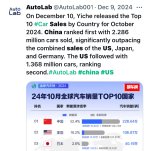
China consumes multiple times more cars, HDTVs and practically every other major goods than the US.

IMG_6585.jpeg


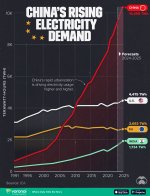
What's more, Chinese electricity demand is more than twice that of the US and is growing exponentially faster:IMG_6574.jpeg

Only someone living in a fantasy would think that a nation that consumes half the cars and other goods and half the electricity as China can possibly end up with a bigger economy.

The real world does not work that way. You cannot get produce without putting energy into the development and production processes. Unless you are counting make-believe products that consume no electricity (maybe US makes $trillionz of stuff without electricity -- including no lights or ventillation or heating.)

BTW, electricity demand in China grew 7% in 2023 and 7% in 2024 while the US remained flat.

Not only is China's economy far larger, it is growing far faster.
 
Last edited:
1. Allowing immigrants from other Asian countries (Pakistan, India, Bangladesh, Vietnam, Malaysia etc. maybe even African countries). Even if China allow 100 thousand young qualified and educated immigrants each year, it will majorly solve it's population issue.

100K? Singapore with 6mil people is already accepting 30K+ permanent residents every year and yet our population is barely growing.

Immigration will make no difference to China with a 1.4bil people and a TFR of 1.0 (implying that every generation will shrink by 50%).

1735905505157.png

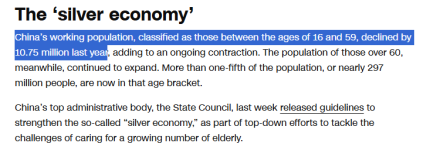
China's working population is already shrinking by >10mil every year, and the decline is only accelerating. Even at current pace, its working population will shrink an equivalent of Taiwan's total population every ~2 years, or South Korea's total population every ~5 years.

Immigration will make no difference to China's demography. Moreover, for young and educated workers looking to immigrate, the first choice of destination for the majority will be English speaking developed countries. And the second choice would be non-English speaking developed countries.

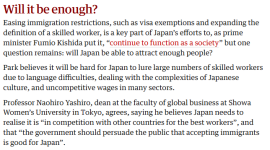
Even Japan has difficulties attracting and retaining skills workers, due to comparatively low wages and an additional language barrier.


1735907354937.png
 

Users who are viewing this thread

Pakistan Defence Latest

Latest Posts

Back
Top