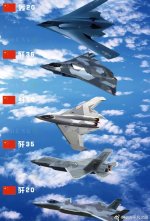
Chinese 6th Generation Aircraft News & Discussions

Videos, we need videos bhai to celebrate the birth of NGAD, dont tell me miscarriage 😭
I mean, they have shown one 6th gen via the B-21 Raider.

While not a fighter, it does give us a glimpse into the US air doctrine, and design theory.
 
I mean, they have shown one 6th gen via the B-21 Raider.


I would not call the B-21 "6th generation".

It seems to be an updated B-2 with more fuel efficient engines and updated electronics.

It in essence does not have any more capability than a B-2 has but to be a little better in stealth, fuel economy and updated electronics.
 
I would not call the B-21 "6th generation".

It seems to be an updated B-2 with more fuel efficient engines and updated electronics.

It in essence does not have any more capability than a B-2 has but to be a little better in stealth, fuel economy and updated electronics.
It has all the characteristics of a 6th gen, from Ai compatibility, to advanced next gen avionics, to "reportedly" some sort of new laser defense system.

It's also uses next gen stealth tech as well.
 
Yes B-21 is definitely a "next generation plane". We should all start defining "next generation" based on comparison to the previous latest generation characteristics.

E.g. B-2 is in part "replaced" or "superseded" by B-21. B-21 is stealthier than B-2 and uses a whole new generation of electronics, sensors, software and stealth materials.

In the same way CAC and SAC's prototypes show what China's next generation of fighters are. These will replace and supersede the J-20 and J-35 which are serving as China's current latest fighters. Obviously to also separate these two from J-20 and J-35 there is the completely new airframe type with no stabilisers, of course it will be using software, electronics and sensors the J-20 and J-35 design phase never dreamed of. SAC's also has changeable airframe with hints of hingeless whatever that means... new tech and way of moving wings have long been experimented but if any of those make their way to next gen fighters obviously we call those a new generation... experimental is one thing, prototyping is one thing, bringing all those new things to service where previous gens of fighters dont have defines that aircraft as next generation. In these ways, J-36 and SAC's J-50 are obviously 6th generation fighters.

It doesn't mean those two 6th gens will stop the relevance and production of J-20 and J-35 no more than F-22's introduction stopped the production of F-15, F-16, and F-18 production and even further development blocks of those legacy 4th gen fighters.

In the other thread where J-hungry was talking about how RQ-180 and X-36 are 6th gens... well RQ-180 is purely ISR. This would be like saying China's CH-7 is a 6th gen fighter. X-36 is purely a empty concept plane, tech demonstrator to evaluate an aerodynamic design. China's experimental planes are almost never disclosed but there would have been numerous computer and wind tunnel based concept designs and even some flying demonstrator experimentals too. We can't call those 6th gen fighters either.

As for B-21... well it is a subsonic bomber with some air to air capability that the USAD desires. It will still be limited as a "fighter" because it is subsonic and will unlikely turn even as well as the J-36.

Next gen is blurring air to air combat where missile trucks and heavy CCA will proliferate as officially hinted by SAC and PLAAF. But missile trucks with high altitude and high speed with better turning capability than pure flying wings like B-2, B-21, GJ-11 and S-70 will be much more useful than strapping ULRAAMs and cooperative engagement capability to these larger pure flying wings.

CAC's J-36 is not a flying wing. It is a rudderless double sweep wing fuselage aircraft with diamond wing. SAC's 6th gen is a rudderless lambda wing with possible variable airframe to better adapt the aircraft to different flight altitudes and speeds for maximum performance throughout various flight regimes. SAC's J-50 is also not a flying wing even though it is completely devoid of stabilisers. Disclaimer on that is it may be canted rudders that fold down during certain modes of flight.

Actual pure flying wings are the original Horton series german aircraft, Northrop's N1/YB-49 experimentals, the numeours experimentals from everyone including India's SWIFT and Ghatak, The countless Chinese flying wing UAVs I can't be bothered listing because there's like a dozen and Russia's S-70, france's Neuron experimental mockup model lol and countless others. Few of these distinguish the fuselage and the wing sweep angle are all subsonic. Flying wings are not supersonic capable designs. What CAC and SAC are flying are NOT flying wings. Both have distinguished fuselage and wings don't operate in the same way as flyng wing's airflow over the wings and after wing.

If CAC's is the "missile truck". It is a supersonic, higher altitude missile truck compared to the B-21... also one with an additional super heavy thrust engine (service engine would not be WS-10C as used on prototype obviously and likely to be VCE as hinted). Chinese VCE ground tests have been talked about for years but no info about program maturity and any flight tests yet.

B-21 therefore is tricky to call a fighter. We can call it next gen aircraft since fighter, strike aricraft, and bomber lines are blurred more especially with other platforms helping merge capablities and cover gaps. But then the B-21 would be a lousier air to air platform compared to J-36. It is however many years ahead in program. B-21 is nearly LRIP where J-36 is probably 5 years away from LRIP if J-10 to J-20 first near final version prototype first flight to LRIP is considered - J-10 took about 8 years from disclosed "first flight" to LRIP, J-20 took about 6 years... J-36 should cut it down to 4 given a linear trajectory but let's call it 5 or 6 years.

B-21 is reportedly only a few years away from LRIP.
 
Last edited:
The H-20 must have gone through some major revisions. That is why it takes a longer time for people to see it. I highly suspect the H-20 has gone from subsonic to supersonic in its last major change.
 
Also should say why planes like X-36 cannot be called 6th gen fighter or even prototype.

First of all X-36 was purely experimental and not involved in any fighter program. If there was an intention to "replace" and "supersede" F-22 with NGAD and that NGAD prototype is based on X-36 then we can sort of call X-36 to be the progenitor tech demonstrator of the NGAD prototype. This just isn't true. NGAD is unlikely to have canard surface which X-36 sort of has... at least as a biplane planform.

Similar china's SAC 5th gen concept was a tripane planform which J-20 beat. We can't call that triplane a 5th gen fighter or even prototype since no prototype was ever built as far as we know. At most only a tech demonstrator would have been evaluated against J-20's progenitor tech demonstrator. These demonstrators cannot hold a candle to what a prototype is. Similarly a prototype is also not the LRIP final form fighter that gets introduced into active service.

X-36 also cannot compare to J-36, J-50 or NGAD because the latter three are all going to be single planform (J-50's rudders in planform mode) while X-36 has two additional surfaces like canards.

If we're defining 6th gen as combat aircraft coming after 5th gen fighters then GJ-11 and S-70 are the only active 6th gen "fighters".

RQ-180 has no weapons and serves as a ISR platform... it's even in the designation. RQ-170 was kept secretive because it's a spy platform that's designed to float subsonically with the most stealth that engineers of the time can give it, deep into enemy territory like with Iran... Except Iran downed at least one RQ-170 with ease and reverse engineered it.

RQ-180 is secretive because it's a spy asset to be as stealthy as possible - even more so than B-2 B-21 etc. Their stealth designs are not compromised by the need to have crewed compartments, complexities of carrying weapons and guidance etc and so on. RQ-180 would be as stealthy as US tech can make it during the time B-21 was no doubt being designed already. So RQ-180 would probably be stealthier than B-21 if nothing more than no need for human crews, no weapons bays and openings, no need for weapons guidance systems and being 20x smaller.

US does not have any 6th gens in service if we use this wrong logic of generation. If that is the case then China's GJ-11 was in service by 2019 which is after J-20 (tick) and has no vertical or horizontal stabilisers or additional control surfaces like canards or levcons, it is a pure flying wing and single planform (tick). Russia's S-70 UCAV has been in service since around 2022 soon after it was revealed, certainly they used it during Ukraine at least in 2023 reportedly. It is also single planform, came after Su-57 in service and combat capable. Therefore can we call these two aircraft 6th gen fighters?

By some flawed logic expressed on this forum, yes. But of course no. They are not. No mroe than B-21 is a 6th gen fighter. 6th gen aircraft is getting weird because aircraft generation has never been defined since bomber aircrafts have never been as formally defined as fighter generations. Bombers have been fluid even within airforces particularly between WW1 and Korean war.
 
I personally highly doubt that H-20 will use folding vertical stabilizers. I think all the artwork surrounding the cranked kite wing is very dubious. China has mastered supersonic tailless flight with J-36, highly doubt a subsonic flying wing H-20 would need vertical stabilizers.
 
The H-20 must have gone through some major revisions. That is why it takes a longer time for people to see it. I highly suspect the H-20 has gone from subsonic to supersonic in its last major change.

The rumour is H-20 change back in those years (such heavy redesigns take almost the full development cycle) has changed from subsonic to supersonic.

I have doubts about this because subsonic strategic bomber is important. Subsonic is quieter for next generation acoustic based sensors (only very limited use but for slow bombers leaving a combat zone, acoustics can give away your presence and help in finding you or at least your leaving vector) and much better for hiding thermal signature. Supersonic sure you can now supercruise and that masks heat signature but bombers during the 1970s which were supersonic like B-1 and Tu-160 were also supercruise capable. Yet there was a need for B-2 subsonic stealth.

Subsonic allows you to cruise silently past enemy lines more effectively than supersonic stealth even if radar signature between the two are the same for example, the supersonic bomber's heat signature is higher and its acoustic signature probably is as well.

So if China's H-20 program did 70% of work lets say for subsonic before requirements shifted to fielding a supersonic strategic stealth bomber, I would imagine they may have recycled that work for subsonic. If so then why not make the subsonic the more silent strategic bomber while the supersonic one is the other redundancy. Have both as strategic bombers with slightly different advantages and weaknesses while both will carry future EW C4ISR alternative variants if possible and suitable. One loiters for longer and is quieter, one dashes into combat zones faster and has speed as extra survivability.

The previous regional supersonic strike JH-xy and the strategy subsonic flying wing bomber can become two strategically ranged subsonic and supersonic.

This is of course pure speculation. We know China goes all out and hasn't got much issue with funding. Once they build something they build thousands and open many production lines. It's not beholden to MIC financial blackmail like the US where MIC players can charge the country $1000 for toilet paper and cups.

Just like with manufacturing cars, electronics and basically any consumer product, mass production is the key. The CPC can purchase both platforms and perform economies of scale. Energy supply is plentiful even within China and especially with almost as much renewable sources constructed than the rest of the world combined in energy generation. Secure lines to Iran, KSA, Russia in case of war and plenty of own strategic reserves within country if any routes are blocked. Russia supplies plenty of raw materials, in the meantime Brazil and Australia do as well. In case of war where Brazil and Australia options are closed, there are strategic reserves enough for years of high intensity war not to mention scrapping. China has more steel in country in reserve processed and product form than the rest of world combined. Scrap a few buildings and there's 1000 H-20's worth of steel material. Everything else China actually has reserves of on its own or comes from Russia. Mostly steel is the issue.
 
Last edited:
I personally highly doubt that H-20 will use folding vertical stabilizers. I think all the artwork surrounding the cranked kite wing is very dubious. China has mastered supersonic tailless flight with J-36, highly doubt a subsonic flying wing H-20 would need vertical stabilizers.
Do you think h-20 would look like the enlarged version of the supersonic J-36 with 4 engines?
 
The United States Government is well aware of the huge gap that exists between them and China in terms of industrial scale and cost control. Therefore, their only hope of maintaining military superiority is to maintain a generational difference in weapons.

This has resulted in them having to make extensive use of immature technologies and over-the-top designs. This developmental gamble has led to the failed Jumwalt, EM guns, LCS, Ford class, and so on. It's hard to foresee if NGAD is the next Jumwalt.

It's wrong to do anything when the empire is in decline.

We can bet that the NGAD won't appear during Trump's second term, not even the next administration.
 
We can bet that the NGAD won't appear during Trump's second term, not even the next administration.
China has the world's largest manufacturing base for missiles, ships and drones. China always have answer for everything. We still have h-20 up in our sleeve to reveal. Type 95 and 96 nuclear submarines and a new type nuclear powered carrier.
 
Last edited:
It has all the characteristics of a 6th gen, from Ai compatibility, to advanced next gen avionics, to "reportedly" some sort of new laser defense system.

It's also uses next gen stealth tech as well.
Called it a next gen stealth bomber at best, just because yankee name it a sixth gen aircraft and it becomes one?
How is B21 a subsonic aircraft going to face sixth gen fighter with much higer speed both in and out of the combat zone, people are expecting B21 to get into the hot zone but he is still on his way?
 
Called it a next gen stealth bomber at best, just because yankee name it a sixth gen aircraft and it becomes one?
How is B21 a subsonic aircraft going to face sixth gen fighter with much higer speed both in and out of the combat zone, people are expecting B21 to get into the hot zone but he is still on his way?
I never said it's a fighter.

It's a bomber that fits the description of a 6th gen aircraft.

It's not meant to fight against fighters.
 

Users who are viewing this thread

Pakistan Defence Latest

Back
Top