Vietnam Defense and News forum

Viet

VIP Member
Joined
Jun 18, 2012
Messages
38,696
Reaction score
23,859
Reputation
1,088.2
Country of Origin
Country of Residence
An alternative to China?

An alternative to China?
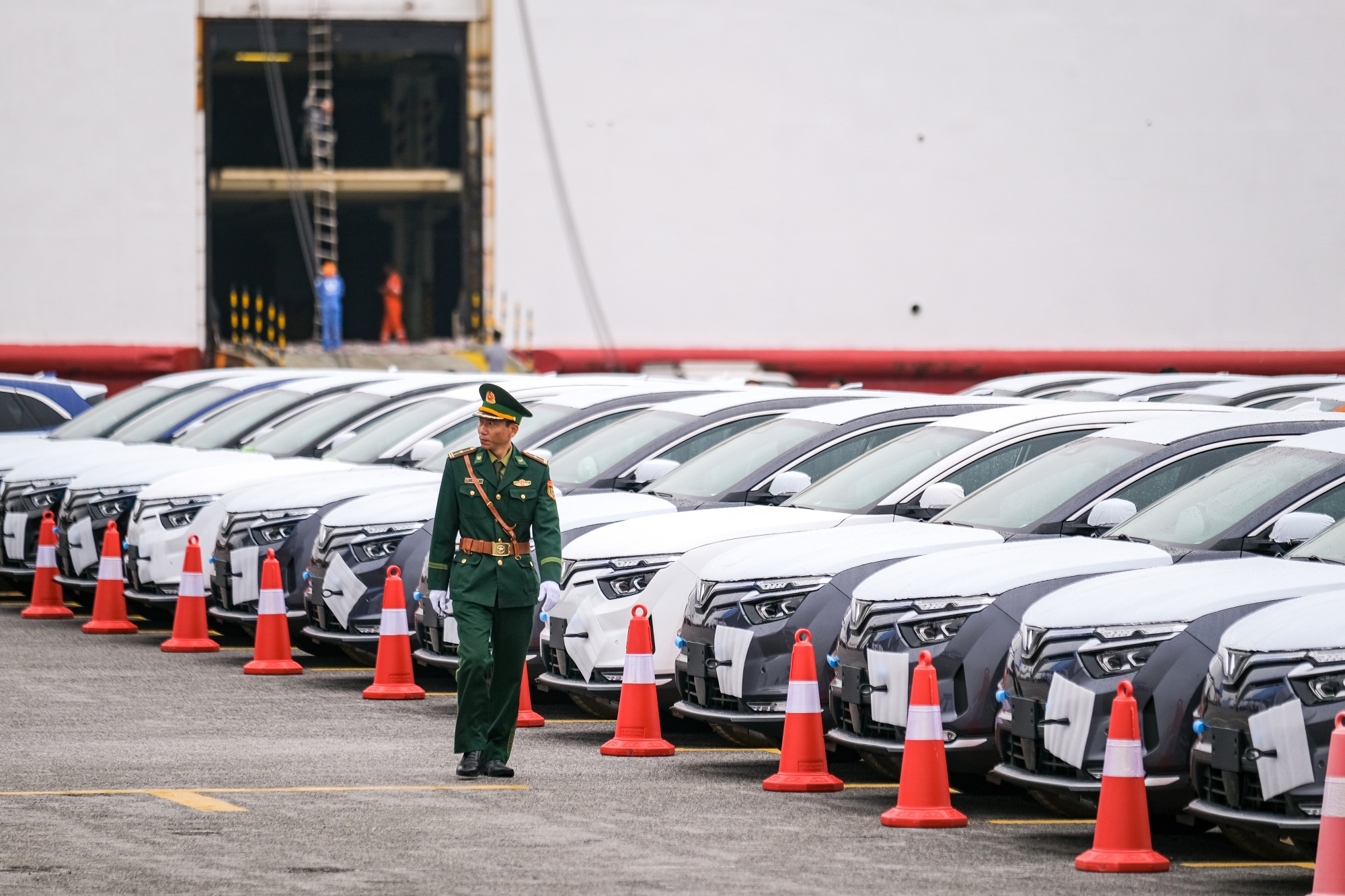
Photographer: Linh Pham/Bloomberg
Save

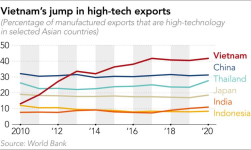
If India wants to build a robust computer and electronics manufacturing industry, it needs to shift focus, fast. Instead of concentrating on the domestic market, it should become regionally competitive and export-driven. That means recognizing that Vietnam, not China, is its biggest rival.

The latest reminder of this urgency came last week with a US appeal for New Delhi to make the business environment easier and more transparent to navigate, or keep losing out on foreign direct investment. Cutting import duties ought to be high on the list, US Ambassador to India Eric Garcetti told the Indo-American Chamber of Commerce on Jan 30.

If you tax inputs, you are taxing your outputs, Garcetti noted. “You are not taxing us, you are not protecting the market. What you are doing is limiting a market.”

A day later, the Indian government reduced tariffs on a range of imported components including battery covers, lenses, antennae and mechanical parts to 10% from 15%. The timing might look like New Delhi was following orders, but it’s more likely a coincidence and even possible that Washington knew it was coming.

Though India is getting a lot of overseas investment, Foxconn Technology Group’s announcement last month that it will spend $100 million on a new plant in Vietnam is a reminder that it doesn’t hold a monopoly over business migration away from China. Mexico, Thailand, Indonesia and Czech Republic are also in the running to secure additional funding to build out the supply chains of the global computer and electronics makers.

Most nations offer a similar mix of incentives to lure investors. These include tax breaks, dedicated free-trade or industrial zones, discounted utilities like water and electricity, free land and commitments to supply workers. But India stands out among peers in implementing higher import taxes, which motivate companies to set up in the country to supply local consumers but makes them less competitive in the export market.

The Modi government’s “Make In India” policy launched a decade ago looks at first to have achieved its desired result. The government raised tariffs on manufactured products, which in turn spurred spurred companies like Foxconn and Pegatron Corp. to expand operations there to skirt those duties.

bloom
 
I don’t understand why, but I see more and more articles like this every day. Everyone should remember that India’s domestic market is much bigger than Vietnam’s. They have greater leverage to demand technology transfer, which is far more valuable than tax breaks and job creation. Vietnam gives a lot of tax incentives to foreign companies, but what’s next? I’ve heard many bad things about Samsung, LG, and Hyundai in Vietnam. They always try to dodge and cheat when they need to share technology with local partners. India shouldn’t settle for less like Vietnam. They have a lot more potential, and following Vietnam’s policies is short-sighted and wasteful of resources.
 
I don’t understand why, but I see more and more articles like this every day. Everyone should remember that India’s domestic market is much bigger than Vietnam’s. They have greater leverage to demand technology transfer, which is far more valuable than tax breaks and job creation. Vietnam gives a lot of tax incentives to foreign companies, but what’s next? I’ve heard many bad things about Samsung, LG, and Hyundai in Vietnam. They always try to dodge and cheat when they need to share technology with local partners. India shouldn’t settle for less like Vietnam. They have a lot more potential, and following Vietnam’s policies is short-sighted and wasteful of resources.
They talk about manufacturing, especially electronics, India wants to copy. Vietnam’s foreign trades to GDP is 200 pct, China 40 pct. Dark sheep is not uncommon. Companies always try to pay as little tax as possible.
The problem with Vietnam is we are still stuck too much in assembly plants.

1708842951200.png
 
https%3A%2F%2Fcms-image-bucket-production-ap-northeast-1-a7d2.s3.ap-northeast-1.amazonaws.com%2Fimages%2F4%2F6%2F4%2F4%2F47754464-4-eng-GB%2FGettyImages-2154299022.jpg

Southeast Asia is emerging as the latest battleground for tech suppliers serving Apple, Google and others. (Nikkei montage/Photo by AP and Takuya Fujiwara)
Taiwanese companies and others face stiff competition from deep-pocketed rivals

TAIPEI/PENANG, Malaysia -- Chinese tech suppliers are taking the battle for business to Southeast Asia, where Taiwanese and other rivals have long been helping the likes of Google and Apple expand production.

Google was one of the first global technology companies to ask suppliers to build production capacity outside China due to escalating tensions between Beijing and Washington. Foxconn, Compal Electronics, Quanta Computer, Pegatron and Inventec, all longtime Taiwanese suppliers, were the major pillars that helped Google -- and other U.S. tech giants -- quickly diversify away from China.

Now, however, they risk seeing orders slip away to Chinese rivals who are also flocking to the region.

Google is asking its Chinese supplier Goertek to build Pixel watches in Vietnam, Nikkei Asia has learned.

Orders for the device's assembly have long gone exclusively to Taiwanese companies, but Goertek will be in charge of making the newest edition of the watch in 2025, a source with direct knowledge of the matter said. It is currently unclear who will win the orders for 2026.

"It's a purely business consideration [to go with Goertek] for consumer electronics goods," the source said. "They have an OOC [outside of China] option, their quality is good, their service attitude is good and their prices are competitive."

https%3A%2F%2Fcms-image-bucket-production-ap-northeast-1-a7d2.s3.ap-northeast-1.amazonaws.com%2Fimages%2F_aliases%2Farticleimage%2F8%2F3%2F8%2F4%2F47754838-1-eng-GB%2F2023-10-04T175253Z_381177835_RC2SL3AERNLZ_RTRMADP_3_GOOGLE-PIXEL.jpg
Pixel 2 Watches: Taiwanese suppliers have long been the sole assemblers of the Google devices. © Reuters

China's BYD, meanwhile, is bidding to make Pixel phones in Southeast Asia, though Google is far from reaching a decision on the matter, according to two people familiar with the matter. All Pixel phones are currently built by Taiwanese suppliers. BYD makes Apple iPads and has massive production capacity in Southeast Asia.

Google did not respond to Nikkei Asia's request for comment.

Goertek and BYD's ambitions underscore the intensifying competition in the tech supply chain.

"Of course we are feeling the heat. We're now directly competing against the likes of BYD, Goertek and Luxshare," said an executive with Taiwan's New Kinpo, which has been manufacturing a variety of products in Thailand for more than 30 years.

Southeast Asia has emerged as a manufacturing powerhouse thanks in part to the escalation of tensions between Washington and Beijing. Geographic proximity to China and considerably lower labor costs make countries like Vietnam and Thailand top choices for supply chain diversification, as companies can easily ship Chinese-made components to these markets for local assembly.

Chinese tech suppliers have been among the most aggressive when it comes to building factories outside China. For example, in the last Apple top suppliers list, 37% of the 35 Apple suppliers in Vietnam are Chinese companies, according to Nikkei Asia's data analysis.

TCL Technology, one of China's top TV makers, expanded its Vietnamese capacity in February 2019 and says on its website that its strategic growth in the country is in response to Beijing's Belt and Road Initiative of overseas infrastructure building.


Political tensions are not the only factor pushing China's suppliers overseas. China's economic slowdown has also spurred many Chinese companies to explore international opportunities, according to Lai Ming-Kuen, a general manager at Acter.

Acter is a Taiwanese builder of manufacturing facilities serving a wide range of electronics sectors, including displays and chips. The company entered Vietnam in 2009, and has recently ventured into Malaysia and Thailand.

"Because of the economic downturn in China, we recently found a lot of Chinese companies are racing to Southeast Asia to grab markets and seek growth drivers beyond their domestic market. A lot of them are also following their customers [BYD and Luxshare]," Lai said.

And these suppliers, Lai added, have more than an economic advantage. "Chinese companies not only offer lower prices to grab projects. In many of these Southeast Asian nations they have quite good diplomatic ties with local governments, and that also helps their companies gain business."

https%3A%2F%2Fcms-image-bucket-production-ap-northeast-1-a7d2.s3.ap-northeast-1.amazonaws.com%2Fimages%2F_aliases%2Farticleimage%2F4%2F4%2F7%2F4%2F47754744-1-eng-GB%2FGettyImages-1491131150%E3%81%AE%E3%82%B3%E3%83%92%E3%82%9A%E3%83%BC.jpg
People visit the Goertek booth at the 2023 China International Consumer Electronics Exposition. Google has tapped the Chinese supplier to assemble smart watches. © Getty Images

Political pressure is likely to intensify this competition in another way, according to Jeff Lin, a tech analyst with Omdia.

"On the international front, we see and expect China's leading companies to become even more committed to expanding overseas," Lin said. "This outward push is driven by the strategic goal of earning more foreign currency and bringing those earnings back to China."

Meanwhile, the "red supply chain," as the industry refers to Chinese suppliers, is rapidly shedding its reputation for low cost and low quality, says Vincent Chang, managing director for Asia and intercontinental regions at Advantech, the world's biggest industrial computer maker.

"Their quality has improved to a certain high level," he said. "They are absolutely not second-tier product suppliers anymore. If you keep such outdated impressions of them, you will lose terribly."

For non-Chinese suppliers, all this adds up to unprecedented competition for everything from workers and land to -- perhaps most urgently -- customer orders.

"Competition with Chinese suppliers basically stayed within China in the past, but now we are facing severe local competition [in Southeast Asia]," Chang said. "They have deep pockets and they have good quality. Our advantage is that we have experience of operating outside of our home earlier than them."

https%3A%2F%2Fcms-image-bucket-production-ap-northeast-1-a7d2.s3.ap-northeast-1.amazonaws.com%2Fimages%2F_aliases%2Farticleimage%2F7%2F3%2F0%2F9%2F47749037-1-eng-GB%2F20240524-BizSpot-FDI-Pie.png

Printed circuit board (PCB), the material on which components and chips are mounted, is a prime example of a sector where competition with Chinese suppliers is heating up.

Nearly 55 PCB makers and their suppliers announced investment plans in Thailand between 2023 and April this year, of which 33 are Chinese, according to data from the Taiwan Printed Circuit Association. At least 13 have started construction in the Southeast Asian country.

"Intense fights over talent, land and orders are the imminent issues we will see when all of the new PCB capacity starts going into production around the end of next year," TPCA Chairman Maurice Lee, who also serves as a senior advisor at Unimicron, Taiwan's leading PCB and substrate maker, told Nikkei Asia.

Moreover, Lee said total production capacity is growing due to geopolitical uncertainties that pushed building new factories -- but total demand is not. "The first thing for everyone is to fight for customer orders. How? By cutting prices."

Many suppliers are already struggling to make use of their existing capacity elsewhere.

"It's a dilemma for us. We will lose orders if we don't invest in overseas capacity, but in the meantime, there's not enough orders for us to fill our old factories in China," said an executive with a Taiwanese thermal solutions provider.

Brian Chen, partner at KPMG Taiwan and KPMG Vietnam, said Chinese tech suppliers moved very fast to make significant investments in Southeast Asia over the past two years. Combined investments from China and Hong Kong exceeded the top single source of foreign investment, Singapore, in 2023.

"Take Vietnam, for example. Either private or state-owned Chinese companies are systematically diversifying their capacity [there]," Chen told Nikkei Asia. New production capacity in Southeast Asia for exports could help Chinese suppliers in the context of the trade war, he added.

https%3A%2F%2Fcms-image-bucket-production-ap-northeast-1-a7d2.s3.ap-northeast-1.amazonaws.com%2Fimages%2F_aliases%2Farticleimage%2F8%2F1%2F9%2F8%2F47748918-1-eng-GB%2F202405xx-BizSpot-Foreign-investment-flow-Column.png

Chen, who has lived in Vietnam for years, said Chinese suppliers plan to build a deep supply chain in the country, and some have even started moving to central Vietnam due to crowding in the nation's north, near the Chinese border.

Expanding the local supply chain, however, could have unintended effects.

"After COVID, Chinese suppliers were aggressively establishing footprints in places like Southeast Asia and Mexico -- in what the U.S. called 'friend-shoring countries' -- to manufacture and export," said Kristy Tsun-Tzu Hsu, director of the Taiwan ASEAN Studies Center at the Chung-Hua Institution for Economic Research in Taipei.

Washington was starting to take note of the large number of Chinese suppliers moving to Southeast Asia, she said, pointing out that the U.S. previously opened an investigation under the former Trump administration into Vietnam's trade practices.

"It is worth monitoring how the U.S. changes its attitude if the trade surplus from Southeast Asia continues to expand," she said.
 
Vietnam emerges as global durian powerhouse

Durian in sold in the Mekong Delta City of Can Tho. Photo by VnExpress/Manh Khuong

According to investors’ reports, the country’s durian export experienced a 7.8 –fold increase as compared to 2022, accounting for nearly 50% of its total fruit and vegetable shipment value. This success is largely attributed to strong demand from China, where durian is considered a luxury fruit and a creative culinary ingredient.

In November 2024, Chinese durian imports totaled 1.53 million tonnes valued at $6.83 billion, marking a 9.4% increase year-over-year. Vietnam commanded 47% of this lucrative market, closely trailing Thailand's leading position.

Durian has become a trending phenomenon among China's middle class, with an array of innovative products such as durian hot pot, durian bread, and themed buffets. Vietnam has capitalized on this opportunity by maintaining year-round and high-quality production to meet premium market demands.

Meanwhile, Indonesia is struggling to compete, with its durian exports reaching only $1.07 million in 2023, significantly below Vietnam's performance, according to Statistics Indonesia (BPS).

CNBC attributed Vietnam’s achievement to its comprehensive strategy, encompassing quality improvement, technological innovation, and international market expansion.

The country has utilized its 150,000 hectares of durian cultivation areas, particularly the Mekong Delta and highland regions, to maintain high-quality production throughout the year.

A strategic trade agreement with China, established through an export protocol in 2022, has further strengthened Vietnam's position. Accordingly, Vietnam commits ensuring strict food safety standards, product traceability, and modern freezing technology implementation.

Vietnam's durian success story demonstrates how strategic planning can transform a local agricultural product into a high-value global commodity.
 
in long term Thailand fruit industry is finished.

I remembered few years back a chinese poster here claimed Vietnamese fruits especially Durian had no chance in China because Chinese loved Thai fruits.
 
Vietnam emerges as global durian powerhouse

Durian in sold in the Mekong Delta City of Can Tho. Photo by VnExpress/Manh Khuong

According to investors’ reports, the country’s durian export experienced a 7.8 –fold increase as compared to 2022, accounting for nearly 50% of its total fruit and vegetable shipment value. This success is largely attributed to strong demand from China, where durian is considered a luxury fruit and a creative culinary ingredient.

In November 2024, Chinese durian imports totaled 1.53 million tonnes valued at $6.83 billion, marking a 9.4% increase year-over-year. Vietnam commanded 47% of this lucrative market, closely trailing Thailand's leading position.

Durian has become a trending phenomenon among China's middle class, with an array of innovative products such as durian hot pot, durian bread, and themed buffets. Vietnam has capitalized on this opportunity by maintaining year-round and high-quality production to meet premium market demands.

Meanwhile, Indonesia is struggling to compete, with its durian exports reaching only $1.07 million in 2023, significantly below Vietnam's performance, according to Statistics Indonesia (BPS).

CNBC attributed Vietnam’s achievement to its comprehensive strategy, encompassing quality improvement, technological innovation, and international market expansion.

The country has utilized its 150,000 hectares of durian cultivation areas, particularly the Mekong Delta and highland regions, to maintain high-quality production throughout the year.

A strategic trade agreement with China, established through an export protocol in 2022, has further strengthened Vietnam's position. Accordingly, Vietnam commits ensuring strict food safety standards, product traceability, and modern freezing technology implementation.

Vietnam's durian success story demonstrates how strategic planning can transform a local agricultural product into a high-value global commodity.
You should thank Ferdinand Romualdez Marcos, President of the Philippines, who gave Vietnam this opportunity!
 
@Viet bro

in long term Thailand fruit industry is finished.

Thailand has err other kinds of "fruits" to offer, which are world renowned and I suspect will keep selling well.

Regards
 
You should thank Ferdinand Romualdez Marcos, President of the Philippines, who gave Vietnam this opportunity!
I don’t understand. why should we thank him? what did he do?
 
Durian, sapodilla, and Star Apple are my 3 favorite fruits.
 
@Viet bro

in long term Thailand fruit industry is finished.

Thailand has err other kinds of "fruits" to offer, which are world renowned and I suspect will keep selling well.

Regards
there is a gap.
Vietnam farmers productivity is twice of Thai farmers. we produce twice volumes with half the costs. technology helps.
Look at Vietnam rice production
in 2024 Thailand rice export 10 million tons, Vietnam 9 million tons. in the past Thailand controls the rice market with great margin. now gone. just a matter of time we will surpass them in rice, durian and the rest.
 
I don’t understand. why should we thank him? what did he do?
China used to import a lot of fruits from the Philippines, people started boycotting Filipino fruits after his BS in the SCS.
 
Well we Pakistanis wish well for Vietnam.

We should do more trade with Vietnam in agricultural goods and textiles.
 
China used to import a lot of fruits from the Philippines, people started boycotting Filipino fruits after his BS in the SCS.
banana?
we have tension with the chinese too. I think it’s even worse than between China and Philippines. but at the end of day the Chinese are capitalists. trey see Vietnam offering fruits with lower costs, faster delivery, better quality.
for us making car or banana is similar to making shoes. no difference.


Users who are viewing this thread

Pakistan Defence Latest

Back
Top