China hits back at Canada with fresh agriculture tariffs

US Postal Service flip-flops on Hong Kong-China packages, lifting a ban imposed a day earlier​

A U.S. Postal Service employee loads parcels outside a post office in Wheeling, Ill., on Jan. 29, 2024. (AP Photo/Nam Y. Huh, File)

A U.S. Postal Service employee loads parcels outside a post office in Wheeling, Ill., on Jan. 29, 2024. (AP Photo/Nam Y. Huh, File)

Updated 12:13 AM GMT+8, February 6, 2025

HONG KONG (AP) — The U.S. Postal Service is reversing course a day after placing a ban on all inbound packages from China and Hong Kong.

The post office had announced Tuesday that it would no longer accept parcels from the China and Hong Kong after the U.S. imposed an additional 10% tariff on Chinese goods and ended a customs exception that allowed small value parcels to enter the U.S. without paying tax.

The Postal Service reversed course Wednesday but gave no reason. It said it would work with Customs and Border Protection to implement a collection process for the new China tariffs to avoid delivery disruptions.

The post office pointed to the short prepared statement on the reversal when asked for more details about the reversal Wednesday by The Associated Press.

The ban had the potential to create massive disruptions for online shopping platforms like Shein and Temu, popular with younger shoppers in the U.S. for cheap clothing and other products, usually shipped directly from China.

Cheap, direct postal service helps these companies keep costs low, as did the “de minimis” exemption that previously allowed shipments to go tax-free if their value is under $800.

The suspension by USPS would have likely have created delays in shipments and potentially higher prices for the companies that rely on rock-bottom pricing for huge sales.

What exactly did the USPS announce?​

One day after the U.S. Postal Service said in a notice that it would stop accepting inbound parcels from the China and Hong Kong Posts until further notice, it said Wednesday that would “continue accepting all international inbound mail and packages from China and Hong Kong.”

Letters and flats — mail that measures up to 15 inches (38 centimeters) long or 3/4 inches (1.9 centimeters) thick — were not included in the brief ban.

Why did it happen?​

The USPS did not give a reason for the ban Tuesday, but the suspension came after Trump closed the “de minimis” customs exemption this week for China that allowed shoppers and importers to avoid duties on packages worth below $800.

The exemption was removed as part of an executive order to levy a 10% tariff on Chinese goods.

U.S. Customs and Border Protection previously stated that it processes an average of over 4 million “de minimis” imports each week.

It also gave no reason for its decision on Wednesday and did not immediately respond to requests from The Associated Press for comment.

What’s likely to happen next?​

Under the new tariffs imposed by Trump on Chinese imports, analysts say consumers are likely to see price hikes and potential delays in shipments from companies like Shein and Temu.

Chinese exports of low-value packages soared to $66 billion in 2023, up from $5.3 billion in 2018, according to report released last week by the Congressional Research Service. In the U.S., Temu, which is owned by China’s PDD Holdings, and Shein comprise about 17% of the discount market for fast fashion, toys and other consumer goods, the report said.

Alibaba’s AliExpress has also commonly used the trade loophole. Neil Saunders, a managing director with research firm GlobalData, noted some businesses who sell through Shopify and other e-commerce platforms, such as Etsy, also ship packages to consumers directly from China. Amazon does the same for a subset of products sold through Amazon Haul, a low-cost online storefront it launched last year to better compete with Shein and Temu, which rely more heavily on de minimis.

Shein and Temu did not immediately comment on the USPS policy changes. On its website, Temu says it also works with private shipping companies such as FedEx and UPS. Shein notes customers can return their packages through USPS and FedEx.

In general, the U.S. imported about $427 billion worth of goods from China in 2023, the most recent year with complete data, according to the U.S. Census Bureau. Consumer electronics, including cellphones, computers and other tech accessories, make up the biggest import categories.


USPS resumes accepting packages from China, Hong Kong

  • USPS lifts suspension of packages from China and Hong Kong
  • Agency says it's working with CBP to implement collection process
  • Suspension followed Trump's 10% tariff on all Chinese imports
Taylor Delandro

Updated: FEB 5, 2025 / 08:47 AM CST
boxes of mailed goods at mail processing facility

(Photo by Frederic J. BROWN / AFP)

Not sure how to find NewsNation on your TV? Find your channel here. Get 24/7 fact-based unbiased news coverage with the NewsNation app.
(NewsNation) The U.S. Postal Service reversed course Wednesday, announcing it will continue accepting inbound parcels from China and Hong Kong a day after it suspended service from those regions.

“The USPS and Customs and Border Protection are working closely together to implement an efficient collection mechanism for the new China tariffs to ensure the least disruption to package delivery,” the USPS wrote in a notice posted to its website.

The USPS did not state a reason for the suspension in a brief announcement, but it came after President Donald Trump imposed an extra 10% tariff on all imports from China.

The USPS announced Tuesday it would stop accepting parcels from China and Hong Kong “until further notice.”

Trump’s order to impose new taxes on Chinese goods coming into the U.S. ended duty-free handling of parcels, which had previously been considered “de minimis” shipments.

Trump recently threatened tariffs against China, Mexico and Canada, three countries he said were not doing enough to crack down on the production and distribution of deadly fentanyl. The U.S. reached border-security agreements with Mexico and Canada to pause the tariffs.

In retaliation, Chinese officials announced they were raising tariffs on certain U.S. goods entering China.

 
US cannot unilaterally back out of international postal agreements. Well, it can, but the ripple effects would reverberate.
 
US cannot unilaterally back out of international postal agreements. Well, it can, but the ripple effects would reverberate.
Though it had been discussed. The division I work in is a work share partner with USPS. I am well aware what the impacts would have been. Every US-based shipper who holds a workshare agreement with USPS would have been impacted.
 
... Chinese exports of low-value packages soared to $66 billion in 2023, up from $5.3 billion in 2018, according to report released last week by the Congressional Research Service. ...
That's some staggering growth despite Trade War 1.0 and Covid-19.

Sometimes I just don't understand all the noise that the patriot Americans make. When the figures finally come out, it's totally thr opposite of what they had been chanting.
 
Last edited:
That is interesting I didn't know that. It's allot lower than I thought which means domestic consumption has increased over the years.

If China can make from toys, to planes, to microchips all by themselves then the main imports will likely be raw materials and oil/gas.
No shit. Since 2018 China exports have increased by $1 trillion.

View attachment 98804

America was not able to slow down China rise and lost leverage in process.
This just means that China's GDP have become so much bigger.
 
That's some staggering despite Trade War 1.0 and Covid-19.

Sometimes I just don't understand all the noise that the patriot Americans make. When the figures finally come out, it's totally thr opposite of what they had been chanting.

Trump listens to his voters.
But he listens more to his billionaire buddies.
And he listens most to his family financial interests.
 
Though it had been discussed. The division I work in is a work share partner with USPS. I am well aware what the impacts would have been. Every US-based shipper who holds a workshare agreement with USPS would have been impacted.


This was going to be a logistical nightmare for business big and small . I see the threat backfiring got it cancelled!
 
Threats and intimidation don't work on China.
US is humiliating itself.

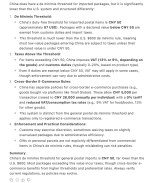
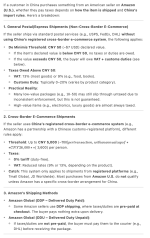
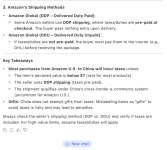
LOL! China taxes products sent into its country by the mail...so don't act so innocently shocked. Your value limit is only $7...anything higher than that is taxed. :ROFLMAO:

ChinaMail1.pngChinaMail2.png
USseller1.png
USSeller2.png
USSeller3.png
 
Last edited:
This was going to be a logistical nightmare for business big and small . I see the threat backfiring got it cancelled!
Yes and no.

For the work share partners, some of us would not mind if this product just went away. I know I would not mind. It's not an easy product to work with once you break down the boxes the individual shipments are packed in. I will give the origin shippers credit; they know how to get a lot of small, lightweight, flimsy packages into a standard box.

The impact would be more toward the sellers. Most of this is drop-shipped direct from China to the end user in the US. Outside of clearing Customs, cross-docking through a facility like one of mine or our competitors, who then hand off to the USPS for final mile delivery, there is no store front or warehouse these shipments go through.
 
This was going to be a logistical nightmare for business big and small . I see the threat backfiring got it cancelled!

But China deals with it in the reverse situation.
They just make mailers jump through more hoops to discourage it.
Why are you not taking that into account?
 

Users who are viewing this thread

Latest Posts

Back
Top