Navigation
Install the app
How to install the app on iOS
Follow along with the video below to see how to install our site as a web app on your home screen.
Note: This feature may not be available in some browsers.
More options
Style variation
You are using an out of date browser. It may not display this or other websites correctly.
You should upgrade or use an alternative browser.
You should upgrade or use an alternative browser.
Royal Saudi Arabian Strategic Missile Force
- Thread starter The SC
- Start date
More options
Who Replied?

Michael
VIP Member

@The SC
I hadn't noticed that PDF actually had this thread. Saudi Arabia's strategic missile force is top secret information. It's not just top secret Saudi information, it's also top secret Chinese information. I wouldn't recommend discussing it publicly. Public discussion of this topic tends to involve inappropriate content.
I hadn't noticed that PDF actually had this thread. Saudi Arabia's strategic missile force is top secret information. It's not just top secret Saudi information, it's also top secret Chinese information. I wouldn't recommend discussing it publicly. Public discussion of this topic tends to involve inappropriate content.

The SC
INT'L MOD
- Thread starter
- #34
Everything in this thread is public official information..so no worries about secrets..@The SC
I hadn't noticed that PDF actually had this thread. Saudi Arabia's strategic missile force is top secret information. It's not just top secret Saudi information, it's also top secret Chinese information. I wouldn't recommend discussing it publicly. Public discussion of this topic tends to involve inappropriate content.

Hussain
Trusted Member

"See eye aye" or some other alphabet soup agency has has been tripping, leaking details, on a regular basis, to the western press. So it's pretty much public knowledge, that the Saudis have two sources for their BM program - same ones as Jeff.@The SC
I hadn't noticed that PDF actually had this thread. Saudi Arabia's strategic missile force is top secret information. It's not just top secret Saudi information, it's also top secret Chinese information. I wouldn't recommend discussing it publicly. Public discussion of this topic tends to involve inappropriate content.
Last edited:
Michael
VIP Member
Well, you guys feel free to discuss it."See eye aye" or some other alphabet soup agency has has been tripping, leaking details, on a regular basis, to the western press. So it's pretty much public knowledge, that the Saudis have two sources for their BM program - same ones for Jeff.
Please Chinese try to avoid discussion on this topic to avoid unnecessary trouble.
禁止“伤害”榜一大哥!
Hussain
Trusted Member
Bro, perfectly understandable.Well, you guys feel free to discuss it.
Please Chinese try to avoid discussion on this topic to avoid unnecessary trouble.
禁止“伤害”榜一大哥!
Hussain
Trusted Member
Saudi Arabia Said to Produce Ballistic Missiles | Arms Control Association

Saudi Arabia’s ballistic-missile programme: an overview
Having relied on missile imports from China since the late 1980s, in the last few years Saudi Arabia appears to have sought an indigenous production capability. Despite this concerning development, its missile programme does not elicit the level of concern sparked by Iran, argues Mark Fitzpatrick.
 www.iiss.org
IntelBrief: Saudi Arabia’s Indigenous Missile Program - The Soufan Center
U.S. intelligence agencies have concluded that Saudi Arabia has begun developing its own ballistic missiles with the help of China, according to recent media reports. Saudi Arabia purchased ballistic missiles from China in the late 1980s, but it has not, until now
 thesoufancenter.org
The SC
INT'L MOD
- Thread starter
- #40
Riyadh’s silent ballistic-missile surge
While the details surrounding Saudi Arabia’s missile capabilities remain largely elusive, recent satellite imagery indicates the country may be quietly modernizing or expanding its ballistic-missile force.
Riyadh’s silent ballistic-missile surge
While the details surrounding Saudi Arabia’s missile capabilities remain largely elusive, recent satellite imagery indicates the country may be quietly modernising or expanding its ballistic-missile force.

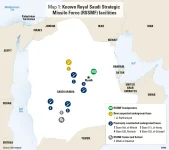
Saudi Arabia established its long-range surface-to-surface missile capability in the 1980s in response to regional missile proliferation and use, particularly during the Iran–Iraq War, as well as Israel’s demonstrated ability to conduct highly effective long-range aerial strikes. In 1988, Riyadh acquired DF-3 (CH-SS-2) intermediate-range ballistic missiles from China. To support the deployment of these systems, the Royal Saudi Strategic Missile Force (RSSMF) constructed four underground bases at al-Hariq, al-Sulayyil, Raniyah and al-Watah.
While the liquid-propellant DF-3 missiles provided substantial range, their operational limitations were readily apparent even at the time of purchase. The DF-3 required complex and time-consuming launch preparations and its inaccuracy further diminished its operational value. By the 2000s, various sources suggested that Saudi Arabia was seeking to procure more-accurate solid-propellant missiles from China, with later reporting claiming that Saudi Arabia had purchased the DF-21 (CH-SS-5) in 2007. Memorabilia (missile models) associated with the RSSMF also suggest that the country may have acquired missile systems other than the DF-3.
In 2014, Saudia Arabia displayed the DF-3 in public for the first time, sparking speculation that Riyadh might adopt a more open posture regarding its ballistic-missile capabilities. While no such increased openness has followed, geospatial analysis points towards significant development activity related to the RSSMF since the late 2010s.
A suspected new missile base
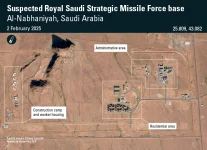
Most notably, Saudi Arabia appears to have constructed an underground missile base near the town of al-Nabhaniyah, marking the first new facility built since the 1980s. Construction began in 2019 and appeared to be largely completed by the beginning of 2024, although some tunnel work continued.
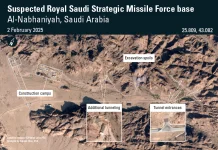
Multiple indicators point to the site’s function as a missile base. The style of the administrative buildings aligns with other known RSSMF facilities, as does the geographical separation between the underground complex and the overground residential and administrative areas. Tunnel entrances follow the same design seen at the RSSMF base at al-Sulayyil, and contractor records confirm the project falls under the purview of the Ministry of Defense. Additionally, RSSMF commander Jarallah Alaluwayt was reported to be in al-Nabhaniyah (engaged in charitable activities) shortly before construction began.
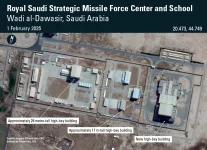
New facilities at the RSSMF Center and School
New construction is also visible at the RSSMF Center and School in Wadi al-Dawasir. The site includes an approximately 29 metre-tall high-bay building, likely built in the late 1980s to support the DF-3 force, possibly as a training or maintenance facility. In the early 2000s, an approximately 17 metre-tall high-bay building was added, likely linked to the reported acquisition of a newer, more compact missile system. Most recently, between 2019 and 2021, a third large high-bay building was constructed at the site. While its exact function remains unclear, its design and placement suggest it serves an operational or support role within the RSSMF infrastructure.
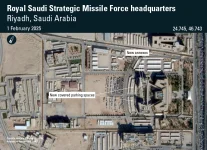
Further activities
Similar signs of modernization or expansion are visible at other RSSMF sites. Two new annexes were constructed at the RSSMF headquarters in Riyadh between 2017 and 2019. In the same time span, the number of covered parking spaces at the headquarters increased from around 511 to 688.
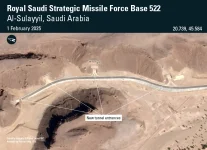
In the second half of the 2010s, new tunnels were constructed at the RSSMF missile bases in al-Hariq and Raniyah. An additional underground section was also constructed at the al-Sulayyil base between 2019 and 2023.
Unanswered questions
While the above activities point towards a potential modernisation or expansion of RSSMF capabilities, details about the nature and scope of these developments remain largely elusive. One exception to the general secrecy surrounding the Saudi missile programme was a 2022 report by Intercept. Citing a United States intelligence source, the article claimed that Saudi Arabia was planning new imports of Chinese ballistic missiles under a programme named ‘Crocodile’. While these plans reportedly raised concerns in Washington, their specifics – including whether they were eventually implemented – remain unclear.
Similar uncertainty surrounds Saudi Arabia’s ambitions for the local assembly or manufacturing of ballistic missiles. As part of its broader Vision 2030 agenda, Riyadh has prioritised the development of a domestic defence-industrial base.
Crown Prince Muhammad bin Salman Al Saud has stressed that at least partial local production will become a binding requirement for all purchases of military hardware. This approach also appears to extend to missile systems. Saudi Arabia is known to have established a solid-propellant motor-production facility at the al-Watah missile base, and US intelligence assessments indicate that it is now producing ballistic missiles with Chinese assistance. Yet details about the specific systems it plans to assemble or manufacture remain unknown.
The secrecy surrounding Saudi Arabia’s ballistic-missile force will likely remain in place unless Riyadh alters its information policy or new information emerges, potentially from the US. The apparent absence of ballistic-missile use in Saudi Arabia’s campaign against Ansarullah (the Houthis) indicates that these systems might serve more as a strategic deterrent than a war-fighting capability. As such, their true role may only come to light in crisis.
https://www.iiss.org/online-analysi...25/02/riyadhs-silent-ballistic-missile-surge/

_Arabia_
Trusted Member

@The SC
I wish that there was less secrecy involved. Impossible to discuss much in detail when this branch of KSA's armed forces are this secretive.
However there is no doubt that after almost 40 years and given the regional developments that KSA has little to envy anyone on this front. Everything else would make no sense given the geopolitics, resources, political will and necessity.
As a curiosity, given the map posted, it is well known that all of those missile bases in the mountains and desert are located in Najd but it would be very strange if they were not present in all major regions of KSA given the extensive geography.
I wish that there was less secrecy involved. Impossible to discuss much in detail when this branch of KSA's armed forces are this secretive.
However there is no doubt that after almost 40 years and given the regional developments that KSA has little to envy anyone on this front. Everything else would make no sense given the geopolitics, resources, political will and necessity.
As a curiosity, given the map posted, it is well known that all of those missile bases in the mountains and desert are located in Najd but it would be very strange if they were not present in all major regions of KSA given the extensive geography.
The SC
INT'L MOD
- Thread starter
- #43
These are only the major bases.. there are many other secret underground bases..@The SC
I wish that there was less secrecy involved. Impossible to discuss much in detail when this branch of KSA's armed forces are this secretive.
However there is no doubt that after almost 40 years and given the regional developments that KSA has little to envy anyone on this front. Everything else would make no sense given the geopolitics, resources, political will and necessity.
As a curiosity, given the map posted, it is well known that all of those missile bases in the mountains and desert are located in Najd but it would be very strange if they were not present in all major regions of KSA given the extensive geography.
_Arabia_
Trusted Member
Logic and geography would at least dictate that.These are only the major bases.. there are many other secret underground bases..
The enormous secrecy makes one wonder though. I don't care what anyone says, I am convinced that KSA has nuclear warheads in those secret underground bases that are ready to be deployed in a worst case scenario (existential threat). Courtesy of Pakistan.
Do I believe that KSA can fully independently of third parties develop nuclear warheads at home? Not yet but all the developments points toward that eventually being and becoming the goal. Look at North Korea. Should not be hard for KSA to be able to follow suit with uranium reserves already found within KSA, finances not being the challenge nor political will or necessity given regional developments.
The SC
INT'L MOD
- Thread starter
- #45
All that is already done!Logic and geography would at least dictate that.
The enormous secrecy makes one wonder though. I don't care what anyone says, I am convinced that KSA has nuclear warheads in those secret underground bases that are ready to be deployed in a worst case scenario (existential threat). Courtesy of Pakistan.
Do I believe that KSA can fully independently of third parties develop nuclear warheads at home? Not yet but all the developments points toward that eventually being and becoming the goal. Look at North Korea. Should not be hard for KSA to be able to follow suit with uranium reserves already found within KSA, finances not being the challenge nor political will or necessity given regional developments.
I want to see KSA enriching its Uranium now to civilian grades and building at least 8 nuclear reactors for electricity and sea water desalination..all with scientific ToT.. and this is the most important point!
Users who are viewing this thread
Total: 1 (members: 0, guests: 1)
Pakistan Defence Latest


Country Watch Latest
-
 Iran - Israel/US War: Israel-US declare war on Iran, Iran responds (149 Viewers)
- Latest: Professor Jiang
-
 TF-X / KAAN / Hürjet Turkish Fighter & Trainer Aircrafts News & Discussions (8 Viewers)
- Latest: MMM-E
-
-
-

Latest Posts
-
Kuwait Announces a Joint Defence Cooperation Agreement with Pakistan (25 Viewers)
- Latest: Pakistan First
-
Iran - Israel/US War: Israel-US declare war on Iran, Iran responds (149 Viewers)
- Latest: Professor Jiang
-

-
