India Economy Thread

An e-voyage from Chennai to Kolkata in 3 hrs — this IIT-M startup claims it’s possible with just Rs 600

These seagliders have a flatter design, improving aerodynamic efficiency, and can fly up to an altitude of 150 meters, and the developer Waterfly Technologies will soon seek certification from the Indian Register of Shipping for civil and military use.
Aero India Expo


Aero India Expo
Online Desk

Updated on:
16 Feb 2025, 6:32 pm

Waterfly Technologies, a startup incubated at IIT Madras, is developing electric seagliders, a sustainable alternative to traditional air and ferry travel, with plans to transform transportation across coastal regions. These seagliders, also known as Wing-in-Ground (WIG) craft, use a unique design that allows them to take off from water, fly at a height of around four meters, and maintain that altitude, leveraging ground effect for efficiency. They are expected to reach speeds of up to 500 km/h, combining the speed and comfort of aircraft with the affordability and maneuverability of boats.

At Aero India in Bengaluru, Waterfly showcased its design, with a prototype expected by the end of 2025. By April 2025, the company plans to develop a 100 kg prototype, followed by a one-tonne prototype later in the year. A full-scale version with a 20-seat capacity and four-ton payload is expected by next year.

Newsportal Moneycontrol recently quoted Waterfly Technologies' co-founder and CEO, in a report saying; “Travelling from Kolkata to Chennai via WIG craft will cost just Rs 600 per seat for a 1,600 km journey, far cheaper than an AC three-tier train ticket, which costs over Rs 1,500.”

These seagliders have a flatter design, improving aerodynamic efficiency, and can fly up to an altitude of 150 meters. They will initially have a 500 km range on battery power, with a hydrogen-electric variant capable of traveling up to 2,000 km. In emergencies, they are safer than conventional aircraft, as they can land on water. The company also targets routes like Chennai-Singapore, with plans for intercontinental travel by 2029, including a Dubai-Los Angeles route.

Waterfly Technologies is seeking certification from the Indian Register of Shipping by 2026, aiming to develop the seagliders for both civilian and military use. The company is currently receiving grants from IIT Madras and exploring defense funding to support its full-scale prototype and applications in cargo and surveillance. It has garnered interest from various industries, including pharmaceuticals and electronics, due to its lower costs and reduced carbon footprint.

The concept of ground-effect vehicles dates back to the 1960s, with military use by the Soviet Union. Unlike those, Waterfly's seagliders are designed with a focus on efficiency and commercial viability. The company is also in talks with India's GRSE shipbuilders for potential military applications, especially for the Coast Guard. Waterfly’s team has experience in developing high-performance electric vehicles, having previously built the first electric race car at IIT Madras.
 

India’s ePlane Startup Bags $1 Billion Deal to Supply 788 Air Ambulances​

India will see an increased presence of air ambulance services with more companies coming forward with deals like this.
Views : 174
eplane with icatt

  • by Ankush Das
The ePlane Company and the International Critical Care Air Transfer Team (ICATT) announced an agreement to improve emergency medical response in India.

The ePlane Company said it will provide 788 electric vertical takeoff and landing (eVTOL) air ambulances to ICATT, as per the partnership, in a deal valued at over $1 billion. The company mentions that this strategic partnership marks the largest initial agreement in the developing eVTOL industry.

Last month, it announced plans to transform urban air mobility space in partnership with TCS. According to the company, all the air ambulances involve The ePlane Company’s e200x, which it claims to be an ultra-compact, highly efficient eVTOL offering safe, affordable, and sustainable air transport, capable of landing and taking off in tight spaces.

The company said the aircraft features an 8m wingspan and can take off from rooftops or a roadside field faster than ground vehicles.

ICATT aims to improve India’s nascent air ambulance network to ensure that no critical patient is left behind due to geographical barriers.

“Healthcare is a fundamental right; everyone should be able to access it when they need it. Here we are integrating technology, health, and a very good cause so that no one is left behind,” said Dr Shalini Nalwad, founder of ICATT, in a statement.

She emphasised the potential for improved organ transport, highlighting that logistical challenges, not a lack of donors, often cause patient deaths. She added, “This collaboration is going to solve this problem and redefine access to healthcare in India.”Prof. Satya Chakravarthy, founder of The ePlane Company, stated, “This collaboration represents a monumental step in expanding the reach and efficiency of aerial medical services across India.” He emphasised the goal of enhancing emergency response, ensuring faster critical care access, and bridging the gap between accident sites and medical facilities.
 
They've been at it forever, apart from maybe a prototype, doubt its seeing the light of day anytime soon.

To view this content we will need your consent to set third party cookies.
For more detailed information, see our cookies page.


To view this content we will need your consent to set third party cookies.
For more detailed information, see our cookies page.


not sure how viable it'll be for people/troop transport but could be modified to a sea skimming weapon or surveillance system of some sort.
 

Tesla begins hiring in India after Musk and Modi meet

Electric vehicle maker Tesla has begun hiring in India, with the company of tycoon Elon Musk issuing advertisements days after US President Donald Trump’s right-hand man met with India’s premier.

Tesla has more than a dozen job listings on its website, for both the capital New Delhi and economic hub Mumbai, including for a store manager and service technicians.

The job listings were posted on the employment website LinkedIn on Monday. Tesla’s India push comes after Musk met one-on-one with Prime Minister Narenda Modi in Washington, raising questions over whether the world’s richest man was meeting the Indian leader in an official or business capacity.

Musk has been seeking business opportunities in the world’s most populous nation, with media reports last year suggesting it was scouting for factory and showroom locations.

Musk has also sought to open his satellite internet service Starlink in India, with communications minister Jyotiraditya Scindia in November saying the company would be allowed to operate if it complies with “security” regulations.

The potential launch of Starlink — with its network of low Earth orbit satellites capable of providing internet to remote and disconnected locations — in the world’s most populous country has been accompanied by fierce policy debates and alleged national security concerns.

Musk was due to visit India in 2024, following suggestions that he would announce major investment plans, but later cancelled the trip due to what he said were “very heavy Tesla obligations”.

While India’s electric car market is small, it still represents a growth opportunity for Tesla which is battling increased Chinese competition and its first slump in annual EV sales.

India has long had steep import taxes for electric vehicles — Musk once complained they were among the “highest in the world” — which had prevented Tesla from making inroads in the absence of local manufacturing.

But India last year cut import taxes on electric vehicles for global automakers that committed to invest $500 million and start local production within three years.

New Delhi had offered quick tariff concessions ahead of Modi’s Washington visit, including slashing duties on high-end motorcycles — a boost to Harley-Davidson, the iconic US manufacturer whose struggles in India have irked Trump.

India has also already accepted three US military flights carrying more than 300 migrants as part of Trump’s immigration crackdown.


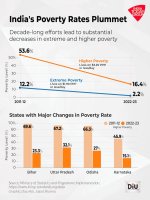
India has almost eliminated extreme poverty, with only 2.2 per cent of its population living below the World Bank's poverty line.​

1739888903349.jpeg
The reduction in poverty is even more pronounced at the $3.20 PPP line, where it has fallen from 53.6 per cent to 16.4 per cent.
 

Apple’s plan to boost iPhone production in India from an estimated 15% of global production today to 25% by 2027 is being deliberately hampered by the Chinese government, according to new reports.

China is reportedly using a mix of three measures to make it harder for Apple’s manufacturing partners to transfer production to India …


iPhone production in India​

Apple has for years been working to lessen its dependence on China as a manufacturing center, with the pandemic exacerbating the risks of having so much iPhone production in one country.

India is the company’s second manufacturing home, with Apple gradually ramping up production from just the iPhone SE to now making the latest flagship phones. It’s been widely reported that Apple has set a goal of making 25% of iPhones in India by 2027.

The Indian government has been encouraging this ramp-up through a series of tax breaks on imported components.

China deliberately hampering this shift​

Two reports in the Financial Times say that China appears to be attempting to hamper this shift of production out of the country.

First, it suggests, the Chinese government is making it hard for engineers to travel to India.

Beijing is tightening its grip on cutting-edge Chinese technology, aiming to keep critical knowhow within its borders as trade tensions with the US and Europe escalate. Chinese authorities in recent months have made it more difficult for some engineers […] to leave the country […]

Among the companies to be hit is Apple’s main manufacturing partner Foxconn, which has been leading the Silicon Valley group’s supply chain diversification into India.
Second, it is using export controls to block or delay the movement of equipment and components.

Chinese authorities have proposed new export controls to retain key battery technologies, and moved to restrict technologies for processing critical minerals, according to multiple industry figures and ministry notices […] An Indian official also alleged China was using customs delays to impede the flow of components and equipment heading south.
Finally, Chinese component manufacturers are reportedly being warned not to establish production plants in India. That would mean Apple can’t circumvent export blocks by having components made in India.

The reports say that the new trade war with China initiated by the Trump administration has increased tensions, and led to the government taking a harder line with American companies.

Indian government not helping in some areas​

While the Indian government has been keen to persuade foreign companies to establish manufacturing plants in the country, the FT reports that political conflict with China has seen the government blocking Chinese companies from building new plants.

Apple supplier Luxshare is said to be one of the companies refused permission.

9to5Mac’s Take​

China was never going to sit back quietly while Apple shifted more and more production outside the country, so it was always likely that the government would find ways to make life harder for the iPhone maker.

But the current trade war means we can expect increasingly hard-nosed action by Chinese authorities against US companies, and Apple is of course a prime target. Unless Trump backs down, which currently looks unlikely, things are only going to get tougher.
 
It is interesting data on iPhone14

To see this dependence in action, consider the production of the iPhone 14, for which comprehensive manufacturing data is now available. The iPhone is assembled in China, so it counts as a Chinese export in official measurements and consequently adds many billions of dollars a year to the U.S. trade deficit (an estimated $10 billion in 2018). But it makes no sense to count the iPhone as a Chinese export because Chinese firms constitute a relatively insignificant part of its production. The phone is designed in California. It is assembled in factories owned by a Taiwanese company. And Chinese firms contribute just four percent of the value of its components. Ahead of China’s contribution are South Korea (25 percent), Japan (11 percent), and Taiwan (7 percent). Number one is the United States, which contributes 32 percent of the value of the iPhone’s components.
 
It is interesting data on iPhone14

To see this dependence in action, consider the production of the iPhone 14, for which comprehensive manufacturing data is now available. The iPhone is assembled in China, so it counts as a Chinese export in official measurements and consequently adds many billions of dollars a year to the U.S. trade deficit (an estimated $10 billion in 2018). But it makes no sense to count the iPhone as a Chinese export because Chinese firms constitute a relatively insignificant part of its production. The phone is designed in California. It is assembled in factories owned by a Taiwanese company. And Chinese firms contribute just four percent of the value of its components. Ahead of China’s contribution are South Korea (25 percent), Japan (11 percent), and Taiwan (7 percent). Number one is the United States, which contributes 32 percent of the value of the iPhone’s components.

Yeah you see this if you go to OEC website and look at the imports/export tradeflows to PRC:


i.e have to look at value addition (or net export value) rather than gross export purely.

But PRC value addition (ofc this goes past telecoms/electronic sectors) is still on another scale compared to India:


India has to heavily invest in capital (produce, buy or onshore it) as far as possible to have any hope of doing same kind of climb....leveraging say its current market cap and bringing more of its northern states up to speed with its southern and western states on the matter for starters.

That's the difficult challenge ahead.
 
@Nilgiri

Thambi,

India has to heavily invest in capital (produce, buy or onshore it) .leveraging say its current market cap and bringing more of its northern states up to speed with its southern and western states on the matter for starters.

Plus, rule of law and heavy investment in education and skilling of manpower.

Regards


This was quick, Apple has integrated well with make in India scheme.
 

Users who are viewing this thread

Pakistan Defence Latest

Back
Top