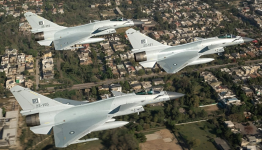
Well China has J-11 and J-16. Perhaps we can get an export copy from them.
In 2008, Russia and China signed an Agreement on the Protection of Intellectual Property Rights.
China explicitly committed itself to “not exporting the Chinese Flanker series of fighter jets.”
Then we should make our own twin engine using JF-17 chassis or the J-10 Chassis from China.
What is clear is that Pakistan does not have the capability to develop fighter jets on its own. Nor does it have sufficient reverse engineering capability. It is impossible for Pakistan to independently develop a new twin-engine fighter based on the JF-17 or J-10 without Chinese help.
Now, these two fighters (JF-17B3/J-10C) have basically reached its limit. Subsequently, minor updates to them are sure to continue, but large-scale upgrades are no longer likely.
JF-17 B3
With two medium thrust engines, the JF-17 would be upgraded from a light to a medium fighter. Its entire aerodynamic profile would have to be completely redesigned, and then it would necessarily add stealth aerodynamic profile design elements.
So what is the difference between such a fighter and the J-35? Why are we spending a lot of research money on a duplicate program?
If it's based on cost considerations, why don't we just use the J-35 foreign trade version for subtraction?
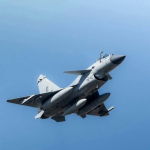
J-10C.
AVIC's main efforts are now focused on the 5th/6th-Gen fighter field.
There are some Chinese military fans who think that the only future upgrade for the J-10C might be to replace the engine with the WS-15.
But I think this is highly unlikely.
The design of the J-10 series fighter is very special. Its engine compartment is different from the design of the engine compartment of other Chinese fighters. ------ The AL-31 engine used in the early J-10 is a special customized version which is not common with the AL-31 engine used in the Chinese Flanker series. The WS-10B engine used in the later J-10 is also a J-10C-specific version.
This means that if it replaces the WS-15 engine in the future, it will also have to have a separate special customized version of the WS-15 made for it. this obviously doesn't make much sense.
Of course, if a big foreign customer is willing to pay for it's big version upgrade R&D separately, or, if it procures the new version of the J-10 in a big batch (>100 units) at a time, CAC would surely be more than happy to do so.
Theoretically, China would not deny Pakistan an assembly line for the J-10CE.
But......
The investment cost of the Advanced Pulse production line is very high. If the final capacity is less than 200 J-10CEs, it will incur huge losses.
The investment cost of a conventional manual assembly line is lower. However, it has high production costs, very low annual production capacity, and inconsistent production quality (heavily dependent on worker competence).
So it is very uneconomical for Pakistan to set up a J-10CE assembly line on its own. Moreover, Pakistan does not have enough money.
This analysis, too, applies to the argument that some of our Pakistani friends want a J-35 assembly line.
Currently, Pakistan's priority should be the complete absorption of JF-17 technology.
We should try to make the Pakistani military as strong as possible.
But we need to improve our economy and education first.
That's the point.