CONCORDE – The greatest feat in aviation?

Fatman17

Moderator
Joined
Apr 24, 2007
Messages
51,441
Reaction score
62,202
Reputation
12,743.8
Country of Origin
Country of Residence

CONCORDE – THE GREATEST FEAT IN AVIATION?​

  1. Aviation Features
  2. Concorde – the greatest feat in aviation?


By STEPHEN SKINNER
21st November 2023
FEATURE


Flying on the edge of space, faster than a rifle bullet, Concorde was a cliché queen. The epitome of Anglo-French collaboration, it was unlike anything that had come before it and required an unprecedented level of technological innovation – as Stephen Skinner discovers…

The planning, design and development of Concorde is considered one of the greatest feats in aviation. World War Two engendered rapid development in aviation and by the end of hostilities in 1945 several military jet aircraft were already nudging the speed of sound or Mach 1. With the war over, the Allies benefited from German research and the Americans were the first to break the ‘sound barrier’ with the rocket-propelled Bell X-1 that exceeded Mach 1 in level flight on October 14, 1947.

On October 14, 1947, Chuck Yeager pushed Bell’s rocket-powered X-1 through Mach 1 – making it the first such machine to do so
On October 14, 1947, Chuck Yeager pushed Bell’s rocket-powered X-1 through Mach 1 – making it the first such machine to do so KEY Collection
Britain and France equalled the American supersonic achievement barely seven years later in 1954 with the prototype English Electric P.1B and Dassault Super Mystère B.1, respectively, and, in October 1958, the Dassault Mirage 3 reached Mach 2 in level flight, closely followed by the P.1B the following month. As the two nations explored supersonic speeds with military jets, their thoughts soon turned to supersonic airliners – which ultimately culminated in Concorde…

English Electric P1B XA847 – seen here in July 1957 – became the first British aircraft to fly at Mach 2 on November 25, 1958
English Electric P1B XA847 – seen here in July 1957 – became the first British aircraft to fly at Mach 2 on November 25, 1958 KEY Collection
An unmistakable shape takes form…
An unmistakable shape takes form… KEY COLLECTION
Many of the commercial types flying during the immediate post-war years were derivatives of wartime designs including the likes of the Avro Lancaster (the Lancastrian) and Vickers Wellington (the VC.1 Viking). This trend was bucked by the hugely successful Vickers Viscount turboprop, before the nation led the world with the development of the de Havilland Comet, the world’s first commercial jet airliner, which entered service in 1952. The latter was undoubtedly ground-breaking, but failed owing to the problem of metal fatigue. It was eclipsed by the larger American-built Boeing 707.

Many of the commercial types flying during the immediate post-war years were derivatives of wartime designs – including the Avro Lancastrian, a pair of which (G-AHBV 'City of Canberra', closest, and G-AHBW 'City of London’) are seen on October 23, 1946 prior to delivery to Silver City Airways
Many of the commercial types flying during the immediate post-war years were derivatives of wartime designs – including the Avro Lancastrian, a pair of which (G-AHBV 'City of Canberra', closest, and G-AHBW 'City of London’) are seen on October 23, 1946 prior to delivery to Silver City Airways KEY Collection
De Havilland’s prototype Comet 1 (G-ALVG) changed the world when it took to the skies for its maiden flight on July 27, 1949. Seen here on December 7 that year, note the ‘Speedbird’ symbol of the type’s launch customer, BOAC – the forerunner then future Concorde operator, British Airways, on its nose
De Havilland’s prototype Comet 1 (G-ALVG) changed the world when it took to the skies for its maiden flight on July 27, 1949. Seen here on December 7 that year, note the ‘Speedbird’ symbol of the type’s launch customer, BOAC – the forerunner then future Concorde operator, British Airways, on its nose KEY Collection
In 1955, Sud Aviation of France flew its revolutionary Caravelle with its twin Rolls-Royce Avon turbojet engines mounted at the rear. The aircraft proved to be very ‘chic’ and established Sud as the leading French civil airliner manufacturer. The British went on to copy this French rear-engined innovation with the Hawker Siddeley Trident and Vickers VC10, which both flew in 1962 and the BAC One-Eleven followed in 1965. Neither of the first two sold particularly well however, and although the One-Eleven had potential, development was slow and it was massively outsold by its US competitors.

Vickers Super VC10 G-ASGB departs the firm’s Brooklands facility in Surrey for its maiden flight on September 29, 1964. With its long, dignified fuselage, elegant swept wing and the magnificently sweet soaring T-tail, the ‘Ten’ - still second only to Concorde for the fastest passenger-carrying flight across the Atlantic - quickly earned the nickname ‘Queen of the Skies’
Vickers Super VC10 G-ASGB departs the firm’s Brooklands facility in Surrey for its maiden flight on September 29, 1964. With its long, dignified fuselage, elegant swept wing and the magnificently sweet soaring T-tail, the ‘Ten’ - still second only to Concorde for the fastest passenger-carrying flight across the Atlantic - quickly earned the nickname ‘Queen of the Skies’ BAE Systems


Designing a supersonic transport​

The British Supersonic Transport Aircraft Committee (STAC), with representation from both the aircraft and aero engine industry and the Government, was formed in November 1956, with a remit to promote research into supersonic airliners. It examined all aspects of such operations and in March 1959, Bristol and Hawker Siddeley were respectively selected to produce feasibility studies for Mach 2.2 and Mach 2.7 designs. From these studies, Bristol, led by its chief engineer Archibald Russell, was chosen to develop its design for a 132-seat supersonic airliner powered by six Bristol Siddeley Olympus engines. This evolved intothe Type 223, a 100-seat slenderdelta concept with four Olympus engines, recognisable as a forerunnerof Concorde.

In the meantime, across the Channel, Sud Aviation was working on its ‘Super Caravelle’ – a delta-winged, 70-80-seat, Mach 2 airliner similar in configuration to the Bristol Type 223. In April 1960 Sud’s technical director, Pierre Satre, met his British counterpart and was surprised to find the two manufacturers had designed very similar aircraft. Lacking a suitable domestically produced engine to power its design, Sud too had selected the Olympus. As a result, exploratory talks between the British and French companies were held in Paris in June 1961. By now Bristol, along with Vickers-Armstrong and English Electric was part of the British Aircraft Corporation. In 1977 BAC was merged with Hawker Siddeley Aviation to form the nationalised British Aerospace, which was privatised in 1981.

A rare artist’s impression of the Super Caravelle
A rare artist’s impression of the Super Caravelle Sud Aviation via Jean-Christophe Carbonel
The French partner, Sud Aviation, was a nationalised firm, formed by the merger of two smaller state-owned aircraft manufacturers, Sud-Est and Sud-Ouest in 1957. In 1970 Sud Aviation merged with Nord Aviation to form Aérospatiale.


Cross Channel collaboration​

On November 29, 1962, two agreements were signed – one between the French and British governments and the other between the manufacturers. These provided for the construction of two Concorde prototypes, two pre-production aircraft and two airframes for static and fatigue testing. With the first flight of the prototype expected to take place during the second half of 1966, the development costs were estimated at between £150m-£170m (£4-5bn today). But these targets proved overly optimistic — Concorde flew three years late and expenditure continued to escalate, regularly causing uproar in the press, and providing ammunition for the project’s vociferous critics. Britain’s Conservative Minister of Aviation, Julian Amery, was wary that France might withdraw from the treaty and insisted on an extraordinary clause in it, whereby if either side withdrew from the agreement it would have to bear all of the development costs. This tactic proved fortuitous, as the threat of such a heavy financial penalty thwarted the later Labour Government’s strenuous efforts to withdraw from the project.

Though military aircraft were then able to fly at supersonic speed for short periods, this supersonic airliner would need to carry passengers and maintain supersonic speeds for several hours. This presented the designers with a series of huge technical challenges. As a result, an exhaustive programme of research, development and testing had to be devised.

Military pedigree: Combined resources evolved from two separate French and British designs – the Super-Caravelle and BAC 223
Military pedigree: Combined resources evolved from two separate French and British designs – the Super-Caravelle and BAC 223 BAE Systems
Even though BAC and Sud had adopted a similar layout for their respective designs, a huge amount of work was concentrated on refining them. The slender delta wing had to generate sufficient lift throughout the speed range – at low speeds it produced vortex lift, which made it controllable, albeit with a high angle of attack (AOA) — while also performing efficiently at high speeds. As a result, the wing was not simply swept, but actually rather complex, drooping and twisting along the leading edge while also cambering and tapering across the wing.

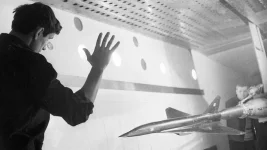
While vortices typically form at the wing tips on conventional aircraft, wind tunnel testing revealed they also formed on Concorde’s wing leading edges – as seen in this image captured during hydromatic testing in a wind tunnel at Filton in 1965
While vortices typically form at the wing tips on conventional aircraft, wind tunnel testing revealed they also formed on Concorde’s wing leading edges – as seen in this image captured during hydromatic testing in a wind tunnel at Filton in 1965 BAE Systems
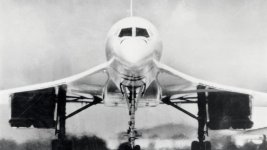
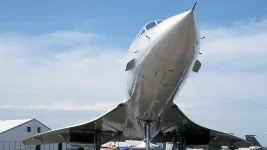
This head on view illustrates the complex shape of Concorde’s wing with it elegantly drooping and twisting along the leading edge
This head on view illustrates the complex shape of Concorde’s wing with it elegantly drooping and twisting along the leading edge AirTeamImages-Dave Sturges
Refinement of the design continued throughout the development process. The initially projected 184ft 6in long aircraft was lengthened after discussions with potential airline customers into one almost 20ft longer, though the 83ft 10in wingspan remained a constant. The first two prototypes F-WTSS (001) and G-BSST (002) were built to this initial size but were succeeded by the third, G-AXDN (101) that was 8ft 6in longer. The fourth Concorde, F-WTSA (102) – the final pre-production example – was 203ft 10in long as it also incorporated an extended rear fuselage to reduce drag.

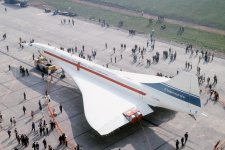
BAC’s Weybridge facility was responsible for manufacturing the forward fuselage. The section closest (5102-02) went on to become G-BOAA, which was delivered to British Airways on January 14, 1976
BAC’s Weybridge facility was responsible for manufacturing the forward fuselage. The section closest (5102-02) went on to become G-BOAA, which was delivered to British Airways on January 14, 1976 BAE Systems

Making Mach 2 work​

The choice of material for Concorde’s fuselage skin was dictated by the decision to choose a cruising speed of Mach 2. Hawker Siddeley subsidiary High Duty Alloys invented and manufactured the Hiduminium-RR58 aluminium alloy, the main structural material for Concorde, able to withstand extreme temperatures, as well as the associated stresses of expansion and contraction. One of the biggest challenges for this material would be ‘creep’ expansion of the metals employed, and its consequent impact on the structural loads. At supersonic cruise, the temperature at the tip of the nose and the tail routinely reached 127°C and 91°C respectively, sufficient for the whole aircraft to stretch between six and ten inches.

This graphic reveals the temperatures Concorde’s structure had to withstand while operating at Mach 2
This graphic reveals the temperatures Concorde’s structure had to withstand while operating at Mach 2 KEY Collection
In a similar fashion, the temperatures on the wing varied from 105°C at the leading edge to 91°C at the trailing edge. This forced the consortium to develop special materials for the flight deck and cabin windows, radome, adhesives and paint. Sections of Concorde’s structure were subjected to static, fatigue, and kinetic heating trials from early 1965. Two complete test airframes of the longer-bodied and higher gross-weight production standard aircraft followed to examine the structural integrity of the design while the third prototype was tested to destruction during static trials in Toulouse.

The sixth example, the fatigue test specimen, was evaluated by the Royal Aircraft Establishment (RAE) at Farnborough and was used to
 
assess the airframe’s durability. It was subjected to repeated ‘flights’, or cycles – fuselage stresses represented those encountered during a real flight. A conservative margin of error was applied so that the aircraft was deemed safe to make 6,700 flights, or fly until 2008. Of note, when British Airways eventually revamped its Concorde marketing strategy and appreciated how very profitable it was, the airline gave some thought to extending the limit. To explore this, the final Concorde built – G-BOAF (216) – was suitably fitted with strain gauges and measuring equipment to examine the life of the aircraft. As a result, the manufacturers deemed that Concorde’s life could be extended to 8,500 flight cycles or until approximately 2015.

The sixth Concorde airframe built was the British static fatigue test airframe – seen here in its specially built facility at the Royal Aircraft Establishment’s Farnborough facility. At the time, fatigue testing of the Concorde airframe was most complex and exhaustive ever carried out
The sixth Concorde airframe built was the British static fatigue test airframe – seen here in its specially built facility at the Royal Aircraft Establishment’s Farnborough facility. At the time, fatigue testing of the Concorde airframe was most complex and exhaustive ever carried out BAE Systems

The matter of control​

While the Airbus A320 is widely believed to have been the first commercial aircraft to pioneer ‘fly-by-wire’ controls, such technology was in fact employed on Concorde. The system used electrical signalling between the control column, rudder bar and the flying controls rather than direct mechanical linkage. On Concorde, however, it was duplicated with a standby mechanical system to provide back-up in the event of a failure. Notably, this was never utilised during the aircraft's service life. Most airliners have ailerons for lateral control, elevators for longitudinal control, and leading-edge slats and trailing edge flaps to increase lift during take-off and landing. However, as Concorde’s wing met both the aircraft’s high- and low-speed demands, the only moving surfaces were elevons – combined elevators and ailerons – located on the trailing edge. These were driven by the aircraft’s three hydraulic systems, as were the distinctive droop nose and visor, and undercarriage.

The twin-wheeled nose landing gear retracted forward into the fuselage, while the four-wheel main units retracted sideways into the central section. The aircraft was also equipped with a small gear unit in the tail to protect the rear fuselage in the event of an over-rotation during take-off or landing. At both BAC Filton and Sud Aviation Toulouse, flight simulators played an important role in the development programme, enabling significant investigation to be made into flight deck layout, SST (supersonic transport) flight control systems and handling characteristics, well in advance of the first aircraft’s maiden flight.

In addition to its obvious function of supplying the engines, Concorde’s fuel system also performed a vital role in trimming the aircraft. The fuel was contained in 17 tanks, occupying some 60% of the wing and nearly half the underfloor volume of the fuselage. The system consisted of four main tanks, feeder tanks for each of the four engines, and a series of transfer tanks that were critical in managing the aircraft’s centre of gravity (CoG) throughout its speed regime.

The full-scale fuel flow test rig constructed at Filton was complete enabling the manufacturer to test the jets fuel system at all attitudes, pressures, temperatures and rates of temperature change it would experience in flight.
The full-scale fuel flow test rig constructed at Filton was complete enabling the manufacturer to test the jets fuel system at all attitudes, pressures, temperatures and rates of temperature change it would experience in flight. BAE Systems
One of the quirks of Concorde’s design was that the centre of lift (CoL) shifted backwards as the aircraft went supersonic — this was countered by pumping fuel aft to the rear trim tanks during acceleration, and then forwards again as the jet slowed to subsonic speeds. Such tanks accommodated around 33 of the 95 tonnes of fuel carried by the aircraft, though only 20 tonnes were typically moved during flight, shifting the CoG by 6ft. Such was the complexity of the system that BAC constructed a 227-tonne full-scale replica at Filton, Bristol.

The rig, which was a movable platform, could test all fuel system functions under simulated altitudes, temperatures, and attitudes from 16° nose down to 50° nose up pitch, with up to 10° of roll. This enabled the manufacturer to replicate in-flight conditions and was instrumental in developing a host of modifications. It was one of several such rigs employed during
 
the development phase, with others used to test hydraulic, electric, and pneumatic systems along with the undercarriage, brakes and wheels.


A Concorde characteristic​

One of the most distinctive features of Concorde (and one favoured by cartoonists!), its famous droop nose, was something of a by-product of the innovative wing design. Such was the shape of the delta that the aircraft adopted a very high angle of attack while flying at low airspeeds – especially on approach to land. To help improve visibility, the entire nose section forward of the windshield, including the heat-resistant visor and its mechanism, was designed to hinge downwards, and could be appropriately configured to suit a given stage of flight. For taxi, take-off and initial climb, this was set to 5° before being raised hydraulically as the aircraft accelerated to supersonic speeds. For approach and landing, the visor was lowered and the nose hinged down 12.5°. Although the lower position was originally 17.5° on pre-production examples this was later rejected as there was apparently a strong visual sensation of there being nothing ahead of the pilots, as this meant the nose disappeared completely from their field of view!

To help improve visibility from the flight deck, particularly during approach and landing, Concorde’s entire nose section forward of the windshield, including the heat-resistant visor and its mechanism, was designed to hinge downwards by 12.5° and could be appropriately configured to suit a given stage of flightBAE Systems
To help improve visibility from the flight deck, particularly during approach and landing, Concorde’s entire nose section forward of the windshield, including the heat-resistant visor and its mechanism, was designed to hinge downwards by 12.5° and could be appropriately configured to suit a given stage of flight BAE Systems BAE Systems
On the two prototype Concordes (001 and 002) the visor was of solid metal construction with just two small, poorly positioned, windows to provide forward view. Complaints by the test pilots were ignored until the US Federal Aviation Administration indicated that it would not certify the aircraft in such a configuration. As a result, a hasty redesign was instigated resulting in a six panelled-glass visor.


With a little help...​

Two British research aircraft were specially constructed to test Concorde’s slender delta concept. The first, the Handley Page HP115 (serial XP841), made its maiden flight from Royal Aircraft Establishment (RAE) Bedford on August 17, 1961, piloted by J M Henderson. It was a small jet with a fixed undercarriage and 75° swept delta wing intended to examine low-speed, high AOA performance. It was a very successful tool and proved that Concorde would not need to use complicated high-lift devices on its wing to fly safely.

Handley Page HP.115 XP841 was one of two British research aircraft constructed specially to test Concorde’s ‘slender delta’ wing concept at low speeds
Handley Page HP.115 XP841 was one of two British research aircraft constructed specially to test Concorde’s ‘slender delta’ wing concept at low speeds KEY Collection
This was followed by the BAC 221 – a substantial reworking of Fairey Delta 2 WG774, which had gained the World Speed Record in 1956 – taking to the air on May 1, 1964. At first glance, it appeared to be an aerodynamic scale model of Concorde though its wing, which was mounted lower on the fuselage, was not a scale replica and featured a different twist, camber, and droop. The BAC 221 was tasked to explore the behaviour of a slender delta wing at AOA high enough to generate a powerful vortex, and the resultant increase in lift, above the leading edge.

A former world speed record holder, Fairey Delta 2 WG774, was converted to support high speed testing during the Concorde programme as the BAC 221
A former world speed record holder, Fairey Delta 2 WG774, was converted to support high speed testing during the Concorde programme as the BAC 221 BAE Systems
Seen here during an early test flight as the BAC 221, this in flight view WG774 reveals the type’s slender delta wing configuration
Seen here during an early test flight as the BAC 221, this in flight view WG774 reveals the type’s slender delta wing configuration KEY Collection
Concorde’s flight deck had a conventional layout with pilot and co-pilot seated side-by-side in the narrow cockpit with the flight instruments in front of them, engine controls between those, autopilot on the glare shield and emergency controls on the overhead panel. The throttles were situated on the console between the pilots and within reach of the flight engineer seated behind with a large panel of instruments for the engines and systems to the right.
 
Magnificent bird <3

I saw one for reals as a kid in Heathrow, closest I ever got, active duty one, not the museum relic.

Also saw one fly in India, they used to have a route, short-lived, or maybe it was on a world tour or something.

5PM, us kids would line up to see it on short finals to airport.
 
173483.jpeg


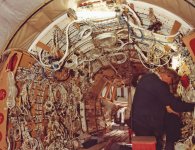
The sheer complexities and intricacies of the electrical systems throughout Concorde is apparent in this view of BAC engineers fitting wiring within the flight deck of a production jet BAE Systems
In the cabin, passenger windows were smaller than those on contemporary airliners – a necessity of the aircraft’s supersonic design. The jet was also rather narrow, with Air France and British Airways opting for a four-abreast 100-seat layout with twogalley areas. Toilets were situatedat the front and centre of the cabin. There was a baggage hold under the forward cabin and in the fuselage aft of the passenger cabin. The port front door was typically used for passenger and crew access, though there was also a midships passenger door. There were service doors opposite these and emergency exits in the rear half of cabin on each side.


Production planning​

BAC and Sud Aviation shared manufacture of the airframe, while Bristol Siddeley and SNECMA built the engines. To balance out each country’s workload, Sud received 60% of the airframe work, while Bristol Siddeley had 60% of the work on the Olympus engines. Prior to the agreement with the French, BAC had planned to build the aircraft entirely by itself – spreading work around its factories. Manufacture of the rear and three forward sections of the fuselage, the vertical tail surfaces, the engine nacelles and ducting, the electrical system, sound and thermal insulation, oxygen and fuel systems, engine installation, and fire warning and extinguishing systems were the responsibility of BAC’s facilities. Sud Aviation produced the rear cabin section, wings and wing control surfaces, hydraulic systems, flying controls, navigation systems, radio, and air conditioning. The automatic flight control system was designed by Marconi in the UK and SNEFA in France.

Cross Channel cooperation: Concorde manufacturing – one of the most complex operations ever undertaken in the aircraft industry – was shared across Aérospatiale, BAC, Rolls- Royce, and Snecma, supported by a large network of more than 800 sub-contractors
Cross Channel cooperation: Concorde manufacturing – one of the most complex operations ever undertaken in the aircraft industry – was shared across Aérospatiale, BAC, Rolls- Royce, and Snecma, supported by a large network of more than 800 sub-contractors BAE Systems
Owing to the huge political sensitivities surrounding the entire project, two assembly lines were established – one at Filton and the other in Toulouse. Substantial infrastructure was required to support the production effort, as well as the transport of airframe sections between sites; these were often delivered by Aero Spacelines Super Guppys.

To ease production, each country completed its own sections so that on arrival at the partner factory they could be joined together without additional labour. Work was also spread around the partners’ factories – BAC’s Weybridge facility in Surrey built the flight deck and front fuselage, its Hurn, Dorset production line the droop nose and its Preston, Lancashire site worked on the air intakes.

The setting up of two final assembly lines was, however, a costly decision that reduced the advantages of the learning curve. It might have paid off if Concorde had sold well, enabling speedy delivery to customers. In contrast, Airbus has avoided such additional costs by centering final assembly of a specific type on one site, even though parts are built in several countries. This massive Anglo-French project required the establishment of close relations between all the companies involved – including the numerous ancillary equipment suppliers. Many committees were established and daily commuting between Filton, Toulouse and other centres was commonplace. Notably, both metric and imperial measurements were accepted as well as English and French languages.

In early 1965, the manufacturers finalised Concorde’s design, establishing the maximum take-off weight at 326,000lb. With a firm plan in place and buoyed by 43 commitments from potential customers (including the likes of Qantas, Lufthansa and Air India) the huge production programme could start with new machinery and jigs constructed.

Icons: G-BOAE (left) and G-BOAD – the sixth and fourth British production examples of the type – undergo final assembly on the BAC line within the gigantic Brabazon hangars at Filton
Icons: G-BOAE (left) and G-BOAD – the sixth and fourth British production examples of the type – undergo final assembly on the BAC line within the gigantic Brabazon hangars at Filton BAE Systems
Each Concorde required so much equipment to be packed into place that assembly presented a major challenge. This was further compounded by the more than 600 ancillary equipment firms that were providing products for the aircraft. And while the allotment of the work between the leading partners had been relatively straightforward, choosing these suppliers and balancing the work between Britain and France was not easily achieved.

On occasions American offerings might arguably have been a better choice, but the overriding policy was to only benefit the firms from partner nations. Sub-assembly began in October 1965, while final assembly of Concorde 001 commenced at Toulouse in April 1966. This was shortly followed by 002 at Filton in August 1966. It was the birth of a truly remarkable aeroplane.

180813.jpeg
Angelo Bufalino Photography
 

The Soviet Union’s flawed rival to Concorde

14 August 2020

Stephen Dowling
Features correspondent
1744666733218.webp
Science Photo Library
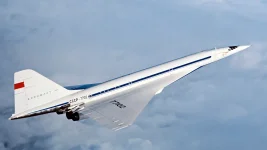
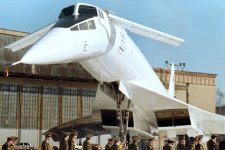
Tu-144 in flight (Credit: Science Photo Library)

The world’s first supersonic airliner was not the Anglo-French Concorde but a Soviet design intended to show the world the superiority of the USSR.

It is December 1968, and a truly ground-breaking airliner is about to take its first flight.

It resembles a giant white dart, as futuristic an object as anything humanity has made in the 1960s. The aircraft is super streamlined to be able to fly at the speed of a rifle bullet – once thought too fast for a passenger-carrying aircraft.

The distinctive, needle-nosed front of the aircraft looks like the business end of something rocket-powered from a Flash Gordon serial; when the aircraft approaches the runway, the whole nose is designed to slide down, giving the pilots a better view of the ground. The effect makes the aircraft look like a giant bird about to land.

It sounds like a description of the Anglo-French Concorde, the plane that will cross the Atlantic in little more than three hours – but it’s not. The spaceship-styled jet sports the hammer and sickle of the Soviet Union on its giant tailfin. It is the Tupolev Tu-144, the communist Concorde, and the first passenger aircraft to fly more than twice the speed of sound.

Its first flight comes three months before Concorde takes to the air. But the Tu-144 – dubbed ‘Concordski’ by Western observers for its similarities to its luxurious rival – never quite becomes a household name.

It is partly down to design failure – but also because of a high-profile disaster at the 1973 Paris Air Show, a tragedy that took place in front of the world’s press.
***

Like many of the great technological feats during the Cold War, politics is at the heart of the Tu-144’s story.

In 1960, Soviet Premier Nikita Khrushschev was made aware of a new aircraft project being investigated by Britain and France to help revitalise their aircraft industries. That passenger aircraft – Concorde – was designed to fly at supersonic speeds, cutting the time it would take to fly from Europe to the US to just a few hours.

Two years later, the British and French signed an official deal to begin design and manufacture. Around the same time, supersonic transport (SST) projects from planemakers Boeing and Lockheed were also given the go ahead.
1744666837156.webp
Science Photo Library
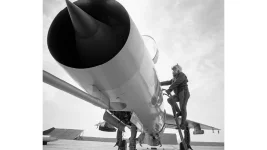
Soviet designers had already used the delta wing configuration on fighters like the MiG-21 (Credit: Science Photo Library)

The Soviets realised they had no time to lose.
“The rivalry between Concorde and the Tu-144 was symptomatic of that international era,” says Jock Lowe, a former Concorde pilot and British Airway flight operations manager. “There was the space race and the race to put a man on the Moon race happening at the same time.

It was an international race between the Tu-144 and Concorde and the American designs made by Boeing and Lockheed &ndash; Jock Lowe, former Concorde pilot
“The thesis was, up to that point, that the faster the aircraft, the more successful it was,” Lowe says. With fighter planes like the MiG-21 and the American F-104 already capable of flying at twice the speed of sound, supersonic travel seemed a possible – if challenging – task.

“Early Soviet success in the space race reinforced confidence in a technocratic political era, and this drove the leadership to believe it could compete with prestigious Western projects,” says David Kaminski-Morrow of aviation publisher Flight Global.

The Soviets had already achieved a coup with Tupolev’s Tu-104 jet airliner, which came as a complete surprise to the West when it took Soviet delgations on visits in the 1950s. According to author Howard Moon’s book Soviet SST, a definitive history of the Tu-144 written before the end of the Cold War, the Tu-104 paved the way for grander aviation ambitions.
1744666871040.webp
Getty Images
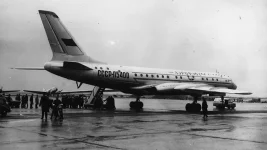
The first Soviet airliner, the Tupolev Tu-104, was a surprise to the West (Credit: Getty Images)

In the 1950s, the USSR’s rapid industrialisation led Soviet planners to demand ever-more impressive projects. “Adding to the laurels of the Soviet space programme and Soviet military aviation, it appealed enormously to leaders mesmerised by the very real achievements of their leading-edge industries. This tension between Soviet technical and economic reality and the heightened expectations of the Soviet elite that commissioned it explains much of its subsequent complex history,” wrote Moon.

The Tu-144 project became something that had to succeed, regardless of the effort required to bring it. And in the 1960s – with so much of the Soviet technical resources thrown into the space race – that was not inconsiderable, according to Kaminski-Morrow.

“The space race undermined the Tu-144 programme by shifting the Soviet focus towards long-range rocketry and high-altitude missiles, and away from supersonic bombers, effectively forcing the Soviets to develop the Tu-144 as a standalone civil aircraft programme.

“This ran counter to Soviet experience in creating airliners and left the developers with the hugely ambitious task of designing from scratch a complex supersonic aircraft which could also satisfy requirements for comfort and economic performance – requirements which had seldom been necessary to consider.”
1744666909337.webp
Alamy
The Tu-144 programme required enormous R&D resources at the same time as the space race (Credit: Alamy)

Several problems soon came to plague the Tu-144. It was a project perhaps 10 to 15 years ahead of what the Soviet aviation industry was capable of at the time. Two of the main areas where the Tu-144 lagged behind were brakes and engine control.

Concorde pioneered some truly bleeding-edge technologies, not least with its brakes. It was one of the first aircraft to have brakes made of carbon fibres, which could withstand the enormous heat generated trying to slow the aircraft after landing (Concorde had a high landing speed around 185mph (296km/h). But the Russians were not able to mimic this design.

An even bigger problem was the engine. Concorde was the first passenger aircraft to have a flight-vital part of its system completely controlled by a computer – it would constantly change the shape of the air inlets to ensure the engines were operating as efficiently as possible.

1744666985854.webp
Science Photo Library
Concorde featured many advanced technologies that the Soviets could not match (Credit: Science Photo Library)

And Concorde also had a flight control system that could adjust, ever so slightly, the shape of the wing to reduce drag as it flew at supersonic speeds. Such computer-controlled wings were unheard of before Concorde – now, today’s sub-sonic airliners also sport them.

Aware that Concorde was slowly but methodically taking shape, the Soviet Union poured more and more resources into the Tu-144. It is something of a testament to the Tupolev design bureau – and the teams from engine designers Kuznetsov and Kolesov, who both built powerplants for the ambitious new airliner – that amid the enormous effort to match the American space programmes, they still managed to build such a plane.
Compared to Concorde, the Tu-144 was much bigger. It was over 215ft (67m) in length – around 12ft (3.7m) longer than its Anglo-French rival. It was designed to cruise at just over Mach 2 (1,340 mph/2,158 km/h) and each of its four engines, with the afterburner lit, could generate more than 44,000lbs of thrust each – 6,000lbs more thrust from each engine than Concorde could achieve.

The Tu-144 was less aerodynamic &ndash; just slightly, but these things are critical &ndash; Jock Lowe
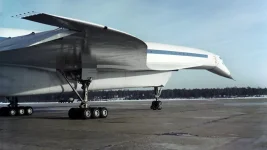
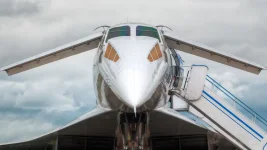
But while the Tu-144 was more powerful, it also took more effort to get into the air. Empty, the Tu-144 weighed a few hundred kilograms under 100 tonnes – more than 20 tonnes heavier than an empty Concorde. Part of this was due to the enormous undercarriage. Concorde had two wheels at the front, and two sets of four wheels underneath the wings. The Tu-144 had two at the front but 12 underneath the wings, partly because Russian tyres were made of synthetic rubber and were more prone to failure (the thinking being that if one or two failed, there would be enough to support the aircraft’s weight).

While on the surface the Tu-144 looked very similar to Concorde, there were many differences, many of them less sophisticated solutions to the problems Concorde’s designers had also solved.

“The Tu-144 was less aerodynamic – just slightly, but these things are critical,” says Lowe.
1744667374057.webp
The Tu-144 looked very similar to Concorde, especially in its supersonic flight profile (Credit: Alamy)
 
Last edited:
“We looked at it and we knew by the time it came into service it wasn’t going to be a competitor.”

The USSR, however, won bragging rights over who got to fly a supersonic airliner first. The Tu-144 first took off in December 1968, and flew supersonic for the first time in June 1969. Concorde would not take to the air until March 1969, and did not go supersonic until October of that year. The Soviets had won a major diplomatic coup – but they soon encountered a series of headaches trying to get the nearly 100-tonne airliner into service.

Western observers, used to the perceived superiority of technology west of the Berlin Wall, believed that the only way the Soviet Union could have come up with the Tu-144 was through industrial espionage; the Tu-144 was dubbed ‘Concordski’, and regarded as an almost carbon copy of Concorde, though with a cruder Soviet finish.

The truth, says Kamisnki-Morrow, wasn’t quite so clear cut. “There is no doubt that Soviet thinking on the Tu-144 was heavily influenced by Concorde – the absence of a horizontal stabiliser [tail planes], for example, was a radical departure from previous Soviet designs.

“But other aspects, such as the engine configuration, were notably different. The Tu-144 also needed to be more rugged to cope with tougher operating conditions.

Although espionage played a role in the Tu-144's development, the Soviets were still capable of exploring their own avenues to solve the multitude of technical problems thrown up by the project. The result was an aircraft which broadly resembled Concorde but which differed substantially in refinement and detail.”

The rivalry among the two supersonic airliner teams was immense

In 1973, the Soviet unveiled the Tu-144 to the West at the Paris Air Show. Tupolev flew the second of their production models to the airshow, pitting it head-to-head against a prototype Concorde already carrying out public flying displays (at this stage, the Western design was still waiting to go into production).

The rivalry among the two supersonic airliner teams was immense. "Just wait until you see us fly," Tu-144 test pilot Mikhail Koslov apparently taunted the Concorde team, according to Time magazine. "Then you'll see something." On 3 June the Tu-144 took to the air, with Kozlov seemingly intent on surpassing Concorde’s flying display the day before, which had been somewhat cautious. Then disaster struck.

The Tu-144 took off, then approached the runway as if to make a landing, with its nose drooped and its undercarriage down – then climbed rapidly, with its engines at full power. Seconds later, it pitched over, broke up in the air and dived into a nearby village. All six of the crew and eight people in the village were killed.

There were several theories as to why the Tu-144 crashed; some believed the pilot had manoeuvred too hard at slow speed, causing the plane to lose lift. Others said the cloudy conditions might have confused the crew. Another theory was the plane had, at the last minute, had to swerve to avoid a French Mirage fighter jet that was flying close to take pictures of the Tupolev’s front canards, which were advanced for the time.
1744667872523.webp
Alamy
The Tu-144 was intended to make a big impression at the 1973 Paris Air Show – but disaster struck (Credit: Alamy)

The crash only highlighted some ongoing issues with Tupolev’s pioneering design, and the Soviet state airline Aeroflot started to get nervous about bringing it into full service. Tupolev had to fix a myriad of issues before the aircraft could be signed off for service. Even then, the first airline flights in 1975 were still essentially test runs, carrying mail instead of passengers from Moscow to what is now Almaty in Kazakhstan.

It took until 1977 for the Tu-144 to start taking passengers.
The Soviets couldn’t find an elegant solution to reducing noise inside the passenger cabin. The engines, and the air conditioning units which drew air from the engine inlets, both created enormous noise. Air conditioning was vital – the cabin would otherwise have become dangerously hot from the heat generated by air friction on the plane’s skin.
Concorde used its fuel as a ‘heat sink’ to keep temperatures down, so didn’t need such powerful air conditioners – and this kept noise down to acceptable levels.

The difference between the Tu-144 and Concorde is apparent in Moon’s description of the first Tu-144 flight that carried foreign observers:

Passengers complained that the loud onrushing sound of wind made conversation impossible and communicated with each other by passing notes &ndash; Howard Moon
“The cabin had shortcomings: several ceiling panels were ajar, service trays stuck, and window shades dropped without being pulled. The five-abreast seating was criticised as cramped. Not all the toilets worked. These shortcomings were normal in a new airliner. A more serious problem remained. On-board speakers played the theme from Love Story, Gloomy Sunday, and Raindrops Keep Falling on My Head, but few aboard could hear it. Their dominant impression was not speed but noise.

“Fed by the onrushing air, the huge air-conditioners and the huge engines created ‘an ear-shattering roar that could almost have been heard in Queens’, according to the New York Times….Passengers complained that the loud onrushing sound of wind made conversation impossible and communicated with each other by passing notes.”

Tupolev had brought the Tu-144 into the air, but once in service, it seemed that the plane was more trouble than it was worth. The intensely political project had chewed through enormous resources. In 1977, Tupolev tried to buy some of the engine management computers Concorde used, but the British, fearing they could also be used on Soviet jet bombers, refused.
1744667894046.webp
Getty Images
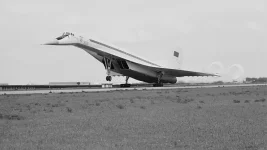
The Tu-144 was one of the last airliners to have to use a braking parachute to decelerate (Credit: Getty Images)

What had been one of the Soviet Union’s prized technological feats became a political hot potato. Aeroflot did not even make any reference to the aircraft in its five-year plan from 1976 to 1982. After a modified Tu-144 crashed on a pre-delivery test flight in June 1978, Aeroflot pulled the plug on the Tu-144’s airline career. It had flown only 102 commercial flights, and only 55 of those had carried passengers. Concorde, in comparison, flew for more than 25 years, racking up thousands of flights and becoming one of the most iconic designs of the 20th Century.

The Tu-144’s production officially ended in 1982. The 14 remaining Tu-144s had a brief second life, training crews for the planned Soviet space shuttle, the Buran. By the time the Berlin Wall fell in 1989, the remaining models were mostly mothballed, a few of them in storage at the Soviet aircraft testing base at Zhukovsky, near Moscow.

***
That should have been the end of the Tu-144’s story. But it wasn’t.

In the 1990s, Nasa began a multi-billion-dollar project to build the next generation of supersonic transports, called the High Speed Research (HSR) programme . Boeing and Lockheed had started building Concorde-like designs in the 1960s but they had been cancelled for various reasons, including fuel costs and noise concerns. Now, nearly 30 years later, Nasa hoped to pick up from where those projects left off.

One member of the programme was a Nasa test pilot called Rob Rivers. He was to become the only member of a very exclusive club – a pilot who would fly both Concorde and the Tupolev Tu-144.

I thought it would be a great idea to fly the Concorde &ndash; Robert Rivers, Nasa test pilot
“I was more or less the programme pilot for the HSR, working with Boeing and other partners. And that was a big project – about a $4bn project from the late 1980s to the early 2000s.

“While I was on the HSR a British Airways pilot came over to Langley to talk to us about Concorde and high-speed flying.

“I thought it would be a great idea to fly the Concorde, and was able to convince othe HSR programme officer the value of it as well. So in 1997, I flew up to JFK Airport and sat in the jumpseat of a Concorde and flew out. I was sat there with my stopwatches and a notebook and a tape measure and recorded all that I could of an Atlantic crossing in a supersonic airliner.” Rivers later flew a series of flights in the Concorde simulator near Bristol, and flew back to America in the cockpit of another Concorde.
Because the US had never built a supersonic airliner – its own plans in the 20th Century had fallen through – Nasa needed help from elsewhere to carry out flight tests.
There was one big problem. “Neither British Airways nor Air France had a spare Concorde we could use for experiments,” says Rivers.

The Soviet Union had collapsed only a few years before. Russia was in dire shape, with its economy in freefall. “President Bill Clinton and the Russians had talked about a huge project with the Russian aviation industry, so that their engineers didn’t float away to places like Iran,” says Rivers.

And what Russia did have was a supersonic airliner – albeit one that had had a chequered career, and was no longer flying.
1744667919362.webp
Science Photo Library
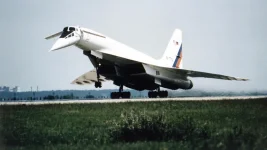
The Tu-144 gave Nasa the chance to use a real aircraft to help design a supersonic plane of the future (Credit: Science Photo Library)

“An agreement was made in 1993 to lease a Tu-144 a do a number of very sophisticated experiments,” says Rivers.
It was not easy to do business in Russia. The Tupolev had to be leased by a British company, IBP Aerospace, a contractual company that could act as a go-between.
“So here was the deal – Nasa had to pay Boeing to pay IBP to pay Tupolev. There were payments in the middle of the night to pay for fuel with US dollars – which were illegal in Russia at the time but the only currency that many vendors would accept,” says Rivers.

It would be an embarrassment if a Nasa pilot turned up on crutches &ndash; Rob Rivers

“The Tupolev we flew had only flown 83 hours and had been retired in 1990. It was mothballed in 1993, but just like a phoenix it rose again.”

The Tu-144 leased by Nasa was fitted with more reliable, modern engines and a whole suite of instruments, including a special ‘data bus’, one which could store all the data from the many experiments running as the plane flew its missions.

However, the early flights were a disaster in terms of data collection. The data bus recorded impossible flight characteristics. The Russian pilots, flying the plane on behalf of Tupolev, couldn’t be interviewed by Nasa.

“Interviews with the pilots hadn’t been written into the contract. And Tupolev was in such financial strife that they only paid you for what was in the contract. If you flew a flight, they paid you after the flight.”

It was decided that Nasa would have to send its own pilots to test the Tupolev.
1744667936284.webp
Nasa
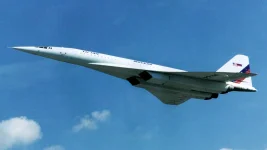
The Nasa programme brought the Tu-144 back from the dead in the late 1990s (Credit: Nasa)

Rivers was confirmed, and his Russian visit was earmarked for September 1998. A few weeks beforehand, he took a short break with a few friends.

“I go trout fishing in Wyoming. And I have a really bad fall while I’m hiking in the back country – I break my tibia, I suffer a spiral fracture of the tibia and fibula and a broken ankle,” says Rivers.

“In Wyoming I tell the doctor ‘I’ve got to get to Russia in two weeks. You’ve got to fix me.’ He said ‘No way, you’re going to be in a cast for six to eight months.’” Eventually the doctor relented, and put a metal rod in Rivers’ leg so he could make the trip.

Nasa did not want Rivers to go to Russia while he was injured. “They felt it would be an embarrassment if a Nasa pilot turned up on crutches,” Rivers says. But it was too late to find someone else.

Rivers’ grimaced through his long-haul flight to Moscow, and was then whisked in a van straight from the airport by Alexander Pukhov, Tupolev’s design director who had worked on the Tu-144 programme in the 1960s. On his first night, he ended up being taken to Tupolev’s flight surgeon. There, Pukhov – a man with a formidable reputation – struck a deal with Rivers.

“Pukhov says to me ‘As long as you’re not on crutches in front of the press, and as long as you’re not on crutches when you walk to the airplane, you can fly.’

When I saw the aircraft for the first time - how big it was and how tall it was off the ground&hellip;it was just amazing &ndash; Rob Rivers

“My leg was killing me but I wouldn’t have missed it for the world. This was going to be the highlight of my test pilot career. I was going to be one of only two Western people to fly it.”

Rivers and fellow pilot Gordon Fullerton – along with Nasa engineers Bruce Jackson and Tim Cox – were billeted at a former KGB sanatorium near Zhukovsky, a former Soviet airbase used for testing experimental designs and prototypes.

“When I saw the aircraft for the first time – how big it was and how tall it was off the ground – it was just amazing.”
Rivers kept to his word that he wouldn’t walk to the plane for his first flight on his crutches, but walking on his ankle was agony. “I spent a lot of hours practising walking with a cane. I could not have done it without my friend Bruce Jackson. It was excruciating to put pressure on my ankle.
1744667957166.webp
Alamy
The Tu-144 lacked the sophistication of Concorde, but it was a much more powerful aircraft (Credit: Alamy)

“At the pre-flight party the day before my first flight I threw my crutches down. I walked out towards Professor Pukhov on my cane, and Pukhov gives this huge belly laugh, and there’s cheers from everyone, and it was just like something from a movie.”

Rivers and Fullerton (who died in 2013) flew the Tu-144 on a series on flights through to the end of 1998. And by the end of it Rivers was the only person on Earth who could lay claim to first-hand experience flying both the Tu-144 and its Western competitor. He says he could not have done it without the assistance of the Russian flight crew, pilot Serge Boresov, navigator Viktor Pedos and flight enginner Anatoli Kriulin, whose expert knoweldge helped make the flights a success.

The Nasa flights spelled the end of the Tu-144’s flying career. Despite the refinements added with Western help, the aircraft was too expensive and unreliable to fly passengers once more. The remaining 'Concordskis' are now in museums or stored in hangars. One now stands outside a technical museum in Germany, right next to an example of its old rival, Concorde.

“The Concorde was more sophisticated,” Rivers says. “But there are many examples of sophisticated engineering on the Tu-144 as well,” he says.

“They were different. The Tu-144, it could carry more passengers, and it could fly them faster, and higher. Tupolev created a remarkable plane that could do what only one other plane in history could do.

“A Concorde was like a Kentucky thoroughbred – a delicate horse but very speedy. And the Tu-144 is like a Clydesdale, a massive horse with unbelievable power but not nearly as efficient.”
 

Professor unmasks Russian spy who stole the secrets of Concorde

Agent Ace leaked engine designs in Cold War battle for technical supremacy

Alex Farber
Media Correspondent
Friday November 24 2023,
The Times
1744668066129.jpeg
Concorde was the subject of a Cold War challenge by Russia to prove that it was technically superior to the West
GETTY IMAGES

Concorde is famous as being the pinnacle of British-French aviation but the story of how it fell victim to a Russian plot to steal its secrets is less well known.

Twenty years after the supersonic jet that transformed transatlantic flight touched down for the final time, a Channel 4 documentary has unmasked the spy, codenamed Agent Ace, whose efforts meant that it was almost eclipsed by a Soviet rival.

Concorde: The Race for Supersonic, a two-part film released on Saturday, details how Ace handed 90,000 pages of classified records to the Soviet Union in the 1970s.

Among the documents were the top-secret designs for the aircraft’s Rolls Royce Olympus 593 engines as its Cold War rival sought to win the race to develop its own supersonic jet, dubbed Concordski by western media.

At stake was the opportunity to prove which power was the most technically advanced and land a string of lucrative commercial contracts with airlines.

Ace has been unmasked by Dr Calder Walton, assistant director of the Belfer Centre’s intelligence project at Harvard, after studying the tightly-restricted archives of the KGB defector Vasiliy Mitrokhin, held by Churchill College, Cambridge.

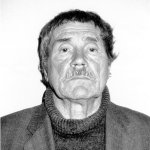
In the film, Walton names Ivor James Gregory as the mole.

1744668077062.jpeg
Agent Ace gave Russia access to top secret designs for the Concorde’s Rolls Royce engines
VICTOR DREES/DAILY EXPRESS/HULTON ARCHIVE/GETTY IMAGES

Gregory, who died in 1982 aged 73, was born in Hong Kong and trained as an engineer before his career progressed within British European Airways.

“We don’t know Agent Ace’s motivations. There’s nothing in his background to suggest he was an ideologically committed Communist although he may have been very good at hiding it,” said Walton.

“However the KGB were masters of bribery and blackmail, so that could have been a factor. Or maybe he was just looking for money.”
Gregory is the second British spy connected to Concorde after the electronic engineer Jimmy Doyle admitted in 1971 that he shared secrets with the Kremlin for cash after being contacted by the Soviet embassy.

1744668029316.jpeg
The intelligence historian Calder Walton said the spy he unmasked could have been motivated by ideology, money or blackmail
PBS


1744668102402.jpeg
The KGB defector Vasiliy Mitrokhin
PENGUIN

The information they shared with the Soviet Union helped it to launch the Tupolev 144. With Concorde still at the prototype stage, it was unveiled at the Paris Air Show in 1973 but crashed, possibly while performing a manouvre beyond its capabilities. The six crew and eight people on the ground died and the Russian jet was never really able to challenge its western twin.

Walton, whose third book Spies, the Epic Intelligence War between East and West will be published next year, added that the extent to which British intelligence were aware of the situation remains unknown.

He suggested the possibility that the documents Gregory was passing to the Soviets may have been sabotaged before being passed on.

“It’s not impossible that the British corrupted some of the information. That is definitely something that the US did in other areas,” he said.
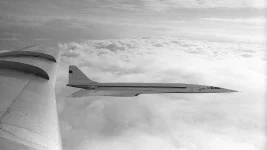
1744668114981.jpeg
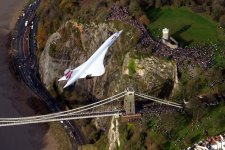
Crowds gather watch a Concorde pass over the Clifton suspension bridge in Bristol on its final flight in 2003
SOUTH WEST NEWS SERVICE

It finally entered service two years after Concorde but design flaws meant it only operated on limited flights between Moscow and Kazakhstan, with passengers reporting numerous horror stories. It was cancelled after just six months and 55 passenger flights.

1744668129985.jpeg
The Tupolev 144 under deveolpment near Moscow at the end of the 1960s. It only made 55 passenger flights, mostly between Russia and Kazakhstan
AFP

“The Soviets were good at reverse engineering things and had some of the best mathematicians on the planet but they were very bad at transforming things into practical products,” Walton said.

“Concorde was a wonderful status symbol for the UK and the western world and being able to create a rival went to the core of the Kremlin’s desire to be taken seriously as a world power that is capable of the same things as the western world. That has not gone away, it’s still here today.”

The beginning of the end for Concorde came on July 25, 2000, when a fire in the undercarriage caused one of the French aircraft to crash over the village of Gonesse, killing all 100 passengers and nine crew members.

A major safety overhaul was completed after just over a year but the very first test flight took place on September 11, 2001 and despite its flawless trip across the Atlantic it landed back into a changed world of aviation in which it no longer fitted.

It made its final flight two years later.
 
Last edited:
There was a recent documentary on a science channel here in the US on the history of the TU-144. Was an interesting watch.
 
Negative. Spot on. As if you might have written the dialogue for the documentary even.
 

Users who are viewing this thread

Pakistan Defence Latest

Country Watch Latest

Latest Posts

Back
Top