Beijingwalker
Banned

Breaking: China’s J-XDS test flight stuns with missing sensor on X images
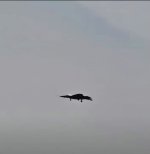
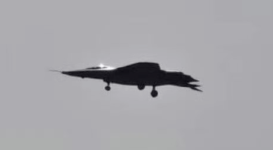
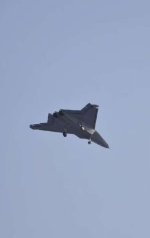
Apr 16, 2025On April 16, 2025, a mysterious Chinese fighter jet, believed to be the Shenyang J-XDS, soared over the skies of Shenyang, Liaoning province, in what observers described as another test flight of a potentially game-changing aircraft.

The flight, captured in grainy images circulating on Chinese social media platforms like Weibo, sparked intrigue due to an unusual detail: the apparent absence of a pitot tube, a critical sensor used to measure airspeed, on the aircraft’s nose.
This observation, first noted by aviation enthusiasts, has fueled speculation that the jet might be a second prototype of the J-XDS, a sixth-generation stealth fighter under development by the Shenyang Aircraft Corporation.
Yet, the low-quality images and unclear perspective leave room for doubt, raising questions about whether this is a new prototype, a deliberate design choice, or simply a trick of the camera. The sighting underscores China’s rapid advancements in military aviation and prompts a deeper look into what this aircraft could mean for global air power dynamics.
The J-XDS also referred to as the J-50 or J-XD in various reports, represents a significant leap in China’s pursuit of next-generation fighter technology. Developed by the Shenyang Aircraft Corporation, a state-owned aerospace giant with a history of producing fighters like the J-11 and J-16, the J-XDS is believed to be a twin-engine, tailless stealth aircraft designed for air superiority and multirole missions.
Its first public sighting occurred on December 26, 2024, when it was spotted flying near Shenyang, escorted by a J-16 strike fighter acting as a chase plane. Images from that flight revealed a sleek, lambda-wing configuration—a triangular design with sharply swept wings and drooped wingtips that enhance stealth and aerodynamic efficiency.
The aircraft features two ventral intakes with diverters and supersonic inlets, a technology that reduces radar visibility by eliminating traditional air intake bumps. Analysts have noted the presence of twin-engine bays with potential thrust-vectoring nozzles, suggesting high maneuverability, and a tricycle landing gear setup with a twin-wheeled nose gear, indicating a robust airframe capable of carrying significant payloads.
The J-XDS’s compact size compared to its counterpart, the Chengdu J-36, has led to speculation that it may be optimized for operations on aircraft carriers, a critical capability as China expands its naval presence in the Indo-Pacific.
What sets this latest test flight apart is the reported absence of a pitot tube, a detail that has aviation analysts buzzing. A pitot tube is a small, protruding sensor typically mounted on an aircraft’s nose or wing to measure airspeed by capturing airflow. Its absence on the J-XDS, as observed in images shared on social media, could indicate several possibilities.
One theory is that this is a second prototype with a different configuration, possibly testing alternative airspeed measurement systems. Modern fighter jets, particularly those of the sixth generation, are increasingly integrating advanced sensors like laser-based or radar-based systems that could replace traditional pitot tubes, reducing drag and radar cross-section.
Such a development would align with China’s push for cutting-edge technologies, as evidenced by its work on adaptive cycle engines and AI-driven flight controls. Another possibility is that the pitot tube was intentionally removed for this test or obscured by the image’s angle, a common challenge when analyzing low-resolution footage.
China’s history of tightly controlling information about its military programs also raises the prospect of deliberate misdirection, with the absence of the pitot tube designed to spark speculation and obscure the aircraft’s true capabilities.
The J-XDS’s design offers a glimpse into China’s ambitions for sixth-generation fighters, a category that remains loosely defined but is expected to include exponential improvements in stealth, sensor fusion, and networked warfare.
Unlike fifth-generation fighters like the U.S. F-22 and F-35, which focus on stealth and multirole capabilities, sixth-generation aircraft are anticipated to integrate unmanned teaming, advanced artificial intelligence, and directed-energy weapons.
The J-XDS’s tailless design, which eliminates vertical stabilizers to reduce radar visibility, mirrors concepts explored in the U.S. Next Generation Air Dominance program and Europe’s Future Combat Air System. Its lambda wings, with movable wingtips that can adjust during flight, suggest a focus on agility and stealth, allowing the aircraft to adapt dynamically to combat conditions.
The inclusion of ventral and side weapons bays, visible in earlier images, indicates a capacity for internal missile storage, preserving the jet’s stealth profile while carrying long-range air-to-air or air-to-ground munitions.
While the exact specifications of the J-XDS remain undisclosed, its estimated length of 55 to 60 feet and a maximum takeoff weight of around 60,000 pounds place it in a similar class to the U.S. F-35, though its carrier-compatible design could give it an edge in naval operations.
China’s aviation industry has a storied history of rapid development, often building on lessons learned from earlier programs. The J-20, introduced in 2017, marked China’s entry into the stealth fighter arena, though early models faced challenges with underpowered engines and immature avionics.
Subsequent iterations, equipped with domestically produced WS-15 engines, have closed the gap with Western counterparts. The J-35, a carrier-based stealth fighter derived from the FC-31 prototype, further demonstrates China’s ability to refine and adapt its designs.
The J-XDS builds on this legacy, incorporating lessons from the J-20 and J-35 while pushing into uncharted territory. Reports from as early as 2018 indicated that the Shenyang Aircraft Corporation was working on next-generation prototypes, with rumors of tailless designs and advanced propulsion systems circulating among defense analysts.
The J-XDS’s public test flights, conducted over densely populated areas, suggest a deliberate strategy to showcase China’s progress, possibly as a signal to rivals like the United States and Japan. The timing of the December 2024 flight, coinciding with Mao Zedong’s birthday, added a layer of symbolism, reinforcing the narrative of national pride and technological prowess.
The absence of a pitot tube, if confirmed, could have significant implications for the J-XDS’s development. Traditional pitot tubes, while reliable, are vulnerable to icing and physical damage, and their protruding shape can compromise stealth. By exploring alternatives, China may be positioning the J-XDS as a testbed for technologies that could be applied to other platforms, including drones and hypersonic vehicles.
For example, laser-based airspeed sensors, which use light to measure airflow, offer greater precision and resilience, though they require sophisticated integration with the aircraft’s avionics.
Such a system would align with the J-XDS’s apparent emphasis on broadband stealth, which seeks to minimize detection across multiple spectra, including radar, infrared, and visual. However, the lack of clear imagery makes it difficult to confirm whether the pitot tube is truly absent or simply not visible due to the camera angle.
An Aviation analyst cautioned that low-quality images can be misleading, citing past instances where supposed design changes were later debunked. “The perspective and resolution of these photos leave too much to interpretation,” the analyst wrote on X, urging caution in drawing conclusions.
To understand the significance of the J-XDS, it’s worth comparing it to its global counterparts. The U.S. Next Generation Air Dominance program, which aims to replace the F-22 by the 2030s, has been shrouded in secrecy, though a full-scale prototype reportedly flew as early as 2020.
The NGAD is envisioned as a “family of systems,” pairing manned fighters with autonomous drones and advanced sensors, much like the J-XDS’s rumored capabilities. However, the program has faced challenges, with costs estimated at $300 million per aircraft and a recent pause for review under the incoming Trump administration.
The U.S. Navy’s F/A-XX, a parallel effort to replace the F/A-18 Super Hornet, remains in the conceptual stage, with no public prototype flights confirmed. In Europe, the Future Combat Air System and Global Combat Air Programme are still years from producing operational aircraft, hampered by complex multinational partnerships.
China’s ability to field two sixth-generation prototypes—the J-XDS and the Chengdu J-36—suggests a faster development tempo, though questions linger about the maturity of their systems and operational readiness.
The J-36, spotted on the same day as the J-XDS in December 2024, offers a contrasting approach. Developed by the Chengdu Aircraft Corporation, the J-36 is a larger, trijet aircraft with a tailless, double-delta wing design optimized for long-range missions and heavy payloads.
Its estimated length of 66 to 85 feet and maximum takeoff weight of 100,000 to 120,000 pounds make it a potential regional bomber or command-and-control platform, capable of carrying long-range missiles like the PL-17. The J-36’s three-engine configuration, with two side intakes and a dorsal intake, is a departure from conventional designs, suggesting a focus on thrust redundancy and high-speed performance.
While the J-36’s role remains speculative, its size and capabilities complement the J-XDS, indicating that China may be pursuing a dual-track strategy: a compact, agile fighter for air superiority and a larger platform for deep-strike and networked warfare.
The J-XDS’s test flights come at a time of heightened tensions between China and the United States, particularly in the Indo-Pacific. China’s growing assertiveness in the South China Sea and its expanding aircraft carrier fleet underscore the strategic importance of advanced fighters like the J-XDS.
The aircraft’s potential carrier compatibility could enhance China’s ability to project power far from its shores, challenging U.S. dominance in the region. Meanwhile, the U.S. Air Force’s F-47, announced by President Trump in March 2025 as the manned centerpiece of the NGAD program, remains in the engineering phase, with Boeing tasked to produce test aircraft.
The F-47’s capabilities are classified, but Trump claimed it has been flying secretly for five years, a statement that contrasts with China’s open displays of its prototypes. This divergence in approach—China’s public unveilings versus the U.S.’s secrecy—highlights differing strategies for shaping global perceptions of military power.
Historically, China’s fighter programs have followed a pattern of rapid iteration and public reveals. The J-20’s development, which began in the 1990s, culminated in its operational debut in 2017, though it faced criticism for lagging behind the F-22 in stealth and engine performance.
The J-35, initially an export-oriented prototype, evolved into a carrier-based fighter for the People’s Liberation Army Navy, demonstrating China’s ability to pivot and refine its designs. The J-XDS appears to follow this model, with test flights conducted in full view of civilian onlookers, a tactic that balances propaganda with technical validation.
The absence of official confirmation from the Chinese Ministry of Defense, coupled with the spread of “candid” images, suggests a calculated effort to generate buzz while maintaining plausible deniability. As aviation journalist David Cenciotti noted in a recent article, “The quality and quantity of ‘unofficial’ images of Chinese military hardware tend to increase as testing progresses, a pattern we’ve seen with the J-20 and J-36.”
The broader implications of the J-XDS extend beyond its technical features. If the aircraft is indeed a second prototype, it could indicate that China is accelerating its sixth-generation program, potentially outpacing Western efforts in terms of prototype development.
The integration of advanced sensors, AI, and unmanned teaming could position the J-XDS as a “quarterback” for future air battles, coordinating drones and other assets in contested environments. This aligns with comments from U.S. Air Force Secretary Frank Kendall, who acknowledged China’s progress but expressed confidence in the NGAD’s eventual superiority.
“China’s advancements are expected, but our system will likely produce the better product,” Kendall said in response to the J-36’s flights, a sentiment that likely applies to the J-XDS as well. However, the U.S.’s slower, more deliberate approach risks ceding the initiative to China, which has demonstrated an ability to produce and test prototypes at a remarkable pace.
As the J-XDS continues its test flights, the absence of a pitot tube remains a tantalizing clue, but not a definitive one. It serves as a reminder of the challenges in interpreting open-source intelligence, where grainy images and fleeting glimpses can spark more questions than answers.
The aircraft’s true capabilities—its sensors, propulsion, and role in China’s broader strategy—will likely remain obscured until more data emerges. For now, the J-XDS stands as a symbol of China’s ambition to redefine air combat, pushing the boundaries of stealth, agility, and networked warfare.
Whether it represents a second prototype or a bold experiment in sensor technology, its presence demands attention from defense planners and analysts alike. The skies over Shenyang have revealed a glimpse of the future, but the full picture remains just out of reach, leaving observers to wonder: what is China hiding, and how will it shape the battles of tomorrow?