
fitpOsitive
Elite Member


Trade wars 
Follow along with the video below to see how to install our site as a web app on your home screen.
Note: This feature may not be available in some browsers.

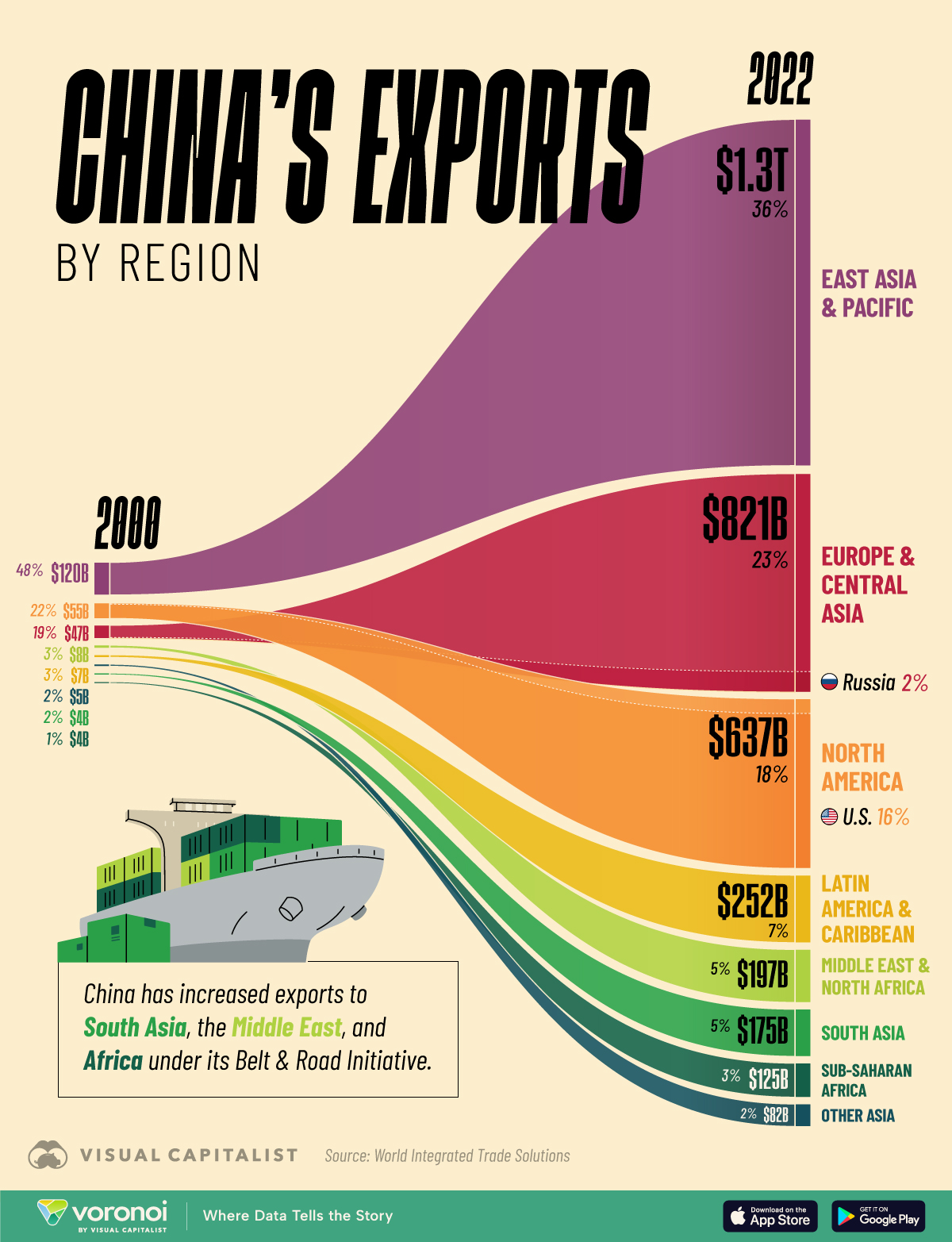
At least somepeople or companies want, business customers, and yes in Japan and SK cases, many consumers. They are business or trade.you really think these countries have producing goods that Chinese consumers want. It is more like components and raw materials China needs to export other products
A good lesson from the 2008 financial crisis, after China helped solve the crisis, what did US do to China right after, pivot to Asia to choke China, lol.How the Trump administration has played this is truly unfathomably idiotic.
Start a trade war with the entire world.
Put massive tariffs on critical goods from China. Create an economic crisis at home.
China predictably fights back and cuts off critical supplies of rare earths which will destroy America's supply chain.
Get a financial crisis in the stock and treasury markets.
China won't pick up the phone.
Unilaterally remove tariffs on China.
Try to tell the entire world to backstab China while you are down.
Tell China you want to be nice and to get that knife off your throat.
Given that the Trump administration has put itself in a corner while making it clear once it gets out of that corner, it will come for China's throat, what incentive does China even have to help him? This is truly stupid to an unfathomable level.


 www-hk01-com.translate.goog
What's the difference ? At 65%, it still effectively stop most products trade.Trump Tariffs | US media: The White House is considering a substantial reduction in tariffs on China, possibly down to 50% to 65%
View attachment 113889
On April 23, U.S. media quoted people familiar with the matter as saying that the Trump administration is considering significantly reducing tariffs on Chinese imports, some of which may be reduced by more than half, to ease tensions with Beijing. The report mentioned that according to a senior White House official, tariffs on China could drop to between about 50% and 65%.
The Wall Street Journal quoted people familiar with the matter as saying that President Trump has not made a final decision, discussions are still ongoing, and there are several options.
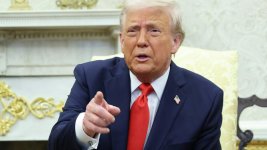
On April 16, 2025, U.S. President Donald Trump delivered a speech at a pre-Easter prayer service and dinner at the White House in Washington, DC. (Reuters)
US media: Or drop to between 50% and 65%
According to the report, according to a senior White House official, tariffs on China may drop to about 50% to 65%. Other people familiar with the matter said that the US government is also considering a tiered taxation approach similar to the one proposed by the House China Committee at the end of 2024, namely, imposing a 35% tax on goods that the United States believes do not pose a national security threat, and imposing at least 100% tax on goods deemed to be strategic to US interests. The bill proposes phasing in these taxes over five years.
The White House has not yet responded.
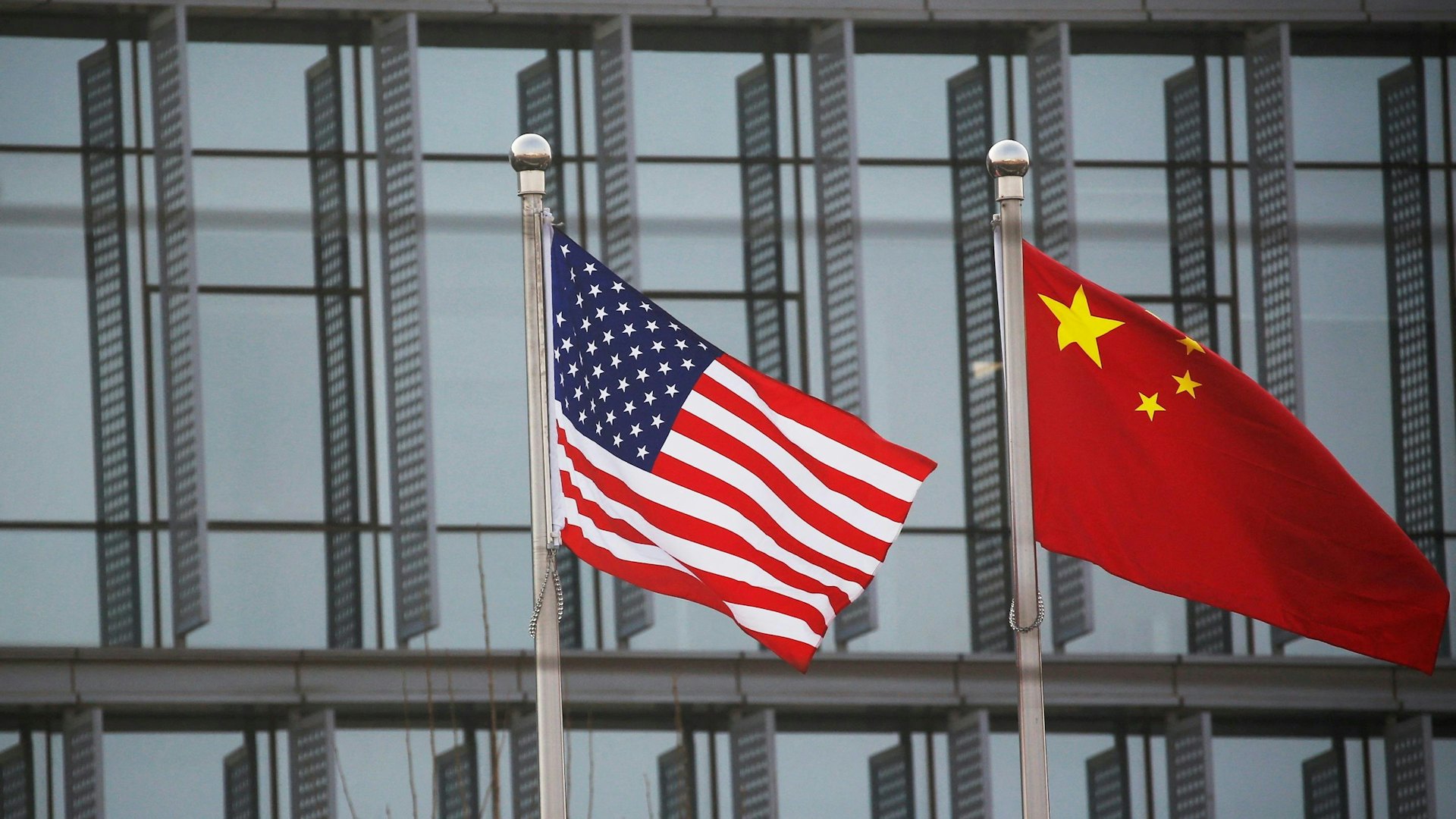
On January 21, 2021, the national flags of China and the United States fluttered in the wind outside an American corporate building in Beijing. (Reuters)
Since Trump announced in early April that he would impose "reciprocal tariffs" on many trading partners around the world, global stock markets have fluctuated sharply. Later, Trump announced that he would suspend the higher "reciprocal tariffs" on most countries for 90 days, but the tariff war between the two countries has been escalating again and again. On April 22, Trump changed his statement and said that he would conduct trade negotiations with China in a very friendly manner . If the two sides reach an agreement, the US tariffs on Chinese imports will be substantially reduced, but will not be reduced to zero.
特朗普關稅|美媒:白宮考慮大幅削減對華關稅 或降到50%至65%
美媒4月23日引述知情人士指,特朗普(Donald Trump,又譯川普)政府正考慮大幅削減對中國進口商品的關稅,部份或減超過一半,以緩解與北京的緊張關

Nobody cares, he is freaking out over the bond yields. Biden might have dementia but at least he is not stupid.What's the difference ? At 65%, it still effectively stop most products trade.
China has enough headaches worrying about ChinaChina is really smart to organize the global community to keep the existing global order of free trade to the benefit of developing nations along with China and Europe.
China doesn't care how the others will react. If they choose to collaborate with the bully US to damage China's interests, China will strike back in reciprocal to damage those countries' interests too, it's that simple as Chinese gov has now stated, and I think that's how Iran will respond too if in similar situation. Don't expect they can push China around and China then should just appease them, world doesn't work that way. After all, over 140 countries' largest trade partner is China, not US.But if those countries are the majority, then it hurts China even more than doing nothing because it will increase inflation in China. You can't isolate yourself from the world. Also, you think if you restrict their imports, they will just stand by and say OK? They will restrict their imports from you in return, further hurting your economy.
That's because they don't know what their limits are before they get an agreement with the Big Kahuna, China.The problem with the Trump Administration is they don't know what they want, they don't know what is the end game they want. Look, Japan their most loyal vassal and first to lick after Vietnam asked the US what they wanted, nobody could give a clear answer. India will face the same issue.
“I DON’T do it for the money. I’ve got enough, much more than I’ll ever need. I do it to do it. Deals are my art form. Other people paint beautifully on canvas or write wonderful poetry. I like making deals, preferably big deals. That’s how I get my kicks.The problem with the Trump Administration is they don't know what they want, they don't know what is the end game they want. Look, Japan their most loyal vassal and first to lick after Vietnam asked the US what they wanted, nobody could give a clear answer. India will face the same issue.


A dozen US states sue to halt Trump's tariffs
Kayla Epstein - BBC News, New York
Wed, April 23, 2025 at 6:00 p.m. PDT·3 min read
New York attorney general Letitia James [Getty Images]
A dozen US states have joined together on a lawsuit aiming to block President Donald Trump's spate of tariffs that have upended global trade.
The suit, which is led by New York's governor and attorney general, argues that the president lacked the authority to impose the levies. It notes such tariffs must be approved by the US Congress.
Twelve states joined the lawsuit, which was filed with the United States Court of International Trade.
The White House accused New York Attorney General Letitia James of "prioritizing a witch hunt against President Trump over protecting the safety and wellbeing of their constituents".
White House spokesman Kush Desai added that the "administration remains committed to using its full legal authority to confront the distinct national emergencies our country is currently facing—both the scourge of illegal migration and fentanyl flows across our border and the exploding annual U.S. goods trade deficit."
The lawsuit states that tariffs must be approved by Congress and questioned Trump invoking a 1970s law called the International Emergency Economic Powers Act (IEEPA) to enact the levies.
"By claiming the authority to impose immense and ever-changing tariffs on whatever goods entering the United States he chooses, for whatever reason he finds convenient to declare an emergency, the President has upended the constitutional order and brought chaos to the American economy," the lawsuit states.
Trump invoked the IEEPA as the basis for several of his tariffs against China, Mexico, Canada, and other countries.
A president can use the law "to deal with any unusual and extraordinary threat, which has its source in whole or substantial part outside the United States, to the national security, foreign policy, or economy of the United States," if he has first declared a national emergency.
The lawsuit argues that the law does not actually grant Trump the power he claims to derive from it. The act has never been used to issue tariffs by any president, congressional research shows.
Last week, the state of California filed its own lawsuit against the Trump administration over tariffs. That lawsuit also argues that Trump lacks the power under the IEEPA to impose these tariffs. Several other lawsuits have similarly challenged Trump's authority using that law for the levies.
Trump has implemented tariffs on global trading partners in a stated effort to correct what he believes is a trade deficit between the US and other nations.
On 2 April, in an event billed as "Liberation Day," Trump shook the global economy by announcing "reciprocal" tariffs on nations across the world. A few days later amid a market backlash, he announced a 90-day pause on the tariffs and lowered the rate to 10% for most countries.
That pause didn't extend to China, which Trump said had a "lack of respect" and was retaliating. Instead, the US issued a 145% on goods imported from China, which has led to a trade standoff and rattled global markets.
On Wednesday, Trump said he hoped to come to a deal with China soon and noted the 145% tariff was "very high".
The White House has also imposed 25% tariffs on certain goods from it's neighbours, Mexico and Canada.
A dozen US states sue to halt Trump's tariffs
The lawsuit argues President Trump did not have the authority to enact the levies and start a global trade warca.news.yahoo.com


