@Beijingwalker
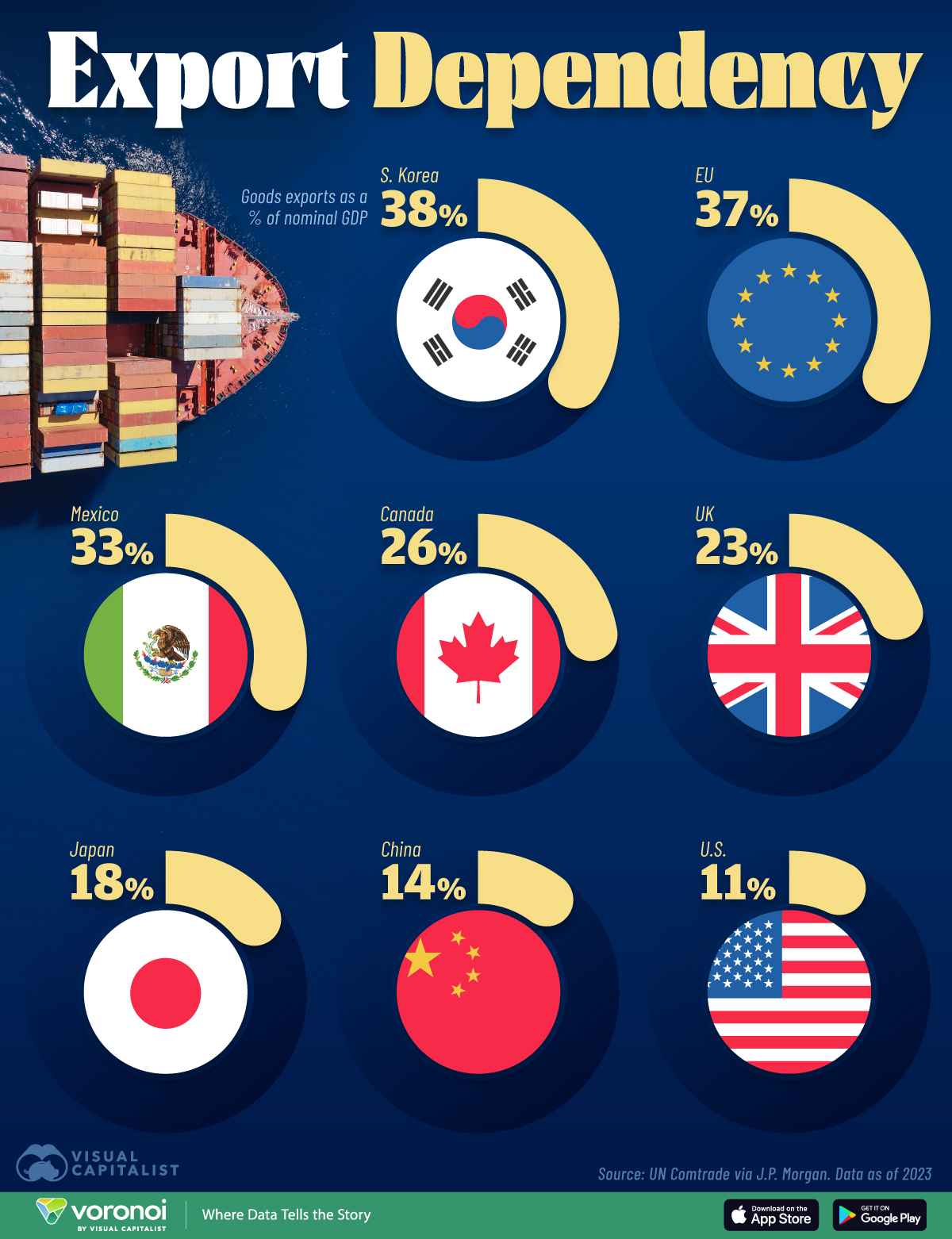
And China is dependent upon exports to keep its economy running. It doesn't have the option of not exporting.
Regards
China has a sanction proof economy
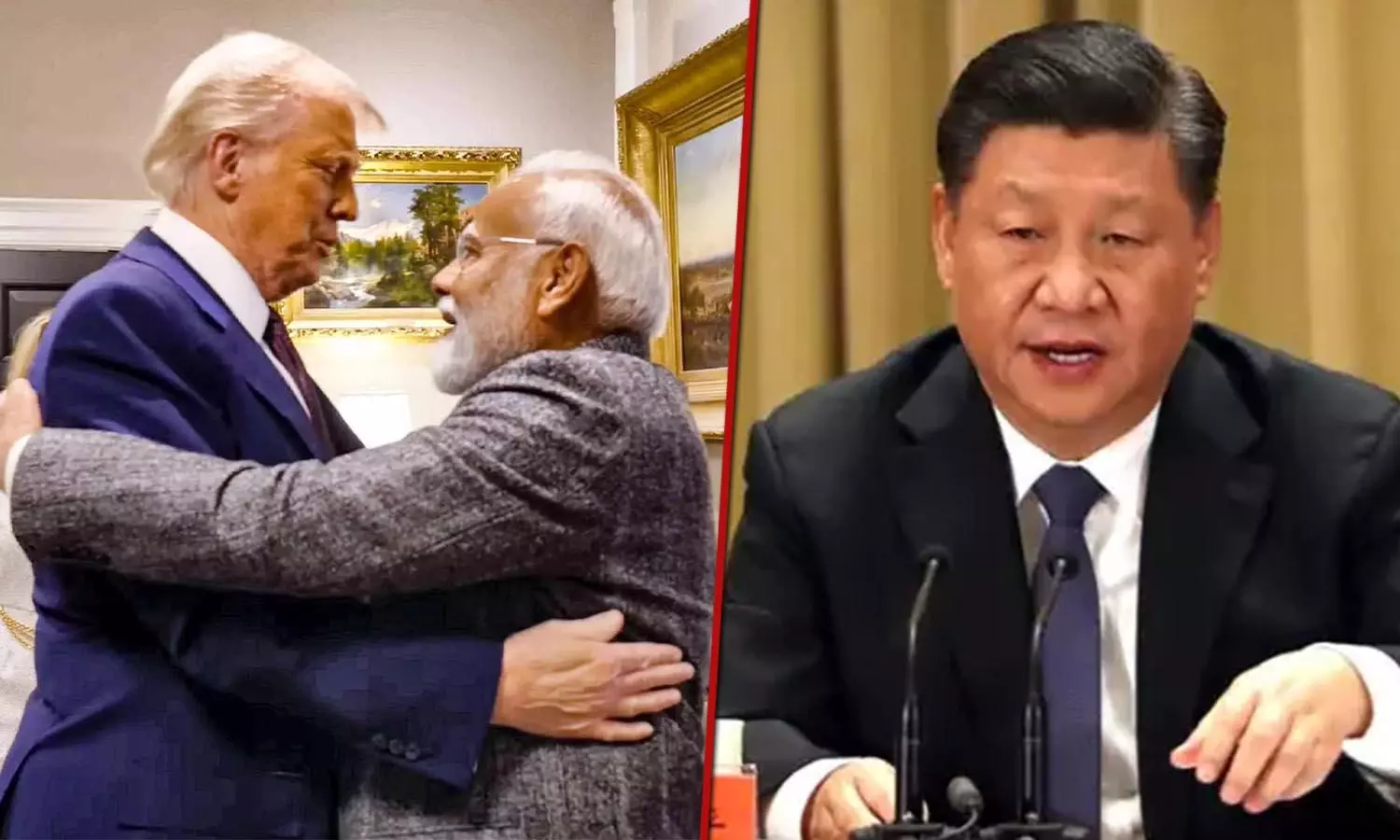
Why India can only grin and bear Trump’s tantrums while China roars back
Prasanna Mohanty
11 Apr 2025 7:37 PM (Updated:12 Apr 2025 10:38 AM)
Donald Trump says countries are “dying to make a deal” with America. China, clearly, is not on the list.
Do you know why
China is aggressively hitting back at the US with counter-tariffs (“fight till the end”) and is responding in kind to Trump’s latest salvo of 125 per cent tariff, unlike any other major economy, including India, or group of nations like the EU?
The EU has proposed a counter-tariff of 25 per cent against the US but is likely to back off after Trump hit a 90-day pause and lowered reciprocal tariff to 10 per cent for all, except China. It is a different matter that Trump told investors that “
this is a great time to buy” — hours before he put the pause button that led stock markets to soar.
China can fight back because it has built itself into a powerhouse of manufacturing, technology and exports.
Bloomberg’s David Fickling writes, “The world’s biggest manufacturer has spent decades building an economy that’s already largely war-proofed against blowback from its own trade practices”, particularly after Trump 1.0 launched the first trade war against it in 2018.
China’s share of US imports has gone up by 4 percentage points to 18.5 per cent since then, while the US share of exports to China slipped by 6.6 percentage points to 17.2 per cent.
Fickling further writes that China dominates US imports in all categories — from smartphones and computers to games consoles to furniture to toys and clothing — while the US is relatively a minor supplier to China, except for jet engines and, to a limited extent, soya.
Higher tariffs against China will, therefore, hit American consumers who have seen four years of high inflation and two-decade-long high interest rates; China’s retaliatory tariff will hit American producers going through the third year of producer price deflation.
Meanwhile, Fickling notes, China has built ties with other trading nations to broaden and diversify its markets for exports, unlike the US.
Others have noted that China, a major buyer of US agricultural produce, diversified imports from Brazil and increased its domestic production of soya, corn, beef, pork, wheat, sorghum, etc., to reduce its dependence on the US.
US data shows that its trade deficit with China may have fallen from $375 billion in 2017 and $418 billion in 2018, but at $295 billion in 2024, it is still very high.
China also leads the biggest trading bloc — the Regional Comprehensive Economic Partnership (RCEP), including the 10 ASEAN members and its free trade agreement (FTA) partners like Japan, Korea, Australia, and New Zealand. This bloc has a global share of 28.8 per cent in trade and 30 per cent in GDP.
After 2018, it set up manufacturing bases in Mexico and other Latin American countries to access the US market, and in Turkiye, Nigeria, and Morocco to access the European markets to beat both trade barriers and the China+1 strategy (Economic Survey 2023-24).
It is now doing so in
Vietnam to access the Indian market, and signed nine economic and technical agreements with Bangladesh last month. No wonder, India is worried about the dumping of Chinese goods as a big fallout of Trump’s tariff war.
Ironically, China and India began their economic reform journey together, in the 1980s. The two started at virtually the same levels in size, per-capita income, and inequality.
But today, China is the number one in
(a) manufacturing (global share of 28.8 per cent against India’s 2.8 per cent in 2023
(b) exports of goods (global share of 14 per cent against India’s 1.8 per cent in 2023)
(c) emerging high-tech (leads the world in 37 of 44 technologies in defence, space, robotics, semiconductors, renewable energy, biotechnology, AI, quantum technology, etc.) and science
China’s GDP, at $17.75 trillion, is five times India’s $3.57 trillion (current USD) in 2023. Despite additional (recent) sops such as corporate tax cut and PLI subsidies, India's manufacturing remains flat at 17.2 per cent of GVA in FY25, as it was in FY14. Goods exports fell to 17 per cent of GDP in FY23 (up to which NAS data is available), from 17 per cent in FY14.
India has shunned all mega trading blocs — both the US-led CPTPP (the US walked out of it in 2017), which was formed to isolate China, and China’s counter to it, the RCEP. Now, China is trying to join the CPTPP.
Meanwhile, the US started the Indo-Pacific Economic Framework for Prosperity (IPEF) in 2022. India signed up, but stayed out of its trade pillar. The Economic Survey of 2023-24 argued that India must join the RCEP to boost manufacturing, develop global value chains (GVCs), check trade and tech deficits and check “potential supply disruptions” and “risk of economic coercion…for political leverage” by China. But the government ignored it.
India is renegotiating all its bilateral FTAs, managing to conclude only four during 2021-24 — Mauritius, Australia, the UAE, and the Trade and Economic Partnership Agreement (TEPA) signed with the European Free Trade Association (EFTA). A World Bank report of 2024 said the impact for the first three “remains to be determined” and dismissed the fourth as “relatively limited in scope”.
Faced with imminent US tariff threats, India woke up in 2025 to resume bilateral FTA renegotiations — with the EU after eight years, with the UK after eight months, with New Zealand after 10 years, and with the US, the first bilateral trade talk (BTA) began a few days ago.
These bilateral FTA talks have become far more complicated after the “reciprocal” tariffs. For example, like the US, the EU demands zero tariff on cars. The EU has an old score to settle, too, along with Japan and Taiwan — as India lost its case in the WTO in May 2023 over erecting tariff barriers (of 7.5–20 per cent on ICT products, while the WTO mandated 0 per cent).
That India erected trade and non-trade barriers (license-permit raj for laptops/PCs, wheat, rice, sugar, pulses, gold, steel, etc., and also quality-control orders) are known — prompting Trump to call India
“tariff king” and “big abuser” of trade ties and attracting the USTR’s ire.
India is not sure whether it wants trade in local currencies with non-US countries or not — as a safeguard against USD dominance. First, it committed to this for BRICS nations in 2024, then backtracked when Trump threatened retaliation — only to revive it in the BIMSTEC talk on April 5.
Trade in local currency among BRICS makes sense — India, China, Russia, Brazil, the UAE and other members constitute 37.3 per cent of global GDP (more than double of EU’s 14.5 per cent) and 40 per cent of global exports and crude oil production. Not so much for BIMSTEC, a minor grouping of Bangladesh, India, Myanmar, Sri Lanka and Thailand.
All the above are relevant to any discussion on India’s trade vulnerabilities or future direction.
Trump 2.0 has made global trade unpredictable and chaotic, through unilateral decisions and flip-flops. India can’t breathe easy, as the US threatened higher tariff on other “bad actors” while hitting the pause button in which India was clubbed with Vietnam, Japan, and Korea.
Then, the White House said “more than 75 countries” had called in to negotiate tariffs. Trump said countries were “dying to make a deal”. A US trade representative said India was among 50 countries willing to lower tariffs. The White House warned against retaliatory tariffs by posting on X on April 9: “Do not retaliate and you will be rewarded.”
What the above indicates is that there could be many like India willing to sweeten the deals by buying American oil, gas, and weapons like F-35 or give a free pass to Trump’s ally Elon Musk. Some are already offering to buy US agricultural produce — which would be hit after China, its biggest market, pulls out. This is to be expected because the US is the most powerful economic and political entity.
Global value chains also come into the picture. These can neither be built, dismantled or rearranged overnight to establish new global trading routes or markets. Here also, India is on weak ground because its presence is very low, even in the Asia-Pacific region.
All the above factors would determine whether India can find alternative markets for its US-bound exports for future stability and predictability — counter-intuitive as it may sound from its own unpredictable, unstable trade policies.
The Federal reached out to three eminent trade experts to find alternative markets for Indian exports bound for the US. All were unequivocal in their response: None.
That probably explains why no expert or trade think tank has prepared any such list yet.
Ajay Srivastava, founder of the Global Trade Research Initiative (GTRI), said: “Had there been alternatives, we would have already exported more, not waited.” For him, the major hurdle in the top export categories to the US — electrical, telecom and electronics in first place and jewellery in third — is “low value addition”. The US has held off reciprocal tariff for pharmaceuticals, which is in second.
The GTRI’s February 2025 report listed the low-value-addition items such as iPhones, solar panels, diamonds, and petrochemicals, and said that “after accounting for PLI incentives and other concessions, the real earnings are close to zero”. Low value addition means little gain from exports.
Biswajit Dhar, former director of EXIM Bank and member of the GOI’s Board of Trade, said: “Nobody can give you that (alternative) on a platter; solution will have to be found on a case-to-case basis or tailor-made.”
His lament is that India doesn’t have a Plan B or initiative; it didn’t take forward its ‘Look East’ and ‘South-South Cooperation’ initiatives or engage with Africa (no bilateral FTA or negotiations with the African Union). On the other hand, businesses are hanging on to the government’s coat-tail.
A former top India trade negotiator, requesting anonymity, told
The Federal that all countries were equally anxious over the US’s tariffs and its changing contours for any clarity to emerge anytime soon. The only new market he could foresee for the future is (neglected) Africa.
Perhaps the only leeway that India could have is by re-routing, re-distribution, or diversion of goods though countries with a favourable trade deal with the US. But this has been nixed by the Commerce and Industry Ministry. On April 9, ministry officials cautioned exporters against it to avoid retaliatory US action.
Trade experts point out that China adopted this strategy after the US’s first trade war of 2018, using Vietnam and Mexico for re-routing.
Given all the chaos Trump 2.0 has spread, it is easier to understand Andhra Pradesh Chief Minister Chandrababu Naidu’s predicament. The only chief minister who has
taken up the cause of his state’s exporters, he has asked the Centre to get the US to
exempt shrimp exports. Andhra Pradesh contributes a bulk of such export and Trump’s tariff has jolted the shrimp farmers, with harvesting halted, purchases frozen, and prices plummeting.
But that (exemption) would be possible only when the BTA negotiations are concluded — expected in autumn (September-October) — and may involve opening up the Indian market for US farm produce. That is sure to spark strong protests from farmers.
Source:
https://thefederal.com/the-federal-...trumps-tantrums-while-china-roars-back-181226

www-hk01-com.translate.goog