@HRK
These are the two projections that the US had theorised in the worst case scenario of their war-gaming where Indian were to target Pakistan's strategic assets:
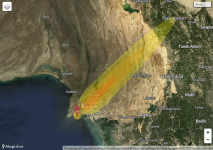
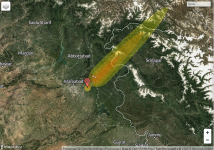
Note that the resulting fallout and ecological damage beyond Pakistan made these "non-feasible" and then 1998 happened!
In 2008 WACCM used the NCAR model to stimulate Global environmental effects of a regional nuclear war.
"A regional nuclear conflict between India and Pakistan would not only inflict immediate damage in the subcontinent, including massive loss of life and destruction of built infrastructure; severe long-term environmental damage would also spread globally, lasting decades, researchers have found.
In a paper published in the AGU journal
Earth’s Future, NCAR Atmospheric Chemistry Division project scientists Michael Mills and Julia Lee-Taylor and their colleagues present the first study of such a scenario to use an Earth system model including coupled interactions between atmospheric chemistry and dynamics, ocean dynamics, sea ice and land components.
They studied a scenario in which India and Pakistan each detonate 50 small nuclear weapons, about half of their current arsenals, in modern megacities, igniting fires that would build for hours after the explosions.
The fires would build into firestorms consuming buildings, vegetation, roads, fuel depots, and other infrastructure, releasing energy many times that of the weapon’s yield, generating 5 Tg of smoke in the form of black carbon (BC).
Calculations using version 1.0 of the Community Earth System Model (CESM1), with the Whole Atmosphere Community Climate Model (WACCM) show that the BC would self-loft to the stratosphere, where it would spread globally, producing the coldest average surface temperatures in the last 1000 years.
Killing frosts would reduce growing seasons by 10-40 days per year for 5 years. The figure shows how CESM1(WACCM) calculates that the BC would remain in the stratosphere (panel a) reducing solar fluxes to the surface (panel b) for nearly 2 decades, much longer than previous studies of the same scenario with other models, due to interaction of the radiation, chemistry, and dynamics calculated in the coupled model. Surface temperatures (panel c) and precipitation (panel d) would be reduced for more than 25 years, due to thermal inertia and albedo effects in the ocean and expanded sea ice.
Previous studies did not include both full ocean dynamics and atmospheric chemistry,
and found that these disruptive effects on surface climate would last about 10 years.
At the same time, intense heating of the stratosphere would cause global ozone losses of 20%-50% over populated areas, levels unprecedented in human history.
The authors calculate summer enhancements in damaging ultraviolet radiation of 30%-80% over mid-latitudes, suggesting widespread damage to human health, agriculture, and terrestrial and aquatic ecosystems.
The combined cooling and enhanced UV would put significant pressures on global food supplies and could trigger a global nuclear famine. The authors also note that the 100 relatively small nuclear bombs in the study represent just a small fraction of the world’s approximately 17,000 nuclear weapons.
Source: Mills, M. J., O. B. Toon, J. Lee-Taylor, and A. Robock (2014), Multi-decadal global cooling and unprecedented ozone loss following a regional nuclear conflict,
Earth's Future, n/a–n/a, doi:10.1002/2013EF000205