PAKISTAN TESTS NEW FATAH-II SURFACE-TO-SURFACE MISSILE - QUWA Jan 2024
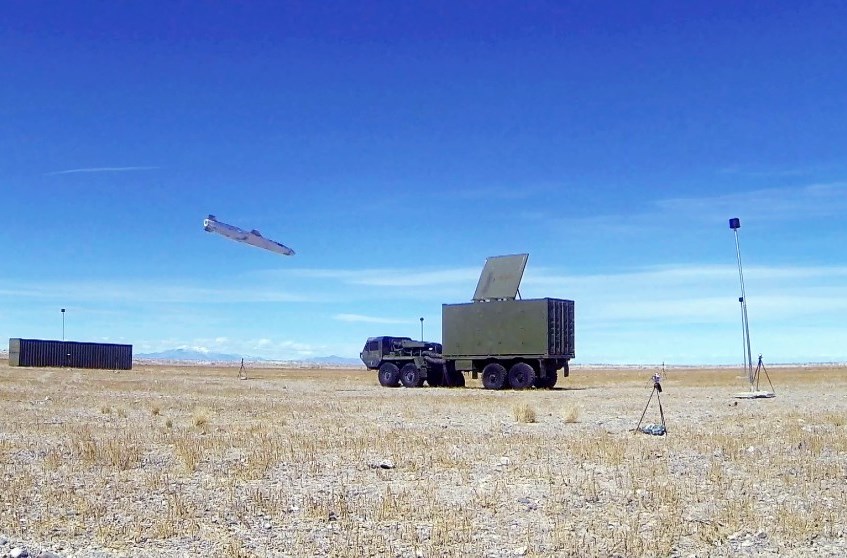
On 23 December 2023, the Pakistani military’s media department, Inter Services Public Relations (ISPR), announced the test firing of a new surface-to-surface missile (SSM) called the “Fatah-II.”

According to the ISPR, the Fatah-II has a range of 400 km and is “equipped with state-of-the-art avionics, sophisticated navigation system and unique flight trajectory.”
The Fatah-II is a new addition to Pakistan’s growing inventory of guided rockets, building upon the Fatah-I multiple launch rocket system (MLRS) and
Nasr-series of short-range ballistic missiles (SRBM).

Though sharing the same core designation of “Fatah,” the Fatah-II does not appear to be a new variant of the Fatah-I. Rather, the ISPR’s visual footage shows that the Fatah-II is based on a different missile platform, not the Fatah-I line of MLRS. In 2023, Global Industrial and Defence Solutions (GIDS), the commercial arm representing a number of Pakistan’s state-owned defence contractors,
showcased a “Fatah-II” that was an evident evolution of the Fatah-I. This earlier Fatah-II inherited the core design attributes of the Fatah-I, but with an improved range of over 250 km and accuracy of 10 m circular error probe (CEP), compared to the Fatah-I’s range and accuracy of 140 km and 50 m CEP, respectively.

In contrast, this ‘new’ Fatah-II not only offers a far greater range at 400 km, but it also seems to be a larger missile. For example, the Fatah-I used an eight-cell launch system (which the original Fatah-II design would have likely reused), while the new Fatah-II seems to leverage a twin-cell system. Finally, the design of the new Fatah-II also exhibits several key differences, such as the lack of fins on the nosecone, for example.

By giving an ostensibly different missile platform the same core designation of “Fatah,” Pakistan could be moving towards making the “Fatah” a family of guided rockets. Thus, it is possible that the original Fatah-II will be redesignated as a Fatah-I-based missile, like “Fatah-IB,” to represent its direct relationship to the Fatah-I. Overall, Pakistan’s investment in the Fatah series highlights the Pakistan Army’s growing focus to build its land-based stand-off range strike capabilities which, in turn, could reflect a broader military effort to building Pakistan’s conventional deterrence posture.
Unpacking the New Fatah-II
As noted earlier, the revised Fatah-II appears to be a larger missile compared to the original Fatah-II shown by GIDS in 2023.
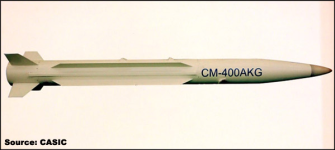
Interestingly, the new Fatah-II’s design seems to bear a resemblance to the CM-400AKG, an air-launched anti-ship rocket used by the Pakistan Air Force (PAF) through its JF-17 Thunder multi-role combat aircraft.
However, the Fatah-II has a much longer stated range than the CM-400AKG (i.e., 400 km to the latter’s 250-280 km). Thus, the Fatah-II is unlikely to be identical to the CM-400AKG as, being a land-based missile, it would have a shorter range. Even if one accounts for an additional booster stage/rocket, it would, at best, match the CM-400AKG’s range, not surpass it.

If one was to assume a Chinese connection for the Fatah-II, then the closest missile matching its range as well as apparent size and design would be the
B611M short-range ballistic missile (SRBM) or, potentially, its BP-12A variant.

Like the Fatah-II, the BP-12A has offers a range of 400 km and, similarly, utilizes a two-cell launch cannister system. The Fatah-II bears general resemblance to the B611M and BP-12A, but it still seems to exhibit some differences. For example, the tail fins of the B611M and BP-12A are right at the end of their respective missile’s fuselages; however, the Fatah-II’s tail fins seem to be slightly further away from the rocket motor/exhaust area. Thus, the Fatah-II may be an original missile design.
While one should not discount the possibility of technical help from the Chinese, the Fatah-II simply does not fully match any known Chinese SRBM available for export. Moreover, there are reasons to believe that Pakistan had been working on a new line of conventional ballistic missiles for its own needs…
--------------------------------
"World Defense Show 2024 where Pakistani defence conglomerate GIDS is offering the Fatah-II long range guided multi-launch artillery rocket system (LR-GMARS) for export.
The high ranking Pak Military delegation will be holding preliminary talks with the military delegations of two potential customers, one in the Middle East and another in West Asia, that have shown heavy interest in acquiring the system.
The export variant of the Fatah-II weapon system has a range of 250 kilometres, and is equipped with state-of-the art avionics, a powerful and sophisticated navigation system combined with a globally-unique flight trajectory(s).
It will provide customers with the capability of tactical and operational precision strike target-engagement deep inside enemy territory, for both mobile and stationary targets, while bypassing a multi-layered, integrated air defence system of a near-peer adversary military.
The system can put various types of 150-kilogram conventional warheads (fragmentation, armour piercing, high explosives) well behind enemy lines, especially useful in saturation attacks on or through enemy air defence and neutralise enemy high-value targets such as airbases, C2 nodes, radar installations and logistical facilities. "

On 27 December 2023, the Pakistani military announced that it test-fired a new 400 km-range surface-to-surface missile, the Fatah-II.

quwa.org