China hits back at Canada with fresh agriculture tariffs

Fool. Watch the video it talks about how switching to domestic is not going to help even with over a billion in population because most of what Yu people export is no use for domestic celestials. Celestials are still poor and becoming poorer as they lose jobs just watch the video they talk to many of your people who are suffering.
You're hilarious. You believe whatever an anti-Chinese media video says. Why don't you look up the increase in China's social consumer goods and the change in the share of domestic demand?
 
You're hilarious. You believe whatever an anti-Chinese media video says. Why don't you look up the increase in China's social consumer goods and the change in the share of domestic demand?
Sure, we will wait. Just as we waited after the one-child policy was removed.
 
You're hilarious. You believe whatever an anti-Chinese media video says. Why don't you look up the increase in China's social consumer goods and the change in the share of domestic demand?
Everything that is not ccp approved and critiques the ccp, or china, is anti-celestial to wumaos like you.

winnie-Xi-poo knew tariffs were coming and if there was a domestic demand it would have happened a long time ago but it hasn't and it never will because what celestials export is no use for the average celestial who now doesn't have a job or money. Many celestials in video are predicting after May holiday there's going to be a huge shutdown of factories and major job losses.

Hold on to your butts wumaos a reckoning is coming.
 
Everything that is not ccp approved and critiques the ccp, or china, is anti-celestial to wumaos like you.

winnie-Xi-poo knew tariffs were coming and if there was a domestic demand it would have happened a long time ago but it hasn't and it never will because what celestials export is no use for the average celestial who now doesn't have a job or money. Many celestials in video are predicting after May holiday there's going to be a huge shutdown of factories and major job losses.

Hold on to your butts wumaos a reckoning is coming.

It's true that China's unemployment rate has grown a bit because of the trade war.
But who told you that unemployment equals no consumption? We are China, not the United States. We're a big country with a whole chain of industrial Cthulhu-level industries, not a fallen empire that needs to borrow money to buy goods.

For example, my province of Hunan is giving out 3,000CNY consumption vouchers every month this year to all Chinese citizens of Hunan origin (no cash is given out so that the money isn't consumed, but saved). You can do the math yourself, 3,000 CNY per month is 36,000 CNY per year, 1.4 billion people is 50.4 trillion CNY, 7 trillion dollars.

The funniest thing is that not only is the Hunan government's finances not under pressure after handing out the money, it's tax revenues went up in the first quarter instead, and consumer goods are up 18% YoY. Because of the rapid growth of consumer goods in society, our service sector is also growing rapidly. While factories have fewer orders, the number of small stores with frontages on the streets is increasing rapidly.

You MAGA's lack the most basic judgment and reasoning skills. Is it hard to expand domestic demand? How dare you believe the Chinese can't do what even the Indians can do?
 
Last edited:
wumao please!

What Orange man is saying is tariffs aren't going away for celestials unless trade becomes fair, meaning Yu celestials are going to be bleeding jobs for the foreseeable future.

To view this content we will need your consent to set third party cookies.
For more detailed information, see our cookies page.

Bleed!
Bleed!
Bleed!

Yu wumaos will soon take a break from this forum when winnie-Xi-poo gives in as factories keep closing one after another. Once the heat blows over you will come back as if nothing ever happened and you will go back to your trolling ways.

teach you another Chinese proverb: “速胜派和投降派是一个硬币的两面”. It means that the person who believes that he can win quickly and the person who wants to surrender are actually the same person, they are two sides of the same coin.

Those of us in China believe that we will inevitably win this tariff war, but we generally expect the war to last more than two years and that it may eventually lead to a hot war. The Chinese are generally preparing for a long war. And so is the Chinese government, which within two weeks of the outbreak of the tariff war had already signed a soybean deal with Brazil, a North American oil deal with Canada, a beef deal with Australia, and a natural gas deal with the UAE. That means the Chinese government has completed shifting all four major categories of U.S. exports to China.

I can understand the mindset of Americans who believe that the US will win, but whereas people like you who are obsessed with fake videos and believe that China will fail and collapse so soon, you are in fact potential surrenders, and in the future you will inevitably be the first to surrender to us. And the Trump administration until now has not put a dedicated task force in charge of the replacement of the commodity supply, apparently they are all in the same category as you. Your kind are bound to be the first to surrender. People like gambit j_hungary who are delusional enough to try to beat China in the future with population issues may instead hold out longer.

Your comments have exposed MAGA as nothing more than a bunch of bullying cowards and refined egoists. Such people cannot revive America, much less defeat a nation as good and strong as ours. You are just another self-absorbed passerby in our thousands of years of history. There are many transients like you, Ghost Fang, Yi Qu, Xiongnu, Xianbei, Khitan, Turk and so on, about thousands of them. In the end, they will become nothing more than a few lines of text in our thick historical records.

Now do you know why we Chinese support Trump and MAGA over DP? Here's why.
 
Last edited:
wumao please!

What Orange man is saying is tariffs aren't going away for celestials unless trade becomes fair, meaning Yu celestials are going to be bleeding jobs for the foreseeable future.

To view this content we will need your consent to set third party cookies.
For more detailed information, see our cookies page.

Bleed!
Bleed!
Bleed!

Yu wumaos will soon take a break from this forum when winnie-Xi-poo gives in as factories keep closing one after another. Once the heat blows over you will come back as if nothing ever happened and you will go back to your trolling ways.

Lol , based on your personal channel "China Observer", China collapes every day, you should be happy, why you are still so depressed and agitated about China every single hour in your life? calling names, hurling insults, China had been long done for, why are you so still so mad about it?

搜狗截图20241124020852.png
 

Trump says he might back off on China tariffs – but Beijing holds firm​

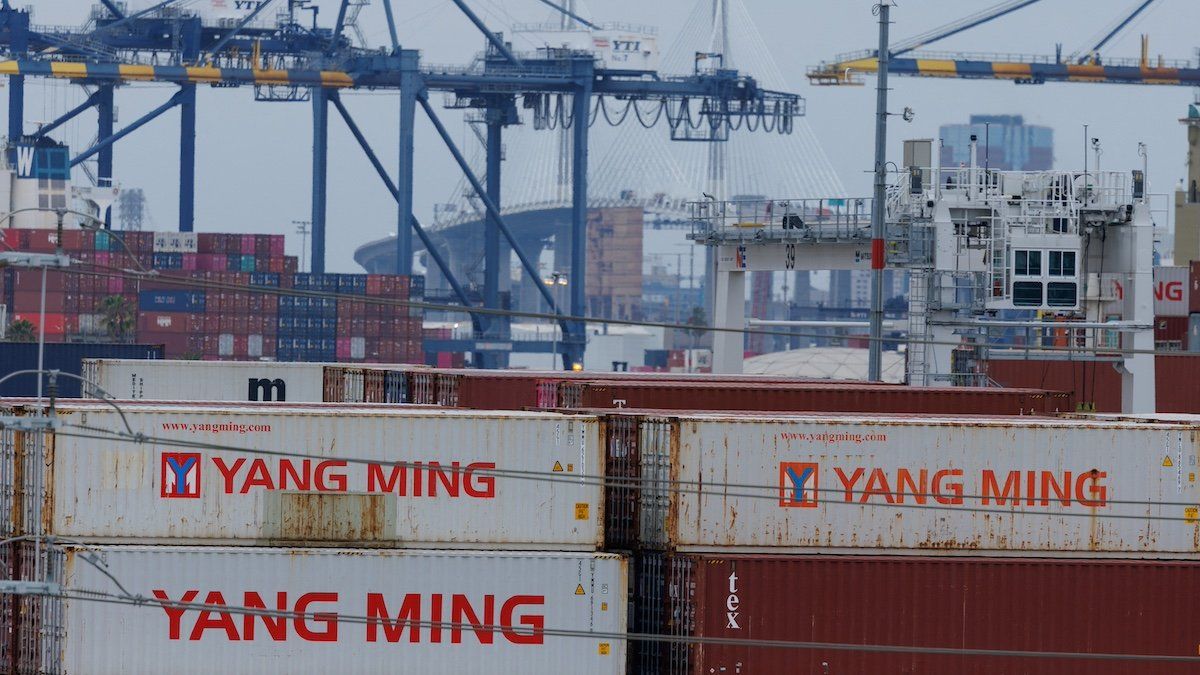
Shipping containers from China are seen at the Port of Los Angeles, in San Pedro, California, U.S., May 1, 2025.

Shipping containers from China are seen at the Port of Los Angeles, in San Pedro, California, U.S., May 1, 2025.
REUTERS/Mike Blake

Matthew Kendrick
May 05, 2025

With US-China trade grinding to a halt, President Donald Trump told ABC News on Sunday that he would lower the 145% tariff imposed on China “at some point,” explaining that “otherwise you could never do business with them.” Beijing has expressed willingness to start talks if Washington is “prepared to … cancel its unilateral tariffs.” So China is playing a game of chicken, and Trump hasn’t quite swerved out of the way.

“There’s no clarity around what Trump wants from China,” says Eurasia Group’s Lauren Gloudeman. “It’s been a huge source of frustration for the Chinese side because since November they have been seeking to get that question answered.”

Beijing isn’t playing ball like Canada or Mexico, which made superficial concessions to Trump to postpone tariffs. China retaliated with 125% tariffs of their own and then moved to protect vulnerable parts of its economy by quietly issuing a series of exemptions on important US imports like aircraft engines, semiconductors, and pharmaceuticals.

“China’s leadership cannot be seen as being coerced into giving into Trump’s tactics,” says Gloudeman, explaining that Beijing is already facing the worst-case scenario for bilateral trade. “It’s quite insulting and humiliating, and the broader strategy for China is counting on Trump to back down first.”

 
wumao please!

What Orange man is saying is tariffs aren't going away for celestials unless trade becomes fair, meaning Yu celestials are going to be bleeding jobs for the foreseeable future.

To view this content we will need your consent to set third party cookies.
For more detailed information, see our cookies page.

Bleed!
Bleed!
Bleed!

Yu wumaos will soon take a break from this forum when winnie-Xi-poo gives in as factories keep closing one after another. Once the heat blows over you will come back as if nothing ever happened and you will go back to your trolling ways.


It's not impossible what you are saying will come true but it's also possible that China won't give in. With that uncertainty in mind, that's a lot of bluster from you, it may come back and embarrass you.
 
Lol, on one hand they claim that China bans protests, on another hand they claim protests are everywhere in China. These haters don't really have many live braincells left to think about basic logics.
 
will be intereresting to watch the incoming trade talk
I think Ccp wil remain hardened, no concession. the US feels more pains than vice versa.
To view this content we will need your consent to set third party cookies.
For more detailed information, see our cookies page.
 

‘Tolerance for pain is higher in China’: Beijing enters US tariff talks with upper hand


SINGAPORE: From Washington and Beijing, planes carrying senior leaders and trade officials are en route to one negotiating table in Switzerland - but who has the upper hand?

The imbalance in negotiating power is already clear, analysts said, as US and Chinese officials convene in Switzerland this weekend for their first face-to-face trade talks since President Donald Trump’s sweeping new tariffs took effect.

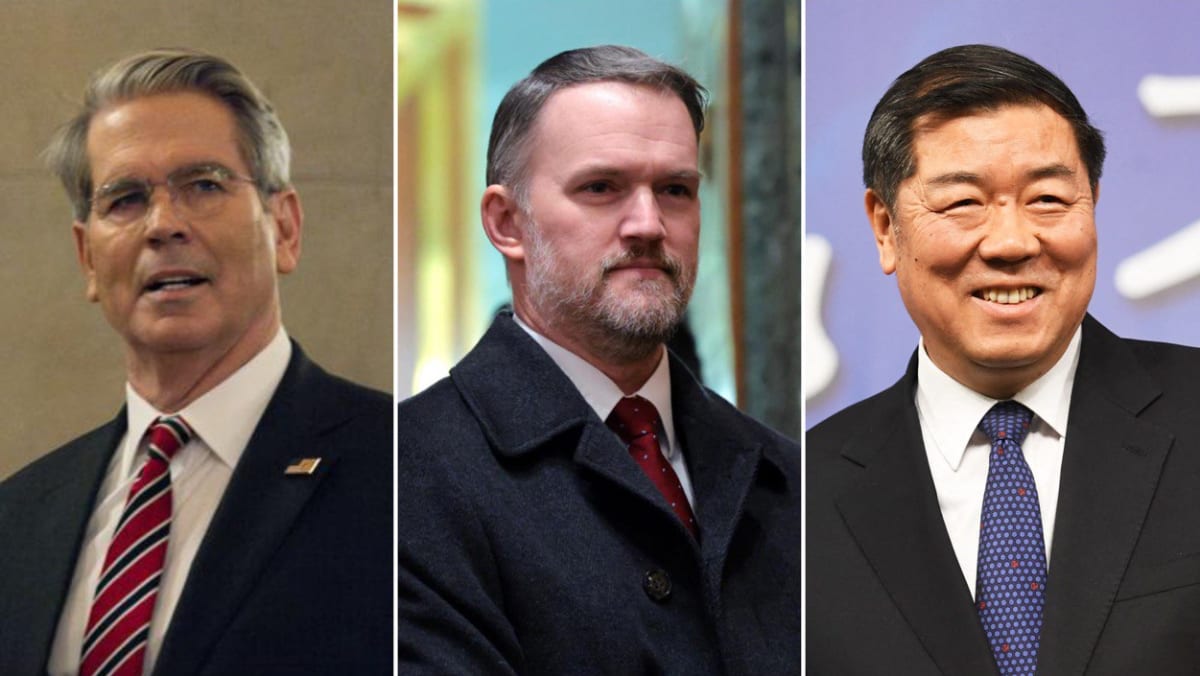
The meetings, scheduled for Saturday (May 10) and Sunday, will be led by US Treasury Secretary Scott Bessent and Trade Representative Jamieson Greer. On Beijing’s side, Vice Premier He Lifeng will represent the government.

Despite its own domestic economic strain, China enters the talks with firmer demands, a unified message, and greater strategic patience, according to observers. The United States, by contrast, has tempered expectations and downplayed the prospects of a deal.

“China does have the upper hand because the US is reaching out,” said Wang Dan, China director at Eurasia Group.

“The trigger for (the talks) is mainly the domestic condition of the US. People have anticipated some hardships, but nobody expected this type of turbulence in the market.”

To be sure, both China and the US are “feeling real economic pain from these outlandishly high tariffs”, said Dexter Tiff Roberts, a nonresident senior fellow at the Atlantic Council’s Global China Hub.

The US faces the threat of empty store shelves and higher consumer prices, while China grapples with a loss of export-related jobs.

“I do think, though, that the tolerance for pain is higher in China … the whole ability to ‘eat bitterness’,” said Roberts, referring to the Chinese saying “chi ku”, which means to “eat bitterness” or to endure hardship.

A HARDER LINE FROM BEIJING​

The US has made clear that the talks are not expected to yield a breakthrough, with Bessent describing them as a first step toward outlining topics for future negotiations.

“My sense is that this will be about de-escalation, not about the big trade deal,” Bessent said in an interview with Fox News on Tuesday. “We’ve got to de-escalate before we can move forward.”

Beijing, meanwhile, has taken a markedly different tone.

China’s commerce ministry issued a statement ahead of the talks insisting the US “must face up to the serious negative impact of unilateral tariff measures on itself and the world.”

It warned that China “will never agree” to any outcome based on “coercion and blackmail”.

The message from Beijing has been consistent: without significant tariff relief, there will be no substantive negotiation.

“I don’t think it’s a tactic,” said Wang. “It’s essentially a safe play for Beijing, because Trump is unpredictable. Even if something is agreed privately … there still can be changes when it comes to the official talks.”

“So China is very much aware of that, and (President) Xi wants to control the situation.”

Roberts noted that Chinese officials had previously denied US claims that negotiations were underway.

“Trump and his people repeatedly said talks were happening when apparently they were not,” he said. “I think they thought saying that would be a strategy to make talks happen sooner.”

“The US is the one that comes into this feeling a little more desperate … I think there was a misperception that China would somehow be more of a pushover and more desperate to come to the talks. And I don't think that's what's happened.”

Xu Jianwei, senior economist for Greater China at Natixis, noted that any US move to reduce tariffs would carry political risk.

“Rolling back tariffs too much would inevitably invite an uncomfortable question for the US: what was the point of the confrontation if it led us back to square one?” he said.

POLICY DIVERGENCE, ECONOMIC STRAIN​

The talks come amid growing economic strain in both countries.

Trump’s tariff package imposed a 10 per cent blanket duty on virtually all imports, on top of existing 25 per cent tariffs on steel, aluminium, automobiles, and parts. Since January, he has also raised tariffs on Chinese imports to 145 per cent, prompting Beijing to hit back with 125 per cent on US exports.

In China, up to 16 million export-related jobs could be at risk under the current US tariffs, according to estimates by Goldman Sachs analysts. These include factory workers whose jobs have been jeopardised by stalled operations and cancelled orders.

In the US, many businesses have warned of disrupted supply chains and looming shortages.

In fact, CEOs of major retailers - including Walmart and Target - have reportedly told the White House that inventories are shrinking and price increases are imminent.

Even Trump has acknowledged that “at some point” the tariffs may need to come down. “Otherwise you could never do business with them,” he told NBC’s Meet the Press last week.

Against this backdrop, the UK and US announced a “breakthrough deal” to reduce some tariffs - the Trump administration’s first bilateral deal since the tariff onslaught.

Markets responded enthusiastically: on Thursday, the S&P 500 rose 0.6 per cent, the Dow gained 0.6 per cent and the Nasdaq climbed 1.1 per cent.

Trump hinted that tariffs on China could be lowered if the Switzerland talks made progress.

“We’re going to see. Right now you can't get any higher. It's at 145 per cent so we know it's coming down,” Trump said.

According to analysts, recent stock market volatility and mixed inflation signals are increasing pressure on Washington to ease tensions - while Beijing watches closely.

“China wants to see what the US can offer,” said Roberts.

Wang added that the consequences are playing out differently in each country.

“There’s more of the economic cost to China,” she said. “For the US, it’s a more political cost.”

“(The) Chinese people and Chinese businesses are used to this kind of policy uncertainty … I think the pain might - on the surface - be more visible for US consumers, but for China, it's real welfare loss.”

Meanwhile, China’s central bank on Wednesday cut the required reserve ratio by 0.5 percentage points and trimmed the seven-day reverse repo rate by 0.1 percentage points - moves aimed at increasing liquidity while keeping broader policy restrained.

According to Wang, these adjustments are not signs of panic.

“It’s not in a hurry to come out with aggressive rate cuts or monetary easing,” Wang said.

“All those messages coming out from (the central bank announcements) are in line with a long term goal. It’s still (about) the technology upgrade, building up the capital market to serve the real economy.”

“This was clearly preparation for trade talks. They're trying to put a little support under a weak economy, and that does give them ultimately more leverage to walk away. They're not gonna be pushovers. There's no way.”

China’s leaders have insisted that they remain confident of hitting this year’s GDP growth target.

On May 5, during a meeting of financial officials in Milan, Finance Minister Lan Fo’an reiterated that “China will adopt more proactive and robust macroeconomic policies and is confident of achieving the growth target of ‘around 5 per cent’ for 2025”.

Yet the government has so far resisted a major stimulus, focusing instead on long-term goals like tech self-sufficiency and financial system reform.

“These are relatively minor adjustments,” said Daryl Guppy, an Australian financial columnist and CEO of Guppytraders.com, “although it suits Western observers to interpret them as something significant because this allows the US to claim their tariff attack has worked”.


“THEY’VE BEEN PREPARING FOR THIS”​

Beijing’s leverage in the talks stems from years of preparation, analysts said.

China has shifted to reduce reliance on the US market, cultivating deeper ties with the Global South and investing in infrastructure through the Belt and Road Initiative.

“The US is far more dependent on China across its supply chain,” said Guppy.

“China has replacement markets … The US is increasingly vulnerable because it cannot quickly substitute China imports.”

Guppy argued that Trump’s team is operating on outdated assumptions.

“They are thinking of China pre-COVID,” he said.

“(They) do not understand the tremendous economic restructure with the digital economy that has taken place since then.”

Roberts noted that China has not been idle in preparing for worsening ties with Washington.

“China hasn’t been static, they’ve been preparing for this.”

“They already dealt with Trump 1.0, and they already had a trade war on a much smaller level with Trump in the first round,” he added.

China's exports rose faster than expected in April, growing 8.1 per cent year-on-year, according to customs data released on Friday. However, China's exports to the US fell 17.6 per cent compared to the previous month.

According to the US commerce department on May 6, imports from China were the lowest in five years and could drop further, given reports of a massive decline in cargo from China.

In the first quarter of 2025, ASEAN overtook the US as China’s largest trading partner, with bilateral trade reaching $234.2 billion - 16.6 per cent of China’s overall foreign trade - a 7.1 percent year-on-year rise.

WHAT’S ON THE TABLE?​

Analysts said the mere fact that talks are happening marks a “breakthrough”. Whether that leads to meaningful progress depends on what the US is willing to offer - and how Beijing responds.

Roberts said a tariff reduction remains likely - a necessary first step before further negotiations can begin.

“Obviously, the first thing they can do is reduce the tariffs, and that's what they'll do. We'll see the tariffs come down. That's the first part of any deal.”

“It might not happen on Saturday, but I think it's likely that we're gonna see that happen soon,” he added.

Wang is more sceptical. “I think we all have very low expectations,” she said.

“No concrete results are expected from this meeting … if there are no real concessions from the US then this talk is nothing.”

China wants the US to remove the tariffs, said Wang. “Otherwise, it's a lack of sincerity from China's point of view.”

Symbolic progress could take the form of extended dialogue or modest tariff rollbacks.

Roberts noted that even small adjustments may allow both governments to save face.

“China might be like we haven't gotten far enough, but we're moving in the right direction,” he said. “Trump could say … ‘Can you believe how they caved?’”

Wang said more technical wins are possible.

“If somehow the US is able to offer some concrete measures, then maybe we're looking at some small deals that involve a currency or export quota … it can be a win on both sides,” she said.

Taiwan could even surface in the talks as part of a broader negotiation, if Washington offers deeper concessions.

“China really wants the US to potentially to somehow reframe their commitment to Taiwan, to give Beijing more power, more leverage over Taiwan,” said Roberts. “I think there's a possibility that the Trump administration could do that as well.”

According to analysts, truly substantive outcomes - such as easing tech export restrictions, formal mechanisms to stabilise the yuan, or commitments on intellectual property - are far less likely in the near term.

“Over the long term, the direction of US-China decoupling is clear,” said Natixis’ Xu.

“But both China and the US will carefully weigh the economic costs before taking each step forward. Without real progress in trade negotiations, both sides will suffer: China will lose export-related jobs, while the US will face higher consumer prices.”

While both sides face serious economic constraints, analysts said China appears in no rush to arrange a meeting between President Xi Jinping and President Trump.

“It’s the last thing China wants to do, to put Xi Jinping in a humiliating position,” said Wang, referencing Trump’s meeting with Ukrainian President Volodymyr Zelenskyy that ended in a shouting match.

“They would rather endure trade war for much longer.”

“I think the US is more supplicant now than China,” Roberts said. “And China has the leverage, but no one's gonna admit to that in Washington.”

Guppy contrasted the two leaders’ negotiating styles: “The Art of the Deal is no match for Sun Tzu’s The Art of War.”
 
Among the main drivers of Beijing's climb-down were internal signals that Chinese companies were struggling to avoid bankruptcies and to replace the U.S. market, three people familiar with the Chinese government's thinking said.

Some areas feeling immediate impact were furniture and toy makers, as well as textiles, said one of the officials.

U.S. diplomats in China have also been closely monitoring factory closures, strikes, and job losses in the industrial heartland in southern China.

Many analysts have downgraded their 2025 economic growth forecasts for China, and investment bank Nomura has warned the trade war could cost it up to 16 million jobs. China's central bank this week announced fresh monetary stimulus.
One of the officials said Chinese companies were struggling to replace the U.S. market because developing nations cannot buy as many items, and that for many firms this was an existential threat that needed to be resolved in days or weeks.

In addition, Beijing was worried it was left without a place at the negotiating table while its major trading partners, such as Vietnam, India and Japan, began talks with Washington, said two officials familiar with Beijing's thinking.


China is bending the knee
 
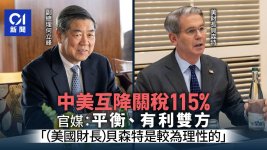
Official media said it was balanced and beneficial to both sides and praised Finance Minister Bensont for his rationality.


1747041992445.jpeg

China and the United States issued a joint statement after the economic and trade talks in Geneva, and both sides will significantly suspend tariffs and reduce each other by 115%. Bloomberg pointed out that the statement showed that both China and the United States would temporarily reduce tariffs for 90 days. The US tariffs on Chinese goods would be reduced from 145% to 30%, while China's tariffs on the US would be reduced from 125% to 10%.

The new media "Yuyuan Tantian" under the official media CCTV published an article today (12th) stating that it understood that the joint statement reached at this meeting was balanced and beneficial to both sides.


The picture shows U.S. Treasury Secretary Scott Bessent and U.S. Trade Representative Jamieson Greer speaking to the media after trade negotiations with China in Geneva, Switzerland on May 11, 2025. (Keystone/EDA/Martial Trezzini/Handout via REUTERS)

The picture shows U.S. Treasury Secretary Scott Bessent and U.S. Trade Representative Jamieson Greer speaking to the media after trade negotiations with China in Geneva, Switzerland on May 11, 2025. (Keystone/EDA/Martial Trezzini/Handout via REUTERS)

Chinese Vice Premier He Lifeng listens to a speech during the China-Switzerland bilateral talks in Geneva, Switzerland, May 9, 2025. (Reuters)

On May 9, 2025, in Geneva, Switzerland, U.S. Treasury Secretary Scott Bessent (left) and U.S. Trade Representative Jamieson Greer (right) attended bilateral talks between the United States and Switzerland. (Reuters)


The article Yuyuan Tantian quoted Luo Zhenxing, director of the Economics Department of the Institute of American Studies of the Chinese Academy of Social Sciences, as saying that there are two factors that have contributed to the substantial progress made in such a short period of time:

First, in this round of Sino-US economic and trade frictions, the US imposed abnormally high tariffs on China, and China resolutely countered to safeguard its own interests. Both sides raised their tariffs to the level of prohibitive tariffs in a very short period of time. Therefore, the impact on both sides was immediate.

The second factor is that after experiencing the last round of Sino-US trade frictions, both China and the United States have become more experienced and have a good understanding of each other's demands.

"Yuyuan Tantian" also quoted Gong Jiong, a professor at the Department of Economics of the University of International Business and Economics, as saying that the main purpose of this communication is to restore Sino-US trade first. On the basis of the restoration, China and the United States will also discuss more issues.

"Yuyuan Tantian" pointed out that regarding the agreement between China and the United States to establish an economic and trade consultation mechanism, the respective economic and trade leaders of China and the United States will jointly lead this mechanism, and the economic and trade teams of both sides will conduct regular and irregular communication on issues in China-US economic and trade. The time and place of future communication will be further agreed upon by both sides.

"Bessant is more rational"​

The article in "Yuyuan Tantian" also mentioned the US trade negotiating representative, US Treasury Secretary Scott Bessent, saying, "At present, Bessent seems to be more rational. During this meeting, the Chinese delegation also gave positive comments to the US delegation."
 
Among the main drivers of Beijing's climb-down were internal signals that Chinese companies were struggling to avoid bankruptcies and to replace the U.S. market, three people familiar with the Chinese government's thinking said.

Some areas feeling immediate impact were furniture and toy makers, as well as textiles, said one of the officials.

U.S. diplomats in China have also been closely monitoring factory closures, strikes, and job losses in the industrial heartland in southern China.

Many analysts have downgraded their 2025 economic growth forecasts for China, and investment bank Nomura has warned the trade war could cost it up to 16 million jobs. China's central bank this week announced fresh monetary stimulus.
One of the officials said Chinese companies were struggling to replace the U.S. market because developing nations cannot buy as many items, and that for many firms this was an existential threat that needed to be resolved in days or weeks.

In addition, Beijing was worried it was left without a place at the negotiating table while its major trading partners, such as Vietnam, India and Japan, began talks with Washington, said two officials familiar with Beijing's thinking.


China is bending the knee
The trade war was initiated by the United States. The tariffs were reduced equally on both sides, so how can you say now that China has surrendered?
 

Users who are viewing this thread

Pakistan Defence Latest

Back
Top