Chengdu J-10 Multirole Fighter Air Craft News & Discussions

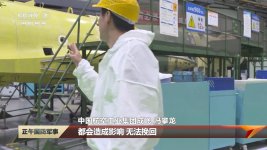
J-10C production line.
The production line is not too intelligent, probably due to the low demand for orders. It belongs to the more advanced traditional production line and has not reached the level of intelligent production line.
This kind of production line, in theory, can be exported to PAC as a whole. the rest is price negotiation.
008pTJr2ly1i15nuoa92ej31hc0u01kx.jpg008pTJr2ly1i15nuocbv6j31hc0u07wh.jpg008pTJr2ly1i15nuoc6ioj31hc0u0e81.jpg008pTJr2ly1i15nuoa2gcj31hc0u04qp.jpg008pTJr2ly1i15nuoacvcj31hc0u04qp.jpg
 
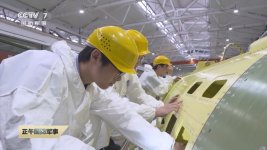
J-10C production line.
The production line is not too intelligent, probably due to the low demand for orders. It belongs to the more advanced traditional production line and has not reached the level of intelligent production line.
This kind of production line, in theory, can be exported to PAC as a whole. the rest is price negotiation.
I would differentiate between “automated” and “intelligent”

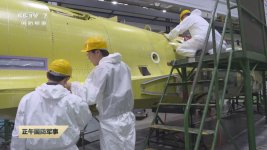
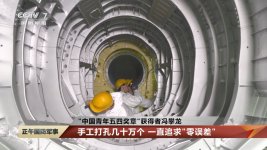
If you are familiar with the aviation industry, commercial or not, actually a large part of the tooling and assembly are still hand-made, not because there isn’t a drive for mechanization or automation (and Boeing did try to), but because skilled hands are actually more precise than machines in tasks like drilling and installing rivets over complex airfoil contours.

That doesn’t mean the production line isn’t intelligent. From what I learned, the CAC’s J-10 line, and later transferred to GAC, adopts a “pulse” production line, smaller number of jets in more numerous blocks, with rapid prototyping and adoption of iterative improvements at play.
 
If you are familiar with the aviation industry, commercial or not, actually a large part of the tooling and assembly are still hand-made, not because there isn’t a drive for mechanization or automation (and Boeing did try to), but because skilled hands are actually more precise than machines in tasks like drilling and installing rivets over complex airfoil contours.
I'm not sure how Boeing builds airplanes now. I'm just basing my judgment on China.

Based on the previous official announcement of the production line for the Y-20 series. The production line has been fully robotically drilled. There are very few workers on the whole production line.
According to the current factory grading standard in China, the production line of Y-20 series belongs to the entry level intelligent production line. It has not yet reached the standard of a “dark factory”.
Some of AVIC's component production factories have fully realized the standard of “Dark Factory”. There are no workers in the factory except for the monitoring room.

If you have any questions about the “dark factory” in China, you can always check the production factory of Seres Group. They live broadcast the factory 24/7 on Douyin platform, so you can see the situation in the workshop at any time.
If you compare their production lines with those of automobiles in Western countries, you will see the gap.

The J-10 series belongs to China's early fighter series and it is at the lower end of the current PLAAF fighter sequence. China's demand for it is low. Current foreign trade sales are also small.
So, its production line is still relatively traditional.
 
Last edited:
I'm not sure how Boeing builds airplanes now. I'm just basing my judgment on China.
What I was referring to when I referenced boeing was their automation project in 2010s, automating processes that were traditionally, and still is, heavily human labour intensive - riveting, composite ply laying, quality inspection, etc. For tasks that demands extreme precision and adaptability, counterintuitively, human labour is more precise.
Based on the previous official announcement of the production line for the Y-20 series. The production line has been fully robotically drilled. There are very few workers on the whole production line.
According to the current factory grading standard in China, the production line of Y-20 series belongs to the entry level intelligent production line. It has not yet reached the standard of a “dark factory”.
Some of AVIC's component production factories have fully realized the standard of “Dark Factory”. There are no workers in the factory except for the monitoring room.
I do not for a moment doubt that a lot of the subsystems of the Y-20 are produced in highly automated factories, what I’m referring to is the final assembly process, which the J-10 production line pics depicted, is still very dependent on skilled labour. This is the case for Y-20 also, as I recall there was a thread where a CCTV state television broadcast reported on the Y-20 production line. Lots of intelligent production - digital twins, automated part cutting and tooling, and yet - human riveteers and human inspectors! Assisted with tools to be sure, but still it’s workers with air drills for that final stretch. This is common practice for the aviation industry.
 
but still it’s workers with air drills for that final stretch. This is common practice for the aviation industry.
You can check out this video from the official.
I'm not sure if you can understand Chinese, but the video clearly shows the complete process of the robot punching the holes.
The perforating robot works automatically on a circular track, which is controlled with an accuracy of 0.02 mm.

To view this content we will need your consent to set third party cookies.
For more detailed information, see our cookies page.
 
You can check out this video from the official.
I'm not sure if you can understand Chinese, but the video clearly shows the complete process of the robot punching the holes.
The perforating robot works automatically on a circular track, which is controlled with an accuracy of 0.02 mm.

To view this content we will need your consent to set third party cookies.
For more detailed information, see our cookies page.

Thanks for the information, that is certainly new to me.
But I would ask you to note that transport jets, and passenger jets with their “tube and wing” configuration have fuselage cross sections with minimal sharp contours but lots of total needed tooling are obviously more ideal for mechanization, but the same cannot be said for tactical jets with much more complex geometric shapes and structures, such as unified body and wing cross section structures. I would wager that for other PLAAF tactical jets like J-16 and J-20, riveteers and other skilled labourers are still bearing the blunt of the burden, especially that tactical jets with low observable requirements demand a substantially higher level of surface finish quality
 
Thanks for the information, that is certainly new to me.
But I would ask you to note that transport jets, and passenger jets with their “tube and wing” configuration have fuselage cross sections with minimal sharp contours but lots of total needed tooling are obviously more ideal for mechanization, but the same cannot be said for tactical jets with much more complex geometric shapes and structures, such as unified body and wing cross section structures. I would wager that for other PLAAF tactical jets like J-16 and J-20, riveteers and other skilled labourers are still bearing the blunt of the burden, especially that tactical jets with low observable requirements demand a substantially higher level of surface finish quality
The smart production model is not only related to the production line, but also to the design thinking of the product itself.

As we all know, the intelligent production line involves a large number of production process changes, and at the same time, a large number of special production instruments and molds need to be manufactured separately.

The J-10 series is an early product. Its original design did not take into account the intelligent production model. Its process design itself was based on the traditional production model. These factors limit the degree of intelligence of its production line. At the same time, it has a small order quantity and does not have the economic factors to build a highly intelligent production line.

Y-20/J-20/J-16/J-35 and so on. These are China's main aircraft models. They consider elements of intelligent production heavily at the original design stage. At the same time, they are in very high demand.

The annual production of J-20/J-16 is more than 100 units. the annual production of J-10C is only about 40-60 units. In the future, the annual production of J-35 will be even larger.

There is no official announcement of the production line of J-20/J-16. You can speculate as much as you want for now.
 
  • Like
Reactions: HRK
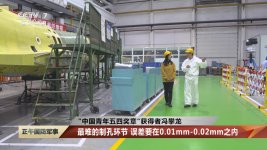
J-10C production line.
The production line is not too intelligent, probably due to the low demand for orders. It belongs to the more advanced traditional production line and has not reached the level of intelligent production line.
This kind of production line, in theory, can be exported to PAC as a whole. the rest is price negotiation.
View attachment 118065View attachment 118066View attachment 118067View attachment 118068View attachment 118069
But is it logically & economically feasible for Pakistan to manufacture those J-10Cs locally? Can the additional number it will acquire justify it?
 
J-10C production line.
The production line is not too intelligent, probably due to the low demand for orders. It belongs to the more advanced traditional production line and has not reached the level of intelligent production line.
This kind of production line, in theory, can be exported to PAC as a whole. the rest is price negotiation.
View attachment 118065View attachment 118066View attachment 118067View attachment 118068View attachment 118069
Price for line should be free and you can retain bigger margin profit rights for international customers, it is win win. You would boost PAF and make money and seal additionally already close relations.
 
But is it logically & economically feasible for Pakistan to manufacture those J-10Cs locally? Can the additional number it will acquire justify it?
I just analyzed the possibility of exporting this production line based on the J-10C production line situation. It is not limited to Pakistan, but also includes other possible prospects.

I will not make a judgment on whether Pakistan will introduce the J-10CE production line. This is a question that needs to be considered for PAF and PAC.
Objectively speaking, my personal suggestion is that PAC abandons JF-17 and introduces J-10CE production line, which is a good plan. If JF-17 and J-10CE are produced at the same time, the PAC may be difficult to support.
But I have no right to decide.

Price for line should be free
I've reiterated it many times.
"Free things are the most expensive things."
You don't seem to understand the truth and logic here. You can try to learn more. Then, you will never ask such questions or requests again
 
I just analyzed the possibility of exporting this production line based on the J-10C production line situation. It is not limited to Pakistan, but also includes other possible prospects.

I will not make a judgment on whether Pakistan will introduce the J-10CE production line. This is a question that needs to be considered for PAF and PAC.
Objectively speaking, my personal suggestion is that PAC abandons JF-17 and introduces J-10CE production line, which is a good plan. If JF-17 and J-10CE are produced at the same time, the PAC may be difficult to support.
But I have no right to decide.

Its suitable for Pakistan as well, to stop Jf17 block 3 production and start J10CEs, we already have 150 Jf17s, if we can produce 80 J10CEs, with 75 F16s. The total fighter will be 325 4th 4.5++ fighter jets. Paf will then be ready for 5th generation J35s. Not sure why Pakistan is trying to make PFX fighter jet which is 4.5+++++ jet, it better to stay with J10CE and J35.
 

Users who are viewing this thread

Pakistan Defence Latest

Latest Posts

Back
Top