Brother,
This is a very complicated subject. One that requires it's on thread if we ignore the grand objective of intercepting missiles and just talk about drones.
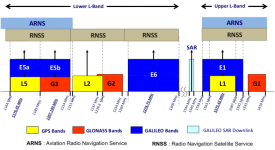
Drones operate on the following bandwidth:
Broadly speaking there are two standards globally adopted which facilitate commination between a ground station and a drone. For commerically manufactured drones there are two international standards that apply to drone Rx/Tx modules namely 802.11 on 2.4Ghz and 5Ghz band - 2.4 Ghz supports b/g/n whereas 5 Ghz supports 802.11 a/n/ac and use GPS L1
View attachment 121849
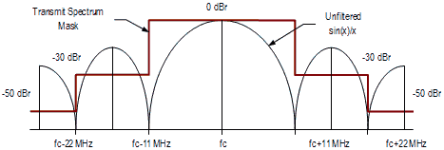
802.11ac as used in DJI drones operates between 5180 and 5825 Mhz - with 802.11ax over Wi-Fi 6 boith 2.4 and 5 Gz can extend the band range from 5.925 to 7.125 Ghz which offers 1200 Mhz spectrum of bandwidth for greater channel capacity as 802.11 b/g/n is limited to 12 channels with 13/14 reserved for some limited devices operating at 2.488Mhz
View attachment 121848
These devices are classed in the armature category because whilst Wi-Fi offers great channel capacity 1200 Mhz of spectrum capacity it is limited by range and reliance on (LOS= Line of Sight) normally with a max range of 5Km with a max range of 12 Km.
Within the armature drone market - Some drones offer fall-back on WiMax, 4G and LTE to overcome these issues and extended the communication range beyond LOS.
Professional drones or augmented drones will operate on frequencies between 433MHz and 915MHz with
military drones operate on 1050MHz to 1250MHz spectrum with some working up to 5800 Mhz spectrum.
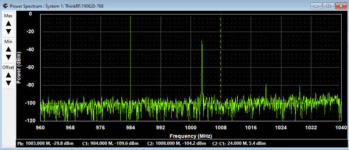
Drone Detection: this can be a combination of Radar, RF analysis:
View attachment 121853
An example of RF analysis to detect drone signatures
There are many ways drones can be countered these include:
- Jammers [Soft Kill]
- Cyber-Takeover [Soft Kill]
- Kinetic [Hard Kill]
- High-Energy [Hard Kill - Lasers and High Powered Microwave Devices]
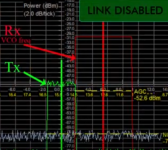
The concepts for the most part are relatively the same, the aim is to inject noise reducing the SNR(Signal to Noise Ration) introducing errors which reduce channel capacity and eventually disable the link between the drone and the ground station:
View attachment 121851
Examples of RF Jamming methodologies include the following:
Noise/Barrage Jamming: Discussed above - wideband noise reduces the Signal-to-Noise Ratio (SNR), increasing error rates and decreasing channel capacity.
Sweep Jamming: A narrowband signal sweeps across frequencies, simulating the effects of barrage jamming at high sweep rates.
Tone Jamming: Discrete tones target specific frequencies, effective against FHSS signals.
Follower Jamming: Tracks frequency changes in FHSS(Frequency-hopping spread spectrum) systems to jam newly selected frequencies.
Smart Jamming: Selectively targets critical signals in DSSS and FHSS systems.
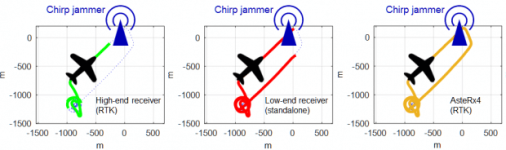
Note: The enemy can augment RF operated drones by inducing self-interference to avoid external interference from a Chirp Jammer or Multiband Jammer as can be seen in this example below.
View attachment 121855
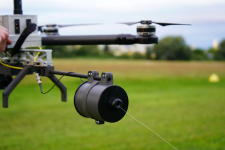
Note: The enemy can counter RF interference by adopting fibre optic route to create resilient drones - this process involves removing the RF module and using a spool of fibre optic cable connecting the drone physically to the ground station:
View attachment 121854
An example of a fibre optic drone used in Ukraine.
Cyber-Takeover
Cyber-takeover is a way of mitigating a drone by taking over the drone remotely, by impersonating the control station. It is done by hacking into the drone, essentially tricking the drone to switch from the legitimate controller. Cyber-takeover lets the mitigator direct the flight of the drone and access the drone's data and camera.
This is an elegant way to mitigate a drone when it works. Unfortunately the success rate of cyber takeover is low for two reasons, the mitigating controller must be able to predict frequency hopping of drone and must always maintain a more powerful a signal to the drone than the original remote. Additionally, cyber-takeover does not work on a drone swarm.
Kinetic Mitigation Options
There are many forms of kinetic mitigation options. Kinetic solutions are essentially all options that physically effect the drone from reaching its intended target. These can include everything from missiles, to kamikaze drones, to drones that shoot nets and even specially trained birds of prey.
Kinetic mitigation solutions, although mentally satisfying suffer from lower success rates and do not work on drone swarms.
High Energy Mitigation Options
- Lasers: Lasers are a type of high-energy mitigation and can be used to destroy malicious drones. Lasers are cost efficient as a means of mitigation and effective over long distances. They can also affect drones that are hardened against jamming, including drones that operate without radio signal direction, or are autonomously programmed. They can be mounted on vehicles or aircraft and do not require a lot of setup time. They also have little effect on human beings or other objects, making them safe to use in populated areas. Drawbacks include being affected by adverse weather and other line of site factors.
- High Power Microwave (HPM) Devices: High-power microwave devices use high power electromagnetic energy to stop drones. The counter-UAS system emits an intense microwave beam that is so powerful it can destroy a small drone within seconds. The counter-UAS system uses high power microwaves to disable or destroy nearby drones. The device emits an intense beam of energy which can quickly destroy un crewed aircraft. It can mitigate either individual drones or even swarms of autonomous drones because the wide beam that destroys the drone's hardware over a wide area. HPM devices are a high cost/high impact technology and are traditionally more available to the military.
To conclude: A successful counter UAS shield MUST include multi-sensor fusion, C2, rapidly mobile deployable and static systems to include a full suite of Radar/RF signal detection, Multiband Jamming, Cyber, Kinetic and High Energy options on the battle field.