Pakistan-India Conflict 2025: News Updates and Discussion

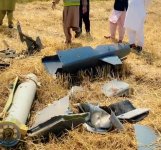
Showing pieces of a missile or a weapon is no proof of anything.

That could be remnant of that weapon after it was intercepted or it’s fragments after it struck a target. There is also a possibility of failure of a weapon due to many reasons and falling short or going astray.

This applies to both the sides.

Secondly, neither side is likely to accept the exact nature of damage caused by the adversary. Why would India accept that Paksiatn caused any damage to anything important. Same goes for Paksiatn also, giving any credit to India in that regard.

The onus of proving success of attacks lies with the attacker. Proving to the world what one achieved is very important in narrative buildup and showing one’s capability to the masses and own population. Showing them that money spent on them was worthwhile.

This is of least importance to the defence forces themselves as they know very clearly, what they lost and gained.
I cant even remember last time I used so many words, without actually meaning anything (let alone using them factually in the first place!)

I dont even use that many words, explaining mean reversion or auto-correlation!

it seems mixing lies and truth, is your only instinct!
 
Showing pieces of a missile or a weapon is no proof of anything.

That could be remnant of that weapon after it was intercepted or it’s fragments after it struck a target. There is also a possibility of failure of a weapon due to many reasons and falling short or going astray.

This applies to both the sides.

Secondly, neither side is likely to accept the exact nature of damage caused by the adversary. Why would India accept that Paksiatn caused any damage to anything important. Same goes for Paksiatn also, giving any credit to India in that regard.

The onus of proving success of attacks lies with the attacker. Proving to the world what one achieved is very important in narrative buildup and showing one’s capability to the masses and own population. Showing them that money spent on them was worthwhile.

This is of least importance to the defence forces themselves as they know very clearly, what they lost and gained.
A quick question to you:

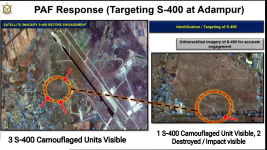
Pak showed satellite images where they found S400 Cheese board radar, why your airforce, has not shown those 'exact satellite images'?


seems, i will wait eternity for your reply!
 
Showing pieces of a missile or a weapon is no proof of anything.

That could be remnant of that weapon after it was intercepted or it’s fragments after it struck a target. There is also a possibility of failure of a weapon due to many reasons and falling short or going astray.

This applies to both the sides.

Secondly, neither side is likely to accept the exact nature of damage caused by the adversary. Why would India accept that Paksiatn caused any damage to anything important. Same goes for Paksiatn also, giving any credit to India in that regard.

The onus of proving success of attacks lies with the attacker. Proving to the world what one achieved is very important in narrative buildup and showing one’s capability to the masses and own population. Showing them that money spent on them was worthwhile.

This is of least importance to the defence forces themselves as they know very clearly, what they lost and gained.
Caged animal cannot tell the difference between glass and real world!
 
Showing pieces of a missile or a weapon is no proof of anything.

That could be remnant of that weapon after it was intercepted or it’s fragments after it struck a target. There is also a possibility of failure of a weapon due to many reasons and falling short or going astray.

This applies to both the sides.

Secondly, neither side is likely to accept the exact nature of damage caused by the adversary. Why would India accept that Paksiatn caused any damage to anything important. Same goes for Paksiatn also, giving any credit to India in that regard.

The onus of proving success of attacks lies with the attacker. Proving to the world what one achieved is very important in narrative buildup and showing one’s capability to the masses and own population. Showing them that money spent on them was worthwhile.

This is of least importance to the defence forces themselves as they know very clearly, what they lost and gained.

So you think this SCALP wasn't intercepted?

20250511_204628.jpg

Anyways you guys are yet to learn the difference between the terms destroyed and damaged. Learn that first and then share us proofs that your air defenses managed to intercept Pakistani rockets and missiles. We are yet to see any proof
 
Showing pieces of a missile or a weapon is no proof of anything.

That could be remnant of that weapon after it was intercepted or it’s fragments after it struck a target. There is also a possibility of failure of a weapon due to many reasons and falling short or going astray.

This applies to both the sides.

Secondly, neither side is likely to accept the exact nature of damage caused by the adversary. Why would India accept that Paksiatn caused any damage to anything important. Same goes for Paksiatn also, giving any credit to India in that regard.

The onus of proving success of attacks lies with the attacker. Proving to the world what one achieved is very important in narrative buildup and showing one’s capability to the masses and own population. Showing them that money spent on them was worthwhile.

This is of least importance to the defence forces themselves as they know very clearly, what they lost and gained.

There is literally no point to this post
 
I am not privy to when the S400 went down.

But my thought was S400 was taken out on 10-May. On the night of 7-May, 6 IAF jets went down and after that they remained behind 200km of the IB due to the PL15s.

Could be wrong here.
This does appear to be the case.
 
I am not privy to when the S400 went down.

But my thought was S400 was taken out on 10-May. On the night of 7-May, 6 IAF jets went down and after that they remained behind 200km of the IB due to the PL15s.

Could be wrong here.

People wondered where was S400? Likely it was taken out before 5-6 Indian aircrafts crashed to death as per many Pakistani insiders OSINT.
 
So you think this SCALP wasn't intercepted?

View attachment 124395

Anyways you guys are yet to learn the difference between the terms destroyed and damaged. Learn that first and then share us proofs that your air defenses managed to intercept Pakistani rockets and missiles. We are yet to see any proof
You can take a picture with their captured pilot, totally destructed plane and there will be Indians who would say "but where is the proof?". Don't you remember that Abhinondan was getting bihh slapped right, left and center and IAF was saying all pilots & aircrafts are accounted for. haha
 
Showing pieces of a missile or a weapon is no proof of anything.

That could be remnant of that weapon after it was intercepted or it’s fragments after it struck a target. There is also a possibility of failure of a weapon due to many reasons and falling short or going astray.

This applies to both the sides.

Secondly, neither side is likely to accept the exact nature of damage caused by the adversary. Why would India accept that Paksiatn caused any damage to anything important. Same goes for Paksiatn also, giving any credit to India in that regard.

The onus of proving success of attacks lies with the attacker. Proving to the world what one achieved is very important in narrative buildup and showing one’s capability to the masses and own population. Showing them that money spent on them was worthwhile.

This is of least importance to the defence forces themselves as they know very clearly, what they lost and gained.

It seems that my comment has broken the hearts of many who were surviving on scraps. I didn’t name any country or take any sides but I don’t know why some people are cheesed off.

Take Hazy videos from social media, edit them a little, add some masala and make big claims. That seems to be the bread and butter for many.

Here is a fairly well written account of this conflict. The author hasn’t taken any sides and analysed all the facts. And he has been critical of Indian effort too, so he is not taking any sides.


Executive Summary

Following a terrorist attack on April 22, India launched punitive strikes on Pakistan on May 7. This began a four-day conflict between India and Pakistan from May 7-10, which became the most serious military crisis in decades between the two rival nuclear states. Both sides have declared victory amid considerable misinformation and disinformation about what occurred. This essay seeks to offer a factually grounded narrative of the evolution of the crisis, while mindful of severe data limitation problems in the public domain that complicate analysis. Even with the limited or contested information currently available, some tentative conclusions are possible.

The conflict represents several military firsts:

This was the first time India used cruise missiles on Pakistan, both the BrahMos cruise missile (co-developed with Russia) as well as the European SCALP-EG.
This was the first time Pakistan used conventionally armed short-range ballistic missiles on India, in the form of the Fatah-I and Fatah-II missiles and possibly other missile types.
While drones have been used sporadically along the Line of Control in Kashmir and elsewhere for smuggling, this is the first instance of drone warfare in the India-Pakistan rivalry where both sides employed drones with the intent of causing damage on the other.
Available information also permits several conclusions about the military situation during the crisis:

India demonstrated an ability to deliver precise standoff attacks across large swathes of Pakistan on each day of the conflict but especially May 7 and May 10. While Pakistani air defenses likely interfered with or intercepted some attempted strikes, Pakistan has a meaningful and serious vulnerability to Indian air attack.
There is no evidence of any manned aircraft crossing into the airspace of the other side, which indicates the seriousness with which both sides viewed the air defense threat of the other even on the final day of the conflict.
On the first day of hostilities, May 7, India likely lost several aircraft to Pakistani counterair operations. While Indian officials neither acknowledged nor denied the losses, they represent perhaps the most meaningful military costs India experienced during the Four-Day Conflict.
On May 8 through May 10, India’s integrated air and missile defense system appears to have largely defeated several waves of Pakistani drone attacks of ambiguous scope, scale, and intensity. On May 9-10, the Indian air and missile defense system appears to have worked against limited Pakistani short-range ballistic missile attacks as well.
After its apparent downing of Indian aircraft on May 7, Pakistan inflicted virtually no observable damage on Indian military units or facilities, though Indian officials have said there was some damage at four installations.
While attention focused primarily on the air and drone campaigns, most of the May 7 strikes occurred in or near Kashmir; subsequent fighting along the Line of Control in Kashmir was deadly and served as a major source of casualties for both sides.
Political conclusions are also possible:

The India-Pakistan relationship remains crisis-prone, and those crises are likely to continue to escalate in severity over time.
While the mutual possession of nuclear weapons heavily conditioned the responses of both sides, overt nuclear signaling was lower than in many prior India-Pakistan crises.
Both sides worked to calibrate escalation and showed some ability to manage escalation adequately. Both sides were sometimes surprised, however, by choices made by the other and, in some instances, likely viewed an adversary’s response as escalatory rather than proportional.
The crisis was costly in terms of human lives and expended or destroyed military equipment. Those costs will likely work to induce some caution in the bilateral relationship in the near-term, a probable principal aim of Indian policy.
The United States played a major role in crisis management, especially in the final hours of the crisis. While it is conceivable another actor could have played this role as crisis communicator of choice for both combatants, and some alternative third parties did play a role in crisis diplomacy, none of those alternative actors appear to have participated with the same efficacy as the United States.
This crisis involved the use of several weapons systems, often in innovative ways, which neither India nor Pakistan possessed at the time of their last crisis in 2019. While this crisis provides a baseline for the next India-Pakistan crisis, the pace of military technological change means that the contours of that next crisis might be meaningfully different. Both sides’ perceived setbacks and failures will serve as a major driver for defense acquisitions and doctrinal innovation.
 
To view this content we will need your consent to set third party cookies.
For more detailed information, see our cookies page.
 
Showing pieces of a missile or a weapon is no proof of anything.

That could be remnant of that weapon after it was intercepted or it’s fragments after it struck a target. There is also a possibility of failure of a weapon due to many reasons and falling short or going astray.

This applies to both the sides.

Secondly, neither side is likely to accept the exact nature of damage caused by the adversary. Why would India accept that Paksiatn caused any damage to anything important. Same goes for Paksiatn also, giving any credit to India in that regard.

The onus of proving success of attacks lies with the attacker. Proving to the world what one achieved is very important in narrative buildup and showing one’s capability to the masses and own population. Showing them that money spent on them was worthwhile.

This is of least importance to the defence forces themselves as they know very clearly, what they lost and gained.

How does it feel waking up every morning having to write nonsense; talking in terms of PARITY ("both sides", "neither side", "same goes for", "they know") against an enemy that is 7x smaller than you?

Take a step back, look at yourself in the mirror, gaze into your eyes and slowly let the realisation overcome you. You'll be one step closer to moksha.
 
Y
Showing pieces of a missile or a weapon is no proof of anything.

That could be remnant of that weapon after it was intercepted or it’s fragments after it struck a target. There is also a possibility of failure of a weapon due to many reasons and falling short or going astray.

This applies to both the sides.

Secondly, neither side is likely to accept the exact nature of damage caused by the adversary. Why would India accept that Paksiatn caused any damage to anything important. Same goes for Paksiatn also, giving any credit to India in that regard.

The onus of proving success of attacks lies with the attacker. Proving to the world what one achieved is very important in narrative buildup and showing one’s capability to the masses and own population. Showing them that money spent on them was worthwhile.

This is of least importance to the defence forces themselves as they know very clearly, what they lost and gained.
Yes at least we can say all those pieces of PL-15 wreckage India proudly (??) showing (like they did AIM-120C in 2019) are those successfully "intercepted" by different top of the line IAF jets.
IAF jets intercepted those PL-15s by successfully putting their bodies against them. 😊
 

Users who are viewing this thread

Pakistan Defence Latest

Back
Top