
Navigation
Install the app
How to install the app on iOS
Follow along with the video below to see how to install our site as a web app on your home screen.
Note: This feature may not be available in some browsers.
More options
Style variation
You are using an out of date browser. It may not display this or other websites correctly.
You should upgrade or use an alternative browser.
You should upgrade or use an alternative browser.
Chinese Trainer JL-9, L-15, JL-10, CJ-7 News & Discussions
- Thread starter SiliconBit (silicon0000)
- Start date
More options
Who Replied?

Fatman17
Moderator
EYE ON THE EAST: CHINA JOINS THE ‘LIFT’ LEAGUE
- Aviation Features
- EYE ON THE EAST: CHINA JOINS THE ‘LIFT’ LEAGUE
By Andreas Rupprecht 1st November 2018
FEATURE
For many years, two Chinese companies — Guizhou and Hongdu — have been the major suppliers of trainers to the China’s air force and naval aviation. Now both are offering very different solutions on the international trainer market.

The L-15C demonstrator maneuvers during an airshow demonstration. The ‘Charlie’ model is so far the most advanced L-15 and incorporates the avionics of the L-15B avionics with the airframe of the L-15A. All photos via Chinese internet unless stated
AIR WARFARE BRIEFING S FROM THE ASIA-PAC IFIC
THE PRODUCTS OFFERED by Guizhou and Hongdu range from primary trainers up to the latest fourth-generation trainers. First in line is the veteran CJ-6 primary trainer, a design based on the original Nanchang CJ-5, itself a license-built Yak-18. Development began as long ago as late 1957, and as of 2018 the type is still in production for an unspecified customer. The next ‘standard’ trainer for the People’s Liberation Army (PLA) is the JL-8, also known as the K-8 Karakorum.
This lightweight primary jet trainer was launched in 1986 as a joint project between the Hongdu Aviation Industrial Group and the Pakistan Aeronautical Complex (PAC). The type is now China’s most widely exported jet trainer and has found particular popularity among Third World customers. The latest FTC-2000G is aimed squarely at this market segment as well. It performed its maiden flight on September 28 this year.
JL-9 and FTC-2000
The FTC-2000G is not a ‘new’ aircraft as such, but the latest in a long-established family that started life as the Guizhou JL-9 Mountain Eagle. In fact, it’s probably the final member of the venerable MiG-21/J-7 line.
Development of the JL-9 began in 2001 as an advanced lead-in fighter trainer (LIFT) based on the earlier JJ-7/ FT-7 design. Consequently, it was originally known as the JJ-7B and later the JJ-9.
In contrast to its predecessors, the JL-9 features a new forward fuselage, replacing the circular intake with a solid nose accommodating an X-band pulse-Doppler fire-control radar with a range of 19 miles (30km), and engine intakes relocated to the fuselage sides.
The stepped tandem cockpit section is redesigned, with a single-piece windshield providing improved forward and downward vision in comparison to the original JJ-7. In fact, it looks very much like a training variant of the abortive Super 7, a joint Sino-US project led by the Aviation Industry Corporation of China (AVIC) and Grumman, which was planned as a modernization of the aging J-7 in the late 1980s. This project was cancelled after the events at Tiananmen Square in 1989. The aircraft features a double-delta wing without leading-edge flaps, while the modern avionics and cockpit include a headup display (HUD) plus a multi-function display (MFD).
However, in order to reduce costs and development time, the JL-9 retains the old WP-13F(C) engine that produces a maximum thrust of 9,700lb (4,400kg) or 14,220lb (6,450kg) with afterburning. Its flight control system is mechanical rather than fly-by-wire (FBW), limiting its performance compared with the rival JL-10. The latter is technologically more advanced but is more expensive and suffered developmental delays.

One of the FTC-2000S variants ordered by the Sudanese Air Force. All six were in service by the time the Sudanese Ministry of Defense announced their arrival in the country on May 16 this year.
The first prototype JL-9 made its maiden flight on December 13, 2003 and test aircraft were evaluated between 2004 and 2005. Following a redesign, the initial revised JL-9 flew for the first time on August 23, 2006, featuring a new control augmentation system (CAS) for enhanced stability and an improved cockpit environment control system. Serial JL-9s were delivered to the People’s Liberation Army Air Force (PLAAF) in 2007 for further trials and operational deliveries began in 2011 — PLA Naval Aviation received its initial JL-9H soon afterwards.
A slightly improved variant, possibly known as the JL-9A, features new formation lighting strips on the forward fuselage and tail fin for night training missions and a new VHF omni-directional radio range (VLOC) navigation system. This model entered production in 2014 and is still being built.
Another development of the JL-9 is the JL-9G, planned as a dedicated trainer to allow naval aviation pilots to practise take-offs and landings on a dummy aircraft carrier deck. The JL-9G has extensive modifications including strengthened landing gear and enlarged wings, and a further retrofired forward fuselage with a diverterless supersonic intake (DSI). Furthermore, the twin ventral stabilizers are replaced by a taller tail fin. A maiden flight occurred in 2009 but due to structural problems the tail hook had to be removed. Now unsuitable for arrested landings, the JL-9G is only used for simulated take-offs from the ‘ski jump’ ramp, followed by a conventional recovery. This version entered service in 2013 and around a dozen are operational.
It was the JL-9 that formed the basis of the FTC-2000 trainer, first unveiled as a demonstrator at the 2016 Zhuhai airshow when a contract was signed with the Sudanese Air Force for six FTC-2000S versions. The first aircraft rolled off the assembly line in June 2017 and the initial batch was delivered the following November. In the meantime, the Nigerian Air Force has also expressed interest, probably eyeing the latest, further improved FTC-2000G.

The FTC-2000 demonstrator performs at Zhuhai in 2016, when this exportoptimized variant made its public debut.

A line-up of JL-9H trainers in service with PLA Naval Aviation’s 2nd Training Regiment at Qinhuangdao/ Shanhaiguan.
In contrast to the FTC-2000S for Sudan — which is essentially a variant of the standard JL-9 — the FTC-2000G employs the stronger airframe of the navalized JL-9G with the DSI intake and reprofiled tail. It also has improved aerodynamics and increased fuel capacity. According to AVIC, the FTC-2000G is aimed as an affordable, versatile aircraft for different types of training as well as combat missions. It features up to seven hardpoints for a maximum armament load of 6,614lb (3,000kg). Several observers have earmarked the FTC-2000G as a potential successor to many of the older MiG-21 and F-7 fighters in south-east Asia and Africa, and as a competitor to the JF-17 Thunder.
A new generation
Perhaps the most eagerly awaited trainer to enter PLAAF and PLA Naval Aviation service is the Hongdu JL-10 Falcon. This type — which began life with the export designation L-15 — is an advanced jet trainer (AJT) developed with technical assistance from Yakovlev OKB. The JL-10 was designed to school pilots for a new generation of Chinese fighters including the J-10, J-11, J-15, J-16 and J-20.
From the outset it was planned to develop two different versions: the standard JL-10/L-15A AJT, powered by two Ukrainian AI-222-25 turbofans, and a dedicated L-15B LIFT, powered by two AI-222-25Fs with afterburning to provide supersonic capability.
As a new design based on the Yak-130, the JL-10 makes use of a more modern airframe — especially in comparison with the rival JL-9 — with prominent leading-edge root extensions (LERXes), a large vertical tail fin and a modern aerodynamic configuration which is expected to allow maneuvers at angles of attack of up to 30 per cent. The cockpit is much more advanced than that of the JL-9 — it’s a fully digital glass environment with HUD, three color MFDs, hands on throttle and stick (HOTAS) controls and three-axis quadruplex digital FBW. For weapons training, the JL-10 has four underwing and two wingtip pylons for a wide variety of stores plus an optional gun pod underneath the fuselage. The standard JL-10 is equipped with a small radar, while the L-15B can even carry a small passive electronically scanned array (PESA) fire-control radar.

Fatman17
Moderator
These JL-10Hs are the first of the type to enter service with the Naval Aviation School. The new trainers were formally inducted at Suizhong air base on August 3 this year.

JL-9 ‘4181’ serves with the PLAAF’s Aviation University/Flight Instructor Training Base, 4th Training Regiment.

This JL-10A is equipped with a PESA radar to serve as an L-15B demonstrator.
The first prototype L-15 AJT was completed in September 2005 and its first flight was completed — after delays due to engine problems — on March 13, 2006. The first example was powered by two interim DV-2 turbofans and was followed by an improved AJT prototype using two AI-222-25 turbofans that took to the air on May 10, 2008.
However, development of the LIFT version still suffered from the slow progress of the afterburning AI-222K-25F. It finally flew for the first time on October 26, 2010. The machine differs from the JL-10 on account of a stretched forward section and longer rear section, and is powered by two AI-222K-25F turbofans with prominent afterburner nozzles.
A first ‘true’ domestic AJT version, designated as the JL-10, was finally unveiled before its first flight on July 1, 2013. Since then, several prototypes have been noted undergoing testing and, based on images from mid-2016, it was assumed that the type was in series production for both services, an assumption confirmed in early 2017. Naval aviation received its first aircraft — dubbed the JL-10H — in March 2017.
In future it seems as if the L-15 will be fitted with domestically produced engines. The standard JL-10 is planned to receive an indigenous turbofan without afterburning (actually an AI-222-25 copy), which was flown for the first time in May 2016.
The L-15B is thought to use the WS-17 Minshan turbofan with a maximum thrust of 10,362lb (4,700kg) with afterburning, developed by the Guizhou Aero Engine Research Institute. The same engine is rumored to have been tested on an L-15 prototype.
Since September 2013 there have been suggestions that the JL-10 might be adopted by naval aviation as a carrierbased trainer, possibly based on the L-15B airframe with the more powerful engines. This remains unconfirmed.
At least three different variants are currently available for export: the standard L-15A, comparable to the JL-10 and the L-15Z already in service with the Zambian Air Force; the L-15B, based on the LIFT version and available with combat-capable avionics; and finally the L-15C, which combines the L-15B’s avionics with the airframe of the L-15A. The Chinese training aircraft family is steadily expanding into new markets and will perhaps pave the way for more extensive global fighter sales in future

The L-15B completes its maiden flight. This aircraft is thought to be powered by indigenous WS-17 Minshan afterburning turbofans.

The L-15Z in service with the Zambian Air Force is an export variant of the standard L-15A.

The JL-9H entered PLANAF service soon after deliveries to the PLAAF began in 2011.
JL-9 ‘4181’ serves with the PLAAF’s Aviation University/Flight Instructor Training Base, 4th Training Regiment.
This JL-10A is equipped with a PESA radar to serve as an L-15B demonstrator.
The first prototype L-15 AJT was completed in September 2005 and its first flight was completed — after delays due to engine problems — on March 13, 2006. The first example was powered by two interim DV-2 turbofans and was followed by an improved AJT prototype using two AI-222-25 turbofans that took to the air on May 10, 2008.
However, development of the LIFT version still suffered from the slow progress of the afterburning AI-222K-25F. It finally flew for the first time on October 26, 2010. The machine differs from the JL-10 on account of a stretched forward section and longer rear section, and is powered by two AI-222K-25F turbofans with prominent afterburner nozzles.
A first ‘true’ domestic AJT version, designated as the JL-10, was finally unveiled before its first flight on July 1, 2013. Since then, several prototypes have been noted undergoing testing and, based on images from mid-2016, it was assumed that the type was in series production for both services, an assumption confirmed in early 2017. Naval aviation received its first aircraft — dubbed the JL-10H — in March 2017.
In future it seems as if the L-15 will be fitted with domestically produced engines. The standard JL-10 is planned to receive an indigenous turbofan without afterburning (actually an AI-222-25 copy), which was flown for the first time in May 2016.
The L-15B is thought to use the WS-17 Minshan turbofan with a maximum thrust of 10,362lb (4,700kg) with afterburning, developed by the Guizhou Aero Engine Research Institute. The same engine is rumored to have been tested on an L-15 prototype.
Since September 2013 there have been suggestions that the JL-10 might be adopted by naval aviation as a carrierbased trainer, possibly based on the L-15B airframe with the more powerful engines. This remains unconfirmed.
At least three different variants are currently available for export: the standard L-15A, comparable to the JL-10 and the L-15Z already in service with the Zambian Air Force; the L-15B, based on the LIFT version and available with combat-capable avionics; and finally the L-15C, which combines the L-15B’s avionics with the airframe of the L-15A. The Chinese training aircraft family is steadily expanding into new markets and will perhaps pave the way for more extensive global fighter sales in future
The L-15B completes its maiden flight. This aircraft is thought to be powered by indigenous WS-17 Minshan afterburning turbofans.
The L-15Z in service with the Zambian Air Force is an export variant of the standard L-15A.
The JL-9H entered PLANAF service soon after deliveries to the PLAAF began in 2011.
Originally published in Combat Aircraft Journal


EYE ON THE EAST: CHINA JOINS THE ‘LIFT’ LEAGUE
- Aviation Features
- EYE ON THE EAST: CHINA JOINS THE ‘LIFT’ LEAGUE
By Andreas Rupprecht 1st November 2018
FEATURE
For many years, two Chinese companies — Guizhou and Hongdu — have been the major suppliers of trainers to the China’s air force and naval aviation. Now both are offering very different solutions on the international trainer market.
The L-15C demonstrator maneuvers during an airshow demonstration. The ‘Charlie’ model is so far the most advanced L-15 and incorporates the avionics of the L-15B avionics with the airframe of the L-15A. All photos via Chinese internet unless stated
AIR WARFARE BRIEFING S FROM THE ASIA-PAC IFIC
THE PRODUCTS OFFERED by Guizhou and Hongdu range from primary trainers up to the latest fourth-generation trainers. First in line is the veteran CJ-6 primary trainer, a design based on the original Nanchang CJ-5, itself a license-built Yak-18. Development began as long ago as late 1957, and as of 2018 the type is still in production for an unspecified customer. The next ‘standard’ trainer for the People’s Liberation Army (PLA) is the JL-8, also known as the K-8 Karakorum.
This lightweight primary jet trainer was launched in 1986 as a joint project between the Hongdu Aviation Industrial Group and the Pakistan Aeronautical Complex (PAC). The type is now China’s most widely exported jet trainer and has found particular popularity among Third World customers. The latest FTC-2000G is aimed squarely at this market segment as well. It performed its maiden flight on September 28 this year.
JL-9 and FTC-2000
The FTC-2000G is not a ‘new’ aircraft as such, but the latest in a long-established family that started life as the Guizhou JL-9 Mountain Eagle. In fact, it’s probably the final member of the venerable MiG-21/J-7 line.
Development of the JL-9 began in 2001 as an advanced lead-in fighter trainer (LIFT) based on the earlier JJ-7/ FT-7 design. Consequently, it was originally known as the JJ-7B and later the JJ-9.
In contrast to its predecessors, the JL-9 features a new forward fuselage, replacing the circular intake with a solid nose accommodating an X-band pulse-Doppler fire-control radar with a range of 19 miles (30km), and engine intakes relocated to the fuselage sides.
The stepped tandem cockpit section is redesigned, with a single-piece windshield providing improved forward and downward vision in comparison to the original JJ-7. In fact, it looks very much like a training variant of the abortive Super 7, a joint Sino-US project led by the Aviation Industry Corporation of China (AVIC) and Grumman, which was planned as a modernization of the aging J-7 in the late 1980s. This project was cancelled after the events at Tiananmen Square in 1989. The aircraft features a double-delta wing without leading-edge flaps, while the modern avionics and cockpit include a headup display (HUD) plus a multi-function display (MFD).
However, in order to reduce costs and development time, the JL-9 retains the old WP-13F(C) engine that produces a maximum thrust of 9,700lb (4,400kg) or 14,220lb (6,450kg) with afterburning. Its flight control system is mechanical rather than fly-by-wire (FBW), limiting its performance compared with the rival JL-10. The latter is technologically more advanced but is more expensive and suffered developmental delays.
One of the FTC-2000S variants ordered by the Sudanese Air Force. All six were in service by the time the Sudanese Ministry of Defense announced their arrival in the country on May 16 this year.
The first prototype JL-9 made its maiden flight on December 13, 2003 and test aircraft were evaluated between 2004 and 2005. Following a redesign, the initial revised JL-9 flew for the first time on August 23, 2006, featuring a new control augmentation system (CAS) for enhanced stability and an improved cockpit environment control system. Serial JL-9s were delivered to the People’s Liberation Army Air Force (PLAAF) in 2007 for further trials and operational deliveries began in 2011 — PLA Naval Aviation received its initial JL-9H soon afterwards.
A slightly improved variant, possibly known as the JL-9A, features new formation lighting strips on the forward fuselage and tail fin for night training missions and a new VHF omni-directional radio range (VLOC) navigation system. This model entered production in 2014 and is still being built.
Another development of the JL-9 is the JL-9G, planned as a dedicated trainer to allow naval aviation pilots to practise take-offs and landings on a dummy aircraft carrier deck. The JL-9G has extensive modifications including strengthened landing gear and enlarged wings, and a further retrofired forward fuselage with a diverterless supersonic intake (DSI). Furthermore, the twin ventral stabilizers are replaced by a taller tail fin. A maiden flight occurred in 2009 but due to structural problems the tail hook had to be removed. Now unsuitable for arrested landings, the JL-9G is only used for simulated take-offs from the ‘ski jump’ ramp, followed by a conventional recovery. This version entered service in 2013 and around a dozen are operational.
It was the JL-9 that formed the basis of the FTC-2000 trainer, first unveiled as a demonstrator at the 2016 Zhuhai airshow when a contract was signed with the Sudanese Air Force for six FTC-2000S versions. The first aircraft rolled off the assembly line in June 2017 and the initial batch was delivered the following November. In the meantime, the Nigerian Air Force has also expressed interest, probably eyeing the latest, further improved FTC-2000G.
The FTC-2000 demonstrator performs at Zhuhai in 2016, when this exportoptimized variant made its public debut.
A line-up of JL-9H trainers in service with PLA Naval Aviation’s 2nd Training Regiment at Qinhuangdao/ Shanhaiguan.
In contrast to the FTC-2000S for Sudan — which is essentially a variant of the standard JL-9 — the FTC-2000G employs the stronger airframe of the navalized JL-9G with the DSI intake and reprofiled tail. It also has improved aerodynamics and increased fuel capacity. According to AVIC, the FTC-2000G is aimed as an affordable, versatile aircraft for different types of training as well as combat missions. It features up to seven hardpoints for a maximum armament load of 6,614lb (3,000kg). Several observers have earmarked the FTC-2000G as a potential successor to many of the older MiG-21 and F-7 fighters in south-east Asia and Africa, and as a competitor to the JF-17 Thunder.
A new generation
Perhaps the most eagerly awaited trainer to enter PLAAF and PLA Naval Aviation service is the Hongdu JL-10 Falcon. This type — which began life with the export designation L-15 — is an advanced jet trainer (AJT) developed with technical assistance from Yakovlev OKB. The JL-10 was designed to school pilots for a new generation of Chinese fighters including the J-10, J-11, J-15, J-16 and J-20.
From the outset it was planned to develop two different versions: the standard JL-10/L-15A AJT, powered by two Ukrainian AI-222-25 turbofans, and a dedicated L-15B LIFT, powered by two AI-222-25Fs with afterburning to provide supersonic capability.
As a new design based on the Yak-130, the JL-10 makes use of a more modern airframe — especially in comparison with the rival JL-9 — with prominent leading-edge root extensions (LERXes), a large vertical tail fin and a modern aerodynamic configuration which is expected to allow maneuvers at angles of attack of up to 30 per cent. The cockpit is much more advanced than that of the JL-9 — it’s a fully digital glass environment with HUD, three color MFDs, hands on throttle and stick (HOTAS) controls and three-axis quadruplex digital FBW. For weapons training, the JL-10 has four underwing and two wingtip pylons for a wide variety of stores plus an optional gun pod underneath the fuselage. The standard JL-10 is equipped with a small radar, while the L-15B can even carry a small passive electronically scanned array (PESA) fire-control radar.
Well ... you dig out such an old report (in fact from me) written in 2018!!!???

Fatman17
Moderator
I had saved it. Hope it's OKWell ... you dig out such an old report (in fact from me) written in 2018!!!???

guangdongt
Registered Member

jl10 Coach aircraft
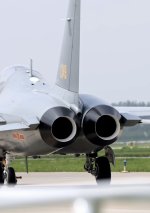
L15 Afterburning turbofan jet engine
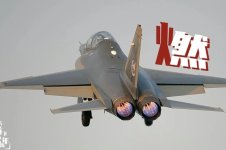
L15 Afterburning turbofan jet engine
Hendarto
Registered Member


China's upgraded JL-9 naval trainer jet featured in official report
By
Liu Xuanzun
Published: Mar 30, 2025 05:43 PM

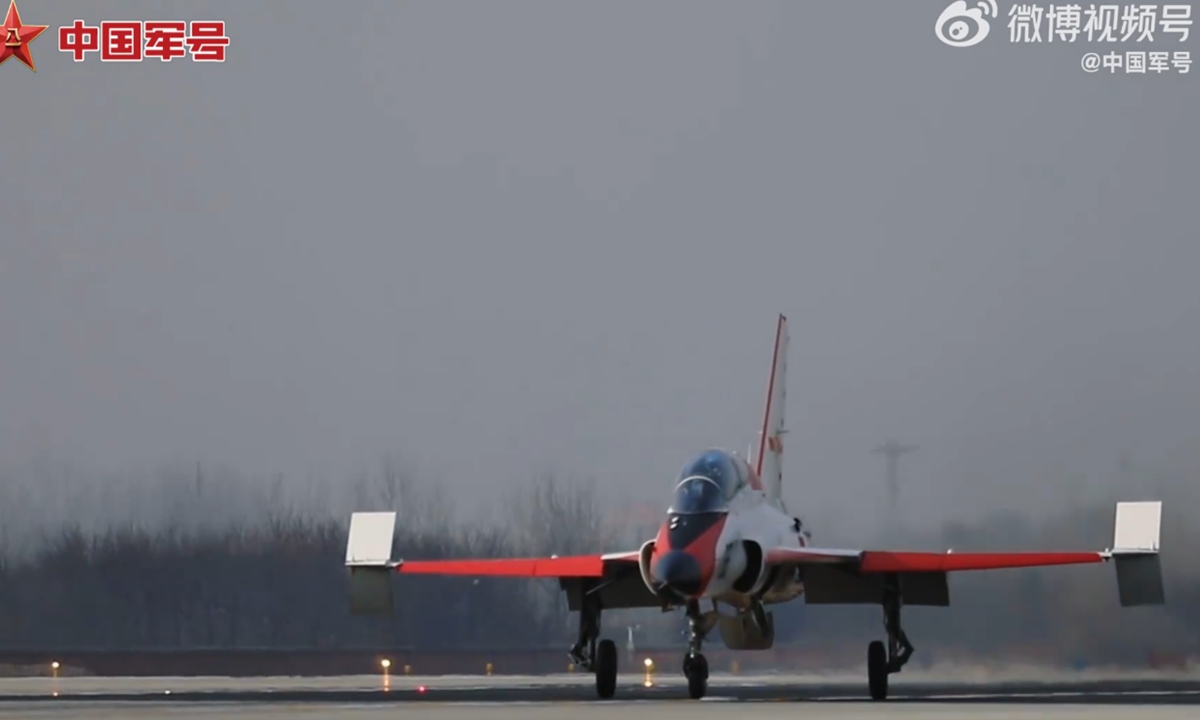
A JL-9 trainer aircraft attached to a regiment affiliated with the Naval Aviation University of the Chinese People's Liberation Army (PLA) lands after a combat exercise in the spring of 2025. Photo: Screenshot from the Sina Weibo account of China Bugle, an official media account affiliated with the PLA news media center
An upgraded version of China's JL-9 naval trainer jet was featured in a recent official report, revealing newly added wingtip split rudders. A Chinese military affairs expert said on Sunday that the technology will enhance carrier pilot training and could be applied to future stealth aircraft.
A regiment affiliated with the Naval Aviation University of the Chinese People's Liberation Army (PLA) recently organized pilots to conduct an aerial maneuvering exercise under combat scenarios, China Bugle, an official media account affiliated with the PLA News Media Center, reported on Saturday evening.
By putting a red team and a blue team against each other in close-range combat training, the exercise tested the pilots' comprehensive combat capabilities in complex battlefield conditions.
The video report showed JL-9 trainer jets in action, with one deploying wingtip split rudders during landing.
Public reports indicate that wingtip split rudders are a new feature to an upgraded version of the JL-9 that made its maiden test flight in May 2020.
Compared to the original JL-9, the upgraded version of the aircraft removed the drogue parachute installation located at the vertical tail, and added wingtip split rudders, aiming to improve stability and low-speed performance, eastday.com, a Shanghai-based news website, reported at the time.
The JL-9 trainer aircraft is used to train pilots for aircraft carrier-based fighter jets, which do not use drogue parachutes, so it is normal for the trainer to remove this design. The new split rudders act as air brakes, helping pilots practice carrier landings more effectively, Song Zhongping, a Chinese military affairs expert, told the Global Times on Sunday.
Using split rudders instead of drogue parachutes can also help lowering the weight of the aircraft, improving overall performance, Song said.
The appearance of the upgraded JL-9 in an official report is an indication that the aircraft has technically matured, Song said.
Beyond the JL-9, Song noted that wingtip air brake and split rudder technologies have potential in future stealth aircraft. To achieve better stealth, next-generation aircraft tend remove vertical wings, so they need to use other types of stabilizers to control the aircraft, and this is when alternative control surfaces like wingtip rudders become relevant.
By
Liu Xuanzun
Published: Mar 30, 2025 05:43 PM
A JL-9 trainer aircraft attached to a regiment affiliated with the Naval Aviation University of the Chinese People's Liberation Army (PLA) lands after a combat exercise in the spring of 2025. Photo: Screenshot from the Sina Weibo account of China Bugle, an official media account affiliated with the PLA news media center
An upgraded version of China's JL-9 naval trainer jet was featured in a recent official report, revealing newly added wingtip split rudders. A Chinese military affairs expert said on Sunday that the technology will enhance carrier pilot training and could be applied to future stealth aircraft.
A regiment affiliated with the Naval Aviation University of the Chinese People's Liberation Army (PLA) recently organized pilots to conduct an aerial maneuvering exercise under combat scenarios, China Bugle, an official media account affiliated with the PLA News Media Center, reported on Saturday evening.
By putting a red team and a blue team against each other in close-range combat training, the exercise tested the pilots' comprehensive combat capabilities in complex battlefield conditions.
The video report showed JL-9 trainer jets in action, with one deploying wingtip split rudders during landing.
Public reports indicate that wingtip split rudders are a new feature to an upgraded version of the JL-9 that made its maiden test flight in May 2020.
Compared to the original JL-9, the upgraded version of the aircraft removed the drogue parachute installation located at the vertical tail, and added wingtip split rudders, aiming to improve stability and low-speed performance, eastday.com, a Shanghai-based news website, reported at the time.
The JL-9 trainer aircraft is used to train pilots for aircraft carrier-based fighter jets, which do not use drogue parachutes, so it is normal for the trainer to remove this design. The new split rudders act as air brakes, helping pilots practice carrier landings more effectively, Song Zhongping, a Chinese military affairs expert, told the Global Times on Sunday.
Using split rudders instead of drogue parachutes can also help lowering the weight of the aircraft, improving overall performance, Song said.
The appearance of the upgraded JL-9 in an official report is an indication that the aircraft has technically matured, Song said.
Beyond the JL-9, Song noted that wingtip air brake and split rudder technologies have potential in future stealth aircraft. To achieve better stealth, next-generation aircraft tend remove vertical wings, so they need to use other types of stabilizers to control the aircraft, and this is when alternative control surfaces like wingtip rudders become relevant.
Oh come on ... check the facts and as explained so often: DO NOT OPEN ALWAYS a new thread just for a report!
This is old, in fact very old and don't ask me why they are making a story of it only now.
This is old, in fact very old and don't ask me why they are making a story of it only now.
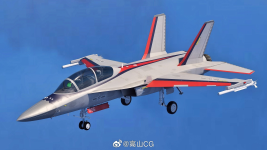
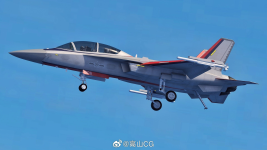
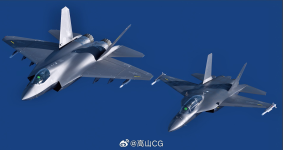
It looks like we may have the first photo of Hongdu's new jet trainer. The most important features are a two-wheeled front landing gear, two canted vertical tails and most likely two engines suggesting a preferred naval use.
Via @WenJian0922 on X
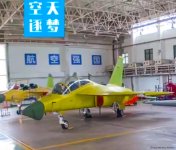
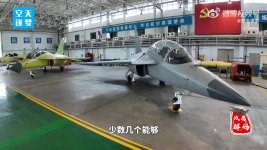
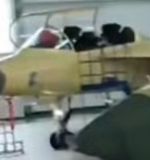
Via @WenJian0922 on X

Michael
VIP Member
CGI from Weibo@高山CG.It looks like we may have the first photo of Hongdu's new jet trainer. The most important features are a two-wheeled front landing gear, two canted vertical tails and most likely two engines suggesting a preferred naval use.
Via @WenJian0922 on X
View attachment 138384View attachment 138385View attachment 138386

Scorpio
Registered Member
What is the designated Model number?It looks like we may have the first photo of Hongdu's new jet trainer. The most important features are a two-wheeled front landing gear, two canted vertical tails and most likely two engines suggesting a preferred naval use.
Via @WenJian0922 on X
View attachment 138384View attachment 138385View attachment 138386
RajaBaja
Trusted Member
It looks like we may have the first photo of Hongdu's new jet trainer. The most important features are a two-wheeled front landing gear, two canted vertical tails and most likely two engines suggesting a preferred naval use.
Via @WenJian0922 on X
View attachment 138385
What's the official designation of this? I believe our airforce is very interested in this. The delay in JL-10 might've served for a better outcome.
This is single engine LIFT platform, can use PL-15 and PL-10, comes with a similar layout and avionics that you'll get in J-35 because it was created as a LIFT for J-20 and J-35 primarily. I've heard a lot about it. Don't know the official designation.
Michael
VIP Member
Who's “Huitong”?Huitong calls it the JL-15 (?) … more I do not know
In theory, it should be called JL-10C (L-15C). Because one of its previous versions was called JL-10B/L-15B.
Or, JL-11 ?
Users who are viewing this thread
Total: 2 (members: 0, guests: 2)
Pakistan Defence Latest


Country Watch Latest
-

-
-
Iran - Israel/US War: Israel-US declare war on Iran, Iran responds (236 Viewers)
- Latest: lightning f57
-

-

Latest Posts
-
-
-
Iran - Israel/US War: Israel-US declare war on Iran, Iran responds (236 Viewers)
- Latest: lightning f57
-

