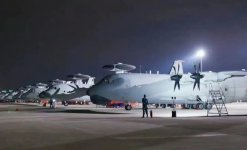
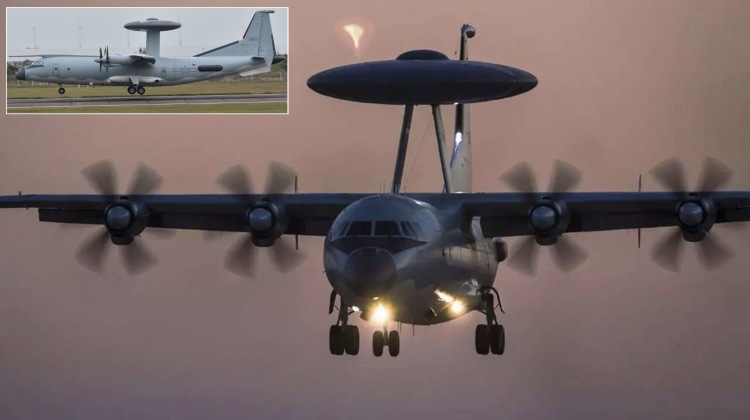
As for the anti-stealth capability of airborne early warning aircraft, in principle, there is no essential difference from land-based anti-stealth radar. The simplest idea is to increase the burn-through distance against stealth aircraft by increasing the power of the radar antenna. The newly adopted E-7 early warning aircraft of the US Air Force is equipped with an oversized balance beam antenna, which even exceeds the antenna size of the E-3 early warning aircraft. For active phased array radars, larger antennas usually mean greater power. It can take a relatively "simple and crude" form, that is, through larger antennas and high-power transceiver components, and improve sensitivity to increase the detection distance and enable it to have a certain anti-stealth capability.
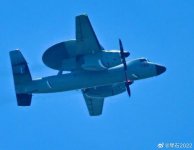
Another anti-stealth idea is to avoid the radar stealth frequency band that is currently optimized by stealth aircraft. Due to limited technical capabilities, stealth fighters of various countries are still unable to achieve full-band stealth and can only absorb or reflect common radar frequency bands used by airborne radars and air defense radars. Land-based anti-stealth radars mainly use large decimeter wave or meter wave radars, but early warning aircraft have limited loads after all, so it is more appropriate to use very high frequency radars-this is also the anti-stealth idea of the new generation of E-2D "Advanced Hawkeye" early warning aircraft of the US Navy.
Another popular direction of anti-stealth radar at present is dual (multi) base radar. Because stealth aircraft are not invisible to radar in all directions, they can use absorbing materials to absorb part of the radar waves. Most of the radar wave energy must be reflected to other directions by the stealth shape instead of returning along the original route. If another radar is deployed in other directions to receive these reflected radar waves, the existence of stealth aircraft can be detected. This is the principle of dual-base radar.
As far as I know, China has successfully developed land-based multi-site radar many years ago. But doing this on an early warning aircraft is much more complicated than with land-based radar. The early warning aircraft must be able to accurately locate itself in real time. Then, the early warning aircraft that transmits radar waves must also send its position and radar wave characteristics to the receiving early warning aircraft in real time through the data link. The latter also needs to know its exact position, and then based on these data, the stealth aircraft can be caught by relying on algorithms. If two early warning aircraft send and receive radar waves to each other, the detection accuracy will be higher and the timeliness will be better.
The principle seems simple, but it is difficult to make it a reality. When an AWACS is flying in the air, accurate positioning itself is a big difficulty, and it also needs to rely on high-speed data links to maintain real-time communication between AWACS. In addition, a large number of anti-interference, signal processing and other problems need to be solved, and powerful computers need to be installed on the AWACS.
But in general, these technologies are no longer insurmountable problems for China.
According to the U.S. Military Observer, under the command and guidance of the KJ-500, the J-20 locked onto enemy targets at a distance of 200 kilometers, achieving "locking on the enemy first, firing on the enemy first", which is a tactic that has been proven in practice by the People's Liberation Army in exercises. It is reported that relying on high-speed data links, not only can information be exchanged between AWACS, but also command and control can be achieved between AWACS and fighters. AWACS, fighters and air-to-air missiles can exchange information with each other at a distance of hundreds of kilometers. The J-20 can carry long-range air-to-air missiles such as PL-15 and stand by at a predetermined location. After receiving the target information, set the parameters and launch the missile. The air-to-air missile was guided by the early warning aircraft through the data link to approach the target, and it hit and destroyed it at a distance of 200 kilometers.
Furthermore, other air platforms, such as the J-16 fighter, can also launch long-range air-to-air missiles such as the PL-15, and then rely on the guidance of the early warning aircraft to achieve "ultra-long-range hunting". However, the J-20 itself has stealth capabilities, and it is difficult for the opponent to discover this secret killer. Moreover, the J-20's supersonic maneuverability makes it more capable of capturing fighter jets.
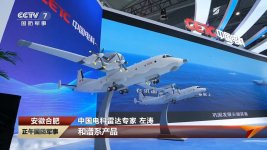
运-9采用中型运输机为基础,价格也比美国现役的E-3预警机和准备采购的E-7预警机便宜得多,这就保证了解放军可以大量采购。 据美国《军事观察》的报道,在空警-500的指挥引导下,歼-20在200公里外的距…

www.sohu.com
With AEW&C aircraft serving as major force multipliers for combat assets across the services, but particularly combat aviation, the KJ-500 has gained particular prominence due to its operations alongside China’s most high profile fighter the Chengdu J-20. J-20s were first delivered to the air force in 2016, and by 2022 the fleet was estimated to have
grown to around 200 aircraft after entry into full scale production the previous year. The class saw its first encounter with another fifth generation fighter
confirmed in March 2022, with United States Pacific Air Forces commander Kenneth Wilsbach singling out the KJ-500 at the time for the important role it played in supporting J-20 operations. “We’re relatively impressed with the command and control associated with the J-20… aircraft in the region… were pretty well commanded and controlled by the Chinese assets,” he stated. “The KJ-500… plays a significant role in some of their capability for long range fires. Some of their very long range air to air missiles are aided by that KJ-500. Being able to interrupt that kill chain is something that interests me greatly.”
Entering service from 2015, the Shaanxi KJ-500’s deployment under Chinese People’s Liberation Army (PLA) frontline units represented the culmination of efforts over

militarywatchmagazine.com
Stimulated by this, US Air Force Secretary Kendall recently publicly stated that he would purchase 200 sixth-generation fighters, 1,000 drones, and 300 F-35A stealth fighters. In this way, each manned fighter can be equipped with two drones to form a new generation of air superiority lineup. As the development work progresses, the number of drones may change. At the same time, the US military is also developing the ultra-long-range AIM-260 air-to-air missile, which uses a two-stage rocket engine and has a range of up to 260 kilometers.
Obviously, with such technological progress, air combat will take on a whole new form, constantly putting forward new requirements for combat aircraft, missiles and command and control systems. However, I am afraid that only China and the United States can keep up with this technological progress.
运-9采用中型运输机为基础,价格也比美国现役的E-3预警机和准备采购的E-7预警机便宜得多,这就保证了解放军可以大量采购。 据美国《军事观察》的报道,在空警-500的指挥引导下,歼-20在200公里外的距…
www.sohu.com