Navigation
Install the app
How to install the app on iOS
Follow along with the video below to see how to install our site as a web app on your home screen.
Note: This feature may not be available in some browsers.
More options
Style variation
You are using an out of date browser. It may not display this or other websites correctly.
You should upgrade or use an alternative browser.
You should upgrade or use an alternative browser.
Indonesian Navy
- Thread starter Indos
- Start date
More options
Who Replied?

Indos
INT'L MOD
- Thread starter
- #17
Beyond Firepower: Rethinking Indonesia’s Surface Vessel Acquisition Priorities
In modernizing the Indonesian Navy’s surface fleet, Jakarta should anticipate changes to the nature of conflict.
By Iqbal Bagus Alfiansyah
December 19, 2024
In light of Indonesia’s defense modernization efforts, as stipulated in the Minimum Essential Force program, the country is actively procuring various new assets. This is also true for the naval force, as Indonesia is pursuing acquiring new surface combatants, particularly frigates, to modernize its aging fleet, address geopolitical challenges, and enhance the country’s power projection capacity. Given these issues and goals, procuring new vessels is more than welcome. However, it is important to remember that Indonesia should not simply aim to procure as many ships as possible, or the largest vessels possible, since there are various technical and operational matters to take into consideration.
First, Indonesia should be aware that the current evolution of warfare will require the country to adapt the way it views warfare. The importance of noting this matter was evident in the past with the rise of the notion of a “revolution in military affairs” (RMA) among American defense experts following the end of the Cold War. They believed that the application of new technologies and extensive battlefield information processing capacity helped win the Gulf War. However, with the recent rise of asymmetrical warfare and the resurgence of interstate and high-intensity conflicts, not to mention further technological advancements, it might be time to think about an “RMA 2.0” for Indonesia and adapt accordingly.
Additionally, it is also important to note that adversaries and belligerents do not hesitate to employ disruptive technologies in the maritime domain. For instance, in recent months, navies all around the world recorded an uptick in cyberattacks from both state and non-state actors. It is not impossible that such attacks could directly impact, for instance, a warship’s navigation systems, or even its kinetic capacities.
Asymmetric warfare tactics are also on the rise and are no longer limited to suicide attacks such as the Al-Qaeda bombing of the USS Cole back in 2000, when the ship was refueling in Yemen. Instead, navies worldwide face drones, a threat that can take several forms. As witnessed in modern battlefields, such as in Ukraine or the Near and Middle East, even small commercial drones can be considered a threat that could impact, at best, the normal conduct of operations, while military-grade drones are changing the face of warfare. One of the most prominent examples would be their use by the Houthis in Yemen to disrupt marine traffic in the Red Sea. Meanwhile, the increasing employment of military-grade unmanned underwater vehicles (UUVs) and unmanned surface vehicles (USVs) for both kinetic and non-kinetic actions highlights a worrying trend, particularly in the Indo-Pacific region.
In light of these challenges, it is important for the Indonesian Navy to take into consideration these evolving maritime security and naval warfare contexts when procuring new surface vessels. To do so, it will be essential to select platforms that could address the four fundamental aspects of modern combat: protection, detection, deployment, and attack. As a matter of fact, the failure to do so might lead to extensive capacity gaps and exacerbate existing issues pertaining to aging warships or even the lack of interoperability. This is why, Indonesian decision-makers are considering several options for its surface fleet – such as Italian shipyard Fincantieri PPA-Evo-class offshore patrol vessel, Turkish shipyard INS’ Istif-class frigate, or the French shipyard Naval Group Belh@rra frigate – they should ensure that whatever they choose can face the challenges of future naval warfare.
Current conflicts highlight the need for a surface combatant to be combat capable: it should be able to address military challenges in a high-intensity environment, while being robust, stealthy, and survivable. Such a platform should also be able to accomplish the whole spectrum of missions required by modern navies, such as anti-submarine warfare, anti-air warfare, anti-surface warfare, and asymmetric warfare. Interestingly, for years, the focus of shipyards all over the world has been to develop heavy frigates and destroyers, arguing that bigger warships will perform better. However, the ongoing evolution in warfare has undermined this assumption that bigger is always better. Moreover, the trend also demonstrates that the quantity and power of weapon systems onboard a warship is no longer the sole determining factor in assessing a vessel’s capability.
Indeed, as high-intensity warfare is starting to succeed decades of low-intensity operations, the stealthiness of a warship is now considered an essential factor in its survivability. Stealth reduces the risk of being detected and thus extend the capacities of a warship to strike, shifting its position from hunted to hunter. Meanwhile, modern warships should be able to be more lethal: the ability to provide area defense through combat-proven weapons and systems – not only for the ship itself, but from an entire Task Force – against threats such as cruise and ballistic missiles, or submarines, is also a key aspect of the enhanced lethality that is needed to protect Indonesia’s sovereign interests. Lastly, it is also essential for a modern warship to be able to counter cyber threats: the ongoing evolution on the battlefield shows that in future conflicts, cyberspace will play an essential role, and being able to fully operate under cyber-attacks is a must.
All in all, as Indonesia is set to launch its first Merah Putih frigate in the months to come, decision-makers should approach the procurement of surface combatants by selecting capable and suitable assets to safeguard national interests and Indonesian sovereignty. Just as Indonesia should avoid amassing a variety of defense assets solely for the sake of increasing “firepower” without considering matters of interoperability and the implications of a new “Revolution in Military Affairs” on the horizon, decision-makers must also prioritize a surface vessel’s operational capabilities, including its non-kinetic functions and cyber warfare capacity, rather than simply aiming for the largest ship.
No less importantly, it is essential to take into account the fact that selecting new warships should not be based on how a conflict was perceived decades ago. Instead, Indonesia must consider recent technological developments to anticipate future needs and ensure that new assets can answer modern threats from state and non-state actors while anticipating tomorrow’s conflicts.

Beyond Firepower: Rethinking Indonesia’s Surface Vessel Acquisition Priorities
In modernizing the Indonesian Navy’s surface fleet, Jakarta should anticipate changes to the nature of conflict.
thediplomat.com
Indos
INT'L MOD
- Thread starter
- #18
Indonesia’s first PPA started sea trials in Italy
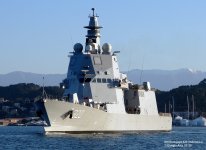
KRI Brawijaya (320) is conducting the first sea-goings from Fincantieri’s Muggiano shipyard (La Spezia). Picture by Giorgio Arra.
The first of two MPCS (Multipurpose Combat Ship / PPA) vessels sold by Fincantieri to the Indonesian Navy (TNI AL), KRI Brawijaya (320), is conducting the first sea-goings from the Italian shipbuilder’s Muggiano shipyard (La Spezia).
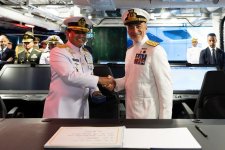
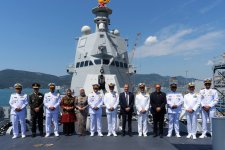
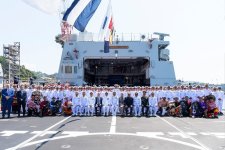
Originally built as the fifth and sixth MPCS/PPA units in the Light Plus configuration for the Italian Navy, the two ships, formerly named Marcantonio Colonna and Ruggiero di Lauria, were respectively renamed KRI Brawijaya (320) and KRI Prabu Siliwangi (321) with a ceremony held at the same shipyard on 29 January 2025, as part of the €1.18 billion euro contract signed in March 2024. The two ships are scheduled for delivery this year.
Italian naval photographer Giorgio Arra took images of Brawijaya (320) during one of the first sea goings this week. The second in class, Prabu Siliwangi (321), was also photographed previously, while being moved among piers of Muggiano shipyard.
The Brawijaya (320) is showed with all the gun armament package including the Leonardo 127/64 mm LW main gun, capable of firing Vulcano long-range guided ammunitions, the 76 mm Single Deck gun with anti-ship missiles and asymmetric threats DART guided ammunitions and two remotely operated 25 mm gun systems. The ship is also equipped with the SAAM ESD PPA air defence missile system based on the MBDA Aster family of missiles (2 naval Group A50 8-cell VLS for a total of 16 missiles) and the Leonardo Kronos Quad C-band four fixed faces AESA radar, alongside the extensive and capable EW suite by ELT Group (Elettronica) including RESM/CESM and RECM.

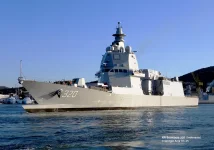
The Italian Navy has recently successfully qualified the SAAM ESD PPA air defence missile system on the Bande Nere (P 434) MPCS/PPA in the Full Configuration centred on the Leonardo Dual Band Radar (DBR) system with Kronos Quad C-band and Kronos StarFire X-band systems, DSS-IRST and ASW suite.
The Italian Navy Montecuccoli (P 432) MPCS/PPA in the Light Plus configuration, the same sold to Indonesia, was deployed to the Indo-Pacific last summer and successfully participated to the Pacific Dragon integrated air and missile defence exercise.

Indonesia’s first PPA started sea trials in Italy - Naval News
The first of two PPA vessels sold by Fincantieri to the Indonesian Navy (TNI AL), KRI Brawijaya (320), is conducting sea trials
 www.navalnews.com
bogey_dope
Registered Member
It will be refurbished first in Fincanteri.
This is just a start, local company has already had plan to make it as well. Possibly Indonesian local shipyard will build another ship like this based on Fincanteri design
PT PAL Indonesia
View attachment 80735
View attachment 80736
What would they operate off these flat tops, harriers are old
Indos
INT'L MOD
- Thread starter
- #25
Indonesia Eyes Giuseppe Garibali Aircraft Carrier Procurement
Published on 21/06/2025
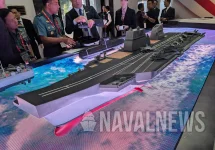
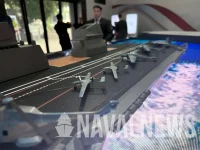
An aircraft carrier scale model at REPUBLIKORP booth at INDO DEFENCE 2025
At the Indodefence exhibition in Jakarta, Indonesian company REPUBLIKORP showcased an aircraft carrier model labeled “Giuseppe Garibaldi” on the adjacent digital panel featuring Bayraktar TB3 drones and fighter jets on its deck.
At the Indodefence 2025 exhibition held in Jakarta between 11–14 June, Indonesia’s leading defence company REPUBLIKORP (with local shipyard PT Palindo Marine) presented a scale model of a naval fleet at its booth. The display featured a notional aircraft carrier, a stealth corvette, a compact submarine, a fast attack craft, and an unmanned surface vehicle (USV).
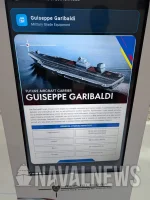
The digital panel accompanying the aircraft carrier model labeled it as “Giuseppe Garibaldi,” referring to the Italian Navy’s former flagship. However, the mock-up bore little resemblance to the actual Giuseppe Garibaldi light aircraft carrier, suggesting it was a conceptual design rather than a direct replica.
Following reports of the Indonesian Navy’s (TNI AL) growing interest in adding an aircraft carrier to its fleet, Naval News visited the booth of Italian shipbuilder Fincantieri to learn more about potential developments. Speaking to Naval News, Fincantieri’s Director of Sales Naval Business Unit, Mr. Mauro Mansini, confirmed that the Indonesian Navy has expressed interest in acquiring the Giuseppe Garibaldi.
He noted that the matter is currently under “state-level” discussion between the two governments and that no formal decision has been made to proceed with the procurement.
“The Giuseppe Garibaldi is in good condition and has approximately 15 to 20 years of remaining operational life. If an agreement is reached, the vessel can be transferred following a refit process tailored to the Indonesian Navy’s specific requirements.”
He emphasized the ship’s versatility, stating that Giuseppe Garibaldi is capable of operating a range of platforms including drones, helicopters, fixed-wing aircraft, and amphibious assets. “It also has proven capability in humanitarian and disaster relief operations,” he added, citing the ship’s involvement in delivering medical assistance and humanitarian cargo following the 2010 Haiti earthquake.
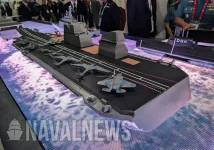
TB3 UCAVs Aboard Garibaldi
Bayraktar TB3 UCAVs aboard the model aircraft carrier showcased on REPUBLIKORP’s booth
In addition to the aircraft carrier model displayed at the REPUBLIKORP booth, scale models of Baykar Technologies’ Bayraktar TB3 were also showcased. The TB3 is a short take-off capable unmanned combat aerial vehicle (UCAV) developed for use on aircraft carriers/LHDs such as the Turkish Navy’s flagship, TCG Anadolu, where it is currently undergoing trials. A full-scale mockup of the TB3, equipped with various payload options, was also exhibited at the stand. The model of the aircraft carrier also featured scale models of Baykar’s AKINCI MALE-class unmanned aerial vehicle (UAV). However, since AKINCI is not designed for shipborne operations, its presence on the carrier model was likely for display purposes only.
Speaking to Naval News during the exhibition, Baykar Tech. officials stated that Indonesia has shown strong interest in the Bayraktar TB3. They revealed that a preliminary agreement has been signed for the acquisition of 60 drones, and the final contract is currently under discussion. The officials added that this 60-UAV package includes both shipborne and land-based variants of the TB3.
This is the first time it has been disclosed that the TB3, previously known in the media as a more advanced, carrier-capable version of the TB2, exists in two configurations. Company representatives noted that the land-based variant features a higher maximum take-off weight (MTOW), larger fuel capacity, and longer endurance than its shipborne counterpart.

Indonesia Eyes Giuseppe Garibaldi Aircraft Carrier Procurement - Naval News
At the Indodefence exhibition in Jakarta, Indonesian company REPUBLIKORP showcased an aircraft carrier model labeled "Giuseppe Garibaldi" on the adjacent digital panel featuring Bayraktar TB3 drones and fighter jets on its deck.
www.navalnews.com



Farhan23
Registered Member


Indonesia Eyes Giuseppe Garibali Aircraft Carrier Procurement
Published on 21/06/2025
View attachment 130223
An aircraft carrier scale model at REPUBLIKORP booth at INDO DEFENCE 2025
At the Indodefence exhibition in Jakarta, Indonesian company REPUBLIKORP showcased an aircraft carrier model labeled “Giuseppe Garibaldi” on the adjacent digital panel featuring Bayraktar TB3 drones and fighter jets on its deck.
At the Indodefence 2025 exhibition held in Jakarta between 11–14 June, Indonesia’s leading defence company REPUBLIKORP (with local shipyard PT Palindo Marine) presented a scale model of a naval fleet at its booth. The display featured a notional aircraft carrier, a stealth corvette, a compact submarine, a fast attack craft, and an unmanned surface vehicle (USV).
View attachment 130224
The digital panel accompanying the aircraft carrier model labeled it as “Giuseppe Garibaldi,” referring to the Italian Navy’s former flagship. However, the mock-up bore little resemblance to the actual Giuseppe Garibaldi light aircraft carrier, suggesting it was a conceptual design rather than a direct replica.
Following reports of the Indonesian Navy’s (TNI AL) growing interest in adding an aircraft carrier to its fleet, Naval News visited the booth of Italian shipbuilder Fincantieri to learn more about potential developments. Speaking to Naval News, Fincantieri’s Director of Sales Naval Business Unit, Mr. Mauro Mansini, confirmed that the Indonesian Navy has expressed interest in acquiring the Giuseppe Garibaldi.
He noted that the matter is currently under “state-level” discussion between the two governments and that no formal decision has been made to proceed with the procurement.
“The Giuseppe Garibaldi is in good condition and has approximately 15 to 20 years of remaining operational life. If an agreement is reached, the vessel can be transferred following a refit process tailored to the Indonesian Navy’s specific requirements.”
He emphasized the ship’s versatility, stating that Giuseppe Garibaldi is capable of operating a range of platforms including drones, helicopters, fixed-wing aircraft, and amphibious assets. “It also has proven capability in humanitarian and disaster relief operations,” he added, citing the ship’s involvement in delivering medical assistance and humanitarian cargo following the 2010 Haiti earthquake.
TB3 UCAVs Aboard Garibaldi
View attachment 130226
Bayraktar TB3 UCAVs aboard the model aircraft carrier showcased on REPUBLIKORP’s booth
In addition to the aircraft carrier model displayed at the REPUBLIKORP booth, scale models of Baykar Technologies’ Bayraktar TB3 were also showcased. The TB3 is a short take-off capable unmanned combat aerial vehicle (UCAV) developed for use on aircraft carriers/LHDs such as the Turkish Navy’s flagship, TCG Anadolu, where it is currently undergoing trials. A full-scale mockup of the TB3, equipped with various payload options, was also exhibited at the stand. The model of the aircraft carrier also featured scale models of Baykar’s AKINCI MALE-class unmanned aerial vehicle (UAV). However, since AKINCI is not designed for shipborne operations, its presence on the carrier model was likely for display purposes only.
Speaking to Naval News during the exhibition, Baykar Tech. officials stated that Indonesia has shown strong interest in the Bayraktar TB3. They revealed that a preliminary agreement has been signed for the acquisition of 60 drones, and the final contract is currently under discussion. The officials added that this 60-UAV package includes both shipborne and land-based variants of the TB3.
This is the first time it has been disclosed that the TB3, previously known in the media as a more advanced, carrier-capable version of the TB2, exists in two configurations. Company representatives noted that the land-based variant features a higher maximum take-off weight (MTOW), larger fuel capacity, and longer endurance than its shipborne counterpart.
View attachment 130228
Indonesia Eyes Giuseppe Garibaldi Aircraft Carrier Procurement - Naval News
At the Indodefence exhibition in Jakarta, Indonesian company REPUBLIKORP showcased an aircraft carrier model labeled "Giuseppe Garibaldi" on the adjacent digital panel featuring Bayraktar TB3 drones and fighter jets on its deck.
Indonesian navy is moving in the right direction and this would be a good purchase
Users who are viewing this thread
Total: 2 (members: 0, guests: 2)


