Navigation
Install the app
How to install the app on iOS
Follow along with the video below to see how to install our site as a web app on your home screen.
Note: This feature may not be available in some browsers.
More options
Style variation
You are using an out of date browser. It may not display this or other websites correctly.
You should upgrade or use an alternative browser.
You should upgrade or use an alternative browser.
Pakistan Air Force | News & Discussions
- Thread starter ghazi52
- Start date
More options
Who Replied?


Hussain
Trusted Member
Brother, Sept 28, which year?
AW139 17-004 wears the test registration CSX81923 at Venegono during a test flight on September 28. Marco Muntz

Fatman17
Moderator
It's an old picture from 2017Brother, Sept 28, which year?
Hussain
Trusted Member
Thank You Brother ! Much obliged.It's an old picture from 2017


Fatman17
Moderator

The new KLJ-7A Airborne Electronically Scanned Array (AESA) radar was also displayed on the ZETC stand. It is a candidate for the Pakistan Air Force’s JF-17 Block 3 configuration, and is expected to be the ‘brains’ of the J-31. China appears to have advanced further with its AESA radars than Russia or Europe.

air marshal
Elite Member
EXERCISE SPEARS OF VICTORY-2024 KICKS OFF AT KING ABDULAZIZ AIR BASE
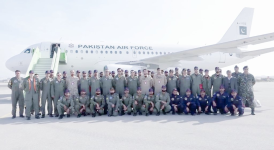
06 February, 2024: The opening ceremony of Exercise Spears of Victory-2024 was held at Air War Centre Dhahran, King Abdul Aziz Air Base, Kingdom of Saudi Arabia. The exercise is witnessing participation of modern fighter jets and support elements from Saudi Arabia, Pakistan, USA, UK, France, Greece, Oman, UAE, Qatar and Bahrain.
Pakistan Air Force contingent will showcase its enhanced combat potential at the exercise alongside its JF-17 Thunder fighter jets, dedicated air & ground crew. The participation not only highlights PAF's commitment to regional and international cooperation but also underscores its capabilities and prowess to operate in diverse and challenging environments.
The fourth version of the exercise is being held in the Eastern region of Saudi Arabia which will provide an opportunity to bolster interoperability within the participating Air Forces in the back drop of shared aerial defence challenges. In addition to fostering military relations, the exercise will also provided a platform to practice integrated employment of combat & combat support assets along with formulation and validation of tactics against contemporary threats.
Through the implementation of a revised training paradigm and the strategic induction plan of niche technologies, PAF has reaffirmed its operational readiness and unwavering commitment to addressing contemporary strategic challenges.
These initiatives have not only bolstered operational preparedness but have also underscored PAF's dedication to staying at the forefront of operational excellence and adaptability in the face of evolving threats. Pakistan Air Force's participation in this prestigious exercise stands as a testament to its resolute dedication to the cause of global peace and security.
06 February, 2024: The opening ceremony of Exercise Spears of Victory-2024 was held at Air War Centre Dhahran, King Abdul Aziz Air Base, Kingdom of Saudi Arabia. The exercise is witnessing participation of modern fighter jets and support elements from Saudi Arabia, Pakistan, USA, UK, France, Greece, Oman, UAE, Qatar and Bahrain.
Pakistan Air Force contingent will showcase its enhanced combat potential at the exercise alongside its JF-17 Thunder fighter jets, dedicated air & ground crew. The participation not only highlights PAF's commitment to regional and international cooperation but also underscores its capabilities and prowess to operate in diverse and challenging environments.
The fourth version of the exercise is being held in the Eastern region of Saudi Arabia which will provide an opportunity to bolster interoperability within the participating Air Forces in the back drop of shared aerial defence challenges. In addition to fostering military relations, the exercise will also provided a platform to practice integrated employment of combat & combat support assets along with formulation and validation of tactics against contemporary threats.
Through the implementation of a revised training paradigm and the strategic induction plan of niche technologies, PAF has reaffirmed its operational readiness and unwavering commitment to addressing contemporary strategic challenges.
These initiatives have not only bolstered operational preparedness but have also underscored PAF's dedication to staying at the forefront of operational excellence and adaptability in the face of evolving threats. Pakistan Air Force's participation in this prestigious exercise stands as a testament to its resolute dedication to the cause of global peace and security.
Fatman17
Moderator
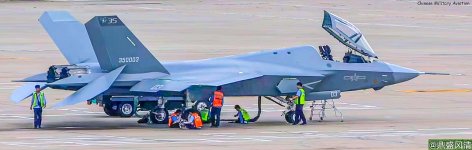
 J-35/FC-31 Blue Shark/Gyrfalcon
 The fully painted J-35 03 prototype 350003 was being serviced before another test flight at SAC. This aircraft has evolved from the earlier FC-31 (Project 310), an export stealth fighter which has a conventional design with twin engines and two large canted swept tail fins similar to American F-35. As the result the ventral stabilizing fins are eliminated to save weight and reduce RCS. In addition it features DSIs, two piece canopy and a pentagon shaped nose similar to F-35. Like J-20, a retractable IFR probe could be installed on the starboard side slightly forward of the canopy. As a 4th generation fighter FC-31 is expected to be equipped with advanced avionics such as an AESA radar and a glass cockpit featuring three large color LED MFDs and a wide-angle holographic HUD. The aircraft could eventually be fitted an F-35 style single piece extra-large panoramic cockpit display (PCD) as specified by the customer. The avionics suite is believed to have been tested onboard a Y-8 testbed with a modified nose. The prototype was initially powered by the Russian RD-33 turbofan (8.5t class) but later by the indigenous WS-13E (WS-21, 9t class). The engine nozzles on the 01 prototype initially appeared without any stealth measures applied. However they are partially shielded by the two horizontal stabilizers extending further back, similar to F-35, thus reduces the IR and radar signatures. FC-31 features a single internal weapons bay inside its belly housing up to 6 AAMs including PL-10E (to be followed by PL-16E), PL-15E and PL-21. The aircraft is also thought to have a secondary surface attack capability where it can carry 50kg class SDBs internally such as LS-6/FT-7 satellite guided bomb and GB50 LGB, or the larger YJ-83K AshM and YJ-91 ARM externally under 6 hard points. An internal gun was expected to be installed but its exact location is still unknown. Due to its relatively small size and lower engine thrust compared to J-20, FC-31 should have a smaller internal payload and a shorter combat radius. It is not expect to have the super-cruise capability initially either when powered by WS-21. However it does carry a relatively cheaper price tag and have a relatively "balanced" performance. Some specifications (speculated): length 17.3m, height 4.8m, wingspan 11.5m, normal TO weight 17.5t, MTOW 28t, combat radius 1,250km with internal fuel, max peed Mach 1.8, ceiling 16km, TO distance 450m, max g load +9/-3, max weapon load 8t (internal 2t, external 6t). It was first rumored in April 2011 that 601/SAC was developing a 4th generation medium multi-role stealth fighter as Project 310 since 2007 after its own heavy stealth fighter design lost the bid to 611/CAC's J-20 (see above). A scale-down model (dubbed F-60) of FC-31 was first unveiled by the 601 Institute in September 2011. A full-scale metal model was probably built in early 2011. One airframe was transported to the 623 Institute for static tests in June 2012. The 31001 prototype was under construction since late 2011. Its first flight took place on October 31, 2012, powered by two smoky RD-33 turbofans. It was rumored that the 01 prototype powered by two upgraded WS-21 turbofan engines flew for the first time on July 1, 2016. As a private venture of AVIC, FC-31 (initially dubbed AFC/Advanced Fighter Concept) has been promoted at the international market as a low-cost alternative to American F-35. Its first foreign customer is expected to be Pakistani AF (dubbed J-31), which has been the primary customer of Chinese made combat aircraft. FC-31 was partially unveiled at 2012 Zhuhai Airshow as an "advanced fighter concept". One image taken in December 2013 suggested that FC-31 was testing a new silver color "stealth" nozzle similar to those onboard J-20. The 03 prototype (02 airframe for the static test) was expected to feature "major" improvements in order to make it more attractive to domestic/foreign customers. Those improvements include a one-piece canopy, a new wide-angle holographic HUD similar to the one onboard J-20, two indigenous WS-21 turbofan engines with a higher thrust, a longer and fatter fuselage made of more composite materials, a bigger internal weapon bay, larger wing area, reshaped F-35 style tail fins and cropped wing and horizontal stabilizer tips similar to those of F-22. It also has the provisions for nose-mounted IRST, EODAS throughout the fuselage, as well as 6 underwing hardpoints to be installed later. An AVIC promotional video released at the 2016 Zhuhai Airshow indicated the 03 prototype was built and was preparing for the maiden flight. The high-speed taxiing test of the 03 prototype started on December 18, 2016. First flight took place on December 23, 2016, powered by two smokeless WS-13E engines. A recent image (September 2019) indicated that the o3 prototype has been wearing a light gray color scheme. It was rumored in October 2018 that a much redesigned variant has been selected by PLAN as its next generation carrier-based stealth fighter (as J-35, Project 1810?), featuring folding wings and a retractable arresting hook, powered by the new WS-19 Huangshan turbofan engines (10t class), possibly with TVC nozzles. Its MTOW is >30t. J-35 is expected to be stationed onboard the new Type 003 Fujian CATOBAR carrier featuring EMALS. It was rumored in September 2020 that a J-35 prototype (02?) was undergoing static test. A full-scale mockup was unveiled in June 2021. Compared to the FC-31 03 prototype, J-35 features foldable wings, a bigger wingspan, larger tail fins for better handlings at low speed/high AoA, a raised cockpit and deeper spine for a better pilot downward view as well as a bigger internal fuel capacity. A boarding ladder was speculated to be installed similar to that of F-35. A recent rumor (March 2021) suggested that a dedicated variant (J-31?) is being developed for PLAAF without arresting hook and folded wings. An airframe was rumored to have been transported to the 623 Institute for static tests in March 2022. First flight was speculated in late 2023. It was also speculated in mid-2023 that a J-35S tandem seat version similar to J-20S could be under development for training and EW purposes. The first flight of J-35 prototype (350001) in a green primer and powered by WS-21 turbofans with sawtooth nozzles occurred on October 29, 2021. The aircraft features a larger radome, a forward opening one-piece canopy with handholds attached for catapult launches, a new narrow frame holographic HUD, an HTY9 ejection seat similar to that onboard J-20, a retractable IFR probe on the starboard side of the cockpit, an IRST or EOTS underneath its nose plus a strengthened nose gear with twin wheels and a launch bar. It also has twin tail booms further stretched in order to move the horizontal stabilizers slightly backward. Consequently the aircraft handling at low speeds has been improved. A recent satellite image (November 2021) suggested that two J-35 mockups (?) were being evaluated at the PLAN Carrier Aviation Test & Training Base for training purposes. A recent image (May 2022) indicated that the 350001 prototype was wearing a gray color scheme and carrying low visibility PLAN markings. Recent images (July 2022) indicated that the 350003 prototype had been built. A recent video (August 2023) indicated at least one J-35 prototype was conducting test flights at SAC with the nose pitot tube removed, suggesting an AESA radar may have been fitted inside. The latest video (September 2023) suggested that another J-35 prototype (or the first J-31 prototype) just conducted its maiden flight over Shenyang. The latest rumor (December 2023) suggested that at least one WS-19 turbofan engine has been tested onboard a J-35. A full-scale mockup was first seen in November 2023 on the deck of Fujian. The development of J-35 is expected to be moved into the next phase as it prepares for launch tests from a land-based EMALS.
- Last Updated 2/8/24
Users who are viewing this thread
Total: 1 (members: 0, guests: 1)
Pakistan Defence Latest


Country Watch Latest


Latest Posts
-

-

-
Pakistan announces austerity measures to conserve fuel as Gulf conflict spirals (20 Viewers)
- Latest: moonaman.varavayi
-

-
