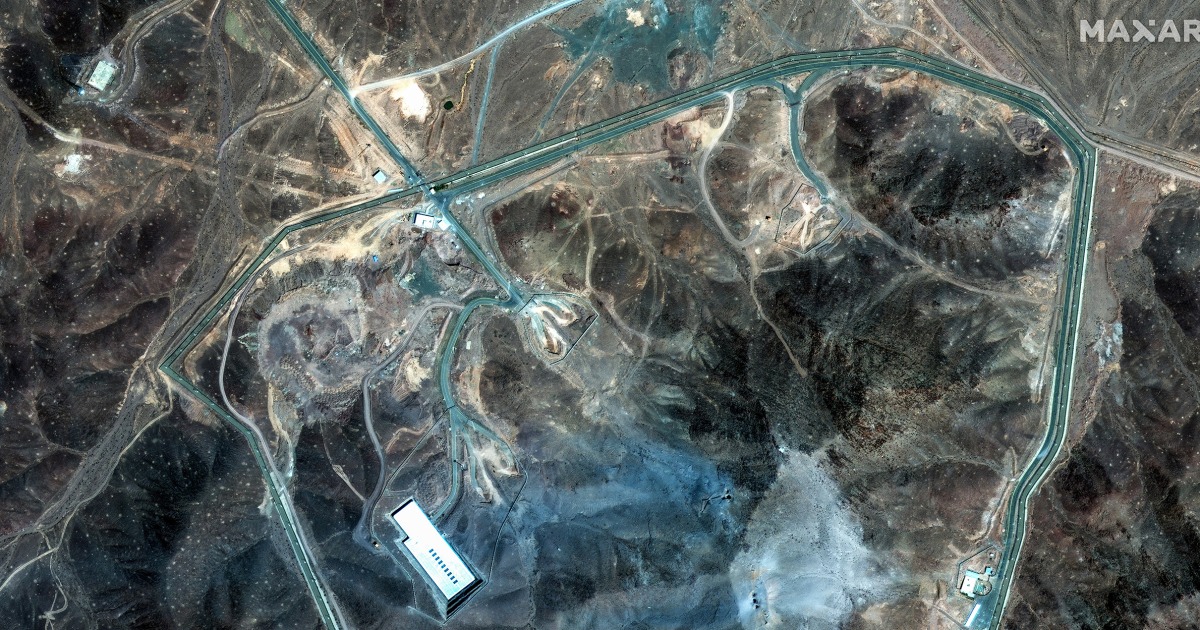
New U.S. assessment finds American strikes destroyed only one of three Iranian nuclear sites
WASHINGTON — One of the three nuclear enrichment sites in Iran struck by the United States last month was mostly destroyed, setting work there back significantly. But the two others were not as badly damaged and may have been degraded only to a point where nuclear enrichment could resume in the next several months if Iran wants it to, according to a recent U.S. assessment of the destruction caused by the military operation, five current and former U.S. officials familiar with the assessment told NBC News.
The assessment, part of the Trump administration’s ongoing efforts to determine the status of Iran’s nuclear program since the facilities were struck, was briefed to some U.S. lawmakers, Defense Department officials and allied countries in recent days, four of those people said.
NBC News has also learned that U.S. Central Command had developed a much more comprehensive plan to strike Iran that would have involved hitting three additional sites in an operation that would have stretched for several weeks instead of a single night, according to a current U.S. official and two former U.S. officials.
President Donald Trump was briefed on that plan, but it was rejected because it was at odds with his foreign policy instincts to extract the United States from conflicts abroad, not dig deeper into them, as well as the possibility of a high number of casualties on both sides, one of the current officials and one of the former officials said.
“We were willing to go all the way in our options, but the president did not want to,” one of the sources with knowledge of the plan said.
In a speech in the hours after they took place, Trump called the strikes he directed “a spectacular military success” and said, “Iran’s key enrichment facilities have been completely and totally obliterated.”
The reality as gleaned through intelligence so far appears to be more nuanced. And if the early findings about the damage inflicted to Iran’s nuclear program hold up as more intelligence comes in, the United States could find itself back in a conflict there.
There have been discussions within both the American and Israeli governments about whether additional strikes on the two less-damaged facilities could be necessary if Iran does not soon agree to restart negotiations with the Trump administration on a nuclear deal or if there are signs Iran is trying to rebuild at those locations, one of the current officials and one of the former officials said. Iran has long said its nuclear program is purely for peaceful, civilian purposes.
The recent assessment is a snapshot of the damage U.S. strikes inflicted amid an intelligence-gathering process that administration officials have said is expected to continue for months. Assessments of Iran’s nuclear program after the U.S. strikes are expected to change over time, and according to two of the current officials, as the process progresses, the findings suggest more damage than previous assessments revealed. That assessment remains for now the current thinking on the impact of the strikes, officials said.
“As the President has said and experts have verified, Operation Midnight Hammer totally obliterated Iran’s nuclear capabilities,” White House spokeswoman Anna Kelly told NBC News in a statement. “America and the world are safer, thanks to his decisive action.”
In a statement of his own, chief Pentagon spokesman Sean Parnell said: “The credibility of the Fake News Media is similar to that of the current state of the Iranian nuclear facilities: destroyed, in the dirt, and will take years to recover. President Trump was clear and the American people understand: Iran’s nuclear facilities in Fordow, Isfahan, and Natanz were completely and totally obliterated. There is no doubt about that.”
He added, “Operation Midnight Hammer was a significant blow to Iran’s nuclear capabilities thanks to the decisive action of President Trump and the bravery of every man and woman in uniform who supported this mission.”
Destruction and deterrence
The U.S. strikes targeted three enrichment sites in Iran: Fordo, Natanz and Isfahan. U.S. officials believe the attack on Fordo, which has long been viewed as a critical component of Iran’s nuclear ambitions, was successful in setting back Iranian enrichment capabilities at that site by as much as two years, according to two of the current officials.
Much of the administration’s public messaging about the strikes has focused on Fordo.
In a Pentagon briefing they held in response to reporting on an
initial Defense Intelligence Agency assessment that concluded that Iran’s nuclear program had been set back by only three to six months, for instance, Defense Secretary Pete Hegseth and Gen. Dan Caine, the chairman of the Joint Chiefs of Staff, talked extensively about the strike at Fordo but not the strikes at Natanz and Isfahan.
U.S. officials knew before the airstrikes that Iran had structures and enriched uranium at Natanz and Isfahan that were likely to be beyond the reach of even America’s 30,000-pound GBU-57 “bunker buster” bombs, three of the sources said. Those bombs, which had never been used in combat before the strikes, were designed with the deeply buried facilities carved into the side of a mountain at Fordo in mind.
As early as 2023, though, there were indications that Iran was digging tunnels at Natanz that were below where the GBU-57 could reach. There are also tunnels deep underground at Isfahan. The United States hit surface targets at Isfahan with Tomahawk missiles and did not drop GBU-57s there, but it did use them at Natanz.
White House officials pointed NBC News to a closed-door briefing conducted in late June by CIA Director John Ratcliffe, who told lawmakers that Iran’s nuclear program was “severely damaged” and that several key nuclear facilities were “completely destroyed,” according to an administration official’s description of the briefing. Ratcliffe said the only metal conversion facility at Natanz, required for nuclear enrichment, was destroyed to the point that it would take “years to rebuild,” according to a White House official who was authorized to describe some contents of the classified briefing.
Ratcliffe also said that the intelligence community believes the strikes buried the vast majority of enriched uranium at Isfahan and Fordo and that thus it would be extremely difficult for the Iranians to extract it to resume enrichment, according to the official. The United States has not seen indications that Iran is trying to dig out the facilities, two officials said.
As
NBC News has reported, the Israeli government believes at least some of Iran’s highly enriched uranium remains intact but buried beneath the Isfahan facility, according to a senior Israeli government official who briefed reporters in Washington last week. The official said, however, that Israel considers the material effectively unreachable, because it is watching and will conduct new strikes if it believes Iran is trying to dig up the uranium. The official also said Israel believes Iran’s nuclear program has been set back by up to two years.
Similarly, even if the targeted Iranian nuclear sites were not completely destroyed, U.S. officials and Republican advocates of the operation believe it was a success because it has changed the strategic equation for Iran. From their point of view, the regime in Tehran now faces a credible threat of more airstrikes if Israel and the United States believe it is trying to revive clandestine nuclear work.
Asked late last month whether he would consider bombing Iran again if intelligence reports concluded Iran can enrich uranium at a level that concerns him, Trump said: “Sure. Without question. Absolutely.”
Iran’s air defenses have been largely destroyed, making it all but impossible for Iran to defend against further strikes on facilities in the future, the White House official said.
“It was made clear that Iran no longer has any more [air defenses], so the idea that they can easily rebuild anything is ludicrous,” the White House official said.
The ‘all-in’ plan
Beginning during the Biden administration, as early as last fall and into this spring, Army Gen. Erik Kurilla, the head of U.S. Central Command, had developed a plan to go “all-in” on striking Iran, according to a current U.S. official and two former officials. That option was designed to “truly decimate” Iran’s nuclear capabilities, in the words of one of the former officials.
Under the plan, the United States would have hit six sites. The thinking was that the six sites would have to be hit repeatedly to inflict the kind of damage necessary to completely end the program, people familiar with the thinking said. The plan would also have involved targeting more of Iran’s air defense and ballistic missile capabilities, and planners projected it could result in a high number of Iranian casualties. U.S. officials expected that if that were to take place, Iran would target American positions, for example in Iraq and Syria, a person familiar with the plan said.
“It would be a protracted air campaign,” the person said.
Some Trump administration officials believed a deeper offensive option against Iran was a viable policy, two of the former officials said.
Trump was briefed on the so-called all-in plan, but it was rejected ultimately because it would have required a sustained period of conflict.
The history
During his first term, in 2018,
Trump pulled the United States out of a 2015 nuclear deal between Iran and world powers that was negotiated during the Obama administration. The agreement, known as the Joint Comprehensive Plan of Action, imposed strict limits on Iran’s nuclear program in return for an easing of economic sanctions.
Under the deal, Iran was a year away from obtaining enough fissile material for a nuclear bomb. After Trump withdrew from the accord and reimposed sanctions, Iran flouted restrictions on its uranium enrichment. Before the June airstrikes, the regime had enough fissile material for about nine to 10 bombs, according to U.S. officials and United Nations inspectors.
Trump has since sought a new agreement with Iran that would block it from developing nuclear weapons. Indirect talks between U.S. and Iranian officials failed to clinch a deal before Israel launched airstrikes on Iran’s nuclear facilities.
Iran has long denied that it wants to build a nuclear weapon, a position its foreign minister reiterated in
an interview with NBC News the day before the U.S. strikes.
President Donald Trump rejected a military plan for more comprehensive strikes on Iran’s nuclear program that would have lasted weeks, NBC News has also learned.

www.nbcnews.com