Navigation
Install the app
How to install the app on iOS
Follow along with the video below to see how to install our site as a web app on your home screen.
Note: This feature may not be available in some browsers.
More options
Style variation
You are using an out of date browser. It may not display this or other websites correctly.
You should upgrade or use an alternative browser.
You should upgrade or use an alternative browser.
Chinese Naval Platform & PLAN discussions
- Thread starter Beijingwalker
- Start date
More options
Who Replied?


US1956
Registered Member
Upps ... as it seems, the CCG 3104 collided with the PLAN Type 52D hull 164.
Likely, the type 52D was received an urgent order "not to sink" the Philippine coast guard. Without the intervention of the DDG, the PCG would has sunk to bottom of the sea in next minute by CCG 3104

Beijingwalker
VIP Member
- Thread starter
- #395
China to Unveil Giant Sea Drone at Beijing Parade
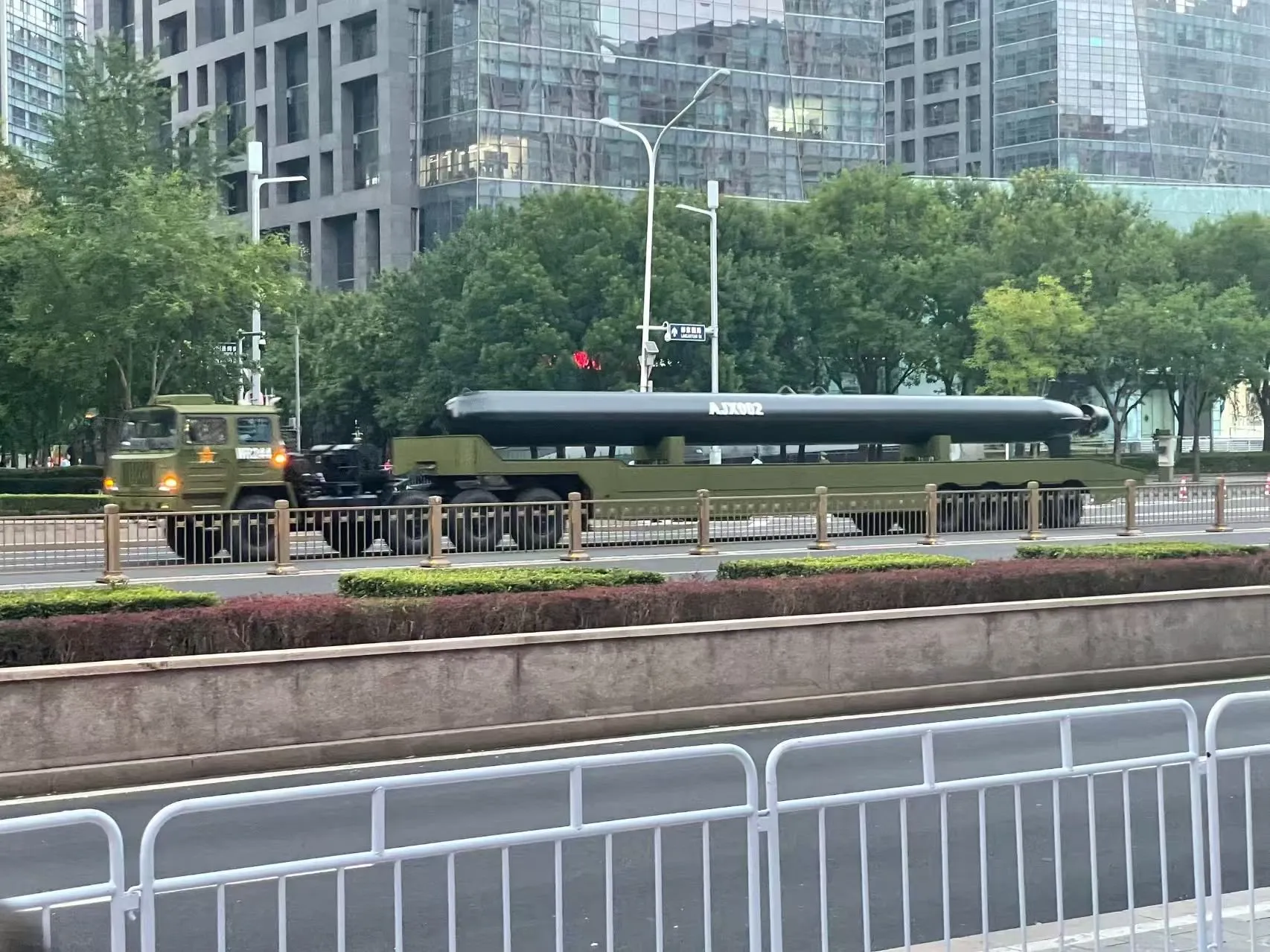
A large Chinese unmanned underwater vehicle. Photo: Weibo
August 17, 2025
During preparations for the Victory over Japan Day parade in Beijing, China has showcased for the first time a massive unmanned underwater vehicle.
The Defence Blog reported on this.
International experts believe the new underwater vehicle is China’s attempt to develop a counterpart to Russia’s Poseidon nuclear-powered unmanned underwater vehicle.

Meanwhile, the South China Morning Post described the weapon concept as one that would employ a disposable nuclear reactor to reach and maintain cruising speeds of more than 30 knots (about 35 miles per hour) for up to 200 hours.
Once expended, the reactor would detach and sink to the seabed, after which the drone could continue operating on battery power to carry out a conventional strike.
Meanwhile, Chinese nuclear scientist Guo Jian of the China Institute of Atomic Energy, in an article for the Journal of Unmanned Underwater Systems, noted that there were ‘substantial differences’ between the system under development and Russia’s Poseidon, although specific details were not disclosed.
He points out that the use of such a weapon as Russia’s Poseidon could provoke a nuclear war, which poses a global threat of annihilation, making its deployment unlikely. In contrast, their new underwater drone serves a completely different purpose.
“Due to its high flexibility and relatively low cost, this unmanned underwater drone with a nuclear power system can function either as a conventional combat unit or as a strike nuclear submarine, rather than as a nuclear missile,” explained Guo.

Despite the uncertainty, China plans to showcase a variety of weaponry at the parade that was previously unknown, thus demonstrating its ambitious plans to build a formidable force in the region.
Militarnyi previously reported that China had launched the research vessel Blue Whale, which was capable of operating underwater autonomously.
The 11-meter unmanned vessel, with a displacement of 12 tons, can reach speeds of up to 40 knots on the surface and remain largely undetected at depth for extended periods.


Beijingwalker
VIP Member
- Thread starter
- #397
What The World Is About To Learn About China’s Extra-Large Underwater Drones
Published on 16/08/2025 Click to enlarge. The two new underwater drones are so large that they almost cannot fit onto a tank transporter for the parade. The AJX002 model has been observed during rehearsals without a cover, while the second type has not yet been unwrapped.
China’s naval expansion continues to surprise onlookers. Less visible, until now, have been developments in underwater drones. That is about to change with an upcoming military parade in Beijing in September. Two new extra-large drone submarines (XLUUVs) will be showcased.
China seeks a strategic advantage in underwater drone technology. While the surface navy is playing catch-up by emulating the still more powerful U.S. Navy, in the underwater realm China is investing more. In particular it is developing extra-large uncrewed underwater vehicles (XLUUVs) more quickly than other navies. The world has largely been oblivious to this, but a major military parade in Beijing will change this. China’s XLUUVs have arrived.
China will mark the 80th anniversary of the end of Second Sino-Japanese War with a grand military parade in Beijing on September 3. A similarly large parade marked the 70th university in 2015. The Chinese Ministry of Defence has already claimed that the parade will “display improved weapons, equipment”. Now images of rehearsals, shared on Chinese social media, have revealed that at least two types of extra-large uncrewed underwater vehicles (XLUUVs) will be among the new systems.
Naval News has been following the progress of China’s ambitious XLUUV program since 2022, and several types have been reported first here. Yet these two new systems will be fresh and it will be the first time that they have been seen in public. It likely reflects the winners in China’s extensive trials program.
Big scale of developments
The new XLUUVs are approximately 18-20 meters long and are generally torpedo-like, with pump jet propulsion. This makes then similar in overall size and shape to the Russian Poseidon nuclear-armed nuclear-powered torpedo. It is however too much of a leap to connect the two types at this stage.
While there has been commentary on nuclear-propulsion for torpedo-like weapons in Chinese media and academic circles, these XLUUVs better match types already observed being tested in China. The country’s Navy (PLAN) has the largest XLUUV program of any nation with at least 5 types in the water for several years.
It is almost certain that the XLUUVs seen being tested in China are not nuclear powered. So while it remains to be seen whether either of these XLUUVs is connected to the rumours of nuclear propulsion, it seems less likely at this point. Instead they reflect progress in operationalising the wider XLUUV efforts.
We assess it likely that these XLUUVs will be models previously observed in satellite imagery.
AJX002 Underwater Drone
One of the underwater drones types has AJX002 painted on the side in large white letters. It is typical of weapon systems to have their designation painted on the side, in Roman letters, for parades. Numerous missiles and other weapon systems have been revealed this way and analysts have learnt to rely on these events. Therefore ‘AJX002’ is likely that this is a reliable designation. Exactly what “AJX” denotes however is unclear at the time of writing.The tank transporter used to tow the new underwater vehicles allows us to estimate their size. The AJX002 is around 18-20 meters (59-65 feet) long and 1-1.5m (3-5 feet) in diameter. It has four lifting lugs along the hull which reveals that it is normally lowered into the water by crane. This is consistent with XLUUVs observed undergoing trials at Sanya and Yulin naval bases in the South Chinas Sea, and near Dalian in the Yellow Sea. Two lugs close together amidships also suggests that the vessel can be broken down into two parts for transport.
An even larger design will also be paraded
At least six XLUUVs have been seen in the parade rehearsal; four of the AJX002 model and two of another slightly larger design.
This second design was under a tarpaulin so its designation text and other details were hidden. However we can tell that it is about the same length as the AJX002 but around twice the diameter. It has at least two sets of masts near the stern, and a similar pump jet. It differs significantly from the AJX002 in that it has ‘X’ form rudders instead of the conventional cruciform (‘+’) arrangement.
The world will learn on September 3 what these XLUUVs look like up close. Possibly new insights will be gained, but the overall message already seems clear. China is investing in XLUUVs at a scale unrivalled among other navies, and is now finally ready to reveal this to the world.
What The World Is About To Learn About China's Extra-Large Underwater Drones - Naval News
China's naval expansion continues to surprise onlookers. Less visible, until now, have been developments in underwater drones. That is about to change with an upcoming military parade in Beijing in September. Two new extra-large drone submarines (XLUUVs) will be showcased.
 www.navalnews.com

sambody
Registered Member
I can see the use case for the Poseidon, but I don't understand what military application an unmanned submarine powered by conventional fuel will have. How is this intended to be used militarily ? What are the cost and operational parameters?

flowerfan
Registered Member
That is BS. Even there was order "not to sink" but the destroyer shouldn't ramed to our own ship. That could not just destroyed the ship but could killed our own people.Likely, the type 52D was received an urgent order "not to sink" the Philippine coast guard. Without the intervention of the DDG, the PCG would has sunk to bottom of the sea in next minute by CCG 3104

Nuffle
Registered Member

It is used due to the extremely favorable characteristics that this class of vehicles possesses, such as the absence of the organic and psychological limitations inherent to human beings, or its applicability in conflict zones, where there would be a high risk of death for the crew. This class would have applications focused on long-endurance reconnaissance, long-range oceanography, high-risk anti-submarine operations, cargo deliveries, and strike operations.I can see the use case for the Poseidon, but I don't understand what military application an unmanned submarine powered by conventional fuel will have. How is this intended to be used militarily ? What are the cost and operational parameters?
I've always envisioned a scenario where a remotely controlled or even fully autonomous submarine swarm could be used to expand the underwater search zone in the maritime environment with its sonar (both in active and passive modes).

US1956
Registered Member
There are more options to sink or to destroy the Philippine coast guard ship;That is BS. Even there was order "not to sink" but the destroyer shouldn't ramed to our own ship. That could not just destroyed the ship but could killed our own people.
The CCG 3104 is bigger and faster than the PCG and the type 52D is much better than the CCG 3104. Sinking a PCG ship is easy, but you have to deal the mess after sinking. We can wait and see if the captain of #164 DDG 52D gets any punishment for damage to CCG 3104
flowerfan
Registered Member
I think punishment is certain. Just hope the no one die or serious injury from this accident.There are more options to sink or to destroy the Philippine coast guard ship;
The CCG 3104 is bigger and faster than the PCG and the type 52D is much better than the CCG 3104. Sinking a PCG ship is easy, but you have to deal the mess after sinking. We can wait and see if the captain of #164 DDG 52D gets any punishment for damage to CCG 3104
Users who are viewing this thread
Total: 1 (members: 0, guests: 1)
Pakistan Defence Latest

Country Watch Latest
-
 Iran - Israel/US War: Israel-US declare war on Iran, Iran responds (95 Viewers)
- Latest: Persian Gulf
-

-
-

-

Latest Posts
-

-

-
-
-
 Makkah Defence Alliance: Turkey, Saudi Arabia, and Pakistan, news & updates (25 Viewers)
- Latest: GoatsMilk