China Auto Thread

Now Europeans Can Order A Chinese EV Online

Last Updated on: 1st September 2025, 11:33 am

China-EV-Marketplace-800x445.jpg


Who would like to purchase a brand new Chinese EV or PHEV online and have it delivered to their door? OK, anyone who lives in the US, put your hands down. Your government has decided you can’t have one. But for those who live in Europe, the service from China EV Marketplace may be just what the doctor ordered.

Not only does China EV Marketplace make it possible for European customers to purchase road legal electric cars and plug-in hybrids directly from China and have them delivered to their homes, the price can include clearing the cars through customs. Now it’s true that people can go to the port themselves to pick up their cars and deal with customs paperwork, but that extra bit of convenience is surely worth the modest amount the company charges for those services.

China EV Marketplace claims to be the largest online shop for Chinese electric vehicles and serves customers worldwide. In the first half of the year, the company sold 7,000 vehicles, which was an increase of 66% compared to the first six months of 2024. However, according to CarNewsChina, this growth is mainly due to plug-in hybrids, as these are not subject to special tariffs when exported to the EU. The minimum order quantity at EV Marketplace is one vehicle, so it is open not only to commercial clients but to private customers as well.

“For the first time, EV enthusiasts across Europe can order a new Chinese BEV or PHEV directly from China and have it delivered directly to their door,” explained Jakub Gersl, COO of China EV Marketplace. “Our new service removes the traditional complexities and headaches associated with international car imports.”

Bringing The Chinese EV To Europe​

Chinese-car-exports-1-1.jpg
Credit: China EV Marketplace
Not only does the service apply to Chinese brands that already have an active presence in Europe, such as BYD, Xpeng, Nio, and Leapmotor, it also can import cars from companies that do not yet sell their products to the Continent. Xiaomi models in particular may appeal to Europeans, given their high performance and lower cost when compared to similar models from Tesla.

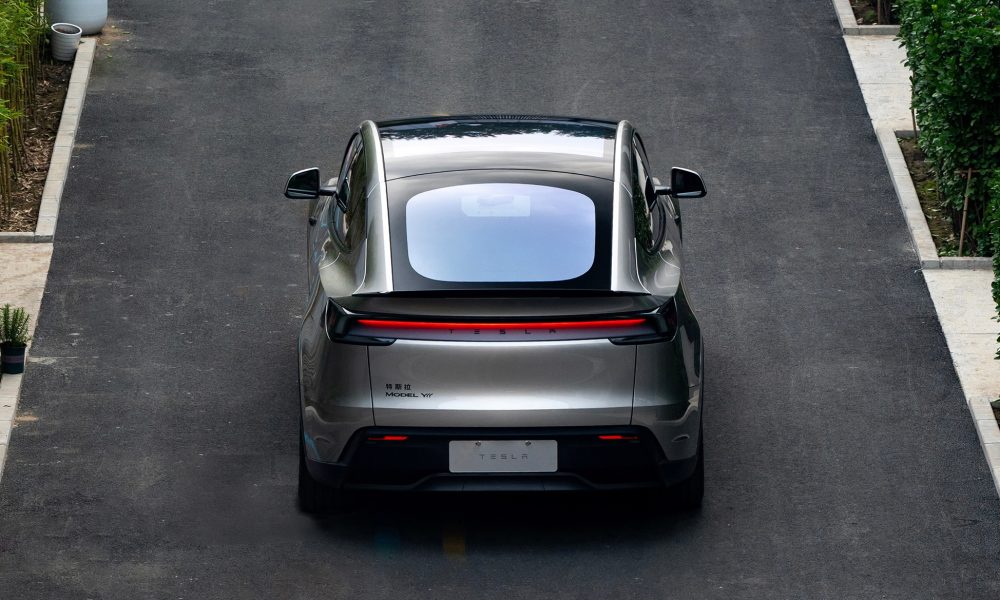
In fact, China EV Marketplace will be only too happy to deliver a Tesla Model Y manufactured in Shanghai to a customer in Europe. Why would someone in Europe want to do that when the same model is being manufactured locally in Germany? The newly introduced 6 passenger Model Y L may be a reason. Be the first on your strasse to own one and make all the other folks in your Nachbarschaft jealous!


Volkswagen manufactures cars in China that are not available in the home market, like the ID.6X and ID.6 Crozz. These can now be imported to Europe for those who want something different. The Chinese made ID.3 is available through the online portal for about €24,000, including VAT — about €6000 less than a domestically-produced ID.3.

Pluses & Minuses​

So why isn’t everyone doing this? Because price is not the only factor when buying a new car. As Electrive points out, these cars come without dealer support. Warranties? Fugeddabowdit. Parts? Nope. Service? Bring your car to the nearest dealer in Shenzen. If your car turns itself into a brick one fine morning, who you gonna call? Do you speak Cantonese?

Since these vehicles are all built to Chinese specifications, they will be equipped with the Chinese GB/T charging standard, not the CCS2 connection commonly used in Europe. They need an adapter so that they can be charged at CCS2 charging points, which may affect charging performance. In addition, all controls will be labeled in Chinese and the vehicle’s operating system will be based on Chinese standards, which cannot easily be converted to other languages. Restrictions on use are also possible if the systems or apps can only communicate with Chinese servers.

In addition to the prices quoted, China EV Marketplace charges $400 to clear each car through customs. Then each will need to be homologated to show it meets the local vehicle codes of the country in which it will be registered. Readers may recall that some Europeans have imported Tesla Cybertrucks to countries where safety standards are more relaxed but encountered problems when they tried to drive them in other nations where safety regulations are more rigorous. China EV Marketplace will take care of the homologation process for a fee — $1500 to $4000, depending on the model and country it is going to.


In theory, customers can satisfy customs and homologation chores themselves, but that takes time and effort. When all is said and done, the extra fees and bureaucratic hassles may diminish the benefits of importing a car from China. However, the lure of having something no one else has is an intangible that you can’t put a price on.

EV Trucks, Too​

Lots of Americans are importing kei trucks from Japan, where the diminutive vehicles are popular because they are cheap and fit on crowded streets. The kei trucks must be 25 years old before they can be legally imported to the US, and they arrive with no warranty and no parts or service network to support them, although such services are beginning to develop. People take a risk when they buy them, but they serve a market niche that domestic manufacturers choose to ignore.

chengshi-x2-evmarketplace_chinacrunch_04.jpg
Credit: China EV Marketplace
Speaking of trucks, China EV Marketplace will import a battery-electric Changan X2 mini box truck from Shenzen to your European country of choice at a cost of $8,090. This trucklet is perfect for inner city deliveries, but there is more to the story. Shipping can add $2,200 to $8,000 to the price, depending on destination.

The customs clearance fee is $400 and the homologation fee is $3,000. The GB/T to CCS2 charging adapter is $990. Add it all up, and the low cost truck quickly more than doubles in price. Still, if it fits a particular purpose and there are no other electric vehicles that are suitable, it may be worth it.

China EV Marketplace
Credit: China EV Marketplace
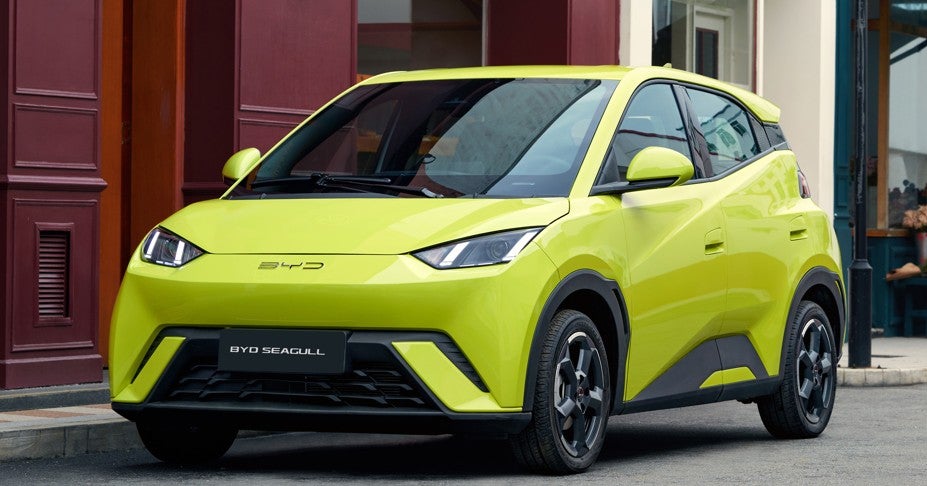
Then for those who prefer Jeep-like vehicles, there is the Baojun Yep, available in orange, green, or black for $11,200 plus tariffs, shipping, customs clearance, homologation, and charging adapter. The BYD Seagull, sold as the Dolphin Surf in Europe, costs $10,200 plus tariffs, shipping, and all the other necessaries, but it sells in Europe for $22,900, so importing one can still save customers a significant amount of money. Will a BYD dealer in Europe service it? That’s a question you should ask before you put your money down.

China EV Marketplace has been active in the United States, but will soon cease operations there. According to reports, sales figures have plummeted due to tariffs. So far, only around 30 vehicles have been sold in the US and those were to commercial customers for comparison purposes.

The Role Of Importers​

Historically, vehicle importers have played an important role in the international auto business. For many years, Max Hoffman was the US importer for BMW automobiles, with a celebrated showroom in New York City. Brumos Porsche in Jacksonville was instrumental in building the Porsche reputation for world class race cars. Luigi Chinetti was responsible for introducing the Ferrari marque to US customers, especially through his North American Racing Team (NART).

Importing cars and trucks is big business. A little known Massachusetts auto dealer by the name of Ernie Boch made a deal to be the exclusive importer of Subarus east of the Mississippi, a move that made him a wealthy man. He used to have a yacht, the Empress Subaru, that sometimes visited Newport, RI. It was notable because it had a Subaru stowed on deck, where it could be lifted ashore via a special hoist.

Those early Subarus were ugly little cars and many of Ernie Boch’s competitors thought he was crazy to get involved with an obscure Japanese automaker. Will Chine EV Marketplace become a part of automotive history? Check back in 20 years for the answer to that question.
 

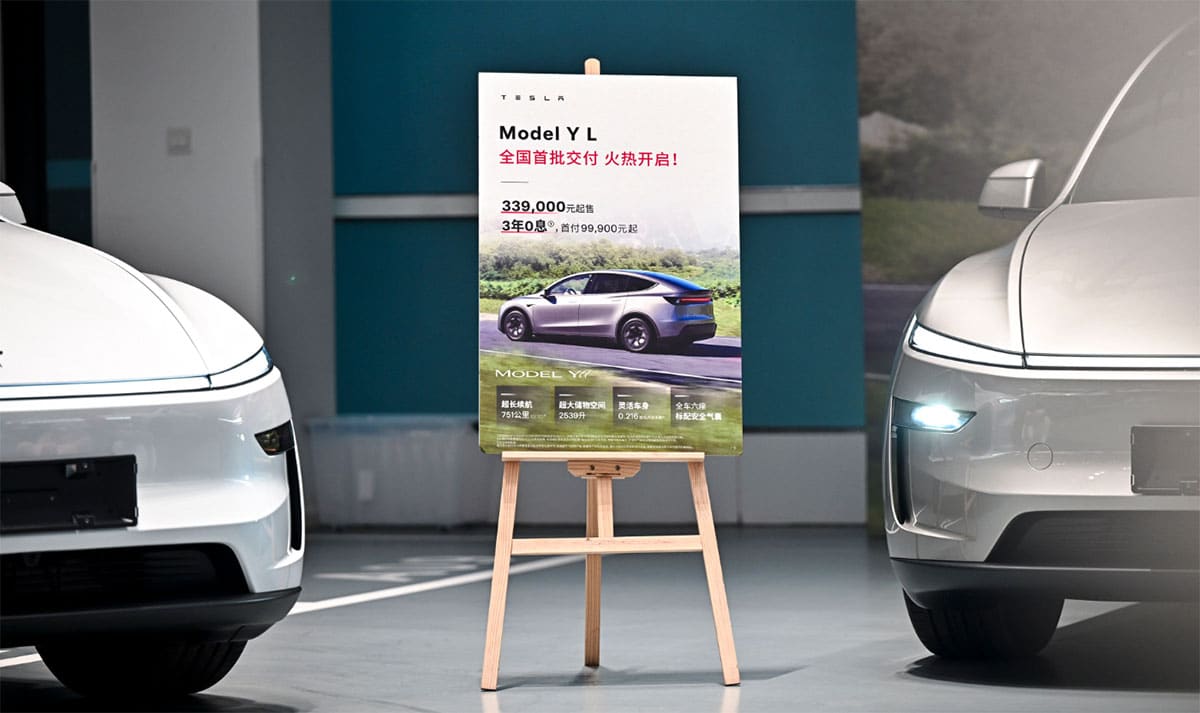
Tesla Model Y L averages nearly 10,000 daily orders in China since launch, report says​


The launch of the six-seat Model Y L SUV (sport utility vehicle) appears to be improving Tesla's (NASDAQ: TSLA) sluggish performance in China.

Since its August 19 launch, Model Y L orders have reached 120,000 units, averaging nearly 10,000 daily orders, local media outlet Cailian reported yesterday, citing a Tesla salesperson.

This figure aligns with information gathered by some analysts.

On August 27, Deutsche Bank cited dealer feedback in a research note as saying that Tesla China's new order flow in August were expected to increase by about 100 percent month-on-month, reaching about 130,000 units.

This growth is primarily driven by the launch of the new six-seat long-wheelbase SUV Model Y L, Deutsche Bank stated.

The strong sales of the Model Y L demonstrate significant market demand for large six-seat SUVs, Cailian quoted an unnamed industry insider source as saying.

Meanwhile, Tesla faces intense competition from domestic brands in the Chinese market and urgently needs a new growth driver, the source added.

Persistent pressure in overseas markets is another reason Tesla is intensifying its focus on China, the insider noted.

Tesla launched the Model Y L in China on August 19 and announced on September 2 that deliveries had commenced.

Customers who order the six-seat SUV are expected to receive deliveries in October, according to Tesla China's website.

The entire Model Y lineup now offers three variants in China: the entry-level rear-wheel-drive Model Y, the long-range all-wheel-drive Model Y, and the six-seat Model Y L, with starting prices of RMB 263,500 ($36,890), RMB 313,500, and RMB 339,000 respectively.

Both five-seat versions have estimated delivery times of 1-3 weeks after ordering, per Tesla China's website.

Tesla China sold 83,192 vehicles in August, including units sold domestically and exported overseas, according to data released Tuesday by the China Passenger Car Association (CPCA).

This represents a 4.04 percent decrease from the 86,697 units sold in the same month last year, though it marks a 22.55 percent increase compared to July's 67,886 units.

Tesla China's monthly sales volume, including exports, from October 2024 to August 2025 showed year-on-year declines in all months except June, which saw a 0.83 percent increase, according to data compiled by CnEVPost.

Tesla's August delivery figures in China and export numbers from its Shanghai factory are currently unavailable.
 

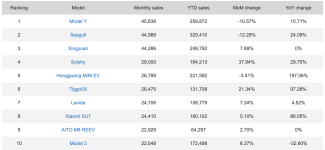
July, 2025 auto sales ranking of Models​


2025/8/28 0:00:00 Gasgoo
Shanghai (Gasgoo)- Sales of the Model Y amounted to 45,838 units, up 10.71% year on year, the first on July, 2025 auto sales ranking of Models, according to the July sales data of the China Passenger Car Association. Sales of the Seagull amounted to 44,989 units, up 24.09% year on year, ranking second on the list while its YTD sales totaled 329,410 units. July sales of the Xingyuan reached 44,286 units, and ranking third on the list while its YTD sales were 249,792 units. (Note: Data here refers to sales of cars, SUVs and MPVs made and sold in China.)

topSellingCarsChina.png


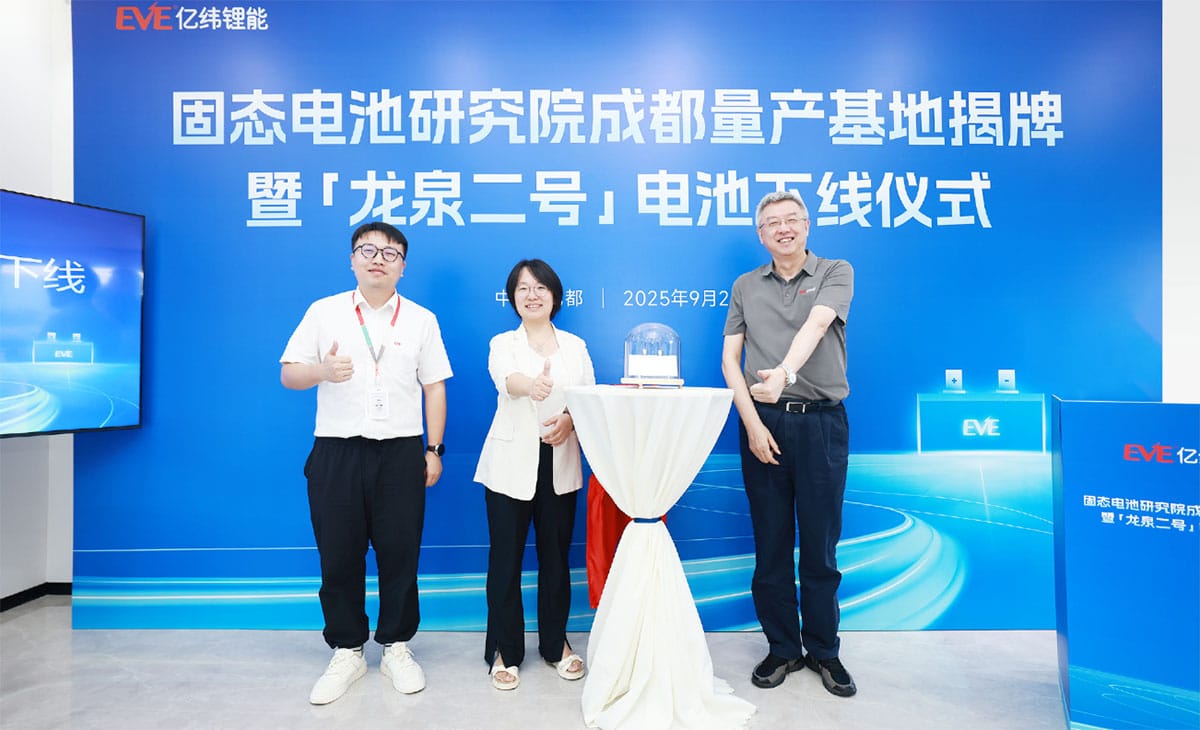
Eve Energy’s new facility will cover an area of about 11,000 m² and is intended to deliver around 500,000 cells per year once production is fully ramped up. Construction is to take place in two phases, with the first to be completed by December 2025. At that time, a production capacity for 60 Ah batteries is planned.

Phase two will be completed one year later in December 2026. Following the completion of the factory, it is to achieve an annual production capacity of 100 MWh. This is considered a “crucial step forward” by the company to advance its solid-state battery industrialisation. Eve plans to achieve an energy density of 400 Wh/kg and 1000 Wh/L for solid-state batteries by 2025. By 2026, battery production for hybrid vehicles is also planned to start.

The battery cells that Eve Energy is planning to manufacture at its new facility are ‘Longquan II’ 10 Ah solid-state battery cells with an energy density of up to 300 Wh/kg or 700 Wh/L. The manufacturer states that the battery cell is primarily intended for humanoid robots, unmanned aerial vehicles for use at low altitudes and high-quality AI devices.
 
Volvo CEO Is Predicting Chinese Dominance Of Our Automotive Future
BY MATTHEW DEBORD SEPT. 9, 2025 12:05 PM EST

intro-1757431312.webp

Volvo

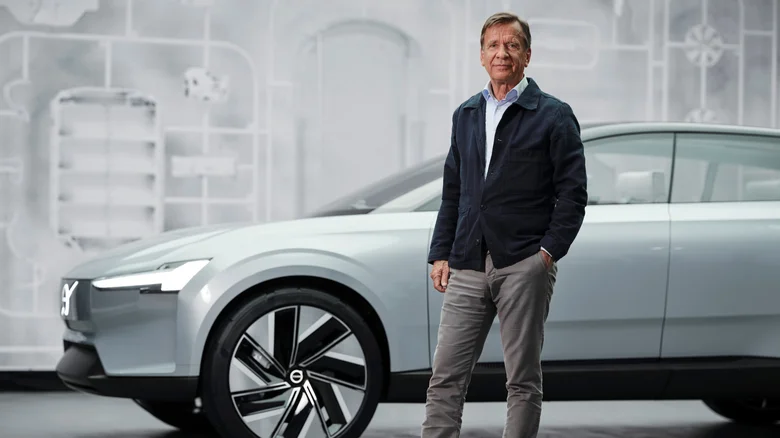
It's fair to say that recently unretired Volvo CEO Håkan Samuelsson has some special insight when it comes to China and the car business, so when he says that the Middle Kingdom is going to set the pace for our automotive future, he should be taken seriously. China's Geely controls Volvo, and Samuelsson has seen up close how rapid the country's rise has been over the past decade. From a Bloomberg interview (via Automotive News), here's a taste of his comments:

There will be new dominant players, exactly as Ford, GM, Toyota and Volkswagen were in the old world. In the new world, there will be two or three very strong Chinese brands. That makes the room for the old ones tougher. So, this will trigger a [wave of] restructuring. Some companies will adapt to new circumstances and survive. Others will not.

Ouch! Samuelsson clearly thinks Volvo will make it, but he also isn't hemming and hawing when it comes to difficulties the brand faces. In the same Bloomberg interview, he offers a cavalcade of urgent changes and thorny challenges, ranging from Volvo's need to concoct an interim electrification strategy that leans on hybrids to figuring out how to navigate the China factor in the face of U.S. tariffs.

Excessive competition in China
Volvo
Samuelsson obviously doesn't think the current structure of the Chinese market will persist. There are too many brands, with spectacular domestic growth powered by the anticipated size of the market overall. If you look around the world, you see U.S. and European markets that have peaked. The only major market that can promise massive growth is China, and so that's where the focus naturally falls.

Increasingly, Western automakers are surrendering to China's onslaught of domestic players and retreating from selling their cars in the local market. Their concern now is that China will try to solve its problem of manufacturing overcapacity by dumping vehicles on primarily the European market, attempting to grab share with low prices. The U.S. is less vexing both because of the tariff wall and the fact that Americans are the only people in the world who favor, at scale, great big SUVs and pickup trucks that run on gas. Samuelsson is 74 years old and has seen this movie before; he knows that consolidation will create Chinese winners and losers, and that the winners will ultimately be quite powerful.

What is Volvo's role in this?
Volvo
Volvo is lucky that it has backing from Geely, and if you read between the lines of his comments, you can tell that Samuelsson knows it. But like other small, offbeat brands such as Jaguar, Maserati, and Aston Martin, – small, Volvo's position is precarious. Yes, it posted some good numbers for EV sales in 2024, but with government incentives disappearing in the U.S., that performance could be hard to repeat. Most of its sales are still in Europe, and that region is setting up to be the industry's main battlefield, with the Chinese cars coming in droves.

What Volvo has going for it, of course, is the Geely factor combined with brand value that's still pretty solid. That's why it can still sell more than 750,000 cars a year. It doesn't entirely need to go all-in (yet) with EVs, thanks to a diverse powertrain strategy that also features plug-ins and hybrids. That said, the conundrum for the future is to figure out where Volvo fits in a radically altered automotive landscape. Success would probably mean sticking around as a respectable player in a China-dominated future, much as it did in the past when the U.S., Japan, and Germany ruled the world.

Read More: https://www.jalopnik.com/1963236/volvo-ceo-predicting-chinese-dominance/
 

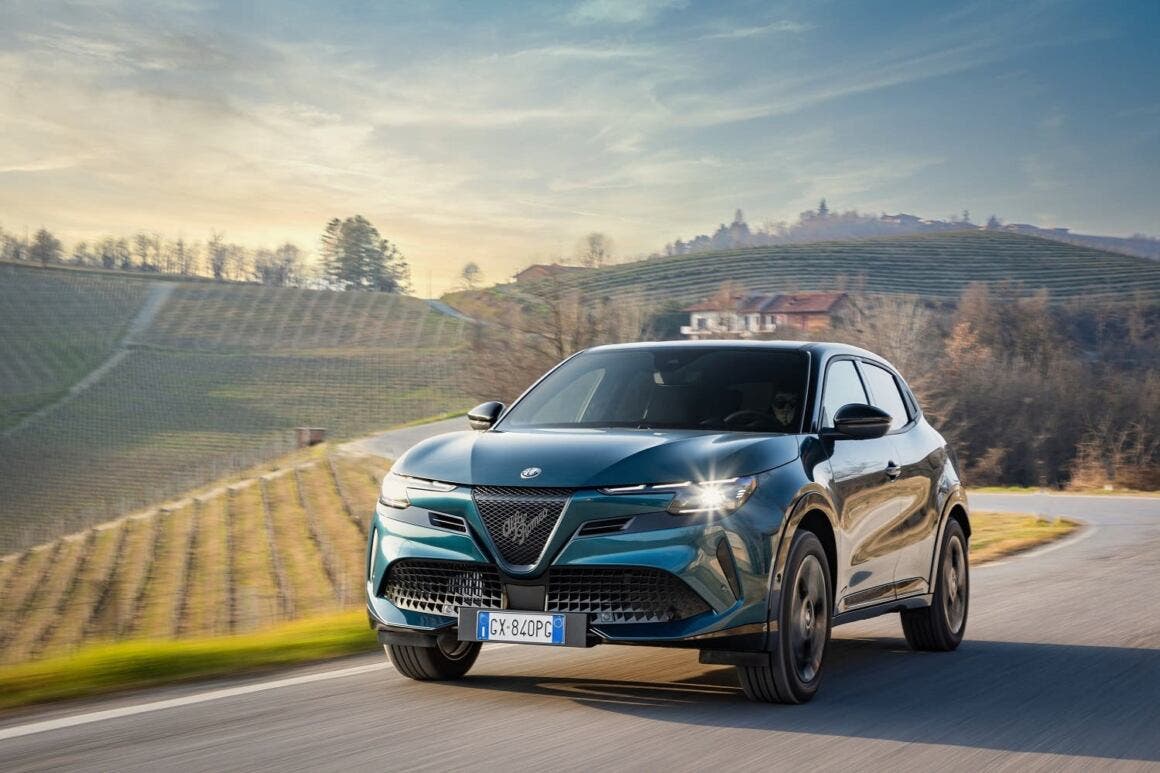
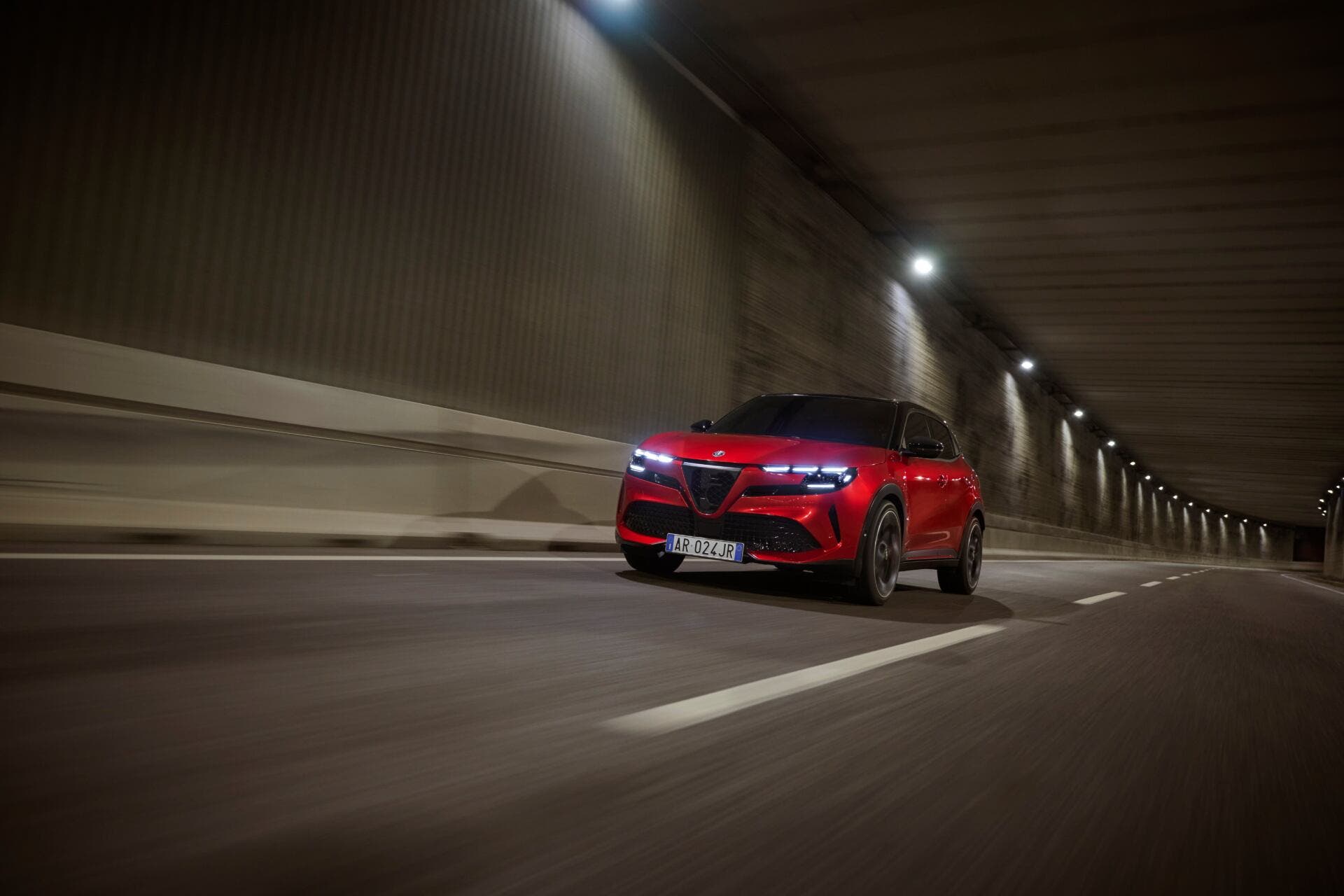
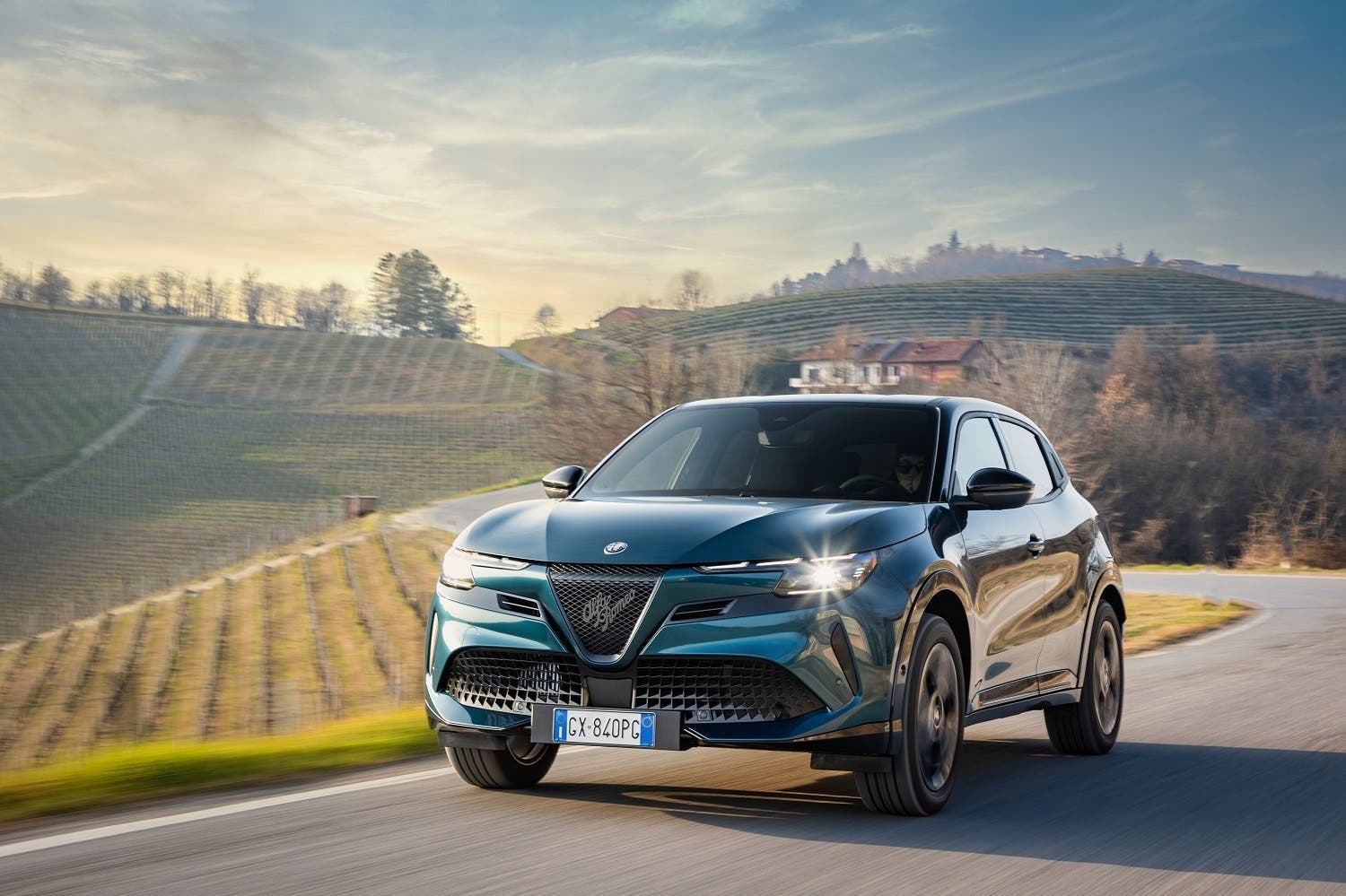
World Car Awards 2026: Chinese cars dominate, but Alfa Romeo Junior also makes the list

Francesco Armenio
September 9, 2025
Chinese brands dominate the 2026 World Car Awards shortlist, while the Alfa Romeo Junior stands out as Italy’s contender.

Alfa Romeo Junior Ibrida Q4


The influence of Chinese automakers on the global market continues to grow, and the latest confirmation comes from the prestigious 2026 World Car of the Year competition. The international jury has released the provisional list of candidates and, out of 48 models, no fewer than 24, half the total, carry the badge of Chinese brands. It’s a clear signal of the industry’s increasing weight on the global stage. Adding a touch of Italian flair to the mix is the Alfa Romeo Junior.

Chinese cars lead World Car Awards 2026 entries, but Alfa Romeo Junior joins the race​


Alfa Romeo junior

The compact model from the Biscione has earned a spot on a shortlist that, for now, includes just nine European cars, highlighting the widening gap with Asia. The list, however, remains subject to changes, as eligibility requires production volumes above 10,000 units per year, a price considered accessible, and availability in at least two of the world’s major markets, Europe, China, India, the United States, Japan, Korea, or Latin America, across at least two continents between January 2025 and March 2026.

The candidates include established names like BMW, Mercedes, Hyundai, Kia, Nissan, and Honda, alongside rising players such as Nio, Zeekr, Xiaomi, and VinFast. Alongside the Alfa Romeo Junior, other European entries include the new Skoda Superb, Mercedes CLA, and Opel Grandland. Still, Asia dominates the lineup, with brands like BYD, MG, and GAC each fielding multiple contenders.

With this first list published, the road to the award officially begins. In November, the 90 international jurors will gather in Pasadena, California, to test-drive the cars. On January 6, the top ten overall finalists will be announced, along with five nominees in each special category: World Electric Vehicle, World Luxury Car, World Performance Car, World Urban Car, and World Car Design of the Year.

The selection will then be narrowed down to three models per category on March 3, leading up to the final ceremony on April 1, 2026, at the New York Auto Show. For the eighth consecutive year, the competition will be sponsored by Brembo, underscoring its ties to Italian excellence in automotive components. As Italy’s standard-bearer, the Alfa Romeo Junior carries solid hopes of standing out among the contenders.


Tesla (TSLA) Rival BYD Warns of “Bloodbath” in China’s EV Market​


BYD (BYDDF), a major rival to Tesla (TSLA) in the electric vehicle market, warned that Beijing’s crackdown on deep discounts will drive many competitors out of China’s auto industry. At the Munich Motor Show, BYD executive vice president Stella Li said China’s market, with about 130 EV and hybrid brands, is far too crowded. She noted that “even 20 OEMs is too much.”

Her comments come as Beijing moves to stop aggressive price wars, which officials say are hurting profits and adding to deflation. Without discounts to attract buyers, smaller carmakers are likely to struggle. Consulting firm AlixPartners expects that by 2030, only about 15 EV and hybrid brands in China will still be financially strong.

BYD Cuts Sales Outlook

BYD has already felt the pressure from China’s tougher market conditions. The company recently lowered its full-year sales goal to 4.6 million vehicles for 2025, down from an earlier goal of 5.5 million, citing rising competition. The downgrade follows a 30% drop in quarterly profit after Beijing tightened rules on supplier payments and discounting.

Citi also lowered its outlook for BYD, now projecting sales of 5.4 million cars in 2025, compared with a prior estimate of 7.2 million. For 2027, the forecast was reduced to 6 million units, down from 8.4 million. BYD sold 4.3 million cars in 2024.

Despite the near-term weakness, Li said the company should benefit as price wars ease and buyers choose cars based on tech and driving features. She added that profits are expected to “remain strong,” though more Chinese automakers will likely look overseas to capture growth.

Overseas Expansion Gains Pace

BYD is moving ahead with overseas plans, with production in Hungary set to start later this year.

Other Chinese firms are also pushing into Europe. State-owned Changan recently launched in the UK, while Leapmotor is working with Stellantis (STLA) to sell EVs in Europe. Still, executives caution that producing cars in Europe is tough due to high labor and energy costs.
 

Updated: 2025-09-15 12:04

XPeng has started production in Magna International's factory in Graz, Austria, home to the Mercedes G-Class, as the Chinese NEV carmaker accelerates its global expansion.

The company said its first European production program started in the third quarter of 2025, with the Magna plant rolling out XPeng G6 and G9 sport-utility vehicles. Additional models are slated to follow as XPeng expands its European lineup.

The move comes as XPeng's overseas momentum builds. Since entering Europe in 2021 through Norway, the Guangzhou, Guangdong province-based automaker has expanded to more than 46 markets worldwide.

Overseas deliveries reached 18,701 units in the first seven months of 2025, up 217 percent from a year earlier.

In Europe, XPeng became the top-selling Chinese brand in the mid-to-high-end pure-EV segment in the first half, registering more than 8,000 vehicles.
 

Zeekr 7X - New Benchmark of SUV's !?​


To view this content we will need your consent to set third party cookies.
For more detailed information, see our cookies page.


New Zeekr 7X EV outputs 784hp and has up to 802km range​

In terms of intelligent driving, the roof is mounted with a lidar. Zeekr previously announced that some models of the new Zeekr 7X will be equipped with the Nvidia Thor-U chip to realize advanced driving assistance features such as high-speed NOA, city NOA, and multi-scenario assisted parking
 

September 15, 2025

Sales of Chinese-made vehicles, including exports, rose by over 16% year-on-year to 2.857 million units in August 2025, after declining by 5% to 2.453 million units a year earlier, according to passenger car and commercial vehicle wholesale data compiled by the China Association of Automobile Manufacturers (CAAM). Domestic sales rose by 15% to 2.246 million units last month, while exports increased by 20% to 611,000 units.

The Chinese government has stepped up its stimulus measures this year to boost domestic vehicle sales, including increasing vehicle trade-in incentives which primarily favour new energy vehicle (NEV) sales. The country’s vehicle market has also responded to strong price competition among domestic manufacturers and numerous new model launches this year.

The government recently confirmed that it will continue to fund its current subsidy programmes at least until the end of 2025, but has ordered local vehicle manufacturers to rein in their excessive discounting, which is seen as damaging the profitability and prospects of the country’s smaller, less established electric vehicle (EV) brands.

In the first eight months of 2025, total sales of China-made vehicles increased by almost 13% to 21.128 million units, up from 18.766 million a year earlier, including a 13% rise in domestic sales to 16.836 million units, with exports also rising by 13% to 4.292 million units. Overall sales of passenger vehicles increased by 14% to 18.341 million units, while commercial vehicle sales rose by 4% to 2.787 million units.

Sales of new energy vehicles (NEVs) rose by over 37% to 9.622 million units year-to-date, accounting for over 45% of total deliveries by the country’s automakers. Battery electric vehicle (BEV) sales surged by 46% to 6.154 million units, while plug-in hybrid vehicle (PHEV) sales rose by 22% to 3.468 million units – with growth slowing sharply in the last several months. Domestic NEV sales rose by 31% to 8.091 million units year-to-date, while exports rose by 87% to 1.531 million units.

Overall vehicle production in the country increased by almost 13% to 21,050 million units year-to-date, compared with 18.674 million in the same period last year.
 

LEWL AUTO AS Becomes First in Norway to Import Xiaomi Electric Vehicles​

09-17-2025 09:38 PM CET

Drammen, Norway - 17 Sep, 2025 - LEWL AUTO [https://lewl.no] AS proudly announces that it has become, according to its own statement, the first dealership in Norway to import Xiaomi electric cars. Based in Drammen, the dealership will offer local test drives, warranty support, and financing options for customers in Viken and throughout Norway.

Xiaomi, widely recognized as one of the world's leading technology brands in consumer electronics and software, is now entering the automotive market with groundbreaking electric vehicles. Its first production models, the Xiaomi SU7, are already making headlines across Europe and Asia for their innovation, range, and performance.

The Xiaomi SU7 boasts a CLTC range of 670 kilometers, making it one of the most competitive EVs in its category for long-distance travel. In addition, its fast-charging capability of up to 96 kW enables quick and convenient recharging on the go. Perhaps most impressive is its acceleration: the SU7 can sprint from 0 to 60 mph in just 1.98 seconds, putting it in the ranks of the world's fastest electric cars.

LEWL AUTO [https://lewl.no] AS has now opened its order books, with expected delivery times ranging from 10 to 12 weeks. Norwegian customers eager to explore this next-generation vehicle can book a local test drive in Drammen starting today.

"The combination of price, range, and power makes Xiaomi EVs especially relevant for Norwegian customers," says Liam, General Manager at LEWL AUTO AS. "We are proud to be the first to bring Xiaomi Norge to Drammen and to provide drivers with a new standard of technology, performance, and value in the electric car market."

Meeting Norwegian Market Demand

Norway continues to lead the world in electric vehicle adoption, with EVs making up the majority of new car sales in recent years. The government's strong support for sustainable transportation, combined with a network of public charging infrastructure, has made the country an ideal market for cutting-edge EVs like the Xiaomi SU7.
 

Who will dominate the automotive industry in 2026? This is what the data reveals

China's case is exceptional. In the last five years, its automotive industry has consolidated a complete ecosystem of manufacturing, innovation, and marketing

AUTOMOTIVE INDUSTRY CANVA
CANVA

The automotive industry is undergoing an unprecedented structural transformation. Factors such as electrification, automation, shifts in regional demand, and trade conflicts—stemming from the tariffs imposed by Donald Trump in the United States—are redefining who leads the global market for automobiles, vehicles, and cars. The latest report by Statista, titled “Trends in der Automobilindustrie”, offers a clear snapshot of how the pieces will move on this highly competitive board toward 2026.

How many vehicles will be sold worldwide in 2026?​

According to the Statista dossier, sales of light vehicles reached 78 million units in 2024, and the figure is expected to rise to 80 million in 2026. However, this growth is uneven and driven mainly by the Asian region, with China playing a leading role.

Global projections by region:​

  • Asia-Pacific: 41.9 million units estimated in 2026.
  • North America: around 19.1 million.
  • Western Europe: 11.8 million.
These three regions account for most of the market and will be decisive in shaping the future automotive agenda.

China leads the growth of the automotive industry​

The case of China is exceptional. Over the past five years, it has consolidated a complete ecosystem of manufacturing, innovation, and commercialization of electric vehicles (EVs), enabling it to become the country with the largest number of electric cars in circulation: more than 31 million units in 2024.

In addition:

  • China controls more than 50% of the global electric vehicle fleet.
  • Local brands such as BYD and Xiaomi are gaining market share not only in their home country but also in emerging markets.
  • Its charging infrastructure is growing rapidly, with plans to expand to more than 15 million public and private chargers by 2030.
This is not only about volume, but also about technological integration, government support, and a young, connected consumer base that quickly adopts new technologies.

Will the United States be able to compete in an increasingly electrified market?​

The United States maintains a solid position, with projected sales of more than 19 million light vehicles in 2026. However, it faces a slower transition toward electrification:

  • Hybrid and electric cars still represent a smaller percentage of total units sold.
  • American brands such as Ford and GM have invested in new electric models but have yet to achieve the volume leadership of their Chinese counterparts.
  • Tesla, the exception, remains the most important player in terms of global market capitalization, surpassing one trillion dollars in 2025.
Nevertheless, the lag in charging infrastructure, high battery costs, and internal political tensions regarding climate change limit the mass adoption of electric vehicles in the short term.

Europe and the automotive industry in 2026​

Europe remains a key region thanks to its capacity for innovation and its regulatory framework that promotes the green transition. Germany, France, and Italy maintain technological leadership, although their market is not growing as fast as Asia’s.

Statista’s data outlines some trends in the so-called Old Continent:

  • The European Union projects a progressive phase-out of internal combustion cars by 2035.
  • Volkswagen, BMW, and Mercedes-Benz are leading developments in electrification, autonomous driving software, and connected features.
  • Despite this, European consumers are showing growing skepticism about the high prices of EVs and “on-demand” digital features.
The challenge for Europe will be to maintain its reputation for quality and technology without losing ground to emerging brands that are more aggressive in pricing.

What impact do tariffs have on automotive competition?​

One of the factors that will most influence the geography of the automotive market is tariffs and trade restrictions, especially between China, the United States, and the European Union.

  • The EU has imposed additional tariffs on Chinese electric vehicles to protect its local manufacturers, arguing unfair competition due to state subsidies.
  • The United States has also taken similar measures as part of its protectionist policy, limiting the import of Chinese vehicles.
These decisions aim to curb the expansion of brands like BYD or Great Wall Motors in the Western market, but they could also raise the price of electric cars, slowing down their global adoption.

What will happen with hybrid cars?​

Amid electrification, hybrid cars continue to play an important role as a transitional technology. According to Statista:

  • As of 2024, 66% of vehicles sold still use gasoline engines.
  • Hybrids represent a viable alternative for markets with limited infrastructure or consumers concerned about EV range.
This type of unit is more widely accepted in regions such as Latin America, Japan, or parts of Eastern Europe, where the transformation process will be more gradual.

Which countries will set the pace in automotive innovation?​

Beyond sales volume, leadership in the automotive industry of the future will also depend on the ability to innovate in areas such as software, artificial intelligence, and cybersecurity.

  • Germany leads in advanced driver assistance systems (ADAS) development.
  • China is making strong progress in the implementation of AI and intelligent voice assistants, both in vehicles and connected services.
  • The United States, through Tesla, leads the development of autonomous driving technologies and vehicle data management.

Who will win the automotive race in 2026?​

China will be the dominant country in the automotive industry in 2026, driven by its leadership in electric vehicles, hybrid cars, and technology adoption. This applies both in terms of volume and accelerated growth.

The United States will maintain its relevance thanks to Tesla and a strong domestic market, while Europe will play a key role as a benchmark in quality, environmental regulation, and software.

However, the board is in motion. Factors such as tariffs, access to strategic raw materials, and consumer behavior will be key to determining who manages to maintain their position and who will fall behind.
 

BYD Launches World’s 1st Mass-Produced 1,000v Electric Bus Platform, Targets Global Expansion​

To view this content we will need your consent to set third party cookies.
For more detailed information, see our cookies page.
 

Users who are viewing this thread

Latest Posts

Back
Top