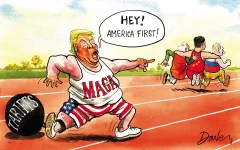
Trump threatens 100% tariffs on BRICS nations over US dollar replacement plans

Even Canada had imposed reciprocal tariffs. The India situation is still playing out, but the punitive tariffs would not have been imposed if they had surrendered like most other countries.

Even in the US, the opulent minority, like Elon Musk, mostly think his policies are stupid. The elite enrichment is happening through other forms of corruption, but the trade policy is just plain stupidity that hurts everyone and benefits no one. Ironically, the ones who support it the most are the white trash MAGA idiots who will get hurt the most when stagflation hits.

Canada is instead devaluing its currency with no other venue.
Elon is not the opulent... his business took a hit in the big beautiful bill... the subsidies have been removed. However, it was counter to his politics as well... smaller government, manageable debt and homogeneous society.

Enough from me.
 
US-China G2 Confirmed : India was on the US-China dinner menu

George Friedman on Why Trump’s Tariffs on India Are Part of a Wider Geopolitical Game​


To view this content we will need your consent to set third party cookies.
For more detailed information, see our cookies page.
 
It does look more or more like the big boys has come to some kind of understanding.

That the days smaller powers can win favor by leverage their rivalry by playing one side against another has become increasing more difficult.

Is this multi-polar? I think that the if the number of poles is small and that all of them can actually find way to accept others and not try to overwelmingly "win" against another pole, a jointly managed world would probably be safer.

Obviously currently world had not reached an equilibrium state and turbulence is expected. Just pray that none of them decided to deliberately go to war to stake clout. And countries seem to get the message to tread carefully and avoid provocation unless they think becoming canon folder like ukraine is what is best for itself.
 
You wrote such a long essay to dilute and turn people's attention away from my topic: INDIA. Not Russia, Not China........ INDIA. Focus on this when responding.

India's screwed itself since the 5 day war. Period. There is no such thing as a "marriage" between the US and India. The divorce has happened. Now you'll have to pray Republicans don't stay in power in the next turn. You'd already pissed them off by doing terrorism in Canada and India. So these things were to happen.

You are India obsessed to such an extent that you are turning on your blinkers to realpolitik. This entire tariff thing isn't about any specific country. It's about a megalomaniac wanting to be the Supreme Leader and wanting to show the world the power of his light sabre.
 
Trump’s tariff war puts US brand globally 'in the toilet' and pushes India closer to China: Jake Sullivan
1000053557.webp


Jake Sullivan criticizes Donald Trump's trade offensive against India, warning it could damage US-India relations and push India closer to China. Trump's tariffs, imposed in response to India's Russian oil imports, have strained ties and prompted India to seek closer relations with Beijing.

Former US national security advisor Jake Sullivan has launched a sharp attack on Donald Trump’s latest trade move against India, warning that the “massive trade offensive” risks undoing years of work to bring New Delhi closer to Washington – and instead pushing it into Beijing’s orbit.


Speaking on The Bulwark Podcast with Tim Miller, Sullivan accused Trump of turning America into a “big disruptor” in the eyes of its allies. He said that while Washington was once seen as a steady hand, it is now viewed as unreliable, even as China gains credibility.
“When I go to these places now and I talk to leaders, they are talking about derisking from the United States,” Sullivan said. “They now see the US as the big disruptor, the country that can’t be counted on. China has moved ahead of the United States in popularity in a whole lot of countries… the American brand globally is in the toilet.”

The thaw in India-China relations carries significant consequences for the US, which had spent decades under successive administrations cultivating New Delhi as a counterbalance to China’s rise. That strategy was disrupted when Trump imposed 50% tariffs on Indian exports over its Russian oil imports, a sudden move that startled Modi’s government.
Henry Wang, president of the Center for China and Globalization think tank in Beijing, said relations between India and China are in an “up cycle,” and as leaders of the Global South, “they have to really speak to each other.”
“Trump’s tariff war on India has made India realize that they have to maintain some kind of strategic autonomy and strategic independence,” he said.
This month, China eased curbs on urea shipments to India — the world’s largest importer of the fertilizer.
Although initial volumes are small, the trade could expand, easing global shortages and prices. China relaxed the ban in June but had maintained restrictions on India until now.


Sullivan pointed to India as the clearest example of Trump’s missteps. Washington, he said, had worked on a bipartisan basis to build a strategic partnership with New Delhi, particularly to counter China’s growing influence. But Trump’s sudden tariff hikes have strained those efforts.
“Take a look at India,” Sullivan said. “Here’s a country we were trying to build a deeper and more sustainable relationship with. Now you have got President Trump executing a massive trade offensive against them and the Indians are saying, ‘Well, I guess maybe we have to go show up in Beijing and sit with the Chinese because we’ve got to hedge against America.’”
Evan A. Feigenbaum, a former US Deputy Assistant Secretary of State for South and Central Asia under George W. Bush, had earlier this month written on how the India-US foundation is now under serious strain. Writing in Emissary, Carnegie’s publication on global affairs, Feigenbaum says Donald Trump’s recent moves could unravel twenty-five years of work.
The US-India relationship, once touted as a cornerstone of global democratic cooperation, is beginning to look fragile. And it’s not because of a war or a failed summit. It’s because of tariffs, tweets, and what one expert calls a toxic blend of “blunt coercion,” “gross interference,” and “a cynical effort to ‘blame India’.”
Also Read: 'A slow-motion catastrophe': Trump is setting fire to decades of US-India diplomacy
Feigenbaum had warned that Donald Trump is “in the process of dismantling” the very relationship that US diplomats, Indian leaders, and multiple administrations painstakingly built since the early 2000s.

Economic impact of tariffs​

The critique comes days after the US imposed a steep 50% tariff on Indian exports, effective August 27. The duties – the highest levied against any country – are set to hit Indian sectors like textiles, jewellery, and mechanical appliances, raising fears of lost jobs and slower growth.
Trump defended the decision as retaliation for India’s continued purchase of Russian oil. However, analysts say the trigger may be more personal. A report by investment banking firm Jefferies suggested the escalation stems partly from Trump’s anger over not being allowed to mediate in the India-Pakistan conflict earlier this year. Agricultural disputes between the two nations have also deepened the rift.
Also Read:
America’s mistake with PM Modi is making trade personal
For Sullivan, the damage goes beyond economics. He argued that Trump’s actions hand China a diplomatic victory, with Beijing now able to present itself as a more responsible player on the global stage.
“One year ago, China was on the defensive,” Sullivan said. “Now, countries are basically saying the US can’t be counted on, and China is looking like the adult in the room.”

More criticism from Washington​

White House trade adviser Peter Navarro has also intensified his attack on India’s oil policy, saying New Delhi is fuelling Russia’s war in Ukraine. Speaking to Bloomberg Television, he declared, “India is helping feed the Russian war machine. I mean Modi’s war, because the road to peace runs, in part, through New Delhi.”
He accused India of profiting at the expense of American consumers by purchasing discounted Russian crude. Linking tariffs directly to energy policy, he said, “It’s real easy. India can get 25 per cent off tomorrow if it stops buying Russian oil and helps to feed the war machine.”
Navarro had earlier called India the “maharaja of tariffs” and described its refiners as a “laundromat for the Kremlin”.
Earlier this month, US Treasury Secretary Scott Bessent had also criticised India’s imports. Speaking to CNBC, he said, “They are just profiteering. They are reselling. This is what I would call the Indian arbitrage — buying cheap Russian oil, reselling it as product. They’ve made $16 billion in excess profits — some of the richest families in India.”
Recently, Bessent told Fox Business that despite the disputes, ties between leaders remain intact. “I do think India is the world’s largest democracy and the US is the world’s largest economy.”
On July 31, Trump had described India and Russia as “dead economies” and signalled that penalties could rise further.
On August 5, Stephen Miller, White House deputy chief of staff, added, “What he (Trump) said very clearly is that it is not acceptable for India to continue financing this war by purchasing the oil from Russia.” He told Fox News, “People will be shocked to learn that India is basically tied with China in purchasing Russian oil. That’s an astonishing fact.”
 
Putin and XI owe Trump a huge debt of gratitude. This bumbling fool just escalated them to undisputed and reliable leaders of the world.
 

Sept. 8, 2025Updated 2:28 p.m. ET

China has racked up a $60 billion trade surplus with Africa so far in 2025, nearly surpassing last year’s total, as Chinese companies redirect trade to the region while President Trump’s tariffs crimp the flow of goods into the United States.

Through August, China exported $141 billion worth of goods and services to Africa, while importing $81 billion, according to data released by the Chinese government on Monday. The widening trade imbalance with Africa stems from surging exports of Chinese-made batteries, solar panels, electric vehicles and industrial equipment.

The swell in exports to Africa, along with record volumes of goods sold to Southeast Asia and Latin America, underscores the resilience of Chinese manufacturers in finding new markets for the products their factories continue to churn out in enormous quantities.

For more than a decade, China has invested heavily in building infrastructure throughout the continent as part of its Belt and Road Initiative. The projects have deepened Beijing’s influence across Africa, creating business opportunities for Chinese companies and providing access to valuable raw materials.

This year, the Trump administration has gutted foreign aid to Africa, leaving a host of health and development initiatives in limbo. It also targeted many African countries with tariffs, including a 30 percent duty on goods from South Africa.

Mr. Trump initially threatened a 50 percent tariff on imports from Lesotho, forcing the textile-dependent country to declare a national state of disaster. The rate was reduced to 15 percent, which is still expected to hurt Lesotho. It was among nearly two dozen African countries that had sent certain products to the United States without any import taxes under a law passed by Congress in 2000.

As the United States pulls back from Africa, China is presenting itself as an economic counterbalance. In June, Beijing said it would waive nearly all tariffs for 53 African countries. China was sending a message: It was committed to nurturing a fruitful, mutually beneficial relationship with Africa.
 

SAO PAULO, Sept 10 (Reuters) - China has approved imports of Brazilian sorghum, an official at Brazil's Agriculture Ministry told Reuters, adding the first cargos could be shipped this year, providing an alternative to plunging U.S. exports sooner than expected by many.

The agreement comes as relations between China and the United States, traditionally a major exporter of sorghum to the Asian country, have sharply deteriorated amid trade tariffs instigated by U.S. President Donald Trump.

"We've watched Brazil become a formidable competitor in other commodities, and this development in sorghum is deeply concerning," said Craig Meeker, a Kansas farmer and past chair of the National Sorghum Producers industry group in the United States.

"U.S. growers have spent 15 years building a relationship with China as a reliable, quality supplier, and we don’t take lightly the potentially devastating impact this could have on our market."

China's General Administration of Customs (GACC) wrote to Brazil saying that its sorghum is eligible for shipment, Eduardo Porto Magalhaes, coordinator for international phytosanitary inspection and certification at the Brazilian ministry, said in an interview on Tuesday.

The designation follows an early August visit by a Chinese delegation to meet with sorghum producers in Brazil. China first announced plans to import Brazilian sorghum during President Xi Jinping's state visit to Brasilia in November 2024, which marked an upgrade in the status of bilateral relations.

"The next steps are to register Brazilian companies, exporters, and producers that intend to export to China. We've already completed the first round of registrations for these companies and will now submit them to China," Magalhaes said.

The first sorghum exports could leave Brazil for China in the next 60 days, Magalhaes said.


September 9, 2025

Sorghum is the third-largest cereal grain in the U.S., and half or more of every crop goes overseas. Exports have long been the lifeblood of our market, supporting prices along with seed companies, elevators, truckers, railroads and exporters across the High Plains and beyond.

For more than a decade, China has been a pillar of that system, buying 70% to 90% of U.S. exports. That reality has changed fast.

In 2025, exports to China are down 97% from last year.
 

U.S. Drugmakers Warn White House of Chaos as Trump Weighs Curbs on China​

Behind the scenes, major pharmaceutical companies and Trump-tied billionaires are furiously lobbying in opposite directions over proposed anti-China measures.

Published Sept. 10, 2025Updated Sept. 12, 2025

The Trump administration has been discussing severe restrictions on medicines from China that, if enacted, could upend the American pharmaceutical industry and availability of everything from generic drugs to cutting-edge treatments.

At the heart of the possible clampdown is a drafted executive order that threatens to cut off the pipeline of Chinese-invented experimental treatments. Major pharmaceutical companies have been buying the rights to drugs created in China for cancer, obesity, heart disease and Crohn’s disease.

The prospect of the order, a draft of which was obtained by The New York Times, has set off furious behind-the-scenes lobbying efforts by two diametrically opposed groups — each with billions of dollars at stake.
 

Huawei unveils chipmaking, computing power plans for the first time​

September 18, 202512:31 PM GMT+8Updated 22 mins ago


SHANGHAI, Sept 18 (Reuters) - Huawei said on Thursday it would roll out four new iterations of its Ascend AI chip over the next three years, breaking years of secrecy to reveal its chipmaking progress and ambitions to compete against Nvidia (NVDA.O), opens new tab for the first time.

The Chinese technology giant has been one of the key players in leading efforts to develop a domestic semiconductor manufacturing industry, aiming to reduce reliance on a supply chain dominated by the United States.

After the launch of the Ascend 910C in the year's first quarter, Vice Chairman Eric Xu said the company plans to launch next year two variants of its successor, the Ascend 950, and follow up with the 960 version in 2027 and the 970 in 2028.

"Computing power has always been, and will continue to be, key to artificial intelligence, and even more so to China's AI," Xu told the annual Huawei Connect conference in the commercial hub of Shanghai, the company said.

The Ascend 950 chip would be powered by the company's own proprietary high-bandwidth memory, he said, revealing that it had overcome a key bottleneck China faced in the technology, limited for years to South Korean and U.S. suppliers.

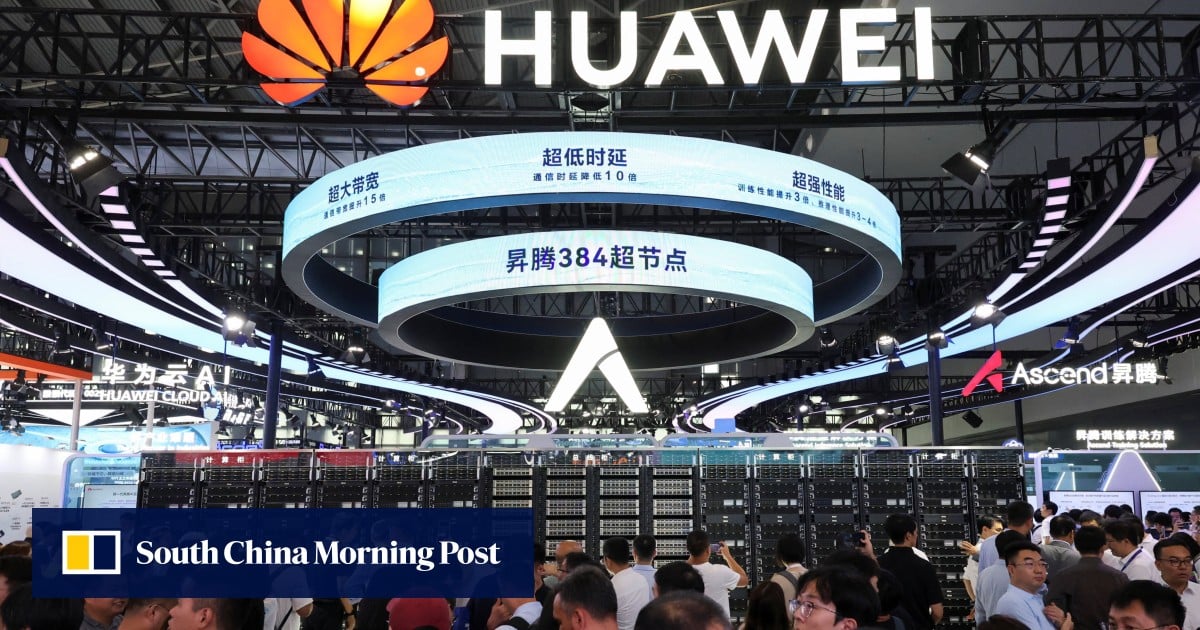
Huawei also plans to roll out new computing power supernodes called the Atlas 950 and Atlas 960, which Xu described as the world's most powerful, supporting 8,192 and 15,488 Ascend chips respectively.

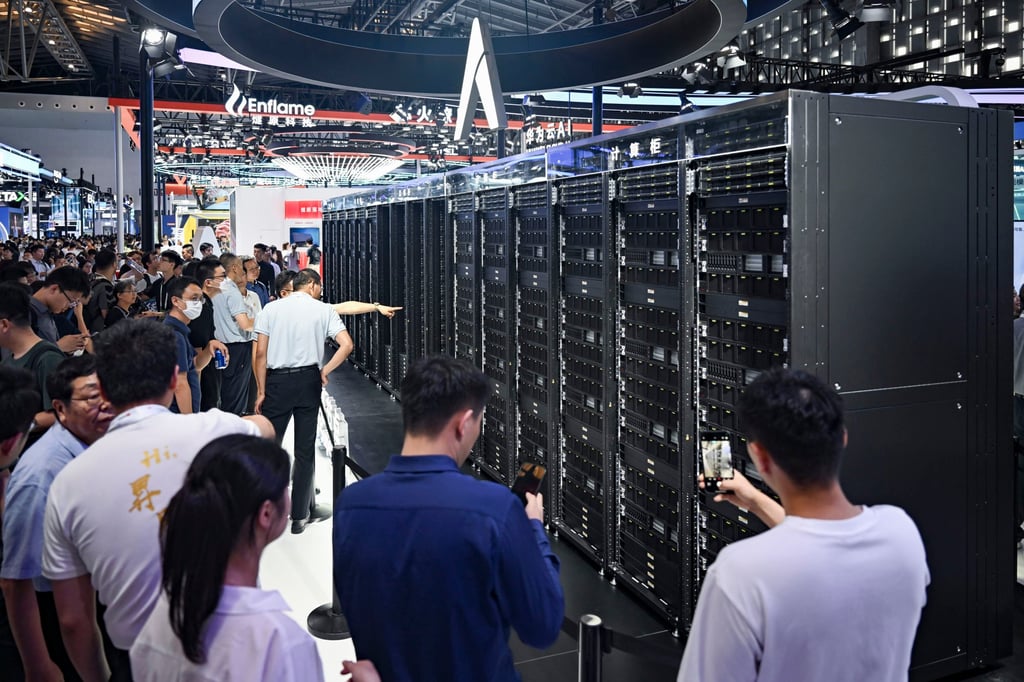
The chips are successors to the Atlas 900, also known as the CloudMatrix 384, which uses 384 of Huawei's latest 910C chips.

On some metrics, the Huawei product outperforms Nvidia's GB200 NVL72, which uses 72 B200 chips, research group SemiAnalysis has said.

Huawei says the system uses "supernode" architecture that allows the chips to interconnect at super-high speeds.

Tech war: Huawei bypasses Nvidia AI chips in computing breakthrough for China​

US-sanctioned Huawei is playing a leading role in finding solutions that can empower China’s AI ambitions without relying on foreign tech​


Published: 11:38am, 18 Sep 2025Updated: 12:22pm, 18 Sep 2025

Huawei Technologies unveiled hardware that it claimed could deliver world-class computing power without using Nvidia’s advanced chips, in a breakthrough that could potentially free the supply chokehold that constrains China’s aspirations in artificial intelligence.

The Shenzhen-based telecoms equipment giant said it had developed the “world’s most powerful” supernode computing cluster using local chipmaking processes, providing a boost to the country’s self-reliance in AI computing and underpinning Beijing’s toughening stance towards Nvidia.

“Huawei is seeking to build a ‘supernode + cluster’ computing solution using chip manufacturing processes available in China to meet the growing compute needs,” Xu Zhijun, Huawei’s deputy chairman and rotating chairman, said at the company’s annual Connect Conference in Shanghai.

Xu also disclosed Huawei’s plans to launch upgraded Ascend AI chips over the next three years, including the Ascend 950PR in the first quarter of 2026, in a timetable that runs in parallel with AI chips from Nvidia and AMD.

Visitors show interest in Huawei’s Ascend AI chip-based CloudMatrix 384 at the World AI Conference in Shanghai, July 27, 2025. Photo: Xinhua

Visitors show interest in Huawei’s Ascend AI chip-based CloudMatrix 384 at the World AI Conference in Shanghai, July 27, 2025. Photo: Xinhua

Xu’s statement comes as Beijing is pressing its tech giants to stop buying the chips that Nvidia tailor-made for China, which were designed to comply with US export restrictions. On Beijing’s new stance, Nvidia CEO Jensen Huang said on Wednesday that he was “disappointed with what I see, but they have larger agendas to work out between China and the United States, and I’m patient about it”.
 

Users who are viewing this thread

Country Watch Latest

Back
Top