Chinese LHD / LAH Carriers - Type 075 & 076 and the future

PLA is not interested in VTOL. China will not develop VTOL, but will use drones.

although we have seen a number of tilt rotor helicopter design and even flying prototype I agree China may not take that route

however I think Type 076 can use EMALS + cats to deploy J35 naval variants

this will allow it to work as a picket carrier freeing up a fully blown aircraft carrier

if China builds say 2 more x Type 076 LHA they can form the following amphibious ready groups (ARG)

1 x Type 076 LHA carrying air component including 6 x fixed wing J35
2 x Type 075 LHD carrying rotary wing including tilt rotor
2-3 x Type 071 LPD carrying the landing forces

3 x ARG
and 3 x Carrier Strike Groups (CSG) with 2 x CATOBAR + 1 x STOBAR by 2030
 

China’s drone-carrying amphibious assault ship the Sichuan expected to start sea trials​

Newly released images of the Type 076 vessel have generated speculation that it is ready for a new phase of testing​

bb725877-c35e-4215-87cf-e8ca5eabfc20_5203c8a9.jpg

Published: 9:00pm, 28 Sep 2025

China’s first drone-carrying amphibious assault vessel, the Sichuan, is expected to begin sea trials soon following the release of new images of the ship.

Pictures circulating on social media showing that the covers had been removed from the Type 076’s electric launch catapult and that a radar system had apparently been installed generated speculation that the ship was ready for the trials.

The release of the images came ahead of the week-long National Day holiday and followed the successful test of the electronic launch catapult and landing gear on the Fujian aircraft carrier earlier this month.

The Sichuan is seen as a key asset for the PLA Navy’s unmanned aerial vehicle operations because of its electromagnetic catapult launch system, and is often described as the world’s first drone carrier.

Amphibious assault ships are likely to play a major role in any military conflict involving Taiwan, and the type 076 ships will be able to expand the operation of PLA strike groups.

Beijing views Taiwan as part of China and has never ruled out the use of force to reunify it with the mainland. Most countries, including its main international partner the United States, do not recognise Taiwan as an independent state, but Washington opposes any attempt to take it by force and is legally bound to supply the island with arms to defend itself.

The Sichuan, which was launched and named in December, is the first type 076 assault vessel, and is able to carry 1,000 marines.

It marks a significant upgrade on its predecessor, the Type 075 assault craft, and has a 260-metre (855 feet) flight deck – larger than the US Navy’s America-class amphibious assault ship and Japan’s Izumo-class helicopter carriers.
Its size means the Sichuan features more internal hangar space for aircraft as well as additional space for launching them.

The Sichuan also stands out from other amphibious assault ships because of its electromagnetic catapult and arresting gear, which are similar to the Fujian carrier’s.

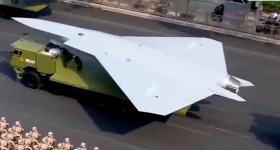
It is expected to carry a fleet of drones, including the GJ-11 stealth uncrewed combat air vehicle, also known as Sharp Sword, which is equipped with electronic warfare systems and precision-guided munitions and can deploy swarming air-launched decoys.

 
PLA is not interested in VTOL. China will not develop VTOL, but will use drones.
As far as I know, several aero-engine research institutes under the AECC have dedicated VTOL research teams. They are also developing VTOL versions of various Chinese turbofan engines. Similar teams also exist within several aircraft design institutes under the AVIC.

From a technical perspective, VTOL technology is essential for Chinese military enterprises. Therefore, at some point in the future (not too far off), we may see a VTOL demonstration fighter.

However, this is at the level of technical research and development, not military application.

As for military applications, I agree that China does not have a strong need for a VTOL manned fighter like the F-35B. However, this VTOL technology could be widely used in areas such as UCAVs, CCAs, and UASFs.

This is similar to China building the J-10B TVC and performing flight demonstrations at air shows. However, we haven't deployed TVC technology on a large scale on the J-10C fighter.
however I think Type 076 can use EMALS + cats to deploy J35 naval variants
Many believe the Type 076 LHD features EMALS, giving it the catapult takeoff and arrested landing capabilities of fixed-wing fighters. Therefore, they believe it might be a smaller aircraft carrier. This has led to various speculations: J-35/J-15T/KJ-600...

However, many overlook a crucial point. There is a fundamental difference between LHDs and aircraft carriers.

An aircraft carrier's core purpose is to launch surface attacks from hundreds of kilometers away. Its design, aircraft composition, fleet organization, and weapons payload are all based on this fundamental element.

An LHD's core purpose is to launch surface attacks at very close range. Everything about it is also based on this fundamental element.

What do we need to strike the enemy at ranges of 50 kilometers and 500 kilometers, respectively?
 
Last edited:
Excellent commentary
To view this content we will need your consent to set third party cookies.
For more detailed information, see our cookies page.


The Type 076 amphibious landing ship with EMALS is China's Strategic "Sweet Spot" for Global Power ProjectionFor years, naval analysts have measured a country’s maritime power in the number and quality of its aircraft carriers. But with the launch of the Type 076 amphibious landing ship, China appears to be pioneering a new, more pragmatic and economically efficient model for projecting air power.

This class of vessel, equipped with an Electromagnetic Aircraft Launch System (EMALS) and optimized for drone operations, represents a strategic "sweet spot" that is both lower in cost and less escalatory than a traditional carrier strike group, making it the ideal tool for projecting influence into regions like the Middle East and the Indian Ocean where the 076 can be stationed at Chinese base in Djibouti.

From an economic perspective, the advantages are clear. A full-sized supercarrier like the Type 003 "Fujian" is a colossal investment, costing billions to build and hundreds of millions annually to operate. A Type 076, while still a major capital ship, is a fraction of that price. This lower cost allows China to build more of them and deploy them more frequently, creating a more sustainable and distributed global naval presence. By using these platforms for regional missions, China reserves its most valuable assets for scenarios that genuinely require the full-scale power of a supercarrier. It’s a shrewd form of risk management that maximizes strategic return on investment.

Strategically, the Type 076 is far less provocative as it is not nuclear powered. The deployment of a full aircraft carrier group, with its accompanying fleet of destroyers and frigates into a region, sends an unequivocal signal of a major power's intent to dominate a theater. This can be met with suspicion and counter-mobilization from other nations. A Type 076, however, can be framed as a multi-role vessel for anti-piracy, humanitarian assistance, or limited amphibious operations. Its primary air wing of stealthy UCAVs, such as the GJ-11 "Sharp Sword," can perform reconnaissance and strike missions far from shore without the high-stakes political signal that launching manned fighter jets would entail. It allows China to maintain a low-profile, "soft-power" presence in sensitive regions while still possessing a credible long-range strike capability.

Moreover, although the US has EMALS technology on its latest Ford class nuclear aircraft carrier it is unable to deploy the EMALS to smaller warships that do not have nuclear power, unlike the Chinese EMALS technology.The combination of its amphibious assault role with a fixed-wing air component gives the Type 076 unprecedented flexibility. It can serve as a floating base for ground forces while simultaneously providing airborne surveillance and precision strike capabilities. This dual-role functionality makes it an ideal platform for addressing the complex, multi-faceted security challenges prevalent in regions like the Indian Ocean or the Persian Gulf, where missions can range from counter-terrorism to protecting vital shipping lanes.

In short, the Type 076 is a powerful statement of China's naval evolution. It is not a replacement for the aircraft carrier, but rather a complementary tool that allows Beijing to project power more flexibly, efficiently, and with less risk of escalation.
https://x.com/Ignis_Rex/status/1972597579222581674/photo/1
 
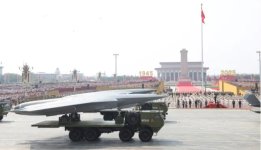
The GJ-11 can carry a 2-ton payload and has a combat radius of 1,500 km.

In comparison, the F-35B has a combat radius of 833km with a 1.5 -ton payload.

Furthermore, the GJ-11's flying wing configuration and top air intake give it a significantly smaller RCS than the F-35B.

Clearly, the class 076, with its GJ-11, boasts significantly greater ground and sea attack capabilities, range, and safety than ships equipped with F-35Bs. Another significant advantage of using drones is that they can attack dangerous air defense networks without concern for casualties. They can even double their attack range by launching suicide attacks if necessary.
 
The Type 076 amphibious landing ship with EMALS is China's Strategic "Sweet Spot" for Global Power Projection

Pakistan-Saudia will need a few of these also. Much cheaper than an AC, yet, you can create a fully functional task force with a couple of accompanying Destroyers and a couple of Frigates and support ships and still have a small air arm. Good for maintaining defensive / offensive posture regionally.
 
As far as I know, several aero-engine research institutes under the AECC have dedicated VTOL research teams. They are also developing VTOL versions of various Chinese turbofan engines. Similar teams also exist within several aircraft design institutes under the AVIC.

From a technical perspective, VTOL technology is essential for Chinese military enterprises. Therefore, at some point in the future (not too far off), we may see a VTOL demonstration fighter.

However, this is at the level of technical research and development, not military application.

As for military applications, I agree that China does not have a strong need for a VTOL manned fighter like the F-35B. However, this VTOL technology could be widely used in areas such as UCAVs, CCAs, and UASFs.

This is similar to China building the J-10B TVC and performing flight demonstrations at air shows. However, we haven't deployed TVC technology on a large scale on the J-10C fighter.

Many believe the Type 076 LHD features EMALS, giving it the catapult takeoff and arrested landing capabilities of fixed-wing fighters. Therefore, they believe it might be a smaller aircraft carrier. This has led to various speculations: J-35/J-15T/KJ-600...

However, many overlook a crucial point. There is a fundamental difference between LHDs and aircraft carriers.

An aircraft carrier's core purpose is to launch surface attacks from hundreds of kilometers away. Its design, aircraft composition, fleet organization, and weapons payload are all based on this fundamental element.

An LHD's core purpose is to launch surface attacks at very close range. Everything about it is also based on this fundamental element.

What do we need to strike the enemy at ranges of 50 kilometers and 500 kilometers, respectively?

yes I understand that

but my question remains

how does the Type 076 LHA recover the GJ-11 UCAV? it must have traps

and if it has EMALS + Traps we cant discount the launch of the J35 which is smaller than J15T and KJ600 AWACS so possible

UCAVS still have higher crash rates compared to a fixed wing manned fighter jet , the gap is closing but the ability to launch a manned aircraft is very crucial
 
It is interesting to see whether the 076 can carry the large, high-performance unmanned fighter jets used in the 93rd military parade. If the 076 can carry the KJ-600 to control the unmanned fighter jets, then it can even complete air defense missions on its own.
WU1.jpgWU2.jpg
 
how does the Type 076 LHA recover the GJ-11 UCAV? it must have traps
and if it has EMALS + Traps we cant discount the launch of the J35 which is smaller than J15T and KJ600 AWACS so possible
The Type 076 LHD has an EMALS catapult and three arresting gears, so it is certain that it has the ability to take off and land fixed-wing manned carrier-based aircraft.
But we need to understand the difference between regular deployment and emergency use.

On any aircraft carrier or airfield, every additional aircraft type requires an entire logistics system.
The Type 076 LHD's interior space is extremely limited. Many people seem to forget that it's a LHD. It routinely accommodates two Type 726 LCACs, numerous amphibious combat vehicles, Marines... and, of course, numerous helicopters and UAVs. All of these weapons require their own maintenance systems...

I have no doubt that the Type 076 LHD has the emergency takeoff and landing capability of the J-15T/J-35/KJ-600, but we cannot interpret this capability as a regular deployment capability.

Many countries have "road runways." These highways can be used to take off and land fighter jets in emergencies, but we shouldn't interpret them as air force bases.
 
The Type 076 LHD has an EMALS catapult and three arresting gears, so it is certain that it has the ability to take off and land fixed-wing manned carrier-based aircraft.
But we need to understand the difference between regular deployment and emergency use.

On any aircraft carrier or airfield, every additional aircraft type requires an entire logistics system.
The Type 076 LHD's interior space is extremely limited. Many people seem to forget that it's a LHD. It routinely accommodates two Type 726 LCACs, numerous amphibious combat vehicles, Marines... and, of course, numerous helicopters and UAVs. All of these weapons require their own maintenance systems...

I have no doubt that the Type 076 LHD has the emergency takeoff and landing capability of the J-15T/J-35/KJ-600, but we cannot interpret this capability as a regular deployment capability.

Many countries have "road runways." These highways can be used to take off and land fighter jets in emergencies, but we shouldn't interpret them as air force bases.

that's true any idea how many GJ-21 UCAVS the Type 076 can accommodate ?

they should restart this program as soon as they have worked out the teething issues

Type 076 is a very valuable platform
 
yes I understand that

but my question remains

how does the Type 076 LHA recover the GJ-11 UCAV? it must have traps

and if it has EMALS + Traps we cant discount the launch of the J35 which is smaller than J15T and KJ600 AWACS so possible

UCAVS still have higher crash rates compared to a fixed wing manned fighter jet , the gap is closing but the ability to launch a manned aircraft is very crucial

Recovery is arrested if you have a fixed wing aircraft / drone operating above a specific weight and engine power. It's much easier to "arrest" a drone with a smaller size than a manned fixed wing jet.

LHD's can't produce power at a scale to launch J-35 type fighters. So the best option would be if China can built a VTOL version. Like what the Japanese are using the LHD's for.

You can't launch a manned jet from an LHD. It can't produce enough power to operate such a powerful EMALS. All that stuff requires a lot more space, engine power and size. LHD don't have all 3.
 
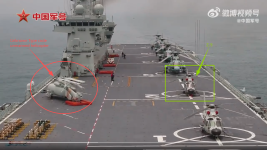
The official video shows an unmanned helicopter of unknown type. Its tail boom is folded. Judging from its appearance, it appears to be much larger than the Z-9 helicopter.
1759204247762.png
Special Note:
This LHD is the second Type 075 LHD. It is numbered 32 and named: Guangxi.
This is a fully commissioned warship in combat readiness. It does not undertake experimental research missions. This means that this unmanned helicopter is already operational.
 
The official video shows an unmanned helicopter of unknown type. Its tail boom is folded. Judging from its appearance, it appears to be much larger than the Z-9 helicopter.
View attachment 150340
Special Note:
This LHD is the second Type 075 LHD. It is numbered 32 and named: Guangxi.
This is a fully commissioned warship in combat readiness. It does not undertake experimental research missions. This means that this unmanned helicopter is already operational.


Isn‘t this an older image showing a Z-20 mock-up?
 

Users who are viewing this thread

Pakistan Defence Latest

Country Watch Latest

Back
Top