Pakistan-Saudi Arabia mutual defense pact: News & Discussion

Announcement of deal baffles experts and former ministers, who say there is no sign of any untapped reserves

Sat 27 Sep 2025 12.00 BST

The newfound camaraderie between the US and Pakistan was on full display this week as Donald Trump welcomed Pakistan’s prime minister, Shehbaz Sharif, and the country’s powerful army chief, Asim Munir, into the Oval Office, heralding them both as “great leaders”.

Having been cold-shouldered by successive US presidents, this was the first time a Pakistani prime minister had been invited to Washington in more than six years. It was also the unprecedented second time this year that Munir – who holds no official government role – held an intimate meeting with Trump, which many took as a telling signal of where the power to cut deals really lies in Pakistan.

Islamabad’s charm offensive with Trump since his re-election has included handing over to the US a high profile member of Islamic State’s affiliate in Afghanistan and publicly crediting the US president with preventing hostilities between India and Pakistan escalating into all-out war, even nominating Trump for the Nobel peace prize for his efforts.

Yet what has appeared most effective is Pakistan’s touting of its allegedly untapped natural resources – namely oil, minerals and gas – for US exploration. In July, Trump wrote on his social media platform Truth Social that “we have just concluded a Deal with the Country of Pakistan, whereby Pakistan and the United States will work together on developing their massive Oil Reserves. We are in the process of choosing the Oil Company that will lead this Partnership.”

The messaging was affirmed by Natalie Baker, the US chargé d’affaires in Islamabad, who told local media that US firms had been “showing keen interest in Pakistan’s oil, gas and mineral sectors, in line with President Donald Trump’s vision”.

Pakistan has already reaped rewards from its promise of oil. After an agreement in August, Trump gave Pakistan a generous 19% tariff on imported goods, the lowest of all south Asia nations and far below the punitive 50% tariffs that its neighbour and nemesis India is facing.

This month, a $500m (£370m) deal for the US to invest in Pakistan’s nascent minerals sector – including copper and rare earths – was announced, despite a lack of definitive data on the country’s mineral reserves.

Yet it is the promise of oil that has left experts and former government ministers even more baffled. They stress that there is no reliable proof that Pakistan has any substantive, untapped oil reserves, despite years of the world’s biggest oil companies attempting to find them.

Moin Raza Khan, a geoscientist and former managing director at Pakistan Petroleum Limited (PPL), which has been at the forefront of oil exploration, said: “What Trump is claiming about Pakistan’s massive oil reserves has nothing to do with reality. It is without the support of any data or evidence. We don’t even know where these massive reserves would be, as we don’t have any surveys and studies so far that show us.”

Khan was among the experts who emphasised that despite more than half a century of exploration and drilling onshore and offshore, no large-scale commercially viable oil wells had been discovered on Pakistani soil. While some small oil repositories had been found, they produce about 65,000 barrels a day. In comparison, Saudi Arabia produces about 4bn barrels a year.

This is far from the first time that proclamations have been made about Pakistan’s potential as a petrostate. The country imports more than 80% of its oil, which is one of the biggest drains on the state coffers, prompting successive leaders to make a push for oil exploration.

Khan emphasised that over the years, more than 30 international companies, including Total, Shell and ExxonMobil, had come to Pakistan with the hope of finding oil, but had eventually left due to the high cost and security risk of exploration and low reward.

In 2015, a survey by the US energy administration estimated that the lower Indus basin in Pakistan could have 9bn barrels of “technically recoverable oil”, a survey that was recently referenced by Pakistan’s minister of state for petroleum, Ali Pervaiz Malik.

However, that survey has been called into question by oil companies. In 2019, the multinational oil corporations ExxonMobil and Eni worked with PPL to find oil and gas reserves offshore. But after spending more than $100m drilling the Kekra-1 Indus G block, nothing was found except a waterbed.

Khan, who headed PPL during the recent failed oil exploration, said: “A total of only 1.2bn barrels of oil have been discovered so far – which is nothing – and they are claiming they can find 100 times this in just the next three years.

It’s just impossible. There is no magic wand to multiply Pakistan’s reserves.”

Islamabad’s ministry of petroleum declined to comment on questions about Pakistan’s oil reserves.

Despite the lack of any new evidence, the country is pressing ahead with 40 new offshore and 31 onshore blocks for oil and gas exploration, which will be awarded on 31 October. US companies are among those invited for bidding.

GA Sabri, a former federal secretary at the ministry of petroleum and former director general petroleum concession, described the claims of massive oil reserves as a “political gimmick” and was sceptical about the success of the oil block auction.

Much of Pakistan’s alleged untapped oil and gas reserves are said to be in the regions of Khyber Pakhtunkhwa and Balochistan, which are in the midst of insurgencies by Taliban and separatist militants and where foreign companies have been routinely targeted.

Sabri said: “When it comes to exploration of new fields, there are high security risks.”

He emphasised that “even if the US does the drilling and starts now, it will take at least two to three decades and hundreds of millions of dollars to do this exploration – and nobody can say for sure reserves will be found”.

Sabri said the success of Pakistan’s onshore oil drilling was nothing short of “a myth”.
Total BS. A retired Pak Navy officer recently revealed that they did a comprehensive sea-bed survey with a Chinese oceanography ship and huge hydrocarbon deposits under our waters were discovered. I don't know who these brainless experts are making nonsense claims.
 
Now people are asking ,,,,what our own military Generals want from us. Are they only to serve other countries. They treat own nation worst then a dog. Even if they stationed in Saudi Arabia, Pak nation won t get anything ,only good perks and privilege those are on deputation like before. All payments will be landed in Askari Bank. ...what Pak will get ?
Small brains tangled with petty things. Please grow up. Don't disgrace your title.
 
Small brains tangled with petty things. Please grow up. Don't disgrace your title.
get out from small brain big brain theory ... A Pakistani citizen comes first, its easy to lick the powerful ..

To view this content we will need your consent to set third party cookies.
For more detailed information, see our cookies page.


To view this content we will need your consent to set third party cookies.
For more detailed information, see our cookies page.
 

Pakistan seeks to deepen economic ties with Riyadh​

High-level Saudi delegation due to arrive early next month


ZAFAR BHUTTASeptember 28, 20252 min read
facebook twitter whatsup linkded email

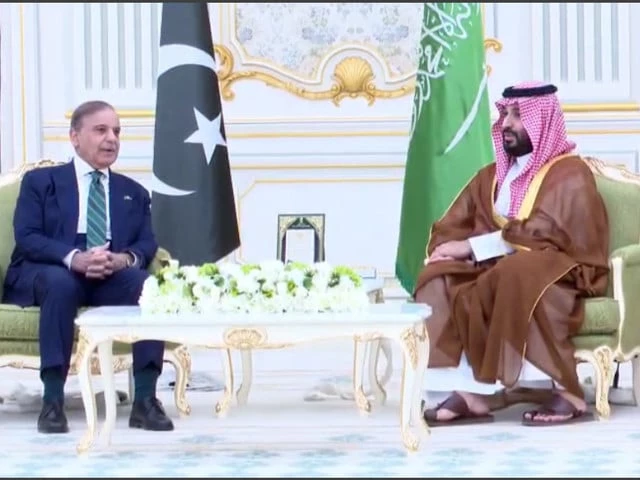
prime minister shehbaz sharif meeting saudi crown prince and prime minister mohammed bin salman photo pm office

Prime Minister Shehbaz Sharif meeting Saudi Crown Prince and Prime Minister Mohammed bin Salman. Photo: PM office


ISLAMABAD:
Following the signing of a defence pact between Pakistan and Saudi Arabia, economic cooperation is being expedited as Pakistan is poised to pitch multibillion-dollar projects in the energy sector and is expected to clinch deals under the “Pakistan Bridge between Gulf Countries and China Concept” in the first week of next month.

Sources told The Express Tribune that a high-level Saudi delegation was due to arrive in early October, when the two sides were expected to sign Memoranda of Understanding (MoUs).

The projects include the revival of a $10 billion oil refinery project, forming partnership for setting up an oil terminal, and onshore and offshore drilling in Pakistan.

Saudi crown prince had visited Pakistan in 2019 during the tenure of the Pakistan Tehreek-e-Insaf (PTI) government and offered to invest $20 billion in different sectors, mainly in an oil refinery. The investment for setting up the refinery in Gwadar was projected at $10 billion.

Recently, Pakistan and Saudi Arabia have signed a defence pact, which is paving the way for boosting cooperation in the energy sector as well.

Pakistan will look for Saudi partnership with state-owned Pakistan State Oil, which has planned to set up an oil terminal in Hub, Balochistan, at a cost of $300 million.
Pakistani exploration companies such as Mari Petroleum and Oil and Gas Development Company (OGDC) are going to seek partnerships in the existing oil and gas blocks to boost production.


“Pakistan’s top priority is to convince the Saudi side to resume work on the $10 billion oil refinery planned in Gwadar,” remarked an official.

Sources said that Pakistan was working on a concept to make Gwadar Port a bridge between the Gulf countries and China. China is a big importer of Saudi oil. Similarly, Pakistan also imports a huge quantity of crude from Saudi Arabia.

The establishment of oil refineries would not only provide opportunities for Pakistani labour, but it would also open avenues for oil exports to China, sources said, adding that Pakistan and China had already signed an MoU to build an oil pipeline. Gwadar Port will also reduce the route for oil supply to China.

Pakistan has formed a working group, which is currently finalising the projects that will be pitched during the visit of the Saudi delegation. Moreover, the Central Asian states are looking at Gwadar Port for the import of oil and other goods.

The maritime affairs minister on Friday held a meeting, attended by representatives of other ministries to finalise the upcoming projects.

The minister urged senior officials from key ministries and state institutions to identify projects for rapid funding, propose regulatory reforms, and strengthen trade and transport corridors.
He announced the creation of a joint working group, bringing together maritime, communications, railways and defence ministries, to produce a short list of workable projects in its first meeting next week.

Discussions focused on integrating Karachi Port, Port Qasim and Gwadar Port with regional transport corridors through rail, road and air networks.

The maritime minister underlined the importance of the long-delayed ML-I railway project, expected to boost freight and passenger traffic from Khyber-Pakhtunkhwa to southern ports and said Pakistan must match its development agenda with the connectivity needs of partner countries.

Other ministries outlined their own connectivity priorities. The communications ministry called for laying fibre optic cables along railway lines and expanding submarine cable networks. It also underlined the need for swift completion of the M-6 motorway, which would link Karachi to Sukkur and was described as a missing link on the China-Pakistan Economic Corridor.
 
My simple Question .....

بھائی ہو کیا رہا ہے ؟؟؟

Trump is a businessman he knows business dealings

اب ایسا کیا ہو سکتا ہے جو پاکستان اور باقی دنیا کو نہیں پتہ اور ٹرمپ بھائی اعلان کرتے پھر رہے ہے؟؟؟؟

I want only Pakistanis to think and respond on these questions and because of this write it in Urdu ....
 
My simple Question .....

بھائی ہو کیا رہا ہے ؟؟؟

Trump is a businessman he knows business dealings

اب ایسا کیا ہو سکتا ہے جو پاکستان اور باقی دنیا کو نہیں پتہ اور ٹرمپ بھائی اعلان کرتے پھر رہے ہے؟؟؟؟

I want only Pakistanis to think and respond on these questions and because of this write it in Urdu ....
easy answer, basically now Pak-Saudia is same, so Trump talking about Pakistani oil in Saudi territory.
 
To view this content we will need your consent to set third party cookies.
For more detailed information, see our cookies page.


This was nation number 2. We have 4 more that want to join the pact.

strategic depth ?

From India's sea border to Egypt, that entire area will become our strategic depth. KSA is a big country so the ocean line touching it is big too.
A couple of nuclear attack submarines to come and we will have from KSA to Indian Gujrat's sea border covered with out deterrence.
 
Last edited:
strategic depth ?
"Strategic Trap" .....

- We are witnessing mess in Middle East, Iran is a confirm target of Zionist and US

- Iran is infiltrated & infested with allies of Israel in it's defence, political circles because of which they have recent attacks on their soils

- Just 2-3 years back Iran militarily attacked Pakistan number of times we have reports of support elements harmful to Pakistan's interest by local security apparatus of Iran at Pak-Iran border.

- Rather to Rush things up we must takes steps sensibly and logical manner and rather to include Iran in Pak-Saudi mutual agreement we must deal Iran separately.

- but before that FIRST we must engage each other with series of mutual agreements of cooperation which MUST deal with the sensitivities of both Nations specially related to TERRITORIAL INTEGRATY & SOVEREIGNTY.
 

Users who are viewing this thread

Back
Top