Navigation
Install the app
How to install the app on iOS
Follow along with the video below to see how to install our site as a web app on your home screen.
Note: This feature may not be available in some browsers.
More options
Style variation
You are using an out of date browser. It may not display this or other websites correctly.
You should upgrade or use an alternative browser.
You should upgrade or use an alternative browser.
Pakistan Minerals and Mining Updates
- Thread starter ghazi52
- Start date
More options
Who Replied?

hydrabadi_arab
Trusted Member
The global gold boom’s $150bn final frontier: Pakistan
The Economist article discusses Pakistan's Reko Diq copper-gold mine in Balochistan as a $150bn untapped opportunity amid the global gold boom. It highlights vast reserves, potential for economic growth via $3.5bn recent financing from ADB and others, aiming for production by 2028. However, it warns of challenges like security risks from insurgency, human rights concerns, environmental issues, political instability, and water scarcity that could bury the promise if not addressed swiftly. (347 chars)Now revenue expected $150bn. It was $60bn initially but after gold/copper boom worth of Reko Diq will keep increasing. And more suck reko diqs will be found soon.
HAIDER
THINK TANK: CONSULTANT

China has announced new measures restricting the export of its rare-earth extraction technologies after learning that Pakistan uses Chinese equipment to produce niche metals for the United States.
The new rules, issued by the Chinese Commerce Ministry, cover rare‑earth production, processing and separation equipment, as well as related raw and auxiliary materials. Overseas rare earths producers need to apply for export licenses from the Chinese government to obtain China’s extraction technologies and separation equipment.
The Commerce Ministry and China Customs also released four related documents extending export controls across strategic materials on the same day. The documents said China will:
Beijing’s latest move follows a memorandum of understanding signed on September 8 between the Pakistani government and US Strategic Metals to produce critical minerals in Pakistan. It also precedes a potential meeting between President Xi Jinping and US President Donald Trump during the APEC summit in South Korea later this month.
This position gave Beijing significant strategic leverage as it moved to align trade and resource policies with national priorities. However, this advantage was undermined by Pakistan’s recent decision to sell rare earths to the US.
“The first phase of this deal is envisaged at approximately US$500 million of investments into Pakistan’s critical minerals sector,” the Pakistani prime minister’s office said last month.
The South Asian country has reportedly shipped the first batch of rare earth elements to the US. Chinese media used to describe Pakistan as China’s “iron brother,” meaning that the duo have very close diplomatic and trade relations. Both countries are now developing the China-Pakistan Economic Corridor, a key part of Beijing’s Belt and Road Initiative.
“Pakistan’s five million metric tons of rare earths reserves, worth several trillion dollars, have suddenly become a new focal point in the strategic rivalry between China and the US,” a Shandong-based columnist says in an article titled “Pakistan’s key minerals saved the US defense industry at the last moment.”
“American defense contractors urgently need these rare earths to sustain production of F‑35 fighter jets and nuclear submarines. Meanwhile, China, with 92% of the world’s rare-earth refining capacity, retains control of the key extraction and purification technologies.”
He says that the actual value of underground rare earths lies in the separation technologies because 90% of the 250 rare-earth minerals discovered globally occur in mixed form.
“The extraction and purification of rare earths is like picking black beans from a bowl of sesame,” he says. “Even if the US invests heavily in Pakistan’s rare-earth mining, the final products will likely fall short of military-grade standards without China’s processing expertise.”
“Pakistan may have earned quick money by accepting US investment and granting mining rights for rare earth development,” says a Shanghai-based writer who identifies himself as a financial planner, “but whether this short-term gain will turn into a long-term benefit remains uncertain. Such a deal, made amid major-power rivalry, could prove risky.”
He adds: “It will not be easy for Pakistan to strike a political balance between China and the US, while any misstep could be costly. As long as Pakistan avoids actions that hurt China’s core interests, the foundation of China–Pakistan friendship will remain strong. Pakistan needs to remember who its true brother is.”
Chinese media have praised chemist Xu Guangxian (1920–2015) for separating praseodymium and neodymium with countercurrent liquid-liquid extraction. Xu’s work culminating in his 1974 success took place at a time when China was under Mao Zedong’s control during the Cultural Revolution and facing severe restrictions on scientific research.
Born in 1920 in Shaoxing, Zhejiang Province, Xu graduated from Shanghai Jiaotong University in 1944 and later earned a PhD in physical chemistry from Columbia University in the US in 1951. After returning to China, he taught at Peking University. In 1972 his department received a military assignment to separate the rare earth elements praseodymium and neodymium, which were then difficult to separate because of their similar properties.
Xu completed the task two years later using a countercurrent extraction process, which separates metals by repeatedly washing them through liquid layers with different chemical affinities. He published his findings in 1975 and became a member of the Chinese Academy of Sciences in 1980.
In fact, Xu was not the first to achieve this separation. Austrian chemist Carl Auer von Welsbach first isolated praseodymium and neodymium in 1885 through a process of fractional crystallization. In the mid-1950s, researchers at Argonne and Oak Ridge National Laboratories in the US advanced the science with liquid-liquid solvent extraction, establishing the technical foundation for achieving the 99.9% purity standards that define modern rare-earth refining.
China today maintains a dominant, near-monopoly position in the global supply of neodymium magnets, accounting for more than 85% of total production. These high-performance magnets are indispensable in advanced industries, powering the permanent-magnet motors of Tesla Model 3 vehicles, the flight control systems of F‑35 fighter jets and the vibration motors inside iPhones.
In China, well-known providers of rare earth extraction equipment include Zhengzhou Tiei Extraction Technology and Baotou Shibo Rare Earth Extraction & Equipment Co., Ltd.
Read: China halts US soybean imports to hit Trump’s MAGA supporters
Follow Jeff Pao on Twitter at @jeffpao3
The new rules, issued by the Chinese Commerce Ministry, cover rare‑earth production, processing and separation equipment, as well as related raw and auxiliary materials. Overseas rare earths producers need to apply for export licenses from the Chinese government to obtain China’s extraction technologies and separation equipment.
The Commerce Ministry and China Customs also released four related documents extending export controls across strategic materials on the same day. The documents said China will:
- add synthetic diamond powders, single crystals, diamond wire saws and related equipment to the export control list;
- establish licensing systems for rare-earth separation and extraction technologies and equipment;
- ban exports of specific middle and heavy rare-earth metals, alloys, oxides and compounds;
- restrict exports of lithium-battery components and artificial graphite materials.
Beijing’s latest move follows a memorandum of understanding signed on September 8 between the Pakistani government and US Strategic Metals to produce critical minerals in Pakistan. It also precedes a potential meeting between President Xi Jinping and US President Donald Trump during the APEC summit in South Korea later this month.
‘Iron brotherhood’
China holds a leading position in the global market for critical minerals, particularly rare earths, lithium, cobalt and nickel. It controls more than 60% of global rare earth production, approximately 70% of lithium refining, nearly 70% of cobalt processing and over 90% of battery-grade graphite output. This dominance stems from years of state investment, technological advancements and pursuit of a national strategy centered on resource security and industrial development.This position gave Beijing significant strategic leverage as it moved to align trade and resource policies with national priorities. However, this advantage was undermined by Pakistan’s recent decision to sell rare earths to the US.
“The first phase of this deal is envisaged at approximately US$500 million of investments into Pakistan’s critical minerals sector,” the Pakistani prime minister’s office said last month.
The South Asian country has reportedly shipped the first batch of rare earth elements to the US. Chinese media used to describe Pakistan as China’s “iron brother,” meaning that the duo have very close diplomatic and trade relations. Both countries are now developing the China-Pakistan Economic Corridor, a key part of Beijing’s Belt and Road Initiative.
“Pakistan’s five million metric tons of rare earths reserves, worth several trillion dollars, have suddenly become a new focal point in the strategic rivalry between China and the US,” a Shandong-based columnist says in an article titled “Pakistan’s key minerals saved the US defense industry at the last moment.”
“American defense contractors urgently need these rare earths to sustain production of F‑35 fighter jets and nuclear submarines. Meanwhile, China, with 92% of the world’s rare-earth refining capacity, retains control of the key extraction and purification technologies.”
He says that the actual value of underground rare earths lies in the separation technologies because 90% of the 250 rare-earth minerals discovered globally occur in mixed form.
“The extraction and purification of rare earths is like picking black beans from a bowl of sesame,” he says. “Even if the US invests heavily in Pakistan’s rare-earth mining, the final products will likely fall short of military-grade standards without China’s processing expertise.”
“Pakistan may have earned quick money by accepting US investment and granting mining rights for rare earth development,” says a Shanghai-based writer who identifies himself as a financial planner, “but whether this short-term gain will turn into a long-term benefit remains uncertain. Such a deal, made amid major-power rivalry, could prove risky.”
He adds: “It will not be easy for Pakistan to strike a political balance between China and the US, while any misstep could be costly. As long as Pakistan avoids actions that hurt China’s core interests, the foundation of China–Pakistan friendship will remain strong. Pakistan needs to remember who its true brother is.”
China’s extraction know-how
China’s rare-earth extraction relies mainly on solvent extraction and ion exchange, processes that use small chemical differences to separate elements. In solvent extraction, organic liquids pull specific rare earths from solution, while ion exchange uses resin columns to isolate ions. Because these elements share similar properties, separation is challenging and often requires additional steps, such as centrifugation or electrolysis, to achieve high purity.Chinese media have praised chemist Xu Guangxian (1920–2015) for separating praseodymium and neodymium with countercurrent liquid-liquid extraction. Xu’s work culminating in his 1974 success took place at a time when China was under Mao Zedong’s control during the Cultural Revolution and facing severe restrictions on scientific research.
Born in 1920 in Shaoxing, Zhejiang Province, Xu graduated from Shanghai Jiaotong University in 1944 and later earned a PhD in physical chemistry from Columbia University in the US in 1951. After returning to China, he taught at Peking University. In 1972 his department received a military assignment to separate the rare earth elements praseodymium and neodymium, which were then difficult to separate because of their similar properties.
Xu completed the task two years later using a countercurrent extraction process, which separates metals by repeatedly washing them through liquid layers with different chemical affinities. He published his findings in 1975 and became a member of the Chinese Academy of Sciences in 1980.
In fact, Xu was not the first to achieve this separation. Austrian chemist Carl Auer von Welsbach first isolated praseodymium and neodymium in 1885 through a process of fractional crystallization. In the mid-1950s, researchers at Argonne and Oak Ridge National Laboratories in the US advanced the science with liquid-liquid solvent extraction, establishing the technical foundation for achieving the 99.9% purity standards that define modern rare-earth refining.
China today maintains a dominant, near-monopoly position in the global supply of neodymium magnets, accounting for more than 85% of total production. These high-performance magnets are indispensable in advanced industries, powering the permanent-magnet motors of Tesla Model 3 vehicles, the flight control systems of F‑35 fighter jets and the vibration motors inside iPhones.
In China, well-known providers of rare earth extraction equipment include Zhengzhou Tiei Extraction Technology and Baotou Shibo Rare Earth Extraction & Equipment Co., Ltd.
Read: China halts US soybean imports to hit Trump’s MAGA supporters
Follow Jeff Pao on Twitter at @jeffpao3

FuturePAF
THINK TANK: CONSULTANT
Can’t blame China for doing this; they laid out their red lines:
It will be up to western mining companies to supply the equipment and training from now on, for at least their projects.
He adds: “It will not be easy for Pakistan to strike a political balance between China and the US, while any misstep could be costly. As long as Pakistan avoids actions that hurt China’s core interests, the foundation of China–Pakistan friendship will remain strong. Pakistan needs to remember who its true brother is.”
It will be up to western mining companies to supply the equipment and training from now on, for at least their projects.
Last edited:
HAIDER
THINK TANK: CONSULTANT
Is There a Hidden Kill Switch in the F-35? China’s Rare Earth Monopoly Raises Red Flags
T
he F-35 Lightning II is one of the most advanced stealth fighter jets ever built. It is currently used by the military forces of ten countries, while ten more nations are waiting to receive their first batch.
At the heart of this issue are rare earth elements and other critical materials. These are special minerals used in the construction of key components of the F-35, such as its radar, weapons systems, engine, and avionics. Without these materials, the jet cannot function. The problem is that China dominates the global supply and refining of these rare earths. This means that if China stops exporting these elements, the United States cannot build or maintain its most advanced fighter jet.
The same issue affects many other American defense platforms. These include advanced submarines like the Virginia-class, powerful naval ships such as the Arleigh Burke-class destroyers, armed drones, smart bombs, and cruise missiles like the Tomahawk. Even radar systems that track enemy aircraft rely on these rare minerals. If China decides to stop supplying them, many of these powerful systems may become useless.
No ‘Kill Switch’ in F-35! U.S. Slams Conspiracy Theories on Fighter Jet Shutdown
In 2023, China reduced exports of gallium and germanium-related products. In 2024, it further cut exports of antimony. Then, from December 2024, it completely stopped exporting all three elements to the United States. On top of that, other key materials like tungsten and tellurium have been added to a restricted export list.
When trade tensions increased earlier this year, China responded to new US tariffs by blocking exports of even more rare earth materials. These included samarium, gadolinium, terbium, dysprosium, lutetium, scandium, and yttrium. China also restricted the sale of magnets made from these elements, which are used in nearly all advanced weapons systems.
If these export bans continue, the impact on US defense manufacturing will be severe. Without these materials, many weapons platforms, including aircraft and naval ships, cannot be built or repaired. The supply chains are deeply dependent on China, not just for mining, but also for processing and refining — areas where China holds a clear advantage.
Britain’s Nuclear Comeback: UK to Buy F-35A Fighter Jets Amid Rising Russian Threat
The problem doesn’t end with the F-35. The newly announced F-47 fighter and other upcoming weapons platforms will require even more of these critical elements. Currently, the United States lacks the capacity to process or refine these materials on its own. Much of the mined material, even from friendly countries like Australia, is still sent to China for processing before being re-imported.
Even the widely used F-16 fighter jet and Minuteman III nuclear missiles rely heavily on antimony — 81% of which is refined in China. Other minerals like magnesium, graphite, and fluorspar are also key to weapons manufacturing and are refined mostly in China.
No modern technology exists today that can fully replace these rare earth elements in defense applications. This means that the United States is in a vulnerable position. If China decides to fully block the export of these materials, the advanced weapons built by the US — including the powerful F-35 — could become non-functional.
This kind of control acts like a “kill switch.” Although it’s not an electronic button that shuts down the aircraft, it is a strategic advantage that can silently stop America’s defense capabilities by cutting off the supply of materials essential to keep those systems running. This hidden vulnerability makes the F-35 and many other platforms heavily dependent on an external force that the United States cannot control.
T
he F-35 Lightning II is one of the most advanced stealth fighter jets ever built. It is currently used by the military forces of ten countries, while ten more nations are waiting to receive their first batch.
China’s Control Over Critical Materials Behind F-35
Known for its powerful radar systems, precise targeting, and stealth technology, the F-35 is often seen as a symbol of modern air power. However, a serious concern has come to light — the aircraft may have a hidden weakness or “kill switch,” and it is not under American control. Instead, China holds the real power to bring the entire F-35 program to a standstill.At the heart of this issue are rare earth elements and other critical materials. These are special minerals used in the construction of key components of the F-35, such as its radar, weapons systems, engine, and avionics. Without these materials, the jet cannot function. The problem is that China dominates the global supply and refining of these rare earths. This means that if China stops exporting these elements, the United States cannot build or maintain its most advanced fighter jet.
The same issue affects many other American defense platforms. These include advanced submarines like the Virginia-class, powerful naval ships such as the Arleigh Burke-class destroyers, armed drones, smart bombs, and cruise missiles like the Tomahawk. Even radar systems that track enemy aircraft rely on these rare minerals. If China decides to stop supplying them, many of these powerful systems may become useless.
No ‘Kill Switch’ in F-35! U.S. Slams Conspiracy Theories on Fighter Jet Shutdown
The Rare Earths Monopoly and China’s Strategic Advantage
China produces and refines most of the world’s rare earth elements. It is responsible for over 90% of the world’s refining capacity and almost all of the refined gallium — a material important for GPS systems and radars. Gallium, along with germanium and antimony, are used in missiles, lasers, and nuclear systems. China has been tightening its grip over these materials in recent years.In 2023, China reduced exports of gallium and germanium-related products. In 2024, it further cut exports of antimony. Then, from December 2024, it completely stopped exporting all three elements to the United States. On top of that, other key materials like tungsten and tellurium have been added to a restricted export list.
When trade tensions increased earlier this year, China responded to new US tariffs by blocking exports of even more rare earth materials. These included samarium, gadolinium, terbium, dysprosium, lutetium, scandium, and yttrium. China also restricted the sale of magnets made from these elements, which are used in nearly all advanced weapons systems.
If these export bans continue, the impact on US defense manufacturing will be severe. Without these materials, many weapons platforms, including aircraft and naval ships, cannot be built or repaired. The supply chains are deeply dependent on China, not just for mining, but also for processing and refining — areas where China holds a clear advantage.
Britain’s Nuclear Comeback: UK to Buy F-35A Fighter Jets Amid Rising Russian Threat
America’s Defense Systems and the Hidden Dependence
A single F-35 fighter uses more than 400 kilograms of rare earth elements. These materials are embedded in its engine, radar, electronic warfare systems, and weapons. The situation is even more alarming when we look at other systems. A Virginia-class submarine uses about 4,200 kilograms of rare earths, while an Arleigh Burke-class destroyer contains about 2,360 kilograms. Drones, cruise missiles, and smart bombs also use rare earth magnets for their engines, targeting, and guidance systems.The problem doesn’t end with the F-35. The newly announced F-47 fighter and other upcoming weapons platforms will require even more of these critical elements. Currently, the United States lacks the capacity to process or refine these materials on its own. Much of the mined material, even from friendly countries like Australia, is still sent to China for processing before being re-imported.
Even the widely used F-16 fighter jet and Minuteman III nuclear missiles rely heavily on antimony — 81% of which is refined in China. Other minerals like magnesium, graphite, and fluorspar are also key to weapons manufacturing and are refined mostly in China.
No modern technology exists today that can fully replace these rare earth elements in defense applications. This means that the United States is in a vulnerable position. If China decides to fully block the export of these materials, the advanced weapons built by the US — including the powerful F-35 — could become non-functional.
This kind of control acts like a “kill switch.” Although it’s not an electronic button that shuts down the aircraft, it is a strategic advantage that can silently stop America’s defense capabilities by cutting off the supply of materials essential to keep those systems running. This hidden vulnerability makes the F-35 and many other platforms heavily dependent on an external force that the United States cannot control.

Aggregate
Registered Member

I think the upcoming meeting between Trump and Xi holds the key to this all.
If they strike a deal, then Pakistan will have no problem and whole Pakistan/US/China relation can strengthen.
If not then Pakistan will have very very tough choices to make as Us is elemental to Pakistan's strategic interests and China is elemental to Pakistan's economy and security. Lets hope Trump/Xi solve their issues to mutual benefit of all.
If they strike a deal, then Pakistan will have no problem and whole Pakistan/US/China relation can strengthen.
If not then Pakistan will have very very tough choices to make as Us is elemental to Pakistan's strategic interests and China is elemental to Pakistan's economy and security. Lets hope Trump/Xi solve their issues to mutual benefit of all.
HAIDER
THINK TANK: CONSULTANT
Whole Chinese mineral project in Baluchistan is now handover to US. Many Chinese engineers killed during construction of those facilities and network roads ...I think the upcoming meeting between Trump and Xi holds the key to this all.
If they strike a deal, then Pakistan will have no problem and whole Pakistan/US/China relation can strengthen.
If not then Pakistan will have very very tough choices to make as Us is elemental to Pakistan's strategic interests and China is elemental to Pakistan's economy and security. Lets hope Trump/Xi solve their issues to mutual benefit of all.
HAIDER
THINK TANK: CONSULTANT
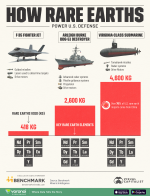
How Rare Earths Power U.S. Defense
Rare earth elements (REEs) are essential components of advanced military technology. From fighter jets to submarines, these critical minerals power key systems that give the U.S. military a strategic edge.This infographic explores the quantities of REEs used in major U.S. defense platforms and highlights their specific applications in modern warfare.
It reveals how different military equipment relies on rare earths not just in bulk, but for highly specialized roles, from laser-guided weapons to stealth capabilities.
Key Takeaways
- U.S. military platforms like the Virginia-class submarine and Arleigh Burke destroyer require thousands of kilograms of rare earth elements (REEs).
- F-35 Fighter jets alone use over 400 kg of REEs, essential for weapons targeting systems, lasers, and other advanced onboard technologies.
Rare Earths in the F-35 Fighter Jet
The F-35 Lightning II requires around 418 kg of REEs per unit. These materials are used in advanced weapons targeting systems, radar, and laser technologies. Elements like neodymium and praseodymium are especially important in the permanent magnets that support flight control and stealth functions.[th]
[td]F-35 Fighter Jet[/td][td]418 kg[/td][td]Guided missiles, Lasers used to determine targets[/td]
[td]Arleigh Burke DDG-51 Destroyer[/td][td]2600 kg[/td][td]Advanced radar systems, Missile guidance systems, Propulsion[/td]
[td]Virginia-Class Submarine[/td][td]4600 kg[/td][td]Tomahawk missiles, Radar systems, Drive Motors[/td]Equipment
[/th][th]Rare Earths Used (kg)
[/th][th]Application Examples
[/th]Massive Demand from Naval Platforms
The Arleigh Burke-class destroyer and Virginia-class submarine are two of the U.S. Navy’s most sophisticated vessels. The destroyer uses about 2,600 kg of REEs, while the submarine demands a whopping 4,600 kg. These elements support radar, sonar, missile guidance, and propulsion systems critical for both offensive and defensive missions.China’s Dominance in REE Supply
While these elements are crucial to U.S. defense, more than 70% of REE imports come from China. This dependence on a single geopolitical rival has raised strategic concerns in Washington, with the Trump administration making efforts to diversify supply chains and boost domestic production.
MH.Yang
Trusted Member

On October 13th. In response to a reporter's question, the Chinese Ministry spokesperson clearly stated: Pakistan and the United States' rare earth trade had been communicated with the Chinese government in advance. China did not express any objections. The ore gifted by the government to the US leaders was Pakistan's gemstone raw ore, not rare earth ore.
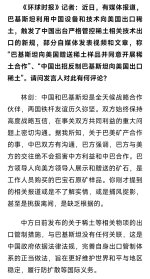
Foreign Ministry Spokesperson Lin Jian: China and Pakistan are all-weather strategic cooperative partners, and the iron-clad friendship between two countries has become stronger over time. The two sides have always maintained a high level of strategic mutual trust and kept in close communication on major issues of common concern. To my, before the mineral cooperation between Pakistan and the US, the Chinese and Pakistani sides have communicated with each other. Pakistan has emphasized that its exchanges with the US will never harm China' interests and China-Pakistan cooperation. The ore samples shown and gifted by Pakistan's leaders to the US leaders were purchased by staff members from Pakistan's gemstone raw ore. The relevant reports you just mentioned are either unaware of the facts, or groundless, or even divisive, and lack any basis.
The export control measures on relevant including rare earths recently released by China have nothing to do with Pakistan. This is a legitimate move by the Chinese government to improve its own export control system in accordance with laws and, aiming to better maintain world peace and regional stability and fulfill international obligations such as non-proliferation.
Foreign Ministry Spokesperson Lin Jian: China and Pakistan are all-weather strategic cooperative partners, and the iron-clad friendship between two countries has become stronger over time. The two sides have always maintained a high level of strategic mutual trust and kept in close communication on major issues of common concern. To my, before the mineral cooperation between Pakistan and the US, the Chinese and Pakistani sides have communicated with each other. Pakistan has emphasized that its exchanges with the US will never harm China' interests and China-Pakistan cooperation. The ore samples shown and gifted by Pakistan's leaders to the US leaders were purchased by staff members from Pakistan's gemstone raw ore. The relevant reports you just mentioned are either unaware of the facts, or groundless, or even divisive, and lack any basis.
The export control measures on relevant including rare earths recently released by China have nothing to do with Pakistan. This is a legitimate move by the Chinese government to improve its own export control system in accordance with laws and, aiming to better maintain world peace and regional stability and fulfill international obligations such as non-proliferation.
nahtanbob
Elite Member

I think the upcoming meeting between Trump and Xi holds the key to this all.
If they strike a deal, then Pakistan will have no problem and whole Pakistan/US/China relation can strengthen.
If not then Pakistan will have very very tough choices to make as Us is elemental to Pakistan's strategic interests and China is elemental to Pakistan's economy and security. Lets hope Trump/Xi solve their issues to mutual benefit of all.
The USA and China are going to be squabbling for a long time
Night Memory
Registered Member

Why are you purposelly lying? Theres no project enlisted in CPEC or anything related to china pakistan partnership that involved making roads to any such facilities. Either show proof or you are just lying.Whole Chinese mineral project in Baluchistan is now handover to US. Many Chinese engineers killed during construction of those facilities and network roads ...
Night Memory
Registered Member
Thanks for sharing this, i suspect the OP has malicious intention.On October 13th. In response to a reporter's question, the Chinese Ministry spokesperson clearly stated: Pakistan and the United States' rare earth trade had been communicated with the Chinese government in advance. China did not express any objections. The ore gifted by the government to the US leaders was Pakistan's gemstone raw ore, not rare earth ore.
View attachment 153804
Foreign Ministry Spokesperson Lin Jian: China and Pakistan are all-weather strategic cooperative partners, and the iron-clad friendship between two countries has become stronger over time. The two sides have always maintained a high level of strategic mutual trust and kept in close communication on major issues of common concern. To my, before the mineral cooperation between Pakistan and the US, the Chinese and Pakistani sides have communicated with each other. Pakistan has emphasized that its exchanges with the US will never harm China' interests and China-Pakistan cooperation. The ore samples shown and gifted by Pakistan's leaders to the US leaders were purchased by staff members from Pakistan's gemstone raw ore. The relevant reports you just mentioned are either unaware of the facts, or groundless, or even divisive, and lack any basis.
The export control measures on relevant including rare earths recently released by China have nothing to do with Pakistan. This is a legitimate move by the Chinese government to improve its own export control system in accordance with laws and, aiming to better maintain world peace and regional stability and fulfill international obligations such as non-proliferation.
HAIDER
THINK TANK: CONSULTANT
Yeah, Chinese here for picnic and charity ...lol... wake up buddy..Why are you purposelly lying? Theres no project enlisted in CPEC or anything related to china pakistan partnership that involved making roads to any such facilities. Either show proof or you are just lying.
Night Memory
Registered Member
Please share proof? Who gave this guy the think tank status. I have worked on CPEC when i was in Pakistan. I wont be surprised if this mal intention has roots in you being a PTI supporter.Yeah, Chinese here for picnic and charity ...lol... wake up buddy..
HAIDER
THINK TANK: CONSULTANT
Edited : waste of timePlease share proof? Who gave this guy the think tank status. I have worked on CPEC when i was in Pakistan. I wont be surprised if this mal intention has roots in you being a PTI supporter.
Last edited:
Pakistan Defence Latest
-
Pak Ship Collides With Indian Navy Unit, Delhi Summons Islamabad's Envoy (13 Viewers)
- Latest: Mujahid
-
 PAF pilot highlights how chinese J10C fighters have left US F16's Obsolete (9 Viewers)
- Latest: MH.Yang
-
-
-
Country Watch Latest
-
-
-

-
-
China’s Massive Stealth Flying Wings Spotted Together At Secretive Test Base (1 Viewer)
- Latest: HERO
Latest Posts
-

-
-
-
 Why India’s oil marketing companies are losing over Rs 500 crore daily (12 Viewers)
- Latest: onlinpunit
-
Pak Ship Collides With Indian Navy Unit, Delhi Summons Islamabad's Envoy (13 Viewers)
- Latest: Mujahid