Russia-Ukraine War - News, Discussions & Updates

Status
Not open for further replies.
Trump — Russia lost one and a half million people in the war and its economy is about to collapse.

Okay. There's one thing I don't understand — why are you so scared and fussing? Just wait a little, things are going well for you, and Ukraine is winning. Why are you rushing around like shit in a hole?

In general, if Russia lost one and a half million people, then it has no army left at all.

So all that's left is to catch a few more Ukrainians running from the manhunters, and then we'll definitely reach the Urals. That is, of course, if there are any Ukrainians left.
To view this content we will need your consent to set third party cookies.
For more detailed information, see our cookies page.

Why you don’t understand? Putin replaces the casualties among russian troops by 1,500 men a day. That information comes from himself. He can constantly replace the losses. As long as he has the money he can run this war until eternity.
 

It seems the clown needs more money to swindle​

NATO is not prepared for war​

That much became apparent last month, when expensive fighter jets were scrambled to shoot down cheap foam drones.


By Sergey Maidukov

Ukrainian writer.
Published On 12 Oct 202512 Oct 2025


FILE PHOTO: A damaged drone lies after falling in the eastern Polish village of Czosnowka, in this picture obtained from social media, in Czosnowka, Poland, September 10, 2025. Dariusz Stefaniuk/via REUTERS THIS IMAGE HAS BEEN SUPPLIED BY A THIRD PARTY. MANDATORY CREDIT. NO RESALES. NO ARCHIVES. BEST QUALITY AVAILABLE. Verification: Reuters was able to independently verify the location the photos were taken from vegetation and telegraph poles that matched verified media coverage from the area and Street View imagery. Reuters was able to independently verify the date by multiple reports and aftermath footage. Additionally, drone identification number appears in multiple images./File Photo/File Photo

A damaged drone is seen near the eastern Polish village of Czosnowka on September 10, 2025 [Dariusz Stefaniuk/Social media via Reuters]
For decades, the North Atlantic Treaty Organization (NATO) prepared for war, confident in its advantage over any adversary. Its member states invested heavily in state-of-the-art weapons. Stealth aircraft, precision weaponry, secretive submarines and city-sized aircraft carriers stood as the guardians of the West.

This power appeared unshakable until recently. On September 10, during another massive Russian aerial attack on Ukraine, more than 20 Russian drones crossed into neighbouring Poland. The NATO member had to scramble multimillion-euro military equipment – F-16 and F-35 fighter jets, military helicopters and Patriot surface-to-air missile systems – in order to shoot down potential threats. Several drones were shot down, including three Shaheds and several cheaply made foam dummies.

That interception operation was not only costly, but it also busted the myth of Western military might. Trillions of dollars in investment in the military industrial complex could not protect NATO borders from two dozen inexpensive drones.

In the following days, unidentified drones shut down airports in Norway, Denmark and Germany, costing airlines millions of euros; in Belgium, drones were also spotted near a military base.

The European media is full of stories about unidentifiable drones, air defences, and speculation over possible directions of a Russian strike. Romania? Poland? The Baltic States? Along the entire eastern border of the European Union, there is no place where the population feels truly safe.

It is hard to imagine the scale of chaos should Russian forces actually go on the offensive. How many countries would act under NATO’s Article 5, which allows for collective action against a military threat against a single member, and how swiftly? By then, where would the Russian forces be?

The central question remains: can the North Atlantic alliance and its modern military technology stop such an advance?

The war in Ukraine has demonstrated that the answer is no. Russian forces display a persistence in combat possible only under dictatorial regimes, where soldiers are indoctrinated and fear their own command more than the enemy.

Modern methods of warfare against armies modelled on World Wars I and II are not nearly as effective as generals once claimed. One just has to look at the front line in Ukraine and the constantly evolving military strategies.

Faced with a formidable military power with seemingly unlimited budget and unconstrained military reach, the Ukrainians had to adapt quickly. They began deploying drones against Russian armour, but the enemy did not remain idle against these attacks. It started constructing improvised metal cages over tank turrets to absorb explosions.

Get instant alerts and updates based on your interests. Be the first to know when big stories happen.
Yes, keep me updated
Precision strikes with Army Tactical Missile Systems (ATACMS) cluster munitions taught them to disperse ammunition in small points, avoiding concentrations of troops and equipment.

Drones on both sides monitor the front line, but it is scorched earth: no movement of tanks or infantry can be seen. Russian advances proceed covertly, mostly at night, with two- or three-man teams crossing bombardment zones, gradually assembling for surprise attacks. Troops on both sides are dug deep underground; what is visible is only the casualty count — several thousand each week.

Is Europe prepared for this type of war? Are NATO soldiers capable of surviving for weeks in foxholes and ruins, without communicating, to avoid detection and destruction?

A survey conducted by Gallup last year suggests the answer is no. In Poland, 45 percent of respondents said they would voluntarily defend their country if war threatened. In Spain, the figure was 29 percent; in Germany, only 23 percent; in Italy, a meagre 14 percent; the EU average was 32 percent.

More than three years into the war with Russia, Ukraine itself is suffering from severe shortages of personnel. Forced conscription has become increasingly unpopular, and draft evasion is widespread, according to Ukrainian media and Western observers. Even with Western weapons and funding, the shortage of soldiers limits Ukraine’s ability to hold the line or conduct meaningful offensives.

Currently, the active personnel of NATO’s European allies number around 1.47 million; that includes the United Kingdom. That seems considerable, until it is compared with Ukraine, where an 800,000-strong army has been facing a 600,000-strong Russian force over a 1,000-kilometre (621-mile) front for more than three years, gradually retreating.

Then there is also the difficult question of how many countries would actually send troops to the eastern front, and in what numbers. Would the NATO member states on the eastern flank be left to fend for themselves, only supplied with arms by their Western allies? And would that lead to tensions within the alliance, and its possible paralysis or even breakup?

Europe has only two options to feel even partially secure: either continue to spend trillions of euros rapidly expanding its own military capabilities, or try to put an end to the Russian aggression by providing full financial and military support to Ukraine.

Ukrainian President Volodymyr Zelenskyy has stated that his nation requires $60bn annually to fend off Russian aggression. It is a heavy burden for the West, especially in these challenging times. Yet it is negligible compared with the price Ukraine is paying — in money, military and civilian lives, lost territory, and destroyed infrastructure.

While Europe hesitates with calculators in hand, Ukraine fights. Every day the war continues, the risk of it spreading westward increases.

The time for swift decisions is now.

The views expressed in this article are the author’s own and do not necessarily reflect Al Jazeera’s editorial stance.

  • Sergey Maidukov
    Sergey Maidukov
    Ukrainian writer
    Sergey Maidukov is a Ukrainian writer. He is the author of “Life on the Run: One Family's Search for Peace in War-torn Ukraine.”


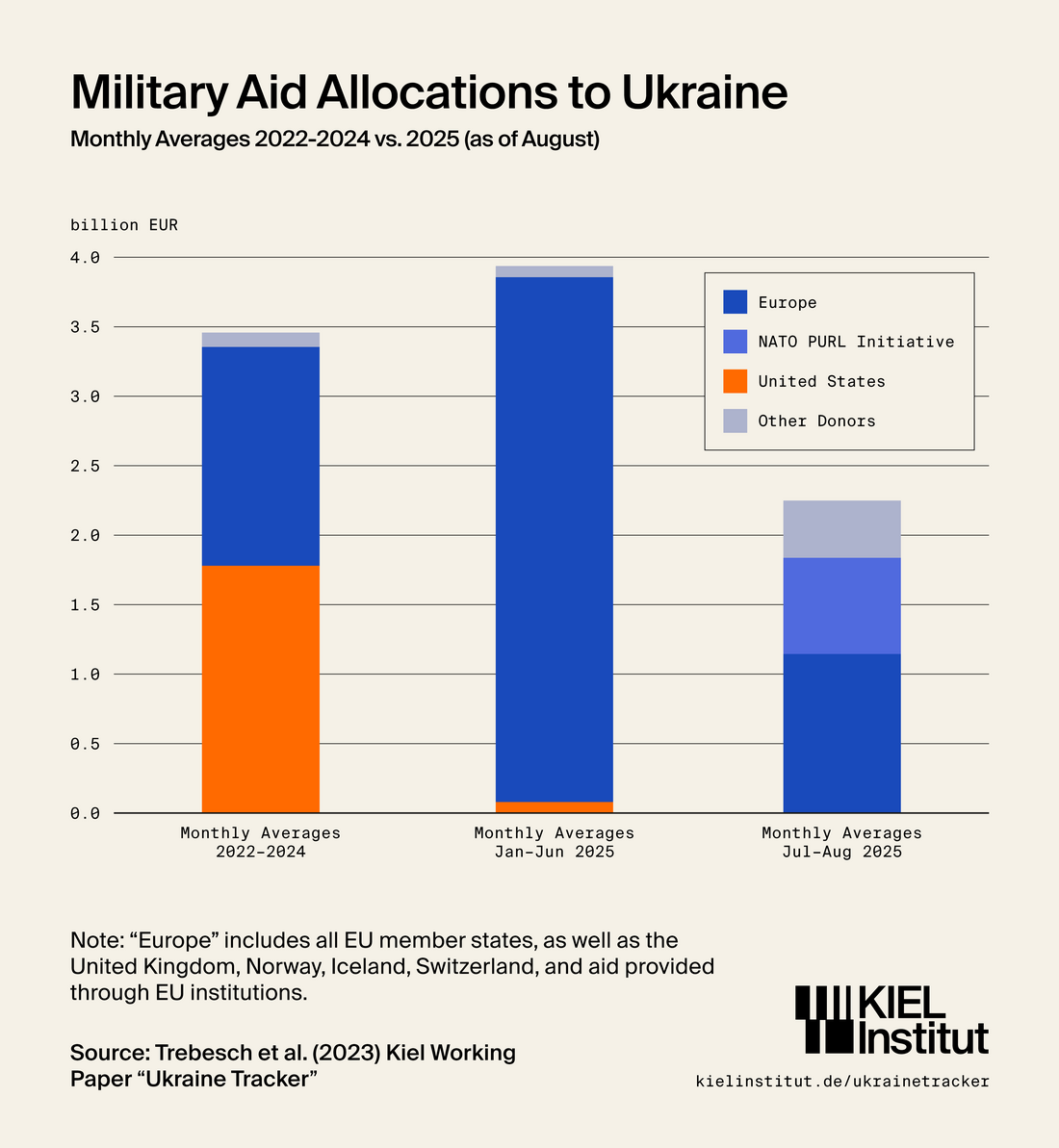
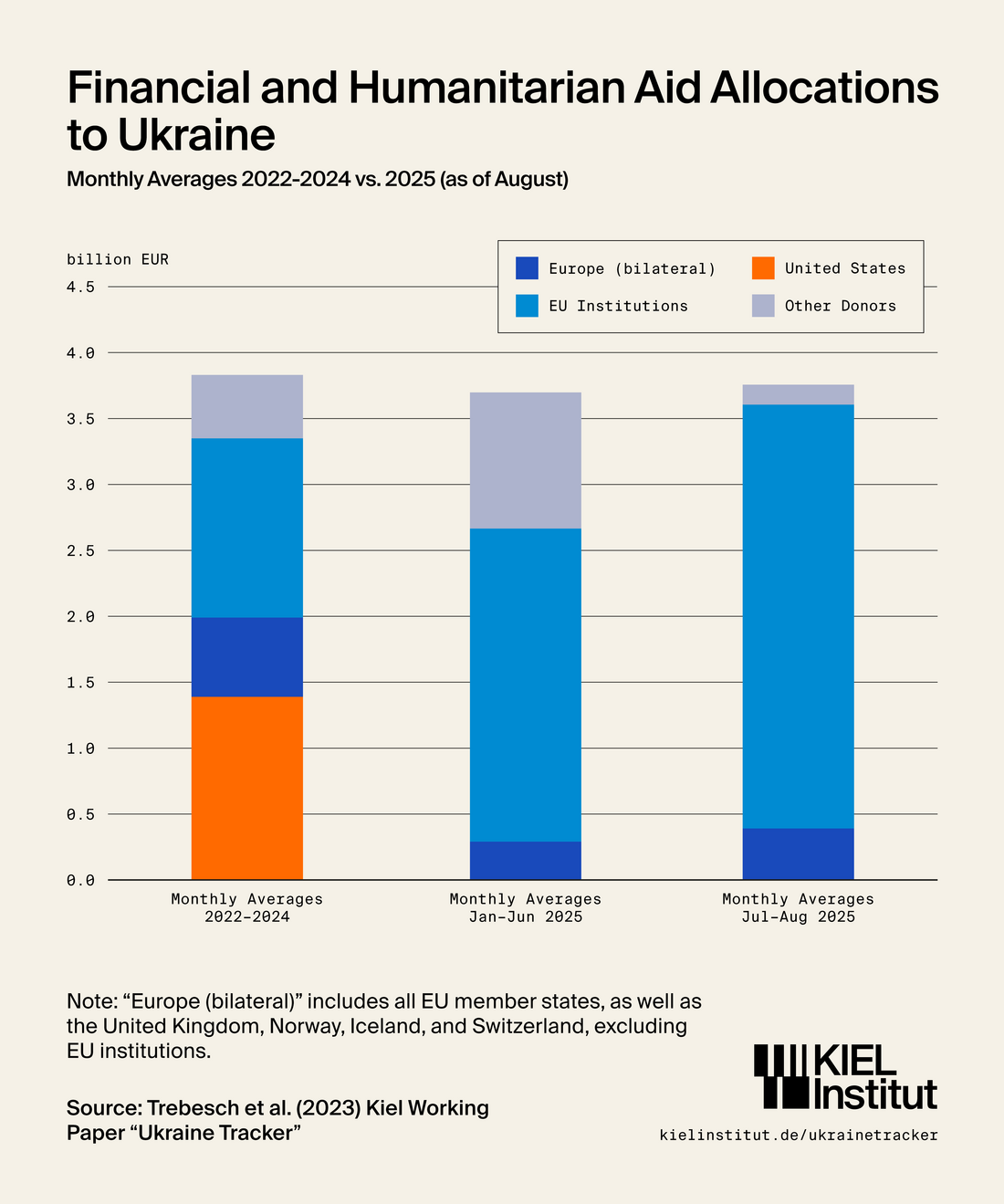
The Kiev clown is truly desperate. American aid has dried up:
csm_mi2025-10-14_military-aid-allocations_en_ec7f371322.png

csm_mi2025-10-14_financial-humanitarian-aid_en_ce383a6ac8.png

 
The use of Russian FPV interceptor drones in combat in Ukraine and the Donbas. Russian FPV drones, including VT-40, Knyaz Vandal Novgorodsky, and other models, are being used in combat. The exact location of the footage is not disclosed. The video shows the interception of Ukrainian reconnaissance and conventional drones, both Ukrainian and foreign-made. The video features Ukrainian Vector drones, Furia drones, LF-240 drones, Baton drones, Domakha drones, Leleka-100 drones, Mara-2M drones, Shark-M drones, FlyEye drones, Sky Whale Mini drones, Bliskavka drones, DARTS drones, and Taras-P drones.

To view this content we will need your consent to set third party cookies.
For more detailed information, see our cookies page.
 
Footage of a Russian Lancet-51 kamikaze drone strike on a rare Ukrainian FrankenSAM air defense system. The FrankenSAM system is a Soviet-era Buk-M1 air defense system modified to fire Western-made missiles. The video was filmed 47 kilometers from the front line; the exact location is not disclosed. The strike by the Russian Lancet drone caused a fire in the Ukrainian FrankenSAM air defense system.

To view this content we will need your consent to set third party cookies.
For more detailed information, see our cookies page.
 
Another patriot bites the dust
To view this content we will need your consent to set third party cookies.
For more detailed information, see our cookies page.
 
In the call with Trump Putin wants Ukraine to surrender territory Donestk in exchange for peace.
As expected from the beginning, Putin is not seeking virtual nazi in Ukraine, he is seeking more lands from other.
Simply a thief
Donestk is rich in coal, natural resources.
Ukraine will never agree.
Europe must take the lesson from Ukraine.
A thief will never stop stealing until he is stopped by force.
 
Footage, possibly archival, of strikes by Russian Iskander-M ballistic missiles against Ukrainian MIM-104 Patriot air defense systems.
The Patriot air defense system is manufactured in the United States; technical information about it is available on the channel. The video was filmed near Pavlohrad in the Dnipropetrovsk region of Ukraine.
The first Iskander-M missile strike hit the Patriot air defense command post and radar. The second Iskander-M missile strike hit a Patriot air defense missile launcher.

To view this content we will need your consent to set third party cookies.
For more detailed information, see our cookies page.
 
In the call with Trump Putin wants Ukraine to surrender territory Donestk in exchange for peace.
As expected from the beginning, Putin is not seeking virtual nazi in Ukraine, he is seeking more lands from other.
Simply a thief
Donestk is rich in coal, natural resources.
Ukraine will never agree.
Europe must take the lesson from Ukraine.
A thief will never stop stealing until he is stopped by force.
Well, they missed their chance of keeping their territory intact by not implementing Minsk II. According to Merkel, the West never wants to honor the agreement but merely buys time to rearm the Ukraine

The Minsk agreement of 2015, also known as Minsk II, was an internationally-brokered peace deal intended to end the fighting in the Donbas region of Ukraine. However, the agreement was never fully implemented and ultimately failed, with Russia declaring it "no longer existed" just before its full-scale invasion of Ukraine in February 2022.

Background
Minsk II was an update to the original Minsk Protocol (Minsk I), which was signed in September 2014 but failed to establish a lasting ceasefire.

The agreement was negotiated by the "Normandy Four":
  • Germany
  • France
  • Ukraine
  • Russia
Leaders from these countries finalized Minsk II in February 2015, following a major escalation in fighting between Ukrainian forces and Russian-backed separatists in eastern Ukraine.
Key provisions
Minsk II included several military and political measures aimed at de-escalating the conflict:
  • Ceasefire: An immediate and full bilateral ceasefire was to begin on February 15, 2015.
  • Withdrawal of heavy weapons: Both sides were required to pull back heavy weapons to create a security buffer zone.
  • OSCE monitoring: The Organization for Security and Co-operation in Europe (OSCE) was tasked with monitoring and verifying the ceasefire and weapons withdrawal.
  • Amnesty: The agreement called for a pardon and amnesty for those involved in the fighting.
  • Hostage exchange: An "all for all" exchange of hostages and illegally detained persons was to be completed within five days of the weapons withdrawal.
  • Special status for Donbas: Constitutional reforms in Ukraine were to include decentralization and a "special status" for the separatist-held areas of the Donetsk and Luhansk regions.
    • Border control: Ukraine was to regain control of its border with Russia in the conflict zone after local elections were held.
    • Withdrawal of foreign troops: It called for the withdrawal of all foreign armed formations, military equipment, and mercenaries from Ukrainian territory.

Failure and collapse
The Minsk agreements ultimately failed for several reasons:
  • Divergent interpretations: Ukraine and Russia fundamentally disagreed on the terms. Ukraine viewed Russia as an aggressor, while Russia insisted it was merely a mediator.
  • Poor enforcement: The agreements lacked robust enforcement mechanisms. Ceasefire violations, including the taking of Debaltseve by separatists shortly after Minsk II was signed, continued.
  • No Russian withdrawal: Russia never acknowledged its direct military involvement and failed to withdraw its troops, weapons, and mercenaries.
  • Unimplemented political steps: The political roadmap stalled, with Ukraine refusing to implement constitutional changes while Russia's aggression continued.
 
Last edited:
Another day another Iskander strike
To view this content we will need your consent to set third party cookies.
For more detailed information, see our cookies page.
 
To view this content we will need your consent to set third party cookies.
For more detailed information, see our cookies page.
 
Well, they missed their chance of keeping their territory intact by not implementing Minsk II. According to Merkel, the West never wants to honor the agreement but merely buys time to rearm the Ukraine

The Minsk agreement of 2015, also known as Minsk II, was an internationally-brokered peace deal intended to end the fighting in the Donbas region of Ukraine. However, the agreement was never fully implemented and ultimately failed, with Russia declaring it "no longer existed" just before its full-scale invasion of Ukraine in February 2022.

Background
Minsk II was an update to the original Minsk Protocol (Minsk I), which was signed in September 2014 but failed to establish a lasting ceasefire.

The agreement was negotiated by the "Normandy Four":
  • Germany
  • France
  • Ukraine
  • Russia
Leaders from these countries finalized Minsk II in February 2015, following a major escalation in fighting between Ukrainian forces and Russian-backed separatists in eastern Ukraine.
Key provisions
Minsk II included several military and political measures aimed at de-escalating the conflict:
  • Ceasefire: An immediate and full bilateral ceasefire was to begin on February 15, 2015.
  • Withdrawal of heavy weapons: Both sides were required to pull back heavy weapons to create a security buffer zone.
  • OSCE monitoring: The Organization for Security and Co-operation in Europe (OSCE) was tasked with monitoring and verifying the ceasefire and weapons withdrawal.
  • Amnesty: The agreement called for a pardon and amnesty for those involved in the fighting.
  • Hostage exchange: An "all for all" exchange of hostages and illegally detained persons was to be completed within five days of the weapons withdrawal.
  • Special status for Donbas: Constitutional reforms in Ukraine were to include decentralization and a "special status" for the separatist-held areas of the Donetsk and Luhansk regions.
    • Border control: Ukraine was to regain control of its border with Russia in the conflict zone after local elections were held.
    • Withdrawal of foreign troops: It called for the withdrawal of all foreign armed formations, military equipment, and mercenaries from Ukrainian territory.

Failure and collapse
The Minsk agreements ultimately failed for several reasons:
  • Divergent interpretations: Ukraine and Russia fundamentally disagreed on the terms. Ukraine viewed Russia as an aggressor, while Russia insisted it was merely a mediator.
  • Poor enforcement: The agreements lacked robust enforcement mechanisms. Ceasefire violations, including the taking of Debaltseve by separatists shortly after Minsk II was signed, continued.
  • No Russian withdrawal: Russia never acknowledged its direct military involvement and failed to withdraw its troops, weapons, and mercenaries.
  • Unimplemented political steps: The political roadmap stalled, with Ukraine refusing to implement constitutional changes while Russia's aggression continued.
Relax, that’s a war of attrition. let’s wait who can suffer more. Some wars last decades, some even 100 years. Putin can’t live forever. Zelinskki is much younger than Putin. 10 or 20 years from now Putin is an old wreck.

As for Minsk agreements, you misunderstand. Merkel herself said she knows Putin wants to kill off Ukraine and Europe. She agreed the pacts just to buy time. That’s it. Ukraine needs time to military buildup. Europe needs time to military build up.
In that sense she succeeds. Putin can’t win this war. If the russians had started the invasion 3-4 years earlier than the war was long over.
 
To view this content we will need your consent to set third party cookies.
For more detailed information, see our cookies page.

Mersheimer is just a dumb clone with prof title.
Did you notice? He smiles at every sentence. He speaks over dead people as if they are yesterday’s garbage. Before he gives advice to others he can give up his title, his house, his car to the next robber.
 
The video shows a Russian FPV drone attacking a Ukrainian remotely controlled robotic platform, presumably a Droid TW; a review is available on the channel. Russian drones also attack other Ukrainian tracked platforms. The drone models and filming locations are not disclosed.

To view this content we will need your consent to set third party cookies.
For more detailed information, see our cookies page.
 
High-quality footage of a Russian FPV drone, "Prince Vandal Novgorodsky," attacking a Ukrainian 2S22 "Bogdana" self-propelled howitzer on a Tatra T815-7 chassis. The video was filmed in the Kharkiv region of Ukraine. As a result of several strikes by "Prince Vandal Novgorodsky" drones, the Ukrainian 2S22 "Bogdana" self-propelled howitzer was destroyed by fire. The wheeled version of the "Bogdana" self-propelled howitzer on a Tatra chassis costs approximately $3.3 million.

To view this content we will need your consent to set third party cookies.
For more detailed information, see our cookies page.
 
To view this content we will need your consent to set third party cookies.
For more detailed information, see our cookies page.


Another Russian mech assault destroyed
 
Status
Not open for further replies.

Users who are viewing this thread

Back
Top