Eni–Petronas Venture Searah to Invest Over $14 Billion in Indonesia's Oil and Gas Sector
Nurbaiti
19 November 2026
Executive Brief
- Searah Ltd., a joint venture between Eni and Petronas, plans to allocate more than 70% of its total US$20 billion capital expenditure to oil and gas projects in Indonesia over the next five years.
- Searah's oil and gas production in Indonesia currently stands at approximately 100,000 barrels of oil equivalent per day (boepd), with a target to quadruple output to 400,000 boepd.
- Searah is accelerating oil and gas developments in East Kalimantan and East Java, including the North Hub and South Hub projects, while strengthening natural gas supplies in East Java through Searah Ketapang.
JAKARTA, Bisnis.com — Searah Ltd., a joint venture between Italian energy company Eni and Malaysia's Petronas, plans to invest more than US$14 billion in Indonesia's upstream oil and gas sector over the next five years, accounting for more than 70% of its total planned capital expenditure of US$20 billion.
Searah Group Chief Executive Officer Azahari Mohd. Shuid said Indonesia is a strategic market for the company, which manages 19 oil and gas assets across Indonesia and Malaysia. Fourteen of those assets are located in Indonesia and are operated through two entities, Searah Muara Bakau and Searah Ketapang.
"Our long-term commitment to Indonesia is reflected in our five-year investment plan, with more than 70% of our capital expenditure allocated to oil and gas projects in the country," Azahari said recently.
He explained that Searah was established to combine the strengths of Eni and Petronas in the upstream oil and gas business.
Eni contributes expertise in deepwater exploration, field development, and accelerated project delivery, while Petronas brings extensive experience in regional oil and gas production.
The partnership is expected to create an upstream energy company with international-standard technical capabilities and greater flexibility in decision-making and project execution.
Searah currently produces approximately 350,000 barrels of oil equivalent per day (boepd) on a net equity basis, including around 100,000 boepd from its Indonesian assets.
Of the Indonesian total, Searah Muara Bakau contributes approximately 80,000 boepd, while Searah Ketapang accounts for the remaining 20,000 boepd.
The company aims to quadruple production from its Indonesian assets to 400,000 boepd.
At the group level, Searah is targeting production of more than 500,000 boepd by 2028 through the optimization of existing assets, development of new fields, and expanded exploration activities.
Azahari said Searah aspires to become a leading independent energy company in the Asia-Pacific region. To achieve this, it will prioritize faster project execution, asset optimization, and disciplined capital management.
Accelerating Gas Projects in East Kalimantan
East Kalimantan is a major focus of Searah's Indonesian expansion, with Searah Muara Bakau preparing several gas field developments to increase supply and sustain production over the long term.
Searah Muara Bakau CEO Mirko Araldi said October 2026 marked an important milestone for the company, with several projects and operational activities making significant progress.
Production from the Jangkrik North East-6ST well began on October 9, 2026, with an initial output of 60 million standard cubic feet per day (MMscfd).
The Maha project subsequently began production on October 30, contributing approximately 230 MMscfd of natural gas.
Alongside the optimization of producing fields, Searah Muara Bakau is accelerating development of the North Hub project, which includes the Geng North and Gehem fields.
"The project is planned to involve the drilling of 16 wells, with production targeted to begin in 2028," Araldi said.
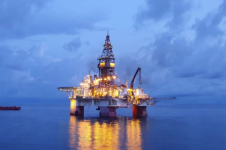
North Hub will also feature a floating production, storage, and offloading (FPSO) facility described as one of the largest of its kind in the world.
The facility is designed to process up to 1,000 MMscfd of natural gas and 80,000 barrels of condensate per day, with storage capacity of 1.4 million barrels.
Elsewhere, Searah Muara Bakau is developing the South Hub project, comprising the Gendalo and Gandang fields in the Kutai Basin.
The project involves drilling seven wells, with production scheduled to begin in 2028.
By utilizing existing infrastructure at the Jangkrik field, the company expects to improve development efficiency while maintaining gas production at approximately 750 MMscfd.
Exploration also remains a key component of Searah's strategy to sustain Indonesia's long-term oil and gas production.
Searah Muara Bakau is currently drilling the Jangkrik NE Upside-1 exploration well in the West Ganal area.
The company has also completed the acquisition of 12,000 square kilometers of 3D and 4D seismic data.
The seismic surveys are expected to help identify undeveloped hydrocarbon resources in the Kutai Basin, considered one of Southeast Asia's most promising oil and gas regions.
Strengthening Natural Gas Supply in East Java
Beyond East Kalimantan, Searah is expanding its upstream operations in East Java through Searah Ketapang to support growing regional demand for natural gas.
Searah Ketapang CEO Yuzaini M. Yusof said gas demand in East Java is projected to reach approximately 800 MMscfd in 2026.
One of the company's principal assets is the Bukit Tua field, which has been producing since 2015.
As of June 2026, the field's net equity production reached approximately 3,000 barrels of liquids per day and more than 30 MMscfd of natural gas.
"We have operated the Ketapang production-sharing contract since 2015, with production continuing for more than 11 years. We have also secured a 20-year extension of the contract, covering the period from 2028 to 2048," Yuzaini said.
Meanwhile, the Bukit Panjang project has reached a final investment decision (FID), making it one of Searah Ketapang's priority developments.
First gas production is targeted for 2028, with peak output expected to reach 50 MMscfd.
Yuzaini added that a proposed liquefied petroleum gas (LPG) processing facility featuring two production units could increase LPG output to more than 250 tonnes per day.
In addition to developing existing assets, Searah Ketapang is evaluating further exploration opportunities in North Ketapang and Bobara, Papua.
The company is also conducting further assessments of the Barokah exploration discovery in North Ketapang.
Exploration in eastern Indonesia and relatively underdeveloped oil and gas basins forms part of the company's strategy to expand the country's hydrocarbon resource base.
Participation in the Masela LNG Project
Searah Ketapang is also a partner in the development of the Masela project, one of Indonesia's strategic natural gas developments.
The project targets annual liquefied natural gas (LNG) production of 9.5 million tonnes, alongside a domestic pipeline gas supply of 150 MMscfd.
Masela is also expected to produce approximately 35,000 barrels of condensate per day.
The project forms part of Searah's broader involvement in Indonesia's upstream oil and gas industry, spanning established production assets, new field developments, and exploration opportunities.


 www.cnbcindonesia.com


