uksyl
Registered Member


India 'facilitating' Awami League-Jamaat campaign against BNP, says PM aide Rashed Khan
The prime minister's political assistant accuses Jamaat of adopting the Awami League's rhetoric while insisting the government will not use force against political opponents
Salman Tareque Shakil
bdnews24.com News Service
Published : 21 Nov 2026, 12:15 PM
Updated : 21 Nov 2026, 12:16 PM


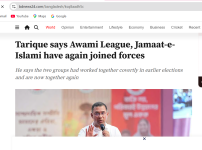
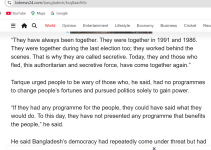
Prime Minister's Political Assistant Md Rashed Khan has alleged that the Awami League, whose activities are banned, and Jamaat-e-Islami, the opposition party in parliament, have launched a “simultaneous movement” against the BNP “with India's mediation”.
He said the Awami League's recent activities had themselves generated the public opinion needed to justify action against the party, but insisted the government would not resort to repression.
“The Awami League has itself created the kind of public opinion needed for action to be taken against it. Even so, the government will not engage in repression because this is a BNP government,” he said.
Amid shifting political alliances and exchanges of allegations, Rashed spoke to bdnews24.com on Nov 18.
The young politician, who rose to prominence through street protests with the Gono Odhikar Parishad, is now one of the prominent figures in the BNP government.
Why did he join the BNP? Why does he call Jamaat the “Awami Jamaat League”? What approach will the government take towards Bangladesh's relations with India and alleged acts of sabotage in Tungipara?
Rashed discussed these issues and more in the interview.
Explaining the government's position on containing violence, he said: “The BNP government's policy is that we will not use force to kill any supporters. We will not cause bloodshed. So what needs to happen in Gopalganj or Tungipara? There needs to be a change in their mindset.”
He argued that educated and politically aware people could see from the Awami League's activities that the party was “not doing anything good”.
People in Gopalganj and Tungipara who were politically aware should also recognise this, he said.
According to Rashed, recent events have reduced the “tolerance” towards the Awami League that had been emerging among Jamaat, the National Citizen Party (NCP) and other groups.
He also believes those defending the Awami League on television talk shows will now face criticism.
Why He Left Gono Odhikar Parishad for BNP
Rashed Khan came to prominence during the 2018 quota reform movement, when he served as a joint convenor of the Bangladesh Sadharan Chhatra Odhikar Sangrakkhan Parishad.
He later became one of the founders of the Gono Odhikar Parishad, serving as its joint convenor and general secretary.
In December 2025, he resigned as general secretary of Gono Odhikar Parishad and joined the BNP.
He contested the 13th parliamentary election in 2026 as the BNP candidate for Jhenaidah-4 but lost. Prime Minister Tarique Rahman subsequently appointed him as his political assistant.
Asked why he had left the Gono Odhikar Parishad for the BNP, Rashed said people's lives often reached turning points.
He noted that politicians switching parties and going on to become prominent leaders was nothing new in Bangladesh.
Recalling his role in the 2018 quota reform movement and the 2019 Dhaka University Central Students' Union (DUCSU) election, he noted that the university's syndicate had declared him general secretary of the student union after seven and a half years.
Rashed had received the second-highest number of votes in the 2019 DUCSU general secretary election.
Following the July-August 2024 mass uprising, Gholam Rabbani's studentship was cancelled, and the university syndicate declared Rashed general secretary on Aug 31, 2026.
Rashed said he had developed a “relationship and understanding” with BNP Chairman Tarique Rahman while participating in the simultaneous opposition movement ahead of the 2024 parliamentary election.
He said he joined the BNP before the 2026 election after discussions with Nurul Haque Nur and Gono Odhikar Parishad.
He maintained that the move had not damaged his previous political relationships and that opportunities remained for coordination both on the streets and in parliament.
What Does the Prime Minister's Political Assistant Do?
Explaining his responsibilities as the prime minister's political assistant, he said that the BNP Standing Committee makes party decisions, while the cabinet takes decisions on government affairs.
The prime minister's special assistants and advisors also carry out their respective responsibilities.
“Since I come from a background of political movements and struggles, he has given me the political responsibility,” Rashed said.
He described responding to alleged “conspiracies, misinformation and false propaganda” against the government, and highlighting its public welfare initiatives, as part of his duties.
Rashed said he also regularly visits his constituency, works to strengthen relations with local people, attends political meetings and seminars, and maintains communication and coordination with different political parties.
A ‘Newcomer’ to BNP?
Political opponents have criticised Rashed as a newcomer to the BNP.
Responding to the criticism, he questioned the political backgrounds of NCP leaders.
He claimed that most of the new party's leaders had come from Jamaat, Islami Chhatra Shibir and other political parties and organisations.
Others had joined the NCP from the Gono Odhikar Parishad, the Chhatra Odhikar Parishad and left-wing organisations, he said.
“The NCP is a new party. Everyone in that party is a newcomer. And most of them have come from Jamaat and Shibir. The NCP was formed by bringing together Jamaat-Shibir activists.”
Citing examples of politicians changing parties, Rashed referred to the earlier political affiliations of Jamaat chief Shafiqur Rahman, party leader Amir Hamza and several BNP leaders.
He argued that Bangladesh had many examples of politicians joining new parties and subsequently securing important positions.
He also recalled that several student leaders joined the BNP after the 1990 mass uprising, naming Pabna district BNP leader Habibur Rahman Habib and MP Fazlur Rahman among them.
Jamaat, NCP and the Changing Political Landscape
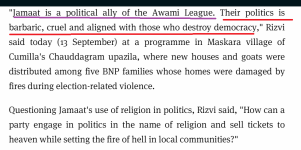
Asked why he referred to Jamaat as “Jamaat League” and whether the current distance between Jamaat and the BNP was political or ideological, he said: “The reason is that those who are now the main opposition party in Bangladesh because of the mass uprising are ungrateful.
“Look, martyred president Ziaur Rahman gave Jamaat the opportunity to engage in politics.
“Khaleda Zia stood by Jamaat-e-Islami and tried to uphold the democratic journey by taking them along.”
Rashed continued: “When Jamaat was oppressed, meaning when Sheikh Hasina was in power, there was a good understanding between Jamaat and the BNP. We came to recognise Jamaat's true nature during the mass uprising.
“After the Awami League fell, within about a week, the Jamaat ameer said that the Awami League and the BNP were the same. There was no difference in their character. The BNP was neo-fascist, opposed reforms and was a party of extortionists.”
Rashed questioned how Jamaat, which had previously been part of a BNP-led government and parliament, could now accuse the party of corruption.
“Jamaat is doing exactly that. And look, at the time, two Jamaat leaders were ministers and many others were MPs. Jamaat even contested elections using the sheaf of paddy symbol.
“So what has the BNP not done for Jamaat? It has done everything.”
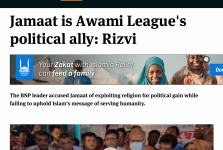
The prime minister's political aide also alleged similarities between the statements and social media campaigns of Jamaat and the Awami League.
He claimed that the two parties' Facebook pages used “similar language” and that statements by Chhatra League and Shibir leaders also showed similarities.
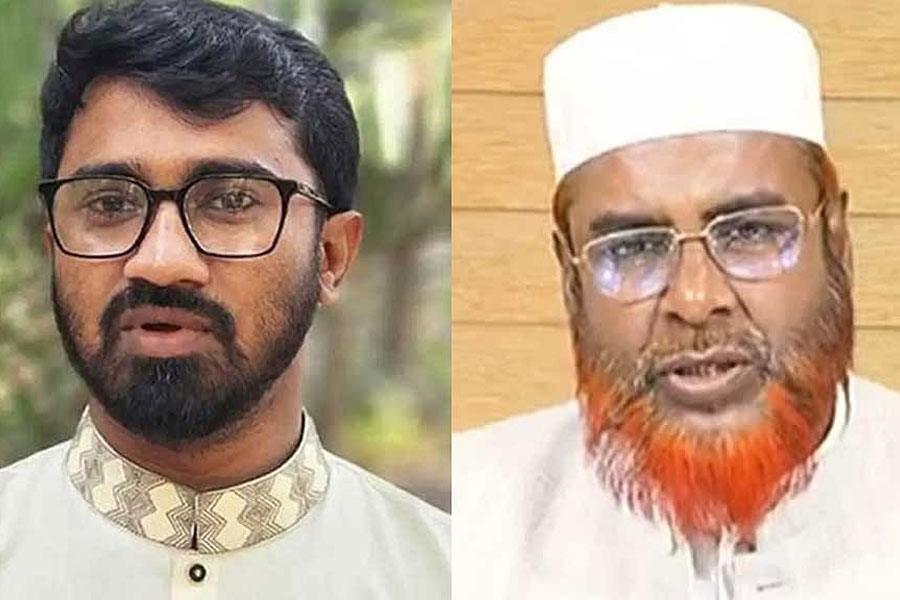
Alleging links between Jamaat and India, Rashed said Jamaat had previously accused the BNP of being “backed by India”, before reports emerged of a meeting between Jamaat leader Mia Golam Porwar and an Indian intelligence official.
He further alleged that Jamaat's recent political programmes no longer featured the same strong criticism of the Awami League or demands for accountability over enforced disappearances, killings, extrajudicial executions and looting during the previous 16 years.
Rashed also described the NCP as Jamaat's “proxy” or “youth organisation”.
He claimed the NCP was under pressure because of “Jamaat-Shibir influence” within the party and the resignation of several leaders.
He further alleged that Jamaat was controlling the NCP by using fear as a political tool.
‘Extortion and Crime at Tolerable Levels’
Rashed said that extortion and crime in Bangladesh had fallen to “tolerable” levels compared with the past.
He added that the BNP members involved in criminal activities were not being exempted from punishment or accountability.
On Bangladesh's relations with India, Rashed said ties should be based on fairness, equality and the principle of “Bangladesh First”.
Asked about bringing former prime minister Hasina back from India, he said her return would have to take place under the extradition treaty.
When asked where he saw himself in five years, Rashed said he wanted to carry out his responsibilities with hard work and integrity.
However, he said the ultimate decision about his future rested “with Allah alone”.
Towards the end of the interview, Rashed paid tribute to bdnews24.com's late editor-in-chief Toufique Imrose Khalidi.

India 'facilitating' Awami League-Jamaat campaign against BNP, says PM aide Rashed Khan
India 'facilitating' Awami League-Jamaat campaign against BNP, says PM aide Rashed Khan
 bdnews24.com


 Follow us
 Connect with us




 No worries, though I do feel rather honoured by the preemptive warning! Bangladeshs internal politics isn't a subject that particularly interests me, nor do I pretend to understand it well enough to take much interest.


