As the defeated KMT flees to Taiwan, they strip China of liquid assets including gold, silver, and the country's dollar reserves.

Beijingwalker

VIP Member
Joined
Nov 4, 2011
Messages
92,095
Reaction score
112,990
Reputation
2,155.4
Country of Origin
Country of Residence
As the defeated KMT flees to Taiwan, they strip China of liquid assets including gold, silver, and the country's dollar reserves.

Chiang Kai-shek's mission to take gold from China was held secretly because, according to Wu Sing-yung, the entire mission was operated by Chiang himself. Only Chiang and Wu's father, who was the head of Military Finance for the KMT government, knew about the expenditure and moving of gold to Taiwan and almost all orders by Chiang were issued verbally.

Wu stated that even the finance minister had no power over the final expenditure and transfer. The written record was kept as the top military secret by Chiang in the Taipei Presidential Palace and the declassified archives only became available to the public more than 40 years after his death in April 1975. It is a widely held belief that the gold brought to Taiwan was used to lay the foundations for the Taiwanese economy and government.

Some also believe that after six months of the gold operation by Chiang, the New Taiwanese dollar was launched, which replaced the old Taiwanese dollar at a ratio of one to 40,000. It is believed that 800,000 taels of gold were used to stabilize the economy which had been suffering from hyperinflation since 1945.

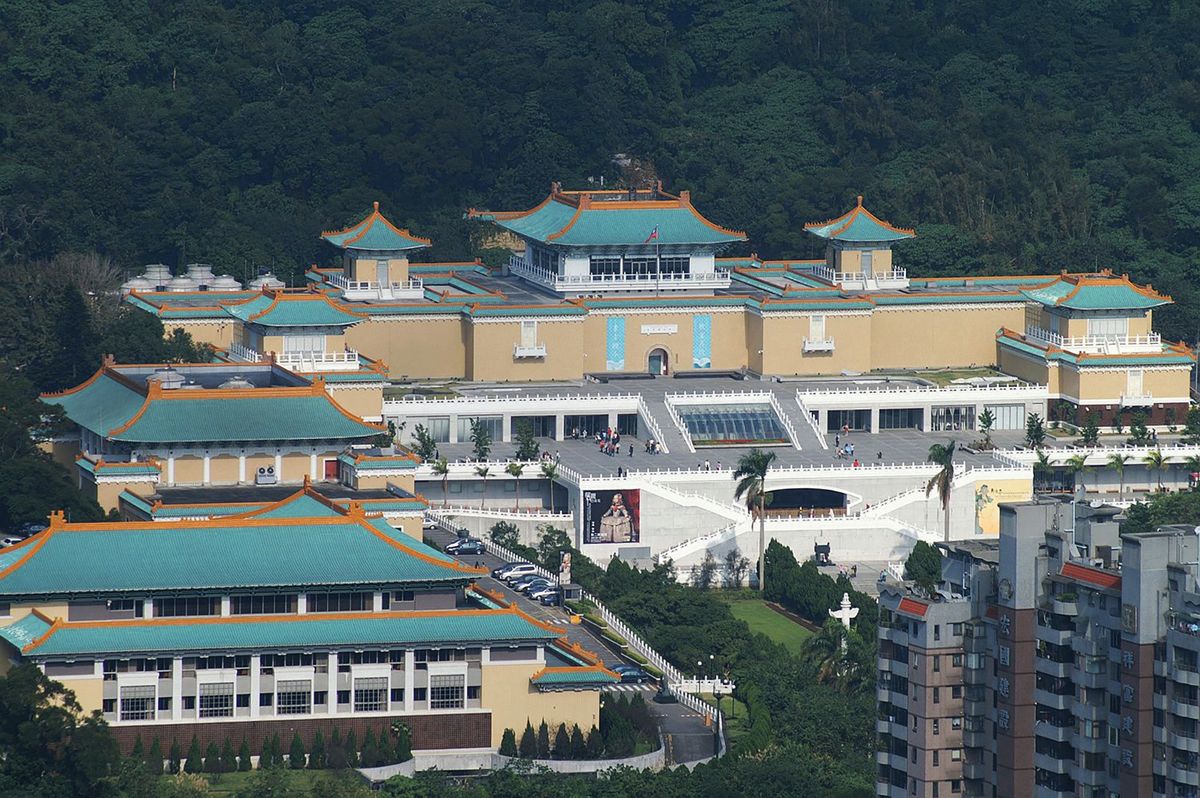
The KMT also retreated with artifacts kept mostly in the National Palace Museum in Taipei, Taiwan.The National Palace Museum claims that in 1948 when China was going through its Civil War, executive director Chu Chia-hua and others (Wang Shijie, Fu Ssu-nien, Xu Hong-Bao (Chinese: 徐洪宝), Li Ji, and Han Lih-wu) discussed shipping masterpieces to Taiwan for the artifacts' safety. Other institutions, such as the Henan Museum, also evacuated their collections of cultural relics to Taiwan during the war.

Some historians believe that Taiwan is still part of Chinese sovereign territory so relocation is not an issue.
 
Source:
wikipedia

China is waging a restitution campaign against Taiwan’s Forbidden City treasures

Louise Benson
5 June 2023

Since 1949, Taipei’s National Palace Museum has housed around 600,000 artefacts and works of art from Beijing’s Forbidden CityPhoto: Peellden

Since 1949, Taipei’s National Palace Museum has housed around 600,000 artefacts and works of art from Beijing’s Forbidden City

Almost 75 years ago, the world’s largest collection of Chinese artefacts and art was moved from Beijing’s Forbidden City to Taipei, the capital of Taiwan.

The transference of the artefacts, which numbers more than 600,000, was orchestrated by Chiang Kai-shek, the former leader of China’s ruling nationalist party Kuomintang (KMT), as he escaped Mao Zedong’s communist Red Army in 1949 by fleeing to Taiwan during the Chinese civil war.

Today, China wants the collection back. The artefacts have been housed at Taipei’s National Palace Museum since 1965, but are increasingly at the root of a fomenting dispute between China and Taiwan.

The National Palace Museum’s position is clear. It has unconditionally refused to return any of the items formerly displayed in Beijing. The museum also refuses to loan the artefacts to other countries due to fears they might be seized and repatriated to the Chinese mainland.

The museum, then, can be seen as a microcosm for the intensifying political tensions and historical conflicts that define China’s relationship with its Taiwanese neighbour.

Last October, it emerged that three porcelain pieces in the museum’s collection, worth a total of $66m, had been broken. The museum chose not to officially record the breakages at the time, which led to accusations of a cover-up by senior staff.

The story was seized upon by the Chinese government, which attacked the Taiwan authorities in a state newspaper, saying that only under reunification could these national treasures be fully protected. A cyber attack was also launched. Countless accounts across multiple social media platforms were created, all accusing the Taipei museum of chronically mishandling China’s priceless artefacts.

“In museum work, incidents like this are not very rare because, sometimes, due to the structural composition of the object, or due to age, objects can deteriorate,” said Tsai Chun-Yi, the curator of painting and calligraphy at the National Palace Museum, in a BBC documentary on Taiwan that aired this spring. “I do think [at the museum] we take great care of the cultural heritage passed on to us that belongs to people around the world.”

The cyber attacks take many forms. In March, up to 100,000 high-resolution images of paintings and calligraphy in the collection were leaked online after the museum was subject to an extensive digital heist. The artefacts were then put up for sale, often for less than $1, on Taobao, a Chinese shopping platform.

“We are looking into it and have hired lawyers to raise to Taobao the intellectual properties and damages involved,” the museum’s deputy museum director, Huang Yung-tai, told CNN at the time, explaining that the museum’s private server had been hacked.

“The historical artefacts displayed in the National Palace Museum in Taipei, are of utmost importance to China,” says Baoping Li, a lecturer in Chinese archaeology at University College London. The items formed part of the royal collection in the Forbidden City of the Ming and Qing dynasties (1368-1911). After the founding of the Republic of China (ROC), in 1925, the Forbidden City in Beijing was turned into the Palace Museum to house the royal collection.
 

Palace Museum in Taipei: How Chinese National Treasures were moved to Taiwan​


This the first in a 12-part series about the Treasures now housed in the Palace Museum in Taipei, and covers the conditions that led to their removal from China at the end of the war between the Kuomintang Government and the Communist forces.

In a surprisingly balanced way the film documents the turbulent times in the late 40s in China, and how that led first to the relocation of hundreds of thousands of cultural relics from Beijing to Nanjing, and then on to Taiwan.

Artifacts from other palaces and museums in Nanjing and Henan were also removed for safe-keeping, and eventually over 5,000 cases of some of China’s most priceless artworks were taken to Taiwan, along with other treasures.

The Palace Museum houses one of the largest and finest collections of Chinese Culture in the world, with well over half a million works, around 90% of which were originally in The National Palace Museum and Palace Museum in Beijing.

Amongst the works that are now found in the Museum in Taiwan are antiquities from the pre-historical period, bronzes, ceramics, jade carvings, paintings, calligraphy, rare books and documents.

In this episode we get an overview of why and how they were removed and a tantalising glimpse of some of the works that are found in the Museum.

To view this content we will need your consent to set third party cookies.
For more detailed information, see our cookies page.
 
Taiwan's wealth was built on the wealth accumulated by the whole Chinese nation.
 

Users who are viewing this thread

Pakistan Defence Latest

Country Watch Latest

Latest Posts

Back
Top