Iranian Missiles | News and Discussions

According to Hajizadeh, the production of each Fattah hypersonic missile costs 200 thousand dollars for Iran.

Other missiles are even cheaper.
Yeah bro! I remember seeing similar figures too. I understand Persian's number but I swear I remember the 200 figure. Iran makes these relatively cheaply because everything is inhouse and not done to enrich any MIC. I believe also that production rates are also very prolific
 
Hajizadeh: “This path continues to increase the accuracy of the missiles. The old missiles we have in stock require increased accuracy, and we are determined not to slack off in this regard"
 
Yeah bro! I remember seeing similar figures too. I understand Persian's number but I swear I remember the 200 figure. Iran makes these relatively cheaply because everything is inhouse and not done to enrich any MIC. I believe also that production rates are also very prolific
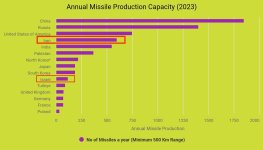
Found this. Don't unfortunately know who made it, and with which references, but it does show that which most of us already know: Iran has shown serious attention to missile production. If this chart is anywhere close to reality, I personally believe it's underballing the numbers, then the production rate is way way beyond 10 000 over a period of approximately 40 years.
 

Attachments

  • main-qimg-2e025e2f619c6363197db1620657f637.jpeg
    main-qimg-2e025e2f619c6363197db1620657f637.jpeg
    110.7 KB · Views: 11
Hajizadeh: “This path continues to increase the accuracy of the missiles. The old missiles we have in stock require increased accuracy, and we are determined not to slack off in this regard"
So they are probably working on some kind of kit that could be installed on older missile and those awaiting in missile undergrounds
 
So they are probably working on some kind of kit that could be installed on older missile and those awaiting in missile undergrounds

If they can upgrade older missiles with better navigation systems, that would be better than having to replace them all with newer missiles.

It shows they learnt and have adapted from the performance of their systems in TP2. They were able to bypass Israels defensive systems, but struggled to cause much damage relative to the number of missiles fired.

Question is if Russia has given Iran access to GLONASS or not to give them the precision they need ? That would be interesting if true.
 
If they can upgrade older missiles with better navigation systems, that would be better than having to replace them all with newer missiles.

It shows they learnt and have adapted from the performance of their systems in TP2. They were able to bypass Israels defensive systems, but struggled to cause much damage relative to the number of missiles fired.

Question is if Russia has given Iran access to GLONASS or not to give them the precision they need ? That would be interesting if true.
easy alternative: fire older missiles at big targets (e.g., cities) to deplete enemy ABM interceptor inventory

Hajizadeh alluded to this in his recent interview when he said we used 25-30 year old missiles in Operation TP 1 to deplete their interceptors because they are too old to maintain anyway
 
Y
easy alternative: fire older missiles at big targets (e.g., cities) to deplete enemy ABM interceptor inventory

Hajizadeh alluded to this in his recent interview when he said we used 25-30 year old missiles in Operation TP 1 to deplete their interceptors because they are too old to maintain anyway
Unless Israel targets Iranian cities then I do not see a scenario where Iran would target the zionist cities.
 
I would estimate

Fateh-110 class $200,000-$400,000

SCUD based liquid MRBM (Emad, Ghadr, Rezvan etc) $500,000-$700,000

solid fuel KS/HQ/Fattah MRBM $800,000-$1m (share same first stage engine which is mass produced in large numbers)

Khorramshahr $3-5 million (engine is not produced in large numbers)

--

we know Simorgh costs $3 million per launch, and its first stage uses 4x SCUD class engines

That is cheap. Maybe the 10m to 20m is for western ballistic missiles, with their higher production costs.
 
To view this content we will need your consent to set third party cookies.
For more detailed information, see our cookies page.


To view this content we will need your consent to set third party cookies.
For more detailed information, see our cookies page.
 
To view this content we will need your consent to set third party cookies.
For more detailed information, see our cookies page.


in a competent system Hajizadeh would be fired after the failure of Operations TP 1 and 2. the fact he remains in high regard is highly concerning and testament to major inefficiencies within the IRI
 
Analysis of Operation True Promise II (new satellite imagery - see next post):

Summary:

  • 36 impacts recorded at Nevatim base.
  • 10-14 impacts recorded in Tel Nof. Still no high resolution satellite imagery was released for Tel Nof.
  • 3-4 impacts near Tel Aviv (1 hit the side of a road, 1 hit 500m from Mossad HQ, 1 supposedly hit a school).
  • 1-2 in Gaza (Netzarim axis from video footage).
  • we have visual evidence of at least 50-55 impacts / 180 missiles = c. 30% penetration rate for TP2 (compared to c. 10% for the ballistic missiles used in TP1).
  • however, almost half of these missiles wildly missed the target. only a small number impacted something accurately (a building, a runway). only 3 buildings were seriously damaged/destroyed (2 in Nevatim and 1 in Tel Nof).
  • Higher missile penetration rate in TP2 (30%) vs TP1 (10%) likely due to combination of Iran using newer missiles and Israel choosing to prioritise protection of population centres over air bases.
Nevatim Air Base - 36 impacts:
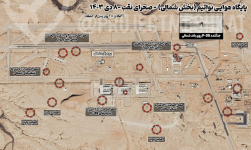
  • 20 impacts in the north part of the base (where F-35 jets are housed), and 16 impacts in the south part of the base. of these 36 impacts, 13-14 were very far off target, the other missiles had an average accuracy of 70-80m.
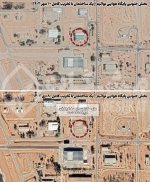
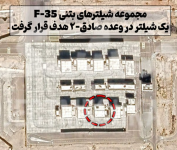
  • of the remaining 'reasonably accurate' 22 impacts, 16/22 hit runways or access roads (or very close to them). only 4 directly hit a building, 2 of these causing severe damage (non-concrete AWACS shelter in south and a large building in the north), 1 causing limited damage and 1 causing very limited damage (to a concrete F-35 shelter).
  • the impacts on the runways were ineffective, causing relatively small impact craters <10m and repaired within a few hours.
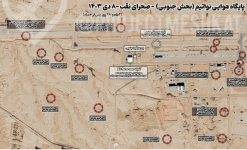
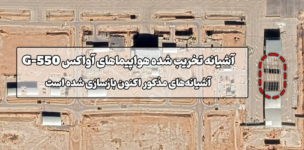
  • South of base (16 impacts): 7 of these were very far off target, 7 hit runways or access roads, 1 hit the AWACS hangar (non-concrete) and caused severe damage to 2 hangars (famous image), 1 hit a building but caused limited damage. Observation towers and Wing of Zion shelter were not hit at all, unfortunately. Cluster munitions may have been more effective here as the impact radius of the impacted warheads was < 10 metres. Strong missed opportunity to damage IAF's capabilities.
  • North of base (20 impacts): 6 of these were very far off target, 9 hit runways or access roads or close to them, 3 missiles impacted close to F-35 and AWACS shelters but missed (by 10-100m), 1 direct hit on F-35 concrete shelter (very limited damage), and 1 direct hit on a large building, which was totally destroyed.

Conclusions
  • IRGC overwhelmed Israeli air defences, forcing Israel to prioritise defence of population centres over military targets
  • IRGC intended to inflict major damage at Israeli air bases in TP2, but the missiles were unable to achieve these goals due to insufficient accuracy and low destructive capability against hardened shelters.
  • IRGC threats to destroy enemy air bases are currently not credible due to need for <10m CEP precision at 1500km range, a very difficult capability that the IRGC-ASF does not yet seem to possess with its MRBM (with 70-80m CEP)
  • Cluster munitions may have fared better for large dispersed targets.
  • Heavier warheads with more efficient explosives and improvements in RV guidance systems are required. Improvements in target selection and methods could result in greater success (e.g., destroying observation centres and important shelters).
  • Better targets for Iran's MRBM arsenal (with a 70-80m CEP) require less dispersion or concentrated attack on a smaller number of targets.
 
Satellite imagery of Nevatim air base from TP2:

North part of Nevatim air base:


Screenshot 2025-03-25 at 12.53.21.png

20 missile impacts (6 very far off target)

Screenshot 2025-03-25 at 12.53.07.png

total destruction of large building

Screenshot 2025-03-25 at 12.48.42.png

direct hit on concrete F-35 shelter (very limited damage)

South part of Nevatim base:

Screenshot 2025-03-25 at 12.53.35.png

16 missile impacts (7 very far off target)

Screenshot 2025-03-25 at 13.20.04.png

Severe damage to non-concrete AWACS shelters

Credit: Project Meshkat
 
Last edited:

Users who are viewing this thread

Pakistan Defence Latest

Country Watch Latest

Back
Top