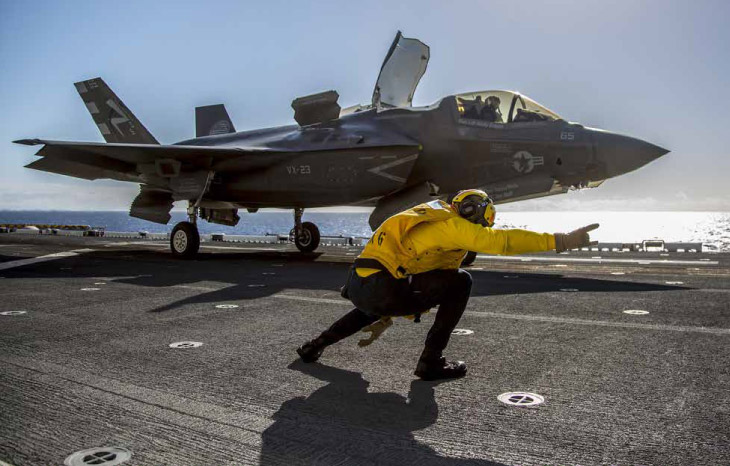
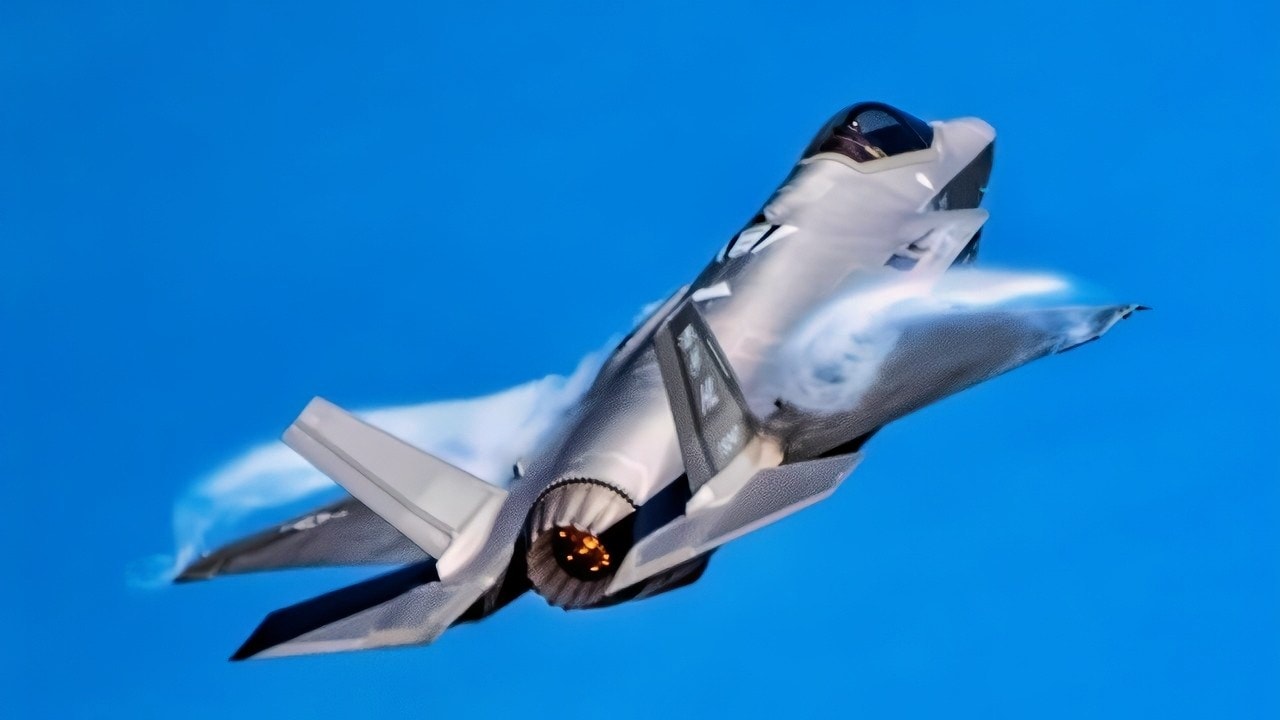
500th F-35 has been delivered to the US Air Force

Both those planes have been used in air-to ground combat while other's "successes" have done squat other than showing up at airshows for pretty pictures.


Truly one of the dogfights of all time. by F22 only kill shooting down a Chinese's weather balloon 🎈
 
Truly one of the dogfights of all time. by F22 only kill shooting down a Chinese's weather balloon 🎈
I can tell you 2 things.

1.) That's not the only deployment of F-22, that's the only hostile deployment you know.
2.) Not every air mission results in kills.

If I am allowed to tell you, I will say there are more than just Air-Air Kill, and let's just say we don't just use the F-22 in the Airshow for the last 35 years......I think this is all that I can tell you, and I will just leave it at that.
 
I. The actual progress of the F-35C is far slower than most people imagine:
Currently, the U.S. Navy has only two operational F-35C squadrons with actual deployment capabilities: VFA-147 and VFA-97. There is also one planned operational squadron, VFA-86, and a training squadron, VFA-125, stationed at a naval air station.

The Marine Corps' VMFA-314 is the only squadron that has achieved combat readiness, deployed in California and aboard the USS Lincoln in 2022. Two additional squadrons, VMFA-311 and VMFA-251, have not yet reached operational deployment status (reportedly due to issues like F-35Cs crashing into the sea and nose-first landings, which have led the Marines to temporarily halt expansion plans).

Moreover, only three U.S. Navy aircraft carriers—the USS Carl Vinson, USS Lincoln, and USS Washington—have completed modifications to accommodate the F-35C. In practice, the F-35C is mostly seen on the Carl Vinson, as the Navy only has about three squadrons available due to rotation and training requirements.

II. Problems with the F-35C on electromagnetic catapult-equipped carriers:
Excessive exhaust temperature, requiring modifications to the blast deflector cooling system:‌
The F-35C's F135 engine produces much hotter exhaust than the F/A-18's. The Navy's existing blast deflectors cannot withstand the heat and require retrofitting. This overheating issue, first reported by the DoD in 2011, remains unresolved and is considered a design flaw. For example, the F-35's military thrust can only be used continuously for three minutes before requiring a cooldown period, and afterburner thrust is limited to 50 seconds (40 seconds for the F-35B). Exceeding these limits damages the aircraft's paint and tail surfaces. Observers may note that F-35Cs always use military thrust, not afterburner, during carrier takeoffs.

No matching electromagnetic catapult settings:‌
The F-35C is heavier than the F/A-18, and the USS Ford was not originally configured for its weight. Additionally, since afterburner use is restricted (due to heat issues), the electromagnetic power output curve becomes problematic. This has delayed proper integration (electromagnetic catapults are still new to the U.S., unlike steam catapults with decades of data).

Incompatible datalink:‌
As a stealth aircraft, the F-35C requires a specialized low-probability-of-intercept encrypted datalink. However, the Ford-class carriers lack the necessary infrastructure, meaning F-35C communications risk exposing its stealth status. Worse, the Ford’s baseline architecture is incompatible with the F-35C, even lacking sufficient bandwidth. Fixing this would require a complete overhaul of the Ford-class datalink system.

High maintenance demands and parts commonality issues:‌
The F-35C’s maintenance requirements are far stricter than conventional aircraft. Ironically, despite Lockheed Martin’s "universal design" claims, different production batches of F-35Cs have non-interchangeable spare parts and operational procedures due to the company’s "build-and-upgrade-as-you-go" approach. This complicates at-sea maintenance, and adapting the Ford’s hangar for F-35Cs would require extensive retrofitting.

III. Other inherent F-35C problems:
Arresting hook design flaw, leading to high landing failure rates:‌
The F-35C’s tailhook is positioned too close to the main landing gear, making arrested landings extremely difficult. Initial carrier trials saw a 30% failure rate per attempt. The DoD deemed this an unfixable design flaw, only slightly extending the hook length and relying on pilot training to mitigate it. Even now, the failure rate has only dropped by about 10%, earning the F-35C the nickname "the submarine fighter" despite its limited deployment numbers.

Poor reliability:‌
Since its introduction, the F-35C has faced hundreds of documented reliability issues, including stealth coating corrosion, inadequate cooling, oxygen system leaks, hydraulic failures, and panoramic cockpit display malfunctions. A 2018 Navy report revealed only 2% of F-35Cs were fully mission-capable (effectively just one jet, given the small squadron sizes), with an overall mission execution rate of 55%—meaning nearly half of sorties faced operational disruptions.
 
    • USS Carl Vinson (CVN-70)
    • USS Abraham Lincoln (CVN-72)
    • USS George Washington (CVN-73)
    • USS Theodore Roosevelt (CVN-71)
In 2026 USS Regan will be F-35C squadron capable.

USN will be more than fine since they only need two F-35C CVN's along with their strike group to handle PLAN and PLAAF. :)
 
A 2018 Navy report revealed only 2% of F-35Cs were fully mission-capable (effectively just one jet, given the small squadron sizes), with an overall mission execution rate of 55%—meaning nearly half of sorties faced operational disruptions.
A 2018 Navy report? You really had to jog far down memory lane to smear the F-35.
 
You are just a typical MAGA that doesn't wanna talks about the problem itself but only wants endless wins, the problem is the F35C unbelievably delayed on compatibility with EMALS carrier, which is Mr Ford.
no the Navy is deliberately going slow on conversion to F-35C diverting funding to other priorities. As for EMALS, the Navy is yet to hit its target of 4,166 MCBOMF Mean Cycles Between Operational Mission Failures. This is not a compatibility issue between the F-35C and EMALS, its a reliability issue with EMALS. The latest reported MCBOMF (2022) is -600. In other words, the ship can launch 600 aircraft before a failure is expected. The Navy is targeting -4,200 launches but is confident enough to send the Ford out on its second deployment.
 
no the Navy is deliberately going slow on conversion to F-35C diverting funding to other priorities. As for EMALS, the Navy is yet to hit its target of 4,166 MCBOMF Mean Cycles Between Operational Mission Failures. This is not a compatibility issue between the F-35C and EMALS, its a reliability issue with EMALS. The latest reported MCBOMF (2022) is -600. In other words, the ship can launch 600 aircraft before a failure is expected. The Navy is targeting -4,200 launches but is confident enough to send the Ford out on its second deployment.
It's always the funding, let's see if they do or they have to wait for the Kennedy, which is again behind her schedule.
 
delivered.png

How The F-35 Is Taking Place As The 2nd Most Common Fighter Jet In The World​


In its 2026 World Air Forces directory, FlightGlobal listed the F-16 Fighting Falcon as the most common fighter jet. It was followed by the Flanker series (Su-27/30/33/34/35) with 1,299, the F-15 family at 897, the F-35 family with 883, and the MiG-29 at 728. Rounding out the top ten list are the Chengdu J-/7F-7 (649), Eurofighter (528), Su-24 Fencer (383), and Su-25 (371).

However, this listing has multiple issues. Most obviously, it excludes the F/A-18 Hornet/Super Hornet (plus the EA-18G Growler) series, which has around 1,200 active airframes.

In early January 2026, Lockheed Martin stated it had delivered around 1,300 F-35s. By the end of March 2026, Lockheed had delivered some 32 F-35s, below the 2025 first quarter's deliveries (47). As of the time of writing, May 2026, it is reasonable to estimate Lockheed has delivered around 1,350 F-35s across all variants. Of these, around 13 or more have been lost to accidents; none have been retired.

To view this content we will need your consent to set third party cookies.
For more detailed information, see our cookies page.

Japan's long-awaited first public display of the F-35B! JASDF Nyutabaru Airshow 2025​


To view this content we will need your consent to set third party cookies.
For more detailed information, see our cookies page.

Italian Air Force F-35Bs on the Cavour – Italian Air Force


To view this content we will need your consent to set third party cookies.
For more detailed information, see our cookies page.

An office with a view: F-35 vertical Landing on HMS Queen Elizabeth​

 
Last edited:
View attachment 205639

How The F-35 Is Taking Place As The 2nd Most Common Fighter Jet In The World​


In its 2026 World Air Forces directory, FlightGlobal listed the F-16 Fighting Falcon as the most common fighter jet. It was followed by the Flanker series (Su-27/30/33/34/35) with 1,299, the F-15 family at 897, the F-35 family with 883, and the MiG-29 at 728. Rounding out the top ten list are the Chengdu J-/7F-7 (649), Eurofighter (528), Su-24 Fencer (383), and Su-25 (371).

However, this listing has multiple issues. Most obviously, it excludes the F/A-18 Hornet/Super Hornet (plus the EA-18G Growler) series, which has around 1,200 active airframes.

In early January 2026, Lockheed Martin stated it had delivered around 1,300 F-35s. By the end of March 2026, Lockheed had delivered some 32 F-35s, below the 2025 first quarter's deliveries (47). As of the time of writing, May 2026, it is reasonable to estimate Lockheed has delivered around 1,350 F-35s across all variants. Of these, around 13 or more have been lost to accidents; none have been retired.

F-35 in current blk 3F is far more advanced than anything out there right now in capabilities the blk 4 with its APG-85 will be evolutionary. The tech gap between the blk3f and blk4 is like the F-16blk30 is to the F-16V/blk70/72.

And yes when it comes to air to air the F-35 has an advantage over the F-22 the F-35 will see the F-22 first. F-35 aggressor squadrons taking on F-22's forcing F-22's to fall back.

-The F-22 pilots had their hands full taking on a premier stealth fighter.

Raptor aviators decided to fall back on tried-and-true tactics that often work against non-stealth aggressors—but this time, the adversary was highly radar-evasive—the F-35 is known as a flying computer.

The F-22, of course, is also one of the stealthiest warbirds in the world.
Now these were restricted F-35's to simulate J-20s and SU-57s lesser capability likely only allowed to use its radar in search and track (no EW) and iris-t and it still got the F-22 to back off.
 
Current US F-35 fleet total is 878

544 F-35As
189 F-35Bs
145 F-35Cs
 

Users who are viewing this thread

Country Watch Latest

Back
Top