Afghan women told to ‘go home’ after de facto ban on male doctors treating them
The unofficial Taliban restriction has forced women into desperate and absurd situations as they seek medical help, according to interviews given to the Guardian and Zan Times
Supported by

Farida*, 37, woke up in excruciating pain one night with a toothache. Over the next few days, the pain intensified. “My teeth had been ruined for years. My molars on both sides of my mouth were severely damaged. I couldn’t sleep at night and could barely eat.”
Farida and her family had returned from Iran earlier this year to live in Herat, a city in western Afghanistan. Like many
migrants forced to return, they have struggled to find work and income. In their straitened circumstances, visiting a doctor has become a luxury but the pain forced Farida to a dental clinic in the Bakrabad area of Herat in early July.
Farida already knew her teeth had decayed. The dentist who examined her said that several teeth needed to be taken out and replaced with implants or dentures. The clinic wrote a treatment plan for Farida that required her to make several visits and pay the whole cost of the treatment in advance.
However, during the third session, when the implants were supposed to be fitted, she was told: “We cannot treat you right now. Go home, and we will call you ourselves because a problem has come up.”
Farida went home, but couldn’t eat or drink properly. Two days later, she called the clinic. They said it was no longer possible to complete her treatment. “An order has come from the Ministry for the Propagation of Virtue and the Prevention of Vice stating that male dentists are no longer allowed to treat female patients. If the situation changes, we will call you.” Three months on, Farida’s treatment remains unfinished.
While there is no publicly announced restriction on male dentists treating women, a ban appears to have spread across the country, according to
media reports and interviews with women and doctors by the Guardian and Zan Times. Dentists report that it has been enforced by Taliban security forces, with raids and warnings to male practitioners that they will be imprisoned if female patients are found in their clinics.
View image in fullscreen
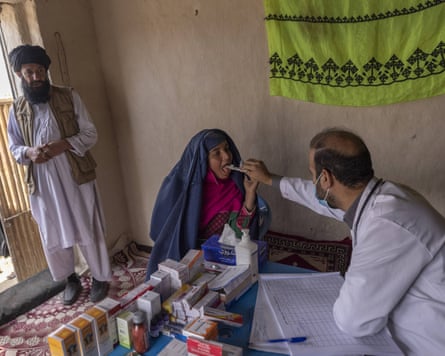
A doctor tends to a patient at a mobile health clinic in Bagrami district, Kabul province. Male doctors have been told a
mahrammust be present even for emergency treatment. Photograph: Bloomberg/Getty Images
In most provinces, male doctors have also received orders and directives from the
Taliban instructing them not to examine female patients. The doctors say they are not allowed to examine or provide emergency care to female patients, except under specific conditions – such as the presence of a female patient’s male guardian (
mahram), or having certain procedures performed by female nurses.
“We are not allowed to directly examine female patients because we are not their mahram. It makes no difference how simple the procedure is or how critical the patient’s condition may be,” says Samim*, a surgeon who has worked for 15 years in a public hospital in northern
Afghanistan.
The escalating bans are reaching new heights of absurdity, with officials in Balkh province in northern Afghanistan banned from calling female patients by their actual names. In May, officials reportedly ordered all hospitals, private practices and clinics to use the word “Bibi” instead of women’s names. They emphasised that this instruction must be observed even on medical prescriptions.
Rahima*, from Kunar province, says one of her relatives, an elderly woman, had to travel hundreds of miles to Kandahar city for dental treatment because her son ran a dental clinic there. The woman’s husband had told her that all the doctors in Kunar knew him, and it would be a source of shame for her to visit a male dentist.
4:33
The promises the Taliban made to women, then broke – video explainer
The Taliban crackdown on women getting medical treatment comes at the same time as they are being restricted from becoming doctors themselves. Since December 2024, women have
lost the right to study at medical institutes, and doctors at hospitals confirmed the Taliban had banned them from hiring female staff.
The remaining practising female doctors are
required by the Taliban to have a mahram. One patient says she was forced to wait to see a male doctor in a practice without female staff despite arriving with her father. She was told the doctor needed another female patient with her mahram to arrive so that if any problem arose the woman could help her, as the doctor would not be permitted to touch a female patient.
View image in fullscreen
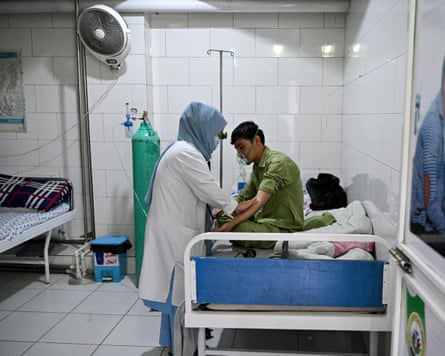
Female doctors are in short supply in Afghanistan. Photograph: Wakil Kohsar/AFP/Getty Images
Women have the option of either risking themselves, the doctors and the clinics by receiving treatment, using female health providers who are not qualified, or living with their ailments.
 ‘We are still here’: a day in the life of 12 Afghan women
Read more
“I don’t know what kind of situation this is. In a city where not a single female doctor can be found, how can they impose so many restrictions? Human life has no importance to them at all,” one patient told the Guardian and Zan Times.
The testimonies gathered run counter to Taliban declarations that doctors treating female patients would be exempt from the prohibitions. In February this year, Hamdullah Nomani, the Taliban’s communications minister,
said male doctors would be considered mahram when treating female patients.
Nargis*, who works as an assistant at a dental clinic in Jalalabad city in eastern Afghanistan, says some doctors have someone outside their clinic to look out for Taliban officials when they are treating a female patient. “Our male doctor sometimes jokes: ‘Let’s keep a
chadari [the full Afghan burqa] inside the office so that when they come, I can put it on so they won’t recognise that I am a male doctor.’”


 Hibatullah Akhundzada




 Huawei debuts world's largest R&D center in Shanghai that is larger than Apple Park and Microsoft HQ combined (13 Viewers)