Afghanistan: General News and Discussion

I am sure their New best friend india can accommodate them. afghans should start apply for indian visa and see how india responds.
Imagine having Afghans mixed with Indian lower classes. It's a no-go area immediately.
 
Research has proven that the Taliban's fighter jet can stay in the air longer than the Indian Air Force's fighter aircraft Tejas😂

To view this content we will need your consent to set third party cookies.
For more detailed information, see our cookies page.
 
The Taliban regime’s assertion that Afghanistan is “the heartland of Asia” reflects a nostalgic geopolitical hubris rooted in a Silk Road past that no longer shapes global power.

Today’s trade, energy, and strategic competition are driven by maritime routes, digital networks, and global supply chains - domains in which _
landlocked, industrially weak, and politically isolated Afghanistan holds little leverage.

In reality, the country remains structurally dependent on external transit routes, especially the ones emanating from Pakistan.

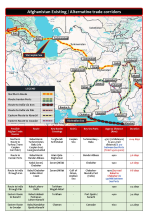
Deputy Prime Minister Mullah Abdul Ghani Baradar’s call to shift to alternative routes (via Iran & CARs) does not reflect economic realities. as alternatives would impose significant economic and political costs.

◾️Economic Implications of Trade Rerouting

Pakistan provides Afghanistan the fastest route to the sea, with logistics reaching Karachi in 3-4 days, compared to 6-8 days via Iran and much longer via the CARs.

Kandahar and Helmand are 150-300 km from Chaman–Spin Boldak, but 1,200-1,300 km from Zaranj/Delaram; Balkh and Baghlan are 500-700 km from Torkham, versus 900-1,000 km from Iran’s Islam Qala.

◾️Iranian corridors are longer and costlier : Rerouting via Iran or the CARs raises transport costs by 30-50%. Shipments that arrived in 22-25 days via Karachi now take 45-60 days through Iran, adding
US$2,000-2,500 per container.

Afghanistan conducts USD 500 million in annual trade with India through Wagah, historically handling 90% of India-Afghanistan trade.

Diverting from Attari–Wagah would increase costs 15-20%, requiring further Indian subsidies.

Perishables, accounting for 83% of Afghan exports, rely on short, low-cost routes. Longer corridors increase spoilage risk, transit times, and strain limited cold-storage capacity, reducing competitiveness.

◾️Iran’s Deep-Seated Distrust and Lack of Cultural Empathy

Afghanistan’s reliance on Iran exposes vulnerabilities. Iran shares limited cultural, ethnic, or religious affinity with Afghanistan and historically perceives Afghans as socio-economically inferior.

This bias manifests in discriminatory treatment of migrants, intensified after events like the Iran-Isreal conflict, when Afghan access to major Iranian cities was restricted.

Iran has deported up to 3,000 Afghans per day, targeting undocumented refugees.

Bilateral disputes over the Helmand River, border security, and 1S - 1S-K infiltration limit political cooperation.

Iran’s entrenched distrust and lack of cultural empathy suggest Afghan dependence would be exploitative rather than collaborative.

◾️Enhanced U.S. Leverage over the Afghan Taliban Regime

Relying on Iranian corridors increases U.S. leverage, as access to Chabahar Port depends on six-month sanctions waivers secured by India, with uncertain renewal.

Dependence exposes Afghan trade to U.S. sanctions on Iranian banking.

Blocked dollar and euro payments could force barter or third-country currencies, while insurance costs, limited port capacity, and cargo delays undermine supply-chain reliability. Afghan banks and firms face heightened secondary-sanctions risks.

Routing trade through a corridor contingent on U.S. regulatory decisions places much of Afghanistan’s economy under indirect American control, allowing the U.S. to influence Taliban behavior via economic pressure.

◾️Recalibration of Internal Power Distribution

Afghanistan’s demographics reveal regional imbalance. Eastern and southeastern provinces - Kandahar, Kabul, Nangarhar, Paktia - are predominantly Pashtun and historically benefited from proximity to Pakistan, consolidating wealth and political influence.
 
Western and northern provinces, farther from major trade arteries, have lagged economically and politically.

As eastern and southeastern areas lose economic leverage, power shift to western and northern leaders, will reduce eastern commanders’ authority, revenue control, and patronage networks.

◾️Long-term Benefits for Pakistan

Limit Smuggling and Terrorism: Pakistan loses around Rs 3.4 trillion per annum due to illicit trade and Rs 1 trillion due to back flow of Afghan transit trade.

Reduction or closure of cross-border trade curbs duty-free Afghan imports diverted into Pakistani markets, limiting smuggling, narcotics, illegal weapons, and terrorist inflows.

◾️Enhanced Inward Orientation - KP and Balochistan: Closure of Pakistan-Afghan trade encourages greater inward orientation of Pakistan’s Pashtun population, fostering integration with Punjab and Sindh, strengthening national cohesion.

◾️Bypassing Afghanistan: Emerging Pak-China-CARs Link: Pakistan aligns regional connectivity with China via the Gwadar - China - Tajikistan corridor through the Karakoram Highway (KKH). Upgrades include the US$2 billion Thakot–Raikot project and TIR system expansion, enabling China–UAE shipments via Khunjerab Pass in 10 days instead of 30 by sea.
New overland routes include Karachi-China-Kazakhstan-Moscow, a pilot Pakistan-Russia railway, and Turkmenistan-Iran-Azerbaijan-Russia corridor.

Gwadar is being developed as a logistics hub for rapid cargo dispatch to Central Asia, with airlifting and cargo rerouting through China under the Customs Convention on the International Transport of Goods, safeguarding supply chains from disruption.

Despite the Taliban regime’s efforts to recalibrate trade corridors, Afghanistan remains dependent on Pakistan for both economic and political viability. Alternatives, whether Iran’s Chabahar Port or routes through the Central Asian Republics, are longer, more expensive, and constrained by geopolitical frictions, making Pakistan the structurally indispensable for Afghan trade.

From Pakistan’s perspective, maintaining selective restrictions on transit routes can function as strategic leverage, creating pressure for more effective border management, stronger counter-terrorism assurances, and curbs on narcotics and smuggling flows originating from Afghan territory.
 

EU and Pakistan urge Afghanistan to root out terror on its soil, ensure women’s rights in joint statement


News Desk
November 23, 2025

1763899832527.png

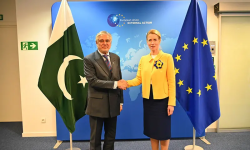
Deputy Prime Minister and Foreign Minister Ishaq Dar and EU High Representative and Vice President Kaja Kallas pose for a photo in Brussels, Belgium on November 22. — X/@ForeignOfficePk

In a joint statement shared on Sunday, Pakistan and the European Union (EU) called on Afghanistan to deal with terrorist organisations operating from its soil and to ensure the protection of human rights, especially those of women and girls.

The development came as the 7th Strategic Dialogue between Pakistan and the EU was convened in Brussels. The meeting was co-chaired by Deputy Prime Minister and Foreign Minister Ishaq Dar and the EU’s chief diplomat Kaja Kallas.

According to a joint statement shared by the Foreign Office (FO), Dar and Kallas discussed relations between Islamabad and Kabul amid cross-border tensions last month, with both top diplomats reaffirming their commitment to regional peace, stability, prosperity, and resolving issues with neighbours through dialogue.

“The two sides called on Afghanistan’s de facto authorities to play a constructive role in achieving the shared objective of rooting out terrorism from Afghan soil,” the statement read.

It added that Dar and Kallas expressed concern over Kabul’s deteriorating socioeconomic conditions and were in favour of a “peaceful, stable and self-reliant Afghanistan”.

They also hoped that Afghanistan would advocate for a “credible political process aligned with the UN-led ‘Doha process’, and in line with the commitments made by the Taliban de facto Authorities to the international community”, according to the statement.
 

Breakdown in Pak-Afghan ties​

Pakistan’s bilateral relations with Afghanistan have come under strain in recent times as the Tehreek-i-Taliban Pakistan (TTP) remains the main point of contention between the two countries.

Pakistan has demanded that the rulers in Kabul take action to stop cross-border terrorism, but the Afghan Taliban deny Islamabad’s allegations of terrorists being allowed to use Afghan soil to carry out attacks in Pakistan.

During a process of dialogue, which followed border clashes between the two countries in October, the two sides had met in an effort to work on mechanisms for lasting peace and stability between the two countries.

On October 25, the second round of talks between the two sides began in the Turkish capital. But Information Minister Attaullah Tarar then announced that the talks “failed to bring about any workable solution”.

However, mediators Turkiye and Qatar intervened and managed to salvage the dialogue process with an October 31 joint statement released by Turkiye stating that “further modalities of the implementation will be discussed and decided” during a principal-level meeting in Istanbul on November 6.

On November 7, however, after the third round of talks, Defence Minister Khawaja Asif said that talks addressing cross-border terrorism were “over” and “entered an indefinite phase” as negotiators failed to bridge deep differences between the two sides.

Following the failure of the talks, the Afghan Taliban suspended trade ties with Islamabad. Pakistan had already closed its border for trade soon after the October clashes.
 
The US on Wednesday (local time) stopped the processing of all immigration requests from Afghanistan citizens after two National Guard troops were shot near the White House in Washington.

Taking to X, the US Customs and Immigration Services, said, "Effective immediately, processing of all immigration requests relating to Afghan nationals is stopped indefinitely pending further review of security and vetting protocols."

It further said, "The protection and safety of our homeland and of the American people remains our singular focus and mission."

The move comes after two National Guard members were critically injured after a gunman opened fire on them near the White House. The suspect has been identified as Rahmanullah Lakanwal, a 29-year-old Afghan national who entered the US in 2021 through Joe Biden's Operation Allies Welcome after the Taliban took over in Afghanistan.

National Guard shooting: All we know​


The two National Guard personnel are from West Virginia. The officials described the attack as "targeted shooting".

According to a report in The New York Times, local officials said that Lakanwal was injured after firing shots in a busy tourist area on the day before Thanksgiving, and that he appeared to have acted alone, targeting members of the West Virginia National Guard.

According to MPD Executive Assistant Chief Jeffery Carroll, Lakanwal turned a corner, lifted his weapon and began firing at around 2:15 pm. Following the incident, the Donald Trump administration ordered the deployment of additional 500 National Guard troops to Washington, Defense Secretary Pete Hegseth said.

A White House official also confirmed that the building was put under lockdown, an order which was lifted at around 5 pm (local time).

How did Trump respond to the incident?​


Trump, who is in Florida to celebrate Thanksgiving, condemned the incident and warned on social media that the "animal" who shot the National Guard members “will pay a very steep price".

Taking to Truth Social, Trump said that he will be speaking on the horrific attack at around 9:15 pm (local time).

In a post on Truth Social, he wrote, "The animal that shot the two National Guardsmen, with both being critically wounded, and now in two separate hospitals, is also severely wounded, but regardless, will pay a very steep price. God bless our Great National Guard, and all of our Military and Law Enforcement. These are truly Great People. I, as President of the United States, and everyone associated with the Office of the Presidency, am with you!"

He further vowed to amplify the government's efforts in deporting and signalled a review of migrants who fled Afghanistan in 2021.

After the shooting, the Trump administration filed an emergency motion in a pending legal case that could force National Guard troops to withdraw from Washington as early as December 11, after a federal judge ruled that the President’s deployment was likely unlawful. The administration has asked a federal appeals court to step in by late next week, a move that could permit the deployment to continue.The US on Wednesday (local time) stopped the processing of all immigration requests from Afghanistan citizens after two National Guard troops were shot near the White House in Washington.

Taking to X, the US Customs and Immigration Services, said, "Effective immediately, processing of all immigration requests relating to Afghan nationals is stopped indefinitely pending further review of security and vetting protocols."

It further said, "The protection and safety of our homeland and of the American people remains our singular focus and mission."

The move comes after two National Guard members were critically injured after a gunman opened fire on them near the White House. The suspect has been identified as Rahmanullah Lakanwal, a 29-year-old Afghan national who entered the US in 2021 through Joe Biden's Operation Allies Welcome after the Taliban took over in Afghanistan.

National Guard shooting: All we know


The two National Guard personnel are from West Virginia. The officials described the attack as "targeted shooting".


According to a report in The New York Times, local officials said that Lakanwal was injured after firing shots in a busy tourist area on the day before Thanksgiving, and that he appeared to have acted alone, targeting members of the West Virginia National Guard.


According to MPD Executive Assistant Chief Jeffery Carroll, Lakanwal turned a corner, lifted his weapon and began firing at around 2:15 pm. Following the incident, the Donald Trump administration ordered the deployment of additional 500 National Guard troops to Washington, Defense Secretary Pete Hegseth said.

A White House official also confirmed that the building was put under lockdown, an order which was lifted at around 5 pm (local time).

How did Trump respond to the incident?


Trump, who is in Florida to celebrate Thanksgiving, condemned the incident and warned on social media that the "animal" who shot the National Guard members “will pay a very steep price".

Taking to Truth Social, Trump said that he will be speaking on the horrific attack at around 9:15 pm (local time).

In a post on Truth Social, he wrote, "The animal that shot the two National Guardsmen, with both being critically wounded, and now in two separate hospitals, is also severely wounded, but regardless, will pay a very steep price. God bless our Great National Guard, and all of our Military and Law Enforcement. These are truly Great People. I, as President of the United States, and everyone associated with the Office of the Presidency, am with you!"

He further vowed to amplify the government's efforts in deporting and signalled a review of migrants who fled Afghanistan in 2021.

After the shooting, the Trump administration filed an emergency motion in a pending legal case that could force National Guard troops to withdraw from Washington as early as December 11, after a federal judge ruled that the President’s deployment was likely unlawful. The administration has asked a federal appeals court to step in by late next week, a move that could permit the deployment to continue.
 
Funny thing this.... the Afghans we have been accused of loving/protecting... bite us.

And the Afghans the US loved... bite them.

Basically, they all bite.
 

Users who are viewing this thread

Pakistan Defence Latest

Country Watch Latest

Back
Top