Afghanistan Strategic and Foreign Affairs

Pak-China-Afghan trilateral​

During Thursday’s briefing, the spokesperson also said Islamabad would continue leveraging the China-Afghanistan-Pakistan trilateral foreign ministers’ dialogue, which showed the positivity with which Pakistan had approached the issue of Afghanistan.

But, he said, this positivity was “linked to the concrete, verifiable and written assurances from the Afghan side that their soil will not be used by terrorist elements” operating against Pakistan.

Pointing out that the Afghan side was not willing to give the verifiable and written assurances, he said, “Despite that, Pakistan wishes to engage with Afghanistan as diplomatic channels are open“.

“The embassy and consulates are functioning, and routine diplomatic exchanges take place.”
 

Pakistan to stay in Pak-China-Afghan forum, seeks action against terrorists​


FO says Kabul must give guarantees, rejects India’s claims and JF-17 deal reports

Khalid Mehmood
January 08, 2026


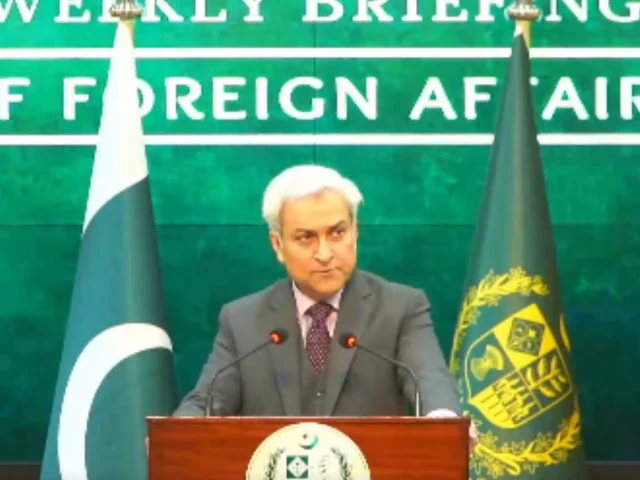
tahir andrabi speaking at the weekly foreign office press briefing photo x fo


Tahir Andrabi speaking at the weekly Foreign Office press briefing Photo: X/FO

ISLAMABAD: Pakistan will continue to be part of the trilateral mechanism involving Pakistan, China and Afghanistan, saying the forum reflects Islamabad’s positive engagement, but it will maintain its long-standing position on bilateral ties with Kabul, including demands for action against terrorist groups.

Speaking at the Foreign Office’s weekly press briefing on Thursday, spokesperson Tahir Hussain Andrabi said it was agreed during the Pakistan-China dialogue to maintain the trilateral mechanism. He said Pakistan does not seek a hostile relationship with Afghanistan but expects concrete steps from the Taliban administration.
 

Air cargo seen as key to boosting Indo-Afghan trade via Amritsar airport​


by The Frontier Post

Air-cargo-seen-as-key-to-boosting-Indo-Afghan-trade-via-Amritsar-airport-810x484.jpg


KABUL (Ariana News): Experts at the Confederation of Indian Industry (CII) Amritsar Zonal Council meeting highlighted the potential of air exports of farm produce to strengthen Indo-Afghan trade and support regional economic growth.

The session focused on Sri Guru Ram Dass International Airport, which last year handled just 972 metric tonnes of exports and 236 tonnes of imports, far below its capacity. Stakeholders noted delays caused by limited aircraft, short customs hours, and holidays.

Former Indian ambassador Navdeep Suri praised the session as the “finest granular interaction on trade” he had seen among Indian business chambers and proposed an Amritsar-Kabul-Dubai trade axis with frequent wide-bodied flights.

RahatCargo MD Sunil Kohli agreed to underwrite 1,500-1,800 tonnes of weekly cargo, provided swift clearances and suitable flights.

CII leaders emphasized that expanding perishable exports, textiles, pharmaceuticals, and value-added goods could become a major economic boost for the region, but required better coordination between airlines, customs, and airport authorities.

In November last year, an Indian foreign ministry official announced that air cargo services between India and Afghanistan will be launched soon.
 
To view this content we will need your consent to set third party cookies.
For more detailed information, see our cookies page.
 

India's Taliban gamble meets tyranny of geography​


As Chabahar falters, geography reasserts Pakistan's centrality in regional connectivity

Kamran Yousaf
January 20, 2026


tribune


ISLAMABAD: Last week's arrival of Noor Ahmed Noor in New Delhi - the first Afghan chargé d'affaires appointed under the Taliban government - marked a quiet but consequential moment in regional diplomacy, signalling a subtle recalibration in India's engagement with Kabul at a time of shifting geopolitical alignments.

Soon after landing, Noor Ahmed Noor met senior officials of India's Ministry of External Affairs (MEA). The MEA later released a photograph showing Noor Ahmed Noor standing besides the India's Joint Secretary for Pakistan, Afghanistan and Iran, a carefully choreographed image that spoke volumes.

The optics underscored a quiet but significant shift: the steady warming of ties between India and the Afghan Taliban regime.

Once viewed in New Delhi as Pakistan-backed proxies, the Taliban are now being engaged as part of India's evolving regional calculus. With India-Pakistan relations frozen and Taliban-Pakistan ties sharply deteriorating, both New Delhi and Kabul appear to be testing a tactical reset to advance their respective strategic interests.

For India, engagement with the Taliban at a time when Kabul and Islamabad are at loggerheads offers leverage against Pakistan and a renewed foothold in Afghanistan. For the Taliban, closer ties with India promise diplomatic diversification and reduced overreliance on Pakistan.

Yet this convergence faces a hard geopolitical constraint: geography.
 
Afghanistan is landlocked and overwhelmingly dependent on Pakistan for access to global markets. While Pakistan has historically allowed Afghan goods transit to India, it has never permitted Indian goods to move to Afghanistan through its territory. This structural reality has long frustrated both Kabul and New Delhi and driven their search for alternative routes.

The most ambitious of these alternatives was Iran's Chabahar Port.

During Ashraf Ghani's administration, Afghanistan, India and Iran signed a trilateral agreement to develop Chabahar as a gateway bypassing Pakistan. After relations between Pakistan and both India and Afghanistan further soured, efforts to operationalise Chabahar intensified.

Only last year, an Indian state-owned company signed a fresh 10-year agreement to operate the port, and the Taliban subsequently joined the arrangement, reviving hopes that the long-delayed project would finally deliver strategic dividends.

Those hopes now appear to be fading.

According to a recent report by The Economic Times, India has quietly pulled back from active involvement in Chabahar due to fears of potential US sanctions on Iran.

Notably, the Indian Ministry of External Affairs stopped short of directly rebutting the report. Instead, MEA spokesperson offered carefully worded responses that neither confirmed nor denied an Indian exit, a silence that has only reinforced speculation that New Delhi is recalibrating under external pressure.

Johar Saleem, Pakistan's former foreign secretary, sees the development as symptomatic of a deeper contradiction in India's foreign policy.

"While these are media reports rather than policy signals, they reinforce what many have long pointed out - that Chabahar was politically oversold without being commercially promising," Johar said.

"Given US sanctions, India's economic engagement with Iran was always suspect. What we are seeing now is another manifestation of India's strategic hypocrisy in the name of strategic autonomy, where narrow interests prevail over any principled policy; that is why, when push comes to shove, New Delhi buckles."
 
The Chabahar episode also exposes the limits of India and Afghanistan's long-standing ambition to sidestep Pakistan. Johar argues that the very idea was flawed from the outset, according to experts.

"This idea of bypassing Pakistan has always been more political than practical. Geography cannot be wished away," he said.

"Pakistan offers the shortest, cheapest and most viable route to the sea for Afghanistan, and for Central Asia as well. Chabahar was only being touted as an alternative, but it could never match Gwadar's logistical advantages."

He also pointed to Iran's own regional outlook, noting that Tehran has repeatedly stressed that Chabahar and Gwadar are complementary rather than competing projects.

"The latest developments simply highlight that Pakistan remains central to regional connectivity, regardless of New Delhi's political preferences," Johar added.
 
Asif Durrani, Pakistan's former ambassador to Iran, echoes this assessment and places particular emphasis on the economics of connectivity.

"India used Chabahar Port as a ruse to denigrate Pakistan's geographical advantage in Central Asia," Durrani said.

"However, upon completion, India found that this route was not economical and was 4045 per cent more expensive than Karachi port or the land route through Wagah. So far, India's private sector has been reluctant to use Chabahar due to its high cost and long distance."

For Afghanistan, the implications are stark. If India scales back its involvement at Chabahar, Kabul's already limited trade options shrink further, pushing it back toward reliance on Pakistan's ports, roads and transit infrastructure.

"Afghanistan has a right to seek various options, and we want to see Afghanistan connecting with Central Asia and its other neighbours," Johar said.

"But geographically and historically Pakistan has always been critical for its trade and connectivity. Our ports, road networks, and transit infrastructure provide Afghanistan with the most efficient access to global markets."

He stressed that this should not be framed as dependence but as an opportunity for mutually beneficial regional integration provided Kabul addresses Pakistan's core security concerns.

"For that, Kabul will have to adopt a more responsible attitude and ensure that there is no outward flow of terrorism from its soil to Pakistan," he added.
 
The quiet unravelling of the Chabahar project raises uncomfortable questions for India as well. If New Delhi's much-touted strategic autonomy collapses under the weight of sanctions risk, its ability to sustain independent regional initiatives comes into doubt.

For all the symbolism surrounding IndiaTaliban engagement, the hard realities of geography, economics and external pressure continue to shape outcomes, according to analysts.
 
To view this content we will need your consent to set third party cookies.
For more detailed information, see our cookies page.
 

Afghan, Turkmen officials discuss key economic, infrastructure projects​


by The Frontier Post

Turkmen-1024x643-1-810x509.jpg


HERAT CITY (Pajhwok): Deputy Prime Minister for Economic Affairs Mullah Abdul Ghani Baradar and Turkmenistan’s Foreign Minister Rashid Meredov have discussed major economic and infrastructure projects, including the Turkmenistan–Afghanistan–Pakistan–India (TAPI) gas pipeline, electricity supply and regional connectivity.

Baradar met Meredov, who also serves as Turkmenistan’s deputy prime minister, in western Herat province on Sunday, according to a statement from his office.

The meeting was attended by Minister of Mines and Petroleum Mullah Hedayatullah Badri, Minister of Energy and Water Haji Mullah Mohammad Younis Akhundzada, Turkmenistan’s Minister of Transport and Railways, the head of the state-owned Turkmengaz company and several other Afghan and Turkmen officials.

The two sides discussed the TAPI project, the Turkmenistan–Afghanistan–Pakistan (TAP) power transmission project, as well as other electricity and railway schemes.

Baradar said the launch of the TAPI project had paved the way for expanding relations between Afghanistan, Turkmenistan and other countries in the region, adding that Saudi Arabia’s Delta International Group had expressed keen interest in investing in the project.

He said Delta International was interested in investing in gas offtake from the TAPI project, expanding the capacity of Turkmenistan’s major gas fields, constructing and extending a gas pipeline from Guzara district of Herat province to Spin Boldak district of Kandahar province and onwards to India’s border, and building a large, modern gas hub at Pakistan’s Gwadar port.

The deputy prime minister urged Turkmenistan to clarify its position on construction of the Torghundi–Herat railway project, noting that Kazakhstan had also shown interest in implementing the scheme.

He said Afghanistan was fully prepared to finalise the TAP project route map and assured full cooperation from the Afghan side for electricity transmission to Bala Murghab, Khmab and Qarqun districts, as well as for the launch of other regional connectivity projects.
 
To view this content we will need your consent to set third party cookies.
For more detailed information, see our cookies page.
 
To view this content we will need your consent to set third party cookies.
For more detailed information, see our cookies page.
 
To view this content we will need your consent to set third party cookies.
For more detailed information, see our cookies page.
 

Users who are viewing this thread

Latest Posts

Back
Top