Define loss, how the **** did usa loss when it didnt loss anything?
Usa job was to enaure afghans dont comit international terrorism which they agreed upon
After being ***ped for 20 years with 100,000+ dead (with less usa troops dead then die of drinking or slipping off ice infront their doors, like just 2000, thats literally nothing) the Afghan drug cartel finally agreed they will say nothing to Israel, india, and USA and will focus on blowing up Pakistanis..this was good enough for Americans so they won and left
Whats next you are going to say USA lost to japan because it is leaving or winding up bases
USA 100% achieved its objective..today afghan Taliban will never antagonize usa or Israel
You ****, Afghan Taliban has returned back to power in Afghanistan.
Hence their 20 year war is won.
Five years on, Afghanistan's Taliban build foreign ties despite rights concerns
Asia / Pacific
Since they seized power in Afghanistan five years ago, the Taliban have succeeded in expanding their diplomatic and economic ties with countries around the world. But Afghanistan remains largely isolated due to a widespread refusal to formally recognise the Taliban government over human rights abuses.
Issued on: 11/08/2026 - 08:04
4 minReading time
Share
By:
FRANCE 24
Russia is the only country to officially recognise the Taliban government in Afghanistan. © Dmitri Lovetsky, AP
Five years after returning to power,
Afghanistan's
Taliban authorities have built working relationships with a slate of countries, despite a lack of formal recognition.
Russia remains the only nation to officially recognise the Taliban government, and many Western countries have demanded to see domestic
reforms on human rights before considering doing the same.
Read more
Four years after the fall of Kabul, Taliban succeeds in near-total exclusion of women
But many states are nevertheless engaging with Afghanistan's leaders – including Britain and
European Union members – driven largely by practical considerations.
Beyond the high walls of the foreign ministry in central
Kabul stand embassies, rows of travel agencies, and an airline billboard promising: "We're all connected."
While few Afghans have the means to go abroad, their government "seeks relations with all countries", according to Taliban spokesman Zabihullah Mujahid.
The authorities' diplomatic strategy has involved hosting envoys in Kabul – and frequently publishing the photos – including those from
China,
Japan,
Turkey,
Saudi Arabia and Britain.
China's ambassador to Afghanistan Zhao Sheng shakes hands with Taliban Prime Minister Mohammad Hasan Akhund on September 13, 2023. © Handout via AP
"The countries of the region and our neighbouring states have particular importance, because our economic ties and interests are closely linked," Mujahid said last month.
This year officials from
Tajikistan,
Turkmenistan,
Kyrgyzstan,
Uzbekistan and
Kazakhstan gathered in Kabul, as landlocked
Central Asia seeks trade routes through Afghanistan to access the sea beyond.
Erica Gaston, who was part of a team mandated by the
UN Security Council to identify strategies for addressing the challenges in Afghanistan, said regional nations were "always more pragmatic" in dealing with the Taliban authorities.
"You had much more receptivity among regional member states to say, 'this is the reality that we have in our region and engagement is inevitable'," said Gaston, who heads the Conflict Prevention and Sustaining Peace Programme at the United Nations University Centre for Policy Research.
'Impenetrable' issues
As well as coordinating on security, Taliban officials have been touting cross-border infrastructure projects to boost the country's fragile economy while Afghans are hit hard by international aid cuts.
Seeing potential in untapped natural resources, the government has expanded the mining sector, attracting firms from neighbouring China and elsewhere.
But foreign funds have been scarce as investors remain wary of the Taliban government's limited official recognition, with rumours that
Iran would follow Russia falling flat.
Despite this, many Taliban officials travel abroad, including a delegation that flew to
Brussels in June for
talks with 15 EU nations about returning failed asylum-seekers to Afghanistan.
Read more
EU hosts Afghan Taliban for migration talks slammed by rights groups
A spokesperson for the bloc told AFP: "Those who have no legal right to stay in Europe must be returned."
Germany has been at the forefront, and deported an Afghan not convicted of any crime for the first time since the Taliban's 2021 return to power, Interior Minister Alexander Dobrindt said in July.
For Gaston, the passage of time has meant "more and more countries accept that this is the reality, even if it's a reality that they don't like or condone".
But many have restricted further ties until they see changes in Afghanistan, particularly on rules that stop girls' education at age 12. Yet no policy shift is expected.
Accusing Supreme Leader Hibatullah Akhundzada and chief justice Abdul Hakim Haqqani of
crimes against humanity over the persecution of women and girls, the International Criminal Court
issued arrest warrants for them last year.
Read more
ICC issues arrest warrants for Taliban leaders over persecution of Afghan women
Afghan women remain banned from a host of places including UN premises, a rule still in force despite a visit last month by the heads of two of its agencies.
A
UN source in Kabul, speaking on condition of anonymity due to the sensitivity of the subject, said the ability to exert influence on the authorities remains "highly issue-dependent".
"Some of these issues are kind of fairly impenetrable, but then you have other issues on which you are able to make progress," they told AFP, citing positive relations in some parts of Afghanistan on counternarcotics and humanitarian access.
Political reality 'has changed'
Multiple nations stepped in this year when
Afghanistan and Pakistan went to war, with China hosting talks after hundreds of civilians were killed.
Qatar, Saudi Arabia, Oman, Iran, Turkey, Uzbekistan and Malaysia were also engaged in trying to stop the fighting, according to the UN.
Pakistan's arch-foe
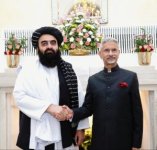
India has strengthened its ties with the Taliban government, with
New Delhi securing a sanctions waiver last year so that Foreign Minister Amir Khan Muttaqi could travel there.
In June, India's UN envoy suggested a rethink was necessary on sanctions – a travel ban, asset freeze and arms embargo – that target dozens of Taliban members.
"The political reality of Afghanistan has changed in the last five years, and the current UN sanctions regime must take that into account," said Harish Parvathaneni.
The diplomat stopped short of detailing what the new approach should be but, as the UN source told AFP, engagement with the Afghan government is "the current state of play".
"Everybody recognises the fact that, essentially, Afghanistan is fully controlled by the de facto (Taliban) authorities and, essentially, there are multiple issues on which the world, the region, has to deal with them," they said.
(FRANCE 24 with AFP)
Since they seized power in Afghanistan five years ago, the Taliban have succeeded in expanding their diplomatic and economic ties with countries around the world. But Afghanistan remains largely isolated…

www.france24.com
Yes I concede that the relationship Pakistan has with the Afghan Taliban is "bad" noweradays.
We will see how the relationship develops in the future.