AI, Software, Coding, Internet Security Thread

OpenAI CFO says companies who are not embracing AI fast enough will ‘get left behind’​

Published Tue, Sep 9 20255:22 PM EDT
thumbnail

Samantha Subin@samantha_subin

Key Points
  • Companies and people that don’t harness artificial intelligence will “get left behind,” said OpenAI finance chief Sarah Friar.
  • The comments come as the company ramps up spending on artificial intelligence to fuel its flagship ChatGPT large language model.
  • Friar also said the company is under constant compute constraints caused by ballooning AI demands.
1757816747452.webp

OpenAI finance chief Sarah Friar is sending a warning signal for companies and professionals to adopt artificial intelligence if they want to keep an edge.

“The people who will get left behind are not embracing AI fast enough,” she said during an appearance at Goldman Sachs’ Communacopia + Technology Conference on Tuesday.


Individuals harnessing AI to their full potential represent one of the biggest threats to businesses, she said, adding that it is “someone who’s using AI deeply that’s going to disrupt you.”

The comments from Friar come as the company ramps up AI spending to fuel its flagship ChatGPT large language model. The Information reported on Friday that the company upped its cash burn to $115 billion through 2029 and over $8 billion this year.

Read more CNBC tech news​

In response to recent profitability reports, Friar said OpenAI is a “for-profit entity that sits inside a nonprofit.” The company is expected to reportedly triple revenue to about $13 billion this year and recently hit $10 billion in annual recurring revenue.

Friar also called attention to compute constraints caused by ballooning AI demands, which have led the company to go beyond its partnership with Microsoft and reach deals with Oracle
, Coreweave and others.

OpenAI is doing a lot of prebuilding to get ahead of future needs, she said.

 
Sam Altman Troubled as People Refuse to Pay for ChatGPT Subscriptions

By Novina Putri Bestari, CNBC Indonesia
13 September 2025 22:00


To view this content we will need your consent to set third party cookies.
For more detailed information, see our cookies page.

Build Hour: Codex​


Jakarta, CNBC Indonesia – Since the launch of ChatGPT, OpenAI has grown rapidly. But the company now faces a new challenge: only a small number of users are willing to pay for subscriptions.


Sam Altman’s company has gained more than 700 million users in the three years since ChatGPT was released. However, this has not translated into strong revenues, as only a small fraction of users are willing to spend money on the paid service.


A study by Menlo Ventures found that only 3% of consumers are willing to pay for AI subscriptions. The survey, which covered 5,000 tech users, suggested that much more needs to be done before AI becomes fully adopted in everyday life.


The lack of paying customers is likely to weigh on OpenAI. The company faces heavy expenses to run its AI services and has already been posting significant losses, reportedly losing billions of dollars annually.


Over the past nine months, OpenAI disclosed that it would spend US$60 billion per year on Oracle computing. Meanwhile, its data center operations will require US$18 billion, and it is expected to spend up to US$10 billion on chips.


To cover these costs, the Wall Street Journal reported Saturday (September 13, 2025), OpenAI will need hundreds of millions of users to pay more for its tools and services.


The road ahead is tough. OpenAI’s annual losses are projected to continue growing. Altman has said that the company expects to lose as much as US$44 billion (Rp 722.3 trillion) by 2029, only then turning profitable.


Beyond finances, OpenAI also faces another major hurdle: restructuring from a nonprofit into a fully commercial entity.


According to the Wall Street Journal, the fate of US$19 billion (Rp 311.9 trillion) in funding commitments depends on resolving this structural issue.

 
To view this content we will need your consent to set third party cookies.
For more detailed information, see our cookies page.


Google DeepMind CEO Demis Hassabis on AI, Creativity, and a Golden Age of Science | All-In Summit​


Singapore IT sector faces burnout, skills gap & talent drain​

1758020362242.webp


Melvin Hipolito

4–5 minutes


New research has highlighted significant challenges facing Singapore's IT and cybersecurity workforce, as burnout and a widening skills gap threaten the sector's long-term sustainability.

The Bitdefender 2025 Cybersecurity Assessment Report has revealed that the intensity of workplace stressors for Singaporean IT professionals far outpaces global trends. According to the report, 64% of cybersecurity professionals in Singapore are experiencing burnout, citing the unrelenting pace and complexity of cyber threats.

The report also indicates an alarming attrition risk, with 53% of local respondents planning to leave their current roles within the next year. This figure is well above the global average of 40%, raising concerns about future staffing in a crucial sector for Singapore's economy and infrastructure.

Escalating skills gap

One of the most serious findings relates to the shortage of advanced cybersecurity specialists. Of those surveyed, 59% reported that the skills gap at their organisations has worsened in the past year. The deficit extends beyond general IT skills, with pressing needs emerging for expertise in threat hunting, Living Off the Land (LOTL) detection, and security analytics using artificial intelligence.

Difficulty in bridging these gaps is affecting operational security. The report notes that 39% of respondents view internal skills shortages as the main barrier preventing their organisations from extracting value from deployed security technologies. This impacts their ability to defend proactively against increasingly sophisticated cyberattacks.

The proliferation of security tools and the growing complexity of managing
hybrid and multi-cloud environments are compounding these pressures. Many professionals express concerns that the operational load is becoming unsustainable, as teams struggle to keep up with both the quantity and diversity of active threats.


Confidentiality concerns and cultural factors


The report draws attention to the issue of underreporting within the Singaporean cybersecurity field. Among those who experienced a breach in the previous 12 months, 75.7% said they were told to keep it confidential, even in situations where they felt the incident should be disclosed. This is significantly higher than the global average of 58% and points to cultural or compliance-driven pressures that may inhibit transparency and open discussion of security incidents.


Unique pressures in Singapore


"Rapid digitalisation in public and private sectors has accelerated demand faster than the pace of talent development. High compliance expectations intensify the pressure on overstretched teams. A 'don't show weakness' workplace culture may suppress open reporting and further isolate professionals at risk."

This assessment from Bitdefender outlines a combination of systemic and cultural factors causing a feedback loop, where attrition and skills gaps lead to operational gaps and increase the administrative burden on already strained teams. Instead of focusing on building long-term resilience, many teams are forced into a position of reacting to incidents as they arise.


Sector recommendations


"To avoid a worsening talent drain, organisations first acknowledge the unique pressures facing cybersecurity professionals in Singapore, then look to invest in automation, up-skilling, and human-centric strategies that support the wellbeing of security teams. Equally important is meaningful up-skilling, focusing on advanced threat detection, AI-driven analysis, and cloud security to best equip IT teams to act proactively.

This approach stresses the importance of both technological investments and strategies designed to ease the personal strain on IT professionals.


The report warns that without action, the risks associated with high staff turnover extend beyond personnel costs. There is the potential that diminished capacity and lost institutional knowledge could multiply vulnerabilities in the country's digital infrastructure, exposing businesses and public services to greater cyber threats.


OpenAI study finally reveals how people actually use ChatGPT​


Anthony Cuthbertson
Tuesday 16 September 2025

3–4 minutes


1758597307023.png

A first-of-its-kind study has revealed how people actually use OpenAI’s hugely popular artificial intelligence chatbot ChatGPT.

Since launching in 2022, the AI tool has grown to more than 700 million users – or “nearly 10 per cent of the world’s adult population”, according to OpenAI. Until now, the way this vast userbase has been using the app has been largely anecdotal.

The new study, by OpenAI’s Economic Research team and Harvard economist David Deming, analysed 1.5 million conversations with ChatGPT to track consumer usage.

OpenAI said the findings showed that conversations typically focus on everyday tasks “that create economic value through both personal and professional use”, with the company calling on AI to be treated as a “basic right” for people.

“ChatGPT consumer usage is largely about getting everyday tasks done,” OpenAI wrote in a blog post announcing the study.

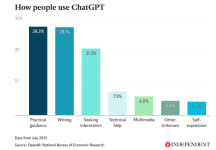
“Three-quarters of conversations focus on practical guidance, seeking information, and writing – with writing being the most common work task, while coding and self-expression remain niche activities.”

It is the first study to use internal ChatGPT message data, for which OpenAI said privacy-preserving techniques were used to protect user data.

The researchers found that the majority of people use ChatGPT for tasks and queries that are unrelated to work, with only 30 per cent using it in a professional capacity.

“Overall, our findings suggest that ChatGPT has a broad-based impact on the global economy,” the researchers wrote in the study.

“The fact that non-work usage is increasing faster suggests that the welfare gains from generative AI usage could be substantial... Within work usage, we find that users currently appear to derive value from using ChatGPT as an adviser or research assistant, not just a technology that performs job tasks directly.”

One unexpected finding from the study was that men and women use ChatGPT for different reasons.


Since launching in 2022, ChatGPT has grown to more than 700 million users (AFP/Getty)


Users with more typically feminine names are more likely to use the artificial intelligence tool for practical guidance and writing assistance, while those with typically masculine names more often use it for technical help and multimedia.

Despite ChatGPT’s meteoric growth since launching in November 2022, it is now facing significant competition from its rivals.

Google’s AI chatbot Gemini recently overtook ChatGPT to become the most popular iPhone app in the UK and the US.

The tech giant attributed the sudden surge in new users to the success of its new image model, known as Nano Banana, which appears to surpass many of the limitations of OpenAI’s tools like DALL-E.

 
To view this content we will need your consent to set third party cookies.
For more detailed information, see our cookies page.


Nvidia plans to invest up to $100 billion in OpenAI as part of data center buildout​

 
To view this content we will need your consent to set third party cookies.
For more detailed information, see our cookies page.


Tech companies scramble after Trump slaps $100,000 fee on H-1B visas​


To view this content we will need your consent to set third party cookies.
For more detailed information, see our cookies page.


Ark's Cathie Wood on H-1B Visas, China Tech Sector, TikTok​

 
Last edited:
To view this content we will need your consent to set third party cookies.
For more detailed information, see our cookies page.


H-1B fee hike will impact the mainstream tech workers, says Wolfe Research's Stephanie Roth​


To view this content we will need your consent to set third party cookies.
For more detailed information, see our cookies page.


Winners and losers from Trump’s H-1B visa shake-up​

 
Last edited:
it's the future. i like pravin swahney discussions on AI. we must train people on AI, cybersecurity(red team and blue team). we have to develop capabilities which we can apply in weapon systems like missiles etc. osint is also very impoprtant. there is a lack o osint qualified people in pakistan. india has two to three such people. AI will help us make drones that will have their own bvr missiles attached to them. they will target enemy jets, important ground positions based on ai and they will take better decisions by themselves. we need this type of attacking mindset and we must train our people on new and existing technologies.

consider a ballistic missile that detects interceptors using ai. it then dive hard and act like a cruise missile, flying above and below, diving as necessary. it's basically like a missile that miss it's target but still have energy and ai to guide the missile again on the target.

think about some kind of technology that will make drone fall without any reason like birds falling from the sky. i think israel has already made this type of weapon. learn ai. it's the future. stop watching women on tiktok. this new generation needs to improve.
 
it's the future. i like pravin swahney discussions on AI. we must train people on AI, cybersecurity(red team and blue team). we have to develop capabilities which we can apply in weapon systems like missiles etc. osint is also very impoprtant. there is a lack o osint qualified people in pakistan. india has two to three such people. AI will help us make drones that will have their own bvr missiles attached to them. they will target enemy jets, important ground positions based on ai and they will take better decisions by themselves. we need this type of attacking mindset and we must train our people on new and existing technologies.

consider a ballistic missile that detects interceptors using ai. it then dive hard and act like a cruise missile, flying above and below, diving as necessary. it's basically like a missile that miss it's target but still have energy and ai to guide the missile again on the target.

think about some kind of technology that will make drone fall without any reason like birds falling from the sky. i think israel has already made this type of weapon. learn ai. it's the future. stop watching women on tiktok. this new generation needs to improve.


but dumb people cannot understand AI!

its a logical fallacy developed by the rich billionaires

it is like a 'penrose's illusion'

AI, at large scale, would make dumb people even more foolish, arrogant and sadistic!

thats why, along with the AI, a large gap between rich and poor should exist, before the launch of AI!

for instance, Robocop like society!

To view this content we will need your consent to set third party cookies.
For more detailed information, see our cookies page.
 
Google Research: 90 Percent of Tech Workers Rely on AI


Kamis, 25 Sep 2025 14:25 WIB


Key Points from Google’s AI Usage Research​


  1. Widespread Adoption
    • 90% of tech workers now use AI in daily tasks, up 14% from last year.
    • AI is mainly applied to writing and modifying code.
  2. Job Market Challenges
    • Despite AI adoption, recent computer science/engineering graduates face higher unemployment than some humanities majors.
    • Software engineer job postings dropped 71% (Feb 2022–Aug 2025).
  3. Industry Competition & Tools
    • Google promotes AI tools (free and paid, up to $45/month).
    • Competitors include Microsoft, OpenAI, Anthropic, and startups like Replit and Anysphere.
  4. Trust & Limitations
    • Only 20% of tech professionals “highly” trust AI-generated code; most are cautious.
    • AI is at mid-level maturity (3–4/5), capable of system-level problem-solving but still needs human oversight.
  5. Perspective from Google
    • Google says AI simplifies tedious tasks but cannot replace all aspects of software development.
    • The surge in adoption is also driven by hype and industry excitement.


Jakarta, CNN Indonesia —


Google’s latest research reveals that as many as 90 percent of workers in the technology industry now use artificial intelligence (AI) in their daily work. This figure is up 14 percent compared to last year.


According to the latest report from Google’s DORA research division, the findings are based on a survey of 5,000 technology professionals across various countries. AI is most commonly used for tasks such as writing and modifying code.


This situation arises amid debates about AI’s impact on jobs and the economy in general. Some industry figures, including Anthropic CEO Dario Amodei, have expressed concerns that AI could increase unemployment.


However, other industry players believe those concerns are overstated.


On the other hand, data shows that recent graduates in computer engineering and computer science face greater challenges in finding jobs. According to data from the New York Fed, the unemployment rate for graduates in these majors is now higher than for fields such as art history and English.


Meanwhile, the number of job postings for software engineers on the platform Indeed reportedly fell 71 percent between February 2022 and August 2025.


Google has become one of the companies driving AI adoption in software development. The company offers a variety of AI-powered tools, ranging from free versions to paid subscriptions costing US$45 per month.


Competition in the AI arena is getting tougher, with players like Microsoft, OpenAI, and Anthropic, along with startups such as Replit and Anysphere, whose valuations continue to soar as AI adoption expands.


Ryan J. Salva, head of Google’s programming tools development division, said that most internal teams at Google are already leveraging AI. He noted that AI is now integrated into various aspects of technical work, including documentation and code editors.


“If you’re an engineer at Google, it’s almost impossible not to use AI in your daily work,” Salva told CNN on Tuesday (Sept 23).


However, even though AI usage is on the rise, not all tech professionals are confident in its results. About 46 percent of respondents said they “somewhat” trust the quality of AI-generated code. Around 23 percent trust it “a little,” and 20 percent said they “highly” trust it.


In terms of code quality, 31 percent of respondents felt that AI only “slightly improved” their work outcomes, while 30 percent said it had no impact at all.


Salva explained that AI’s current capabilities in software development are at levels three to four on a five-level maturity scale. This means AI can already perform cross-system problem-solving but still requires human oversight and multiple layers of safeguards.


Despite the rapid adoption of AI, Salva is among those who believe that there are important parts of software development that cannot be automated. He sees AI as helping to simplify tasks that workers consider tedious.


However, he also acknowledged that the rise in AI use is likely being fueled by the hype surrounding the technology.


“Software development is like the fashion industry. We’re all racing to chase the latest style of jeans,” he said.


“And when the talk around it is so loud, everyone gets excited to try something new,” he concluded.


(dmi/dmi)


To view this content we will need your consent to set third party cookies.
For more detailed information, see our cookies page.


Microsoft ends Israeli military use of AI, data services for its mass surveillance of Palestinians​

 
To view this content we will need your consent to set third party cookies.
For more detailed information, see our cookies page.


Israel's mass surveillance: Microsoft blocks the army from using its software​

 
To view this content we will need your consent to set third party cookies.
For more detailed information, see our cookies page.


$20B AI CEO: The ONLY trait for success in the AI era | Aravind Srinivas, Co-founder of Perplexity​

 
To view this content we will need your consent to set third party cookies.
For more detailed information, see our cookies page.


Accenture Layoffs 11,000 Staff | AI Reshaping IT Jobs in India & Beyond​


To view this content we will need your consent to set third party cookies.
For more detailed information, see our cookies page.


Big Tech Told Kids to Code. The Jobs Didn’t Follow.​

 
Last edited:

Users who are viewing this thread

Latest Posts

Back
Top