AJK govt bans Joint Awami Action Committee, notification issued

Colonial this, colonial that

The Messiah Imran will save all, with no plans, idiots as PTI members

All it will do is bring more chaos to a system that doesn't work


PTI at the moment is a terrible terrible party that can't be trusted at all to safeguard Pakistan interests


Sure!!! Only Trust The Duffers Who Already Lost Half Our Country
 
PTI at the moment is a terrible terrible party that can't be trusted at all to safeguard Pakistan interests


like I said the faujeeets just re hash non sense to be spilled by a new generation of idiots..

lets look at the faujeeeets and their labeling of enemies of the state over last 70 years

Fatima Jinnah -

During the 1965 Pakistani presidential election campaign, Ayub Khan and his supporters ran a smear campaign against Fatima Jinnah (Madar-e-Millat, sister of Muhammad Ali Jinnah), accusing her of being a pro-India and pro-American agent (sometimes called a foreign agent or traitor to Pakistan).

Key Details​

  • Fatima Jinnah challenged Ayub Khan as the candidate of the Combined Opposition Parties (COP). She criticized his dictatorship and called for democracy.
  • In response, Ayub Khan’s side portrayed her as unfit to rule (including gender-based attacks) and disloyal to Pakistan. She was labeled an Indian/American agent working against national interests.
  • State-backed propaganda, including newspaper ads, amplified these accusations. Sources describe her being "declared a traitor" or branded as such by the regime.
  • This was a common tactic at the time to undermine opponents. Ayub won the indirect election (via Basic Democrats) amid widespread rigging allegations, though Fatima Jinnah had strong popular support, especially in urban areas and East Pakistan.
While Ayub Khan may not have used the exact word "traitor" in a single recorded quote in every source, his campaign and government machinery clearly promoted these disloyalty accusations, which amounted to calling her a traitor in political terms. This episode is well-documented in Pakistani political history as a low point in attacks on the "Mother of the Nation."
 
Last edited:
Sheikh Mujibur Rahman

The Pakistani army and military government under Yahya Khan explicitly called Sheikh Mujibur Rahman (Bangabandhu) a traitor and charged him with treason in 1971.

Key Historical Facts​

  • On the night of 25 March 1971, the Pakistan Army launched Operation Searchlight in East Pakistan. They arrested Sheikh Mujibur Rahman from his residence in Dhaka shortly after.
  • He was immediately charged with treason and sedition (including "waging war against the state"). A secret military tribunal later tried him on these charges.
  • On 26 March 1971, in a radio broadcast, President Yahya Khan and the regime accused Mujib and the Awami League of treason.
  • The official Pakistan White Paper (August 1971) formally blamed Mujib and the Awami League for the crisis, portraying their actions as treasonous and secessionist.
This mirrors the earlier smear campaign against Fatima Jinnah. In the eyes of the Pakistani military establishment at the time, Mujib’s demand for autonomy (Six Points) and the non-cooperation movement were seen as betrayal of the Pakistani state, leading to his arrest, trial, and a death sentence (which was never carried out due to international pressure and the war’s outcome).

Note: In Bangladesh, Sheikh Mujibur Rahman is revered as the Father of the Nation. In Pakistan’s official narrative (especially within parts of the military), he has long been viewed as the man who broke up the country. Recent statements (as late as 2025) by Pakistani military spokespersons have continued to refer to him as a "traitor."

This episode is central to the history of the Bangladesh Liberation War and the atrocities of 1971.
 

Bhutto​

1971 (Under Yahya Khan)​

  • During the East Pakistan crisis, General Yahya Khan (then President and Army Chief) and the military establishment accused Zulfikar Ali Bhutto of treason.
  • Yahya ordered Bhutto's arrest on treason charges (similar to Mujib's), though this was short-lived as Bhutto soon became President after Yahya's resignation following the 1971 defeat.
Yahya and parts of the army blamed Bhutto (along with Mujib) for the breakup of Pakistan. Yahya reportedly accused Bhutto of "breaking Pakistan" even later.

1977–1979 (Under Zia-ul-Haq)​

  • General Zia-ul-Haq overthrew Bhutto in a military coup (Operation Fair Play) on 5 July 1977.
  • The Pakistan Army under Zia did not primarily charge Bhutto with treason. Instead, they arrested and tried him on conspiracy to murder a political opponent (Ahmad Raza Kasuri's father was killed in the ambush). Bhutto was convicted and executed on 4 April 1979.
  • Zia and the regime portrayed Bhutto as corrupt, authoritarian, and responsible for national ills (including indirectly linking him to 1971), but the official legal case was the murder charge, widely viewed as politically motivated ("judicial murder").
  • There were mentions of potential high treason cases or broader charges against Bhutto's government, but these were not the basis for his execution.

 
Last edited:
Nawaz Sharif

the Pakistan Army (under General Pervez Musharraf) did call Nawaz Sharif a traitor and formally charged him with treason (high treason) after the 1999 military coup.

Key Details (1999 Coup)​

  • In October 1999, Nawaz Sharif (then Prime Minister) attempted to remove General Pervez Musharraf as Army Chief while Musharraf was abroad. This triggered a bloodless coup.
  • The military arrested Sharif and put him on trial before a military court.
  • He faced charges including hijacking, kidnapping, attempted murder, and treason.
  • The army and military regime explicitly portrayed him as having committed treason against the state and the armed forces.
Sharif was initially sentenced to life imprisonment (some reports suggested the military wanted a death sentence, but it was commuted due to Saudi intervention). He was later exiled to Saudi Arabia in 2000.

Other Instances​

  • Later years: Nawaz Sharif and the military establishment have had a turbulent relationship. Sharif has accused the army of interfering in politics and toppling his governments (especially in 2017 via the Panama Papers case). In response, some pro-establishment voices and cases have accused him (or his party) of sedition/treason — for example, in 2018–2020 when he criticized the military’s role. However, these were not formal army-led treason trials like in 1999.
  • The 1999 case remains the clearest and most direct instance where the Pakistan Army officially labeled and tried him as a traitor.
 
Last edited:
Benazir Bhutto

the Pakistan Army and military establishment did label Benazir Bhutto a "security risk".

Key Evidence​

  • In 1990, during the period leading to the dismissal of her first government, senior military intelligence officials explicitly labelled her a “security risk” for Pakistan. This was mainly due to her public criticism of the army and her independent stance on security and foreign policy issues.
  • A former Military Intelligence (MI) official later testified in the Asghar Khan case that Benazir Bhutto was considered a security risk because of her criticism of the military.
  • Benazir herself publicly stated on multiple occasions that military hardliners called her a “security threat” or “security risk”, particularly for advocating peace with India, supporting a broad-based government in Afghanistan, and trying to assert civilian control over security policy.

Context​

The military viewed her with deep suspicion because:

  • She was seen as too independent and pro-Western.
  • She attempted to reform or reduce the influence of the ISI and military in politics.
  • Her approach to India and Afghanistan was considered “soft” by hardliners.
This label contributed to the hostility that led to the repeated dismissal of her governments, though — unlike some other leaders — she was never formally charged with treason.
 
Last edited:
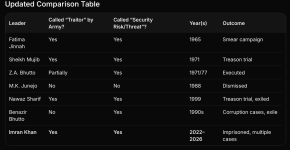
for those with less IQ (they know who there are) follow the pattern that has been established


the following national leaders from Fatima Jinnah to Imran Khan have been labeled traitors , security risk and all the horse crap they could copy and paste....


Screenshot 2026-06-26 at 9.14.55 PM.png


there is good reason why there is a very low opinion of these touts and even less what they claim as "truth"

now enjoy your weekends and hopefully you have learned something

ie lies have no legs.
 
Last edited:
Already acknowledged the aspects in the 2nd paragraph so why restate them?
You cannot isolate recent events and then dismiss a root cause saying it does not explain everything.

The same social habits that produced support for Ayub, Bhutto, and later PTI are part of the same pattern, not separate ones. Even Jinnah had to work within that reality and, in practice, accept mass politics as it evolved.

Bhutto also had real educated and middle class support, not just rural crowds. Ayub too had an early reformist image and attracted educated backing before the fallout set in. Then with PTI, the middle class mobilized strongly as well, but Pakistan’s historically thin middle class, weak civic culture, and the tendency of many people to stop at symbolic effort meant that support was always vulnerable to disappointment.

Once IK's compromises became visible, the same crowd that elevated him also helped cool the wave.

If anything, it was the impending bogey of return of the status quo under PDM and Khan's own rhetoric with victimhood similar to how Bhutto and everyone else before him "Mujhe kyun nikala" put out at different levels of resonance - actually boosted his popularity at the polls. Then what happened after May's events? Where are the jiyalas? PPPP can still gather more even with suppression than PTI can.

I mean if he could - where are they? its been 4 years the man is in jail and no masses are storming Adiala or parliament nor has KPK descended into full civil war yet for just IK. Because the state(in its part of the cycle and elitist tilt) did what it does suppression, negotiations, partial acceptance, policing, communication controls, and selective concessions.

Where are these "fantastical" current events that have dismissed the long standing root causes?

Instead, there are more visible and AJK is a prime example - long running structure of elite capture, weak accountability, and a governance setup that many residents see as remote, over administered, and unresponsive.

PTI can provide that movement a voice but CANNOT change the system because they are borne of it and the state is running a very similar playbook BECAUSE that is all it knows how to do.

Nothing new in that nor some "recent" events that would suggest that Pakistan's Biryani is now different because now the masala is being made in factories and sold in packets - its still Biryani and Pakistanis are ok with it.
Not sure about rest of Pakistan but in AJK majority of the awaam supports PPP and Pmln and all the big rich politicians, MNAs, most of the vote is done on baradarism. When PTI won majority seats, all the politicians were ex PPP and Pmln. This Action Committe protest was started by normal people, who used the grievances to gain sympathy, it worked aswell, large number of people came out to protest, the government accepted many demands, prices were reduced. People should blame the politicians aswell who make big promises during elections and after elections forget about the awaam, when questioned they blame Pindi. But why our rulers still support these corrupt politicians, the politicians decide who becomes police officer, judge and everyone is on payroll. This kind of system over the decades will produce those who will fight against it. Now obviously some nationalists are trying to hijack the protests and using it against the establishment, but then again AJK politicians are also playing dirty politics, by making up stories and fake propaganda.
 

Users who are viewing this thread

Latest Posts

Back
Top