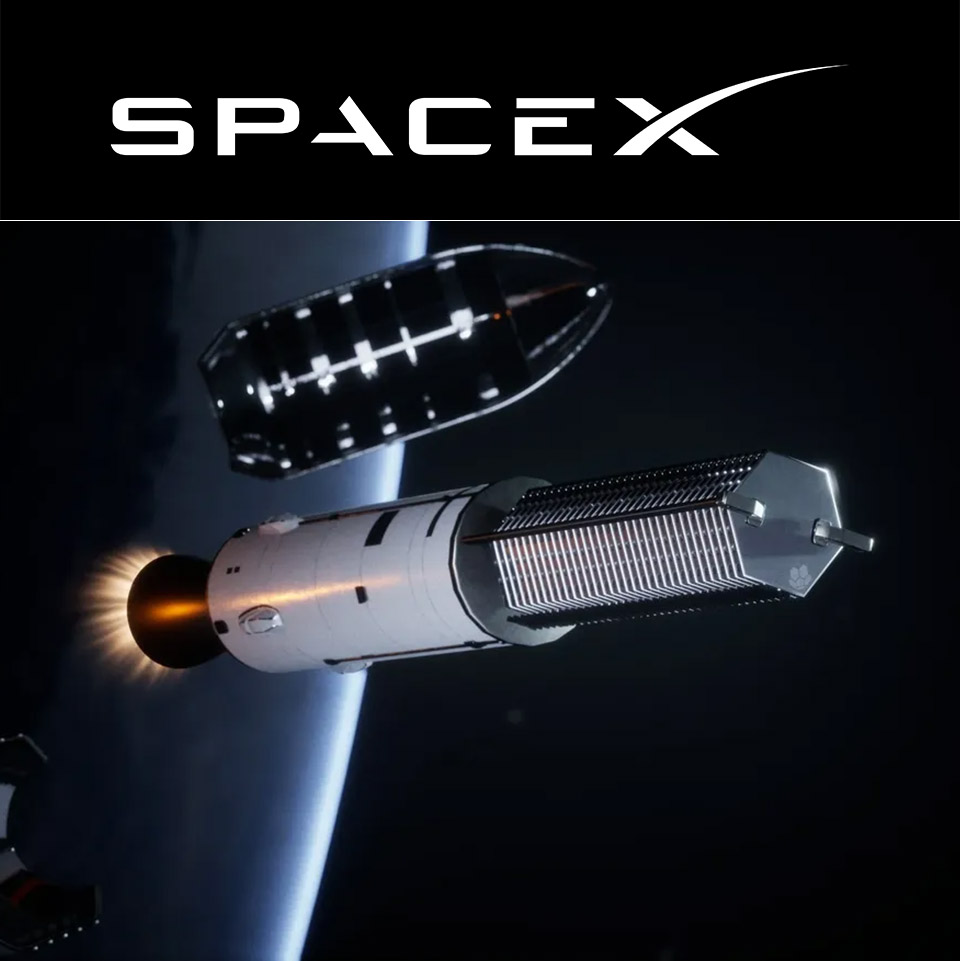
All things SpaceX - Updates and Discussion

WOW! Seriously! Wow!.

I did not know that.

Kudos to Musk for his vision and literally making space flight a viable commercial venture.
And I'm glad he's out of politics. I remember him vigilantly visiting the manufacturing plants, spending days and nights planning, talking to the people. Spacex (Especially Starship Program) clearly seemed to be suffering as he got distracted with politics.

Maybe he can become the President of Mars and run a DOGE-Mars once the habitats begin .. and get that dream achieved in another way :D

But yes, I always thought humanity's space dreams are a dead end, until this guy yelled 'Hold My Beer'
 
To view this content we will need your consent to set third party cookies.
For more detailed information, see our cookies page.


SpaceX launches another 28 Starlink satellites; lands booster 525th time, 137th launch of year
 
To view this content we will need your consent to set third party cookies.
For more detailed information, see our cookies page.


SpaceX launches another 29 Starlink satellites; lands booster 526th time, 138th launch of year
 
To view this content we will need your consent to set third party cookies.
For more detailed information, see our cookies page.


To view this content we will need your consent to set third party cookies.
For more detailed information, see our cookies page.


Major update on Starship HLS
 
To view this content we will need your consent to set third party cookies.
For more detailed information, see our cookies page.


SpaceX launches another 28 Starlink satellites; lands booster 527th time, 139th launch of year
 
SpaceX is set to receive $2 billion to develop satellites that can track missiles and aircraft under President Trump’s Golden Dome project, people familiar with the matter said.

The funding was included in the tax-and-spending bill that Trump signed in July, but wasn’t publicly linked to a contractor. The planned “air moving target indicator” system could eventually field as many as 600 satellites, some of the people said.
 
I thought comrade Musk had a falling out with Trump, but business goes on in the background...
 
I thought comrade Musk had a falling out with Trump, but business goes on in the background...
Regardless of the relationship between the two, as an entity, SpaceX is in the best position to assist the US in achieving its goals. The usual contractors will be mired in red tape for years.
 
To view this content we will need your consent to set third party cookies.
For more detailed information, see our cookies page.


SpaceX launches the Bandwagon-4 mission; lands booster 528th time, 140th launch of year
 
To view this content we will need your consent to set third party cookies.
For more detailed information, see our cookies page.


SpaceX launches another 29 Starlink satellites; lands booster 529th time, 141st launch of year
 
To view this content we will need your consent to set third party cookies.
For more detailed information, see our cookies page.


SpaceX launches another 28 Starlink satellites; lands booster 530th time, 142nd launch of year
 
06KUFmNndIfHJBXmv8yIRMV-1.fit_lim.size_1600x900.v1760468750.png

06KUFmNndIfHJBXmv8yIRMV-1.fit_lim.size_1600x900.v1760468750.png

Wow I just read they want to put 60 of these V3 in a Starship per launch.


1 Tb/s from space: the new Starlink revolution is underway​


Once fully operational, each Starship flight will be capable of carrying up to 60 V3 satellites—twenty times the payload of a single Falcon 9 launch.

These upgraded spacecraft come equipped with advanced phased-array antennas and extended solar panels, both designed to deliver exceptional transmission power. Each satellite is expected to provide up to 1 terabit per second of download capacity and 200 gigabits per second for uploads—a tenfold jump compared with the V2 generation. Collectively, the first wave of orbital launches could add an astonishing 60 terabits per second of total bandwidth to the Starlink network.
 
WOW! Seriously! Wow!.

I did not know that.

Kudos to Musk for his vision and literally making space flight a viable commercial venture.

The insanity level is going to dial up crazily with the Starship. They are currently launching 28 V2 minis which will soon be 60 larger V3s.
 
Space-based data centers are proposed, solar-powered facilities in orbit designed to handle power-intensive computing tasks and reduce carbon emissions. While still in the early stages, companies like Google, SpaceX, and Starcloud are developing projects to test and deploy these systems, which would rely on clusters of satellites connected via lasers to terrestrial systems. Challenges include radiation, extreme temperatures, space junk, and the initial high costs, but proponents believe the technology is feasible and could become more cost-effective
 

Elon Musk Says SpaceX May Eventually Deploy Space-Based Data Centers​


Elon Musk has a talent for bringing far-fetched ideas down to earth. When word surfaced last month that two of the new generation of space companies were collaborating, he couldn’t help but share his thoughts, even if it was merely to make a simple point about SpaceX’s intentions to build data centers in orbit. There was no fanfare, no extensive explanation, just a deadpan remark to scaling up existing satellite technology. In a world where the demand for processing power is constantly increasing, that casual statement sent shockwaves across the IT community, drawing everyone’s attention to that untapped resource – literally the void where silicon meets sunlight.

Rendezvous Robotics and Starcloud simply kind of took off. Rendezvous, a new firm born out of MIT labs, creates modules that can be snapped together in zero gravity. Consider them flat tiles, each containing batteries, chips, and wiring, and stacked into a rocket like a pack of playing cards. Once in orbit, electromagnets separate the tiles and then snap them back together, allowing them to construct structures that are far too large for a human to handle alone, or even a robot arm to operate.

Starcloud brings vision and intelligence to the table. They want to launch a satellite in December equipped with an NVIDIA H100 data center GPU, a beast of a component capable of handling AI workloads. And that’s just the beginning: they intend to build a comprehensive data center with 5 gigawatts of power – enough to power a decent-sized city – as well as 4 kilometer-wide solar panels and cooling sheets. For comparison, the International Space Station’s solar arrays are the largest ever built, yet they only cover a fraction of its surface. Conventional architecture just cannot scale that large; it would require an army of engineers or machinery to figure out the arrangement, and even then, the equations would not make up. That’s where Rendezvous’ tiles come in, which have been layer by layer tailored to Starcloud’s huge grid – all without the need to manually turn a single bolt.

Musk didn’t take long to provide his thoughts on the situation. “Simply scaling up Starlink V3 satellites, which have high speed laser links would work…SpaceX will be doing this,” he explained. Just boost them up and use the laser connections to start data flowing, and you’ll have orbital compute farms. The present v2s can reach a maximum speed of 100 gigabits per second to Earth; the v3 is ten times faster, with far more mass and muscle. SpaceX is launching dozens of these at a time on their Starship, and testing indicates that they will have their dispensers sorted by mid-2026. Musk made it clear that this is simply an extension of the hardware that has already demonstrated its ability to beam broadband internet to the far reaches of the planet.

The demand for raw computing is rapidly increasing, and the Earth is beginning to feel the impact. These facilities consume electricity and water like there is no tomorrow in order to stay cool, which naturally irritates populations concerned about the environmental impact. Up in space, however, the sun shines brightly and provides unlimited energy for free – no need to worry about electricity bills – while the vacuum of space handles all heat rejection on its own, eliminating the need for air conditioning or fans. However, critics continue to point out the high upfront expenditures and the difficult engineering involved, such as safeguarding fragile circuits from severe radiation and keeping all that data synced across long distances. But history has repeatedly demonstrated that when rockets become affordable and reliable, people begin to take them seriously – see how Starlink transformed a constellation of thousands into a money-making machine – so why not utilize the same structure to house server racks instead?

Eric Schmidt purchased Relativity Space in May because he envisions placing servers in orbit, and Jeff Bezos, being Jeff Bezos, isn’t going to let anybody else take the lead on this one – he predicts gigawatt monsters floating around space in approximately 20 years. And then there’s Musk, with SpaceX’s unequaled logistics – he’s the one who can make it all happen. Caleb Henry, who analyzes the space industry for Quilty Space, says the indications are clear: when billionaires back a new idea, money follows, and the rules are rewritten. Satellites have been moving data around for years – telecom birds transfer messages, while earthbound observers take pictures and send them back home – but onboard intelligence has advanced to the next level. A dedicated data center is the actual game changer, processing inquiries in the void and returning responses faster than any landline.
 

Users who are viewing this thread

Pakistan Defence Latest

Latest Posts

Back
Top