All things SpaceX - Updates and Discussion

It’s wild that reentry and heat shield are almost a non issue now. Still need more work on Raptor 3 reliability but they seem pretty close there.

Next major milestone is ship catch and reusability, then in orbit fuel transfer.


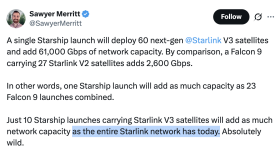
The significance of V3 Starlinks

Significant improvement yet a ways to go before truly competitive across the general marketplace. This is directly from Starlink's website:

1790640400891.png

Today, we have 1Gb service to our house for $70/month. Our provider is working at break-neck speed to replace all the cable with fiber as two other providers are busy putting fiber in our neighborhood as well as across the town. T-Fiber (division of T-Mobile) has already sent a solicitation of fiber services starting at $70 per month for the same 1Gb speeds.

A year from now, when we are in our new house, the entire neighborhood is being fitted out with fiber including from the node terminating in the residences. One of my future neighbors has our current provider as theirs. I want to speak with them about the equipment they have.

Am I negating Starlink? Absolutely not. It is replacing service across the town at quite a few residences who for the time being either have that or are saddled with ADSL as that is all that is available to them from the LEC.


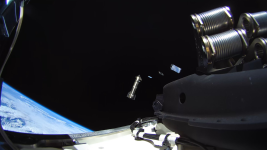
remember these 26 are the big ones that can't fit in a Falcon 9.


images
 
Last edited:
After years of research, Project Suncatcher is scheduled to embark on its first test in orbit, launching a prototype satellite to evaluate how Google Tensor Processing Units (TPUs) perform in space.

Announced last year, Project Suncatcher is a long-term, research moonshot exploring whether space could one day host scalable machine learning infrastructure. In low Earth orbit, satellites can access near-constant sunlight, generating up to eight times more solar power than on Earth. Eventually, it could be possible to link together multiple constellations of satellites, allowing them to manage larger AI workloads while in orbit.

Big breakthroughs happen when you work backwards from an end goal. In our case, it's to ensure AI's profound benefits in key areas, from healthcare to scientific discovery, can reach everyone, far into the future. Just as early research into autonomous driving and quantum computing required years of experimentation before we got to practical systems, exploring compute in space begins with measured, deliberate steps.

Turning that idea into reality starts with a basic question: Can our AI hardware operate in space? This initial mission onboard the upcoming Transporter-18 rideshare mission with SpaceX was developed in partnership with Planet. It’s designed to gather in-orbit data on how our TPUs handle the physical stress of spaceflight and the radiation and thermal extremes of space.

As we prepare for an early test launch and work toward our next milestone in 2027, the Project Suncatcher team discussed what we hope to learn and the engineering hurdles ahead in a new video series digging into the science behind the mission.

A rocket trip into low Earth orbit lasts about 10 minutes, during which the spacecraft experiences intense vibration and sustained acceleration loads up to 10 times the force of gravity, or g-force. Individual components, such as the TPU chips, can experience even greater forces up to 50 to 100 g. The team conducted vibration testing by intensely shaking the satellite on all three axes to mimic the frequencies of a rocket launch. Tests like this rarely go as planned, so we were pleasantly surprised that the hardware held up to the force.

Once the TPU chips make it to space, the level of radiation outside the Earth’s atmosphere presents another challenge to overcome. Solar events and cosmic rays can wreak havoc on electronics, so our team tested TPUs in a proton beam facility at UC Davis’s Crocker Nuclear Laboratory while running AI workloads. During the test, we monitored closely to see how errors, like a bitflip, would affect our workloads. Initial results have shown that our Trillium TPUs hold up remarkably well, and can survive a radiation total ionizing dose greater than what they would receive during a five-year space mission.

But some things can only be tested in space. Putting our first TPUs in orbit next week will help us get data and learnings to inform future launches.

Cooling orbital data centers is a crucial research challenge. TPUs generate a large amount of heat in a small area, which needs to be diffused safely or the chips are at risk of overheating. But in space, there’s no airflow. In a vacuum, you can only diffuse heat via radiators, which requires a totally different approach to cooling electronics.

We’re working on a number of different approaches for this, including a combination of heat pipes and radiators to cool the chips. So far, our team has tested the technology in a thermal vacuum chamber that simulates both the thermal and vacuum environment in space. We’ll see how our new TPU cooling system works in space and refine our designs as we learn more.

Future designs of our satellites will each carry dozens of TPU chips while orbiting the Earth in clusters. To maintain the bandwidth necessary to process AI, every satellite has to know both its own position and where it sits relative to its neighbors. To do this, the satellites will communicate via lasers.

The technology in space already exists, but most state-of-the-art systems are optimized for low bandwidth across large distances, whereas our lasers need to operate at very high bandwidth over extremely short distances. Maintaining the necessary connection requires extraordinary precision, similar to hitting a coin-size target from miles away while both points are in motion. We’ll test our work on this in 2027 when we put two satellites in orbit.

Exploring space as a viable location for scalable AI compute won’t happen all at once. It takes methodical engineering, starting with proving our hardware can handle the physical and unpredictable realities of operating in orbit. This first launch is about seeing what works, identifying points of failure, and applying those findings to future missions.

Every transformative technology we’ve built at Google began with an audacious goal — and the discipline of working backward to solve hard problems all along the way. As our latest moonshot heads to the launchpad, our team is excited to share what we learn and the science driving this work forward.


Googles Project Suncatcher satellite is launching on the Transporter 18 mission today


​

​
 
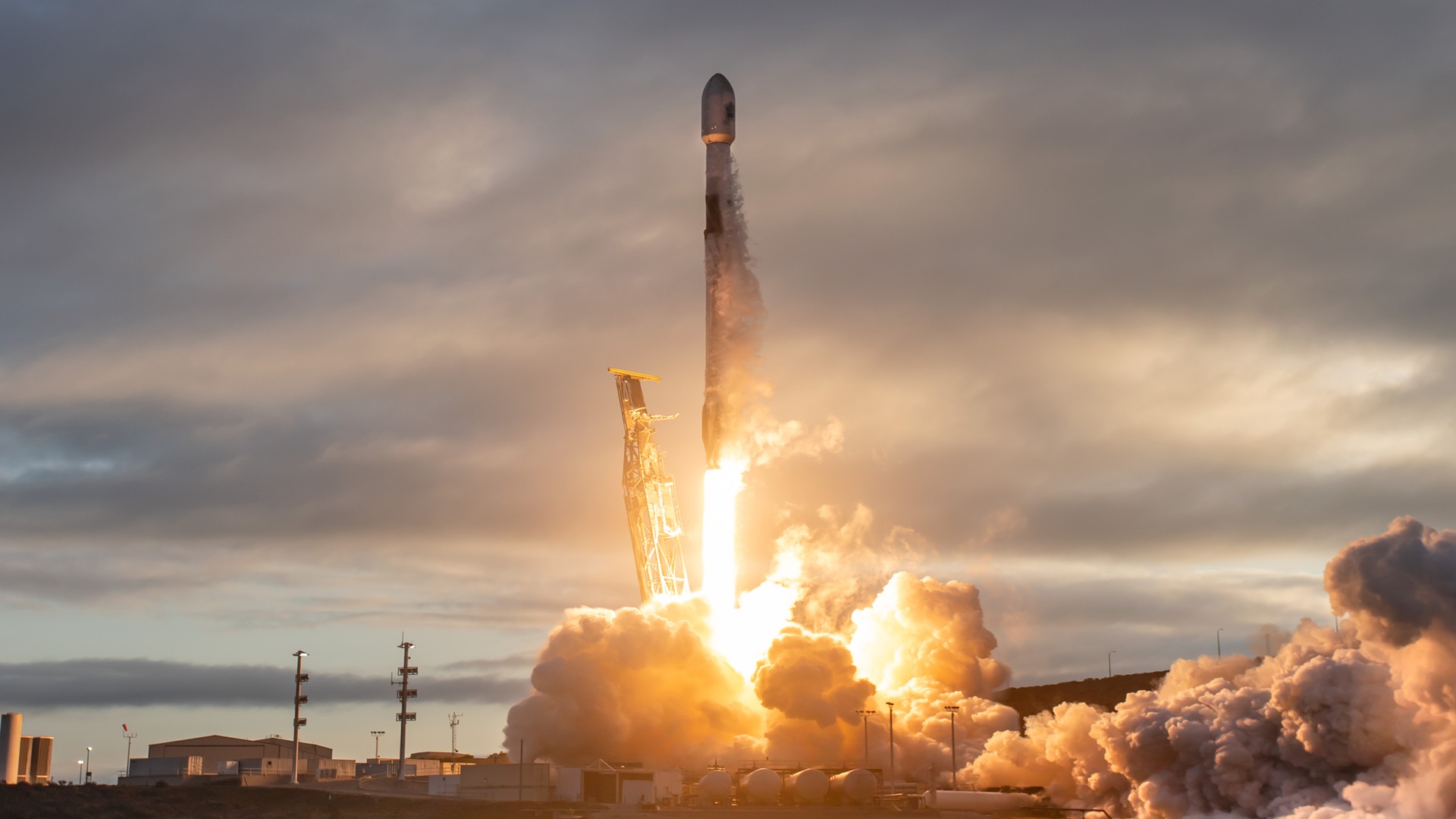
Third SpaceX launch tonight is the classified NROL-97 payload on Falcon Heavy
 
remember these 26 are the big ones that can't fit in a Falcon 9.


images

I think people aren't grasping the scale of things with Starship. They just launched 26 of these massive satellites...but that was just a test flight. The regular full payload is 60 of these satellites.

That's insanity.


insanity2.png
 
Last edited:
Successful launch of NROL-97 and landing of side boosters.

Falcon Heavy flies its first mission for U.S. spy satellite agency​

The NRO has previously flown payloads on 22 Falcon 9 rockets but this is the first time it has used the heavy-lift Falcon Heavy, which consists of three Falcon 9 boosters and an upper stage, topped by a payload fairing.

22 missions on Falcon 9...and now suddenly the NRO is switching to the Falcon heavy. :unsure:

Well either this is because of the retirement of the Delta IV or the military is building heavier satellites to take advantage of SpaceX's heavier lifting capacities at a cheaper price.

Note: Starship is waiting in the wings...
 
Last edited:

SpaceX proposes 32-mile Florida pipeline to supply fuel for Starship rockets​


A 16-inch pipeline could link SpaceX’s Cape Canaveral facilities directly to an interstate natural gas network.

SpaceX is seeking approval for a 32.4-mile natural gas pipeline in Florida to supply fuel for its Starship rockets as the company prepares to expand launch operations at Cape Canaveral.

The proposed 16-inch transmission pipeline would run through Brevard County and connect SpaceX facilities with the existing Florida Gas Transmission interstate pipeline, according to a September regulatory filing.

Coastal Connect Services (CCS), a SpaceX subsidiary, has asked the Florida Public Service Commission to approve a tariff allowing it to build and operate the pipeline. The infrastructure would bring natural gas directly from the interstate network to customers including SpaceX.

The company says its existing supply system, which relies on trucks and local pipelines, cannot meet growing fuel requirements at Cape Canaveral. SpaceX uses methane in liquid form, along with liquid oxygen, as propellant for Starship’s Raptor engines.

Pipeline replaces truck deliveries​

Natural gas delivered through the proposed pipeline could provide the methane feedstock needed for Starship operations. Unlike conventional rockets that use refined kerosene or hydrogen, Starship’s Raptor engines are designed around methane, making a reliable gas supply an important part of SpaceX’s launch infrastructure.

CCS said in its filing that the dedicated pipeline is needed to provide safe, timely and efficient natural gas deliveries as SpaceX increases operations in Florida.

The project would also push SpaceX further into infrastructure normally built and operated by energy companies. Instead of depending entirely on outside suppliers to transport fuel to its launch sites, the company is seeking more direct control over how that fuel reaches its facilities. SpaceX has not commented publicly on the Florida proposal, according to Reuters.

Starship fuel network expands​

Florida is not SpaceX’s first attempt to build a dedicated natural gas connection for Starship. The company has also sought approval for an approximately 8-mile pipeline serving its Starbase launch complex near Boca Chica in South Texas.

The two projects point to a broader effort to establish dedicated fuel infrastructure around SpaceX’s major Starship launch sites. The Florida pipeline would be about four times as long as the proposed Texas connection.

SpaceX has also begun hiring natural gas traders as it works to secure fuel supplies for Starship operations in Florida and Texas, Bloomberg reported. The move could allow the company to manage both the physical infrastructure and commercial procurement needed to supply its methane-fueled rocket fleet.

Starship is SpaceX’s fully reusable heavy-lift launch system, consisting of the Super Heavy booster and Starship upper stage. Both stages use Raptor engines fueled by liquid methane and liquid oxygen.

The Florida project remains a proposal and requires regulatory approval. CCS is seeking approval for the tariff governing the pipeline, and the filing does not mean construction has been authorized.

If approved, the 32.4-mile line would give SpaceX a direct natural gas connection at Cape Canaveral as the company builds out the ground infrastructure needed to support future Starship operations.
 

Users who are viewing this thread

  • Back
    Top