Navigation
Install the app
How to install the app on iOS
Follow along with the video below to see how to install our site as a web app on your home screen.
Note: This feature may not be available in some browsers.
More options
Style variation
You are using an out of date browser. It may not display this or other websites correctly.
You should upgrade or use an alternative browser.
You should upgrade or use an alternative browser.
AMCA vs KAAN vs KF-21 India Turkey & Korea’s Fighter Jets Battle For Air Supremacy—Who Leads The Pack? OP-ED
- Thread starter dani191
- Start date
- Status
- Not open for further replies.
More options
Who Replied?

MMM-E
Elite Member

Turkiye is not China ... stop compare Turkiye with China
China had a lot of difficulties in developing the furbofan Engine because China had zero technological knowledge and experience before
on the other hand
Türkiye has experience in producing parts and modules for turbofan Engines since 1987 ( over 1.500 parts for 50 different types of military and commercial engine programs )
and Turkiye gained extensive experience through years of manufacturing GE-F110 Engine components and under license production
1 -- Single crystal blade casting, considered a critical technological step in turbine engines ( Turkiye is one of a few Countries with this technology )
2 -- Turkiye has blisks and spools manufacturing technologies which are currently produced by only a few Countries in the world
3 -- Materials and progress technologies also have an importance in the development and sustainability of the TF-35.000 Engine
( the fields of high temperature applications, super alloys, precision casting, coating technologies , ceramics and porous structures. )
4 -- Again, for the first time in the world, TEI produced an engine combustion chamber using the layered import method
5 -- There are only a few Countries in the world that can process aircraft engine turbine blades with the additive manufacturing Nickel Superalloy method and Turkiye is one of them
Turkiye has officially started developing the TF-35.000 Engine for KAAN in 2018
According to TEI , The TF-35.000 Engine first flight with KAAN by 2029-2030 period and integration-mass production by 2032-2035 period ....
2018-2032 ....( This is not a short time )
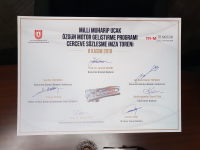
China had a lot of difficulties in developing the furbofan Engine because China had zero technological knowledge and experience before
on the other hand
Türkiye has experience in producing parts and modules for turbofan Engines since 1987 ( over 1.500 parts for 50 different types of military and commercial engine programs )
and Turkiye gained extensive experience through years of manufacturing GE-F110 Engine components and under license production
1 -- Single crystal blade casting, considered a critical technological step in turbine engines ( Turkiye is one of a few Countries with this technology )
2 -- Turkiye has blisks and spools manufacturing technologies which are currently produced by only a few Countries in the world
3 -- Materials and progress technologies also have an importance in the development and sustainability of the TF-35.000 Engine
( the fields of high temperature applications, super alloys, precision casting, coating technologies , ceramics and porous structures. )
4 -- Again, for the first time in the world, TEI produced an engine combustion chamber using the layered import method
5 -- There are only a few Countries in the world that can process aircraft engine turbine blades with the additive manufacturing Nickel Superalloy method and Turkiye is one of them
Turkiye has officially started developing the TF-35.000 Engine for KAAN in 2018
According to TEI , The TF-35.000 Engine first flight with KAAN by 2029-2030 period and integration-mass production by 2032-2035 period ....
2018-2032 ....( This is not a short time )
MMM-E
Elite Member
The KF-21 literally looks like a smaller F-22. I can’t help but wonder how Seoul got the design so close?
Chinese J-35 looks like the F-35
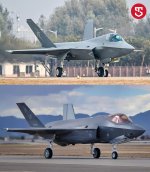
And KF-21 looks like the F-22
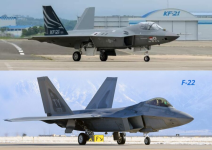
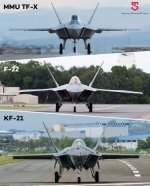
The 5th gen Fighter Jets ( KF-21 , KAAN ) are inspired in design by the first example, the F-22
KingQamaR
Elite Member
Chinese J-35 looks like the F-35
View attachment 157993
And KF-21 looks like the F-22
View attachment 157994
The 5th gen Fighter Jets ( KF-21 , KAAN ) are inspired in design by the first example, the F-22
View attachment 157997
The Korean KF-21 Looks like a simpler version of the f22. And it has no internal bay. They will have to make lots of changes to KF-21.


The KF-21 literally looks like a smaller F-22. I can’t help but wonder how Seoul got the design so close?
LM was assisting the development phase
KingQamaR
Elite Member
LM was assisting the development phase
You are right about that. KF 21 development team had advisors and tech support from your American Lockheed Martin for the design.

Indos
INT'L MOD

The KF-21 literally looks like a smaller F-22. I can’t help but wonder how Seoul got the design so close?
It is already look like 2012 December C103 design ( made by ADD Korea and Indonesian Aerospace). TD Phase.
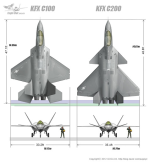
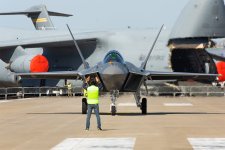
F22 is of course the design inspiration, similar like US predator MALE UCAV that become inspiration of China, Turkish, Indonesia MALE UCAV design. The one that more resemble Predator MALE UCAV is Indonesian Aerospace Elang Hitam MALE UCAV among the three I mentioned
Last edited:
Indos
INT'L MOD
You are right about that. KF 21 development team had advisors and tech support from your American Lockheed Martin for the design.
LM only come after 2016 ( EMD Phase). Refinement of C103 into C109. Pretty much the same design, but just a bit bigger than C103 design
Indos
INT'L MOD
LM is more on system integration part I would say with integration of many US made components, despite 60% of the components are already Korean.
KAI and LM prefer F16 Stealthy design (KFX-E) so we dont take KAI/ LM prefered design, but C103 design (ADD Korea and Indonesian Aerospace) that become KF21 design
It is well documented in my KF21/ IFX thread with credible source.
KAI and LM prefer F16 Stealthy design (KFX-E) so we dont take KAI/ LM prefered design, but C103 design (ADD Korea and Indonesian Aerospace) that become KF21 design
It is well documented in my KF21/ IFX thread with credible source.

Michael
VIP Member

The design of any fighter jet is a product of a combination of factors, including tactical positioning, aerodynamics, and available technologies (including domestically developed and imported technologies).The KF-21 literally looks like a smaller F-22. I can’t help but wonder how Seoul got the design so close?
The tactical positioning of modern fighter jets is generally clear and publicly known.
Aerodynamics also largely determines their general appearance.
These two key factors determine the high degree of similarity among fighter jets from different countries. However, significant differences exist in the availability of technologies among countries, leading to many subtle differences in their fighter jets.
However, if their tactical positioning is completely different, they are unlikely to be similar.
The latest J-36 fighter jets have a completely different tactical positioning than other fighter jets; therefore, their appearance is also completely different from existing fighter jets. If other countries also develop fighter jets with the same tactical positioning, then their final appearance will be highly similar to the J-36.
This is a rigorous scientific and technological principle.
Indos
INT'L MOD
The Korean KF-21 Looks like a simpler version of the f22. And it has no internal bay. They will have to make lots of changes to KF-21.
It has, just not functional as Today. Block 3 is Stealth variant with upgrade work. KF21 is made with modular system.
Those who design are Phd, they are not stupid who want to redesign the plane again to reach 5th gen capability. You see KF21 looks fatty already, so some space in the belly is already there
The same of why it is produced with A2A combat for Block 1, with block 2 for Multi Role capability ( just system integration thing)
Step by step
Last edited:
Indos
INT'L MOD
LM is more on system integration part I would say with integration of many US made components, despite 60% of the components are already Korean.
KAI and LM prefer F16 Stealthy design (KFX-E) so we dont take KAI/ LM prefered design, but C103 design (ADD Korea and Indonesian Aerospace) that become KF21 design
It is well documented in my KF21/ IFX thread with credible source.
Design of long-delayed KF-X still in debate
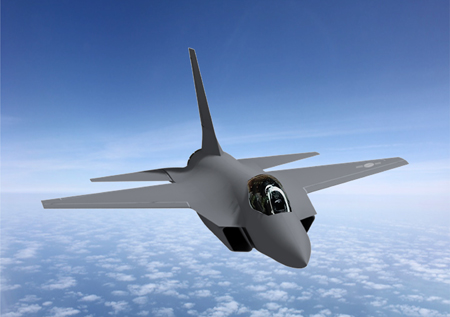
A conceptual model of the single-engine C501
By Kang Seung-woo (The Korea Times)
Posted : 2014-03-03 16:52
After a decade-long delay, Korea's indigenous fighter program is about to officially hit the road with bidding by partner firms scheduled for next month.
However, which design concept to go with — a single- or twin-engine aircraft — is emerging as the biggest sticking point in the program, codenamed KF-X.
Currently, the state-run Agency for Defense Development (ADD), siding with the Air Force, claims the nation's future fighter should be a two-engine, clean-sheet aircraft, proposing a design labeled C103.
The Defense Acquisition Program Administration (DAPA), on the other hand, has promoted a single-engine version of an aircraft, named C501, to be derived from the Korea Aerospace Industries (KAI) FA-50 light attack fighter, saying the plane is cheaper and easier to develop and build than the ADD preference.
The KF-X, aimed at manufacturing "F-16+ class" fighter jets with the help of global defense contractors to fill a fighter gap envisioned the next decade, has been delayed due to budget constraints and questions over its feasibility.
The program, initiated by the late former President Kim Dae-jung in March 2001, had its basic strategy resolved in April 2010 and the ADD conducted a final study on the feasibility of the development program between 2011 and 2012. The Air Force plans to secure 120 new jets to replace its aging fleet of F-4s and F-5s under the fighter project.
In January, 20 billion won ($18.7 million) from the defense budget for 2014 was appropriated for deciding on its design and engine, and DAPA said it would begin accepting bids from manufacturers to participate in the indigenous program in April.

A conceptual model of the twin-engine C103
The Korean Air Force believes that more than anything else, a twin-engine aircraft has better combat performance as well as better safety.
"Twin-engine fighters are more expensive, but they can carry heavier payloads over longer distances," said Greg Waldron, Asia managing editor of FlightGlobal, an aviation and aerospace industry website.
"In addition, a twin-engine fighter provides a larger margin of safety in that if the pilot loses one engine, he can usually make it back to base with the remaining one."
The Air Force also prefers the twin-engine version for possible future upgrades.
"The C103 is a Eurofighter-like 4.5th-generation plane that can easily be upgraded to a fifth-generation fighter, while the C501 is a fourth-generation one," said a local aviation analyst on condition of anonymity.
The ADD has reserved space for a conformable weapons bay in its C103 design, which would give it the makings of a low-observable fighter.
The analyst said that if Korea opts for the twin-engine aircraft in the KF-X, the combat plane will eventually be able to replace the Air Force's F-16s and F-15s in the future.
"Otherwise, the KF-X will only end up as replacement for F-4s and F-5s," he said.
Thus far, the Korean Air Force has only used the American airplanes, so it has been troubled by U.S. interference in international sales and upgrades.
The Air Force says the clean-sheet, brand-new aircraft will be free from that hindrance. The KAI FA-50 is based on the T-50 supersonic trainer, co-developed with Lockheed Martin.
"The biggest advantage is that Korea will be able to export it without an export license (from the United States)," said Yang Uk, a senior research fellow at the Korea Defense and Security Forum.
"The aircraft will help the Air Force save operational and maintenance costs, as well."
In addition, the Air Force says that the development of F-16-class fighters will be meaningless because the KF-X planes will enter service from 2023, with neighboring countries such as China and Japan featuring advanced stealth jets — J-20s and F-35s, respectively.
"In terms of military strategy and military buildup, considering the operational environment of the 2030s to 2050s, the Air Force believes that a twin-engine fighter is a better choice," said an Air Force officer.
"However, it is the defense ministry's task force who calls the shots and we will follow the decision."
According to KAI, the C501 will be built based on the FA-50, although it will be larger, but Yang said that the up-sizing plan is unfeasible.
"If the C501 is built based on FA-50, KAI should redesign the plane's aerodynamics, which will pose a big financial burden," he said.
"If so, there will not be much difference between the C501 and C103 in terms of cost and development time."
However, according to the Korea Institute of Science and Technology Evaluation and Planning (KISTEP) in November, the single-engine design will cost 6.4 trillion won for development, compared with 8.6 trillion won for the twin-engine aircraft. In addition, the single-engine plane's operational and maintenance costs were evaluated at about 1 trillion won cheaper, along with earlier deployment — 10.5 years for the twin-engine model and 8.5 years for the single version.
"KAI is a listed company, so they should consider seeking a profit from the KF-X," said the aviation analyst.
Richard Aboulafia, vice president of the Virginia-based Teal Group, believes that there is definitely a market for a new medium weight affordable fighter design in the coming decades. Lockheed Martin is expected to close its near-ubiquitous F-16 production line in 2015.
"The KF-X should follow previous successful medium fighters like the F-16 and Dassault Mirage series," he said.
Aboulafia also said that a decision to make the KF-X a twin-engine design would be very damaging to export prospects.
"Two large combat engines would make the KF-X too large and expensive for most of the export fighter market," he said.
"On the flip side, if two small civilian engines are adapted for combat use, that would make the KF-X an underperforming and inadequate plane, much like Taiwan's Ching Kuo."
In terms of combat performance, the number of engine is not a conclusive factor.
"The engine is a crucial part of a combat aircraft, but it is merely one aspect of a system of systems. Employed properly, both single and twin-engine fighters can be highly effective in combat." Waldron said.
James Hardy, Asia-Pacific editor of IHS Jane's Defense Weekly, calls the Air Force's preference for a twin-engine aircraft "ironic" given that it turned down twin-engine F-15 in favor of the single-engine F-35 in the F-X III competition last year.
"Single engine aircraft are no longer seen as inferior for most missions — thus the F-35 is single-engine, as are the F-16 and Saab Gripen," he said.
Yang said that there is no clear definition for the KF-X and that has led to ceaseless debates.
"If an aircraft from the KF-X achieves stealth fighter status, it is a high-class fighter jet now, but it will be a medium fighter in 2025-26. There is no clear standard for a medium-class aircraft," he said.
"I believe that KAI will be able to manufacture the high-class plane, should it get more funds. If the government really wants to see economic effects from the KF-X, it should be a national project."
DAPA wants a participant to optionally pay 20 percent of the KF-X development cost, which will prevent KAI from developing a twin-engine aircraft that requires more technical effort. In addition, the arms procurement agency will require compensation for any delay in deployment, the unidentified analyst said.
"If a decision to go ahead with a twin-engine design is made, the government should ease the company's financial burden," he said.
.jpg)
Design of long-delayed KF-X still in debate - The Korea Times
A conceptual model of the single-engine C501By Kang Seung-woo After a decade-long delay, Korea’s indigenous fighter program is about to...
Last edited:
albert_008
Registered Member
haha, Turkey? want to compare tech with China?Turkiye is not China ... stop compare Turkiye with China
China had a lot of difficulties in developing the furbofan Engine because China had zero technological knowledge and experience before
on the other hand
Türkiye has experience in producing parts and modules for turbofan Engines since 1987 ( over 1.500 parts for 50 different types of military and commercial engine programs )
and Turkiye gained extensive experience through years of manufacturing GE-F110 Engine components and under license production
1 -- Single crystal blade casting, considered a critical technological step in turbine engines ( Turkiye is one of a few Countries with this technology )
2 -- Turkiye has blisks and spools manufacturing technologies which are currently produced by only a few Countries in the world
3 -- Materials and progress technologies also have an importance in the development and sustainability of the TF-35.000 Engine
( the fields of high temperature applications, super alloys, precision casting, coating technologies , ceramics and porous structures. )
4 -- Again, for the first time in the world, TEI produced an engine combustion chamber using the layered import method
5 -- There are only a few Countries in the world that can process aircraft engine turbine blades with the additive manufacturing Nickel Superalloy method and Turkiye is one of them
Turkiye has officially started developing the TF-35.000 Engine for KAAN in 2018
According to TEI , The TF-35.000 Engine first flight with KAAN by 2029-2030 period and integration-mass production by 2032-2035 period ....
2018-2032 ....( This is not a short time )
View attachment 157991

MH.Yang
Trusted Member
Turkiye is not China ... stop compare Turkiye with China
China had a lot of difficulties in developing the furbofan Engine because China had zero technological knowledge and experience before
on the other hand
Türkiye has experience in producing parts and modules for turbofan Engines since 1987 ( over 1.500 parts for 50 different types of military and commercial engine programs )
and Turkiye gained extensive experience through years of manufacturing GE-F110 Engine components and under license production
1 -- Single crystal blade casting, considered a critical technological step in turbine engines ( Turkiye is one of a few Countries with this technology )
2 -- Turkiye has blisks and spools manufacturing technologies which are currently produced by only a few Countries in the world
3 -- Materials and progress technologies also have an importance in the development and sustainability of the TF-35.000 Engine
( the fields of high temperature applications, super alloys, precision casting, coating technologies , ceramics and porous structures. )
4 -- Again, for the first time in the world, TEI produced an engine combustion chamber using the layered import method
5 -- There are only a few Countries in the world that can process aircraft engine turbine blades with the additive manufacturing Nickel Superalloy method and Turkiye is one of them
Turkiye has officially started developing the TF-35.000 Engine for KAAN in 2018
According to TEI , The TF-35.000 Engine first flight with KAAN by 2029-2030 period and integration-mass production by 2032-2035 period ....
2018-2032 ....( This is not a short time )
View attachment 157991
China began producing the WS-5 in 1963, making it one of the earliest countries to produce turbofan engines.
I see. So the logic that you believe Turkey can manufacture high-thrust engines in just a few years comes from the fact that China can do it?
Last edited:
MH.Yang
Trusted Member
Chinese J-35 looks like the F-35
View attachment 157993
And KF-21 looks like the F-22
View attachment 157994
The 5th gen Fighter Jets ( KF-21 , KAAN ) are inspired in design by the first example, the F-22
View attachment 157997
If you search the news from the first half of this year, you will find an interesting news.
In the first half of this year, China sentenced an spy to death. This spy was convicted of stealing the technical data of J-35 from China and selling it to the KF-21 team of South Korea.
And the why China discovered this spy was that China found that the shape data of KF-21 was almost completely copied from J-35.
This spy case is no secret among fans who understand Chinese military news. Therefore, the shape of KF-21 will be very similar to J-35.
- Status
- Not open for further replies.
Users who are viewing this thread
Total: 1 (members: 0, guests: 1)
Pakistan Defence Latest


Country Watch Latest
-

-
-
 Trump orders military base mass shooter to be executed by firing squad (5 Viewers)
- Latest: AZ_HighCountry
-

-


