Air Force Eyes New-Build F-16s to Boost Fighter Force
Sept. 16, 2026 | By Stephen Losey and Chris Gordon
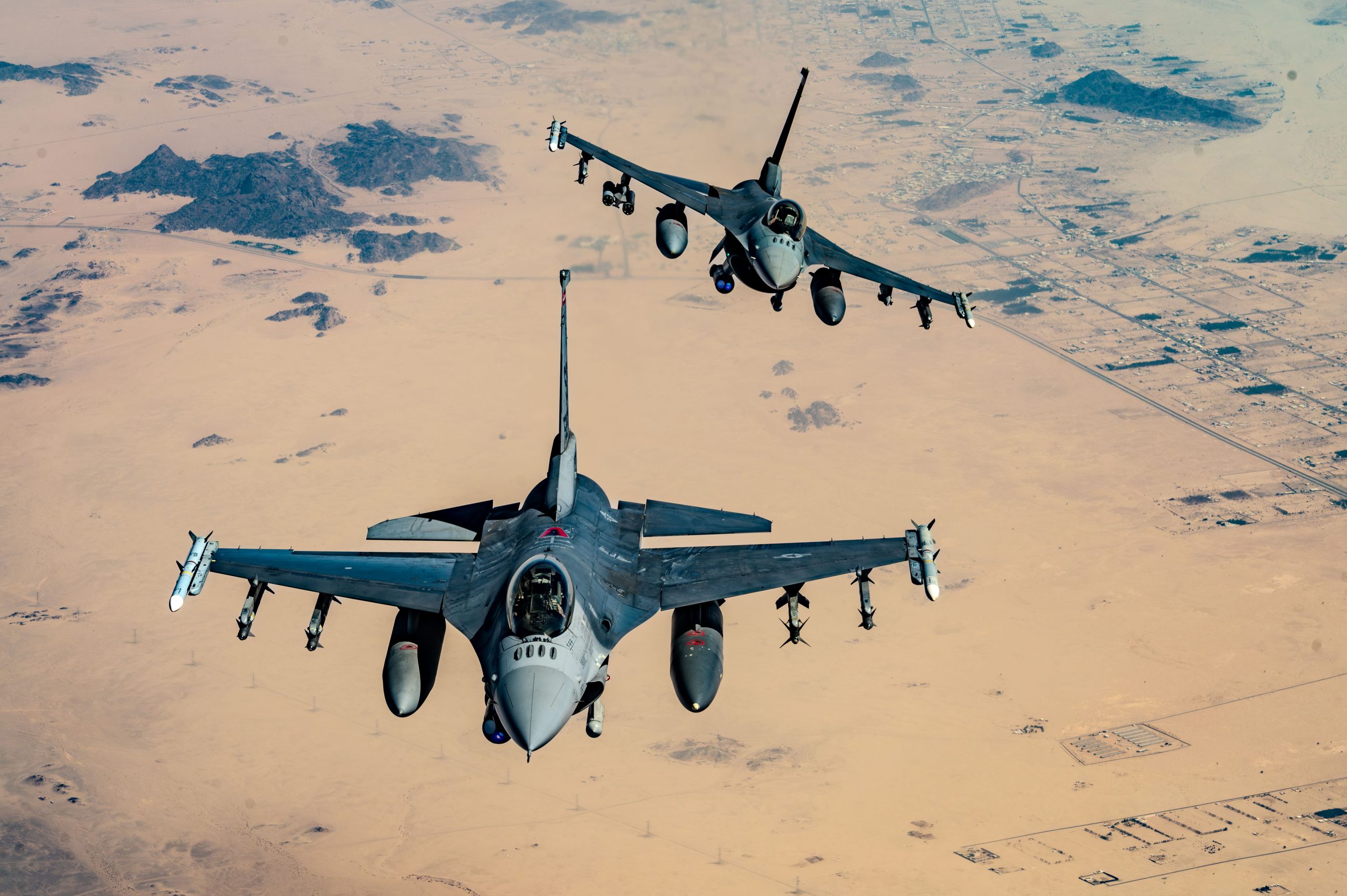
 U.S. Air Force F-16 Fighting Falcons fly a presence patrol over the U.S. Central Command area of responsibility, Feb. 11, 2025. U.S. Air Force photo by Staff Sgt. Jackson Manske
The Air Force will consider acquiring new F-16 Fighting Falcon jets to help fill capacity shortfalls in its aging fighter fleet, multiple people familiar with the matter told Air & Space Forces Magazine. These discussions are happening as the Air Force is building its proposed fiscal 2028 budget and the five-year spending plan that goes with it.
Buying new F-16s—which would be the U.S.’s first in more than 20 years—is viewed as one way to quickly build back lost fighter capacity, as Lockheed Martin continues to operate a hot production line for the aircraft. Buying F-16s from Lockheed, which also produces the F-35 Lightning II, would have parallels to the decision to acquire F-15EX Eagle IIs from Boeing, which likewise came after a yearslong gap in USAF purchases.
The new-build F-16s, potentially dubbed “F-16G” to reflect upgrades from existing F-16C and D models, could be on the agenda for discussion when Air Force four-stars gather this fall for a Corona gathering of top service officials.
Lockheed Martin deferred questions to the Air Force: “This topic is best addressed by the U.S. government, but we stand ready to support the U.S. Air Force and its mission needs,” Lockheed said in a statement. “Our proven products are the backbone of the USAF fleet and provide the most advanced and versatile capabilities to ensure air dominance now and decades to come.”
The Air Force, in a written response to Air & Space Forces Magazine, said it is examining its options as it looks to the future.
“The Department of the Air Force is in initial phases of analyzing options for the next Future Years Defense Program,” an Air Force spokesperson said. “At this stage, we have neither defined the precise mission requirements nor the spectrum of options that could fill it.”
Lockheed currently produces F-16E and F models, single- and dual-seat variants respectively, for the United Arab Emirates. The company moved its production line for Block 70 F-16s in 2019 from Fort Worth, Texas, to Greenville, S.C.
If the Air Force decided to buy more F-16s, Lockheed would likely keep its Greenville production line going. The potential upgraded F-16 from that line is being referred to as a G model by those familiar with the discussions.
Inside Defense reported in December 2025 the Air Force had made inquiries with Lockheed about the pricing for new F-16s.
The Air Force today has 826 F-16s in its inventory, with 484 of those operated by the Active-Duty force. The jets average 34 years old, however, and the newest in the inventory have been flying since 2005.
USAF F-16s carry out a variety of critical missions, including air-to-air and air-to-ground strikes. F-16s that carry out suppression of enemy air defense missions are referred to as “Wild Weasels” and have seen heavy action in operations against Iran.
New F-16 purchases would drive other movement in the industry. Both Pratt & Whitney and GE Aerospace make engines that go on the F-16. Pratt, which is owned by RTX, announced Sept. 15 it has licensed Hermeus to manufacture its F100-PW-229 used on the F-15 and F-16, saying the agreement will strengthen the U.S. defense industrial base by creating a new source for the widely used engine.
Northrop Grumman, which is developing two major upgrades for existing F-16s, would also likely benefit. The company is working on the Integrated Viper Electronic Warfare Suite, or IVEWS, and an upgraded large aperture targeting pod called LITENING LA.
IVEWS, also known as the AN/ALQ-257, is an advanced electronic warfare system providing radar warning, active jamming, and detecting, identifying and locating of potential threats.
A source familiar with the issue, who asked not to be named to speak more freely, said any new F-16 would likely have IVEWS and multiple other new capabilities placing it not only beyond the legacy C and D fighters, but also the Block 70 fighters Lockheed is currently building.
“If the Air Force were to buy a new F-16, this would not be your grandfather’s F-16,” the source said. “This would be more akin to buying an F-15EX.”
The source said buying more F-16s would make sense for the Air Force, since Lockheed and Boeing are facing capacity constraints limiting how many F-35As and F-15EXs, respectively, they can build. And the service’s existing fleet of F-16s has been flown hard in the wars of recent decades, the source said.
“There’s only so many times you can do a service life extension program before you begin to lose the strength and integrity of the airframe itself,” the source said.
The Air Force will consider acquiring new F-16 Fighting Falcon jets to answer capacity shortfalls in its aging fighter fleet, sources say.

www.airandspaceforces.com