America's Labor Day 2026 (FWIW)

Davey Crockett

Elite Member
Joined
Dec 17, 2023
Messages
12,990
Reaction score
10,362
Reputation
1,213.5
Country of Origin
Country of Residence
Source:
Federal Holiday
Last edited:
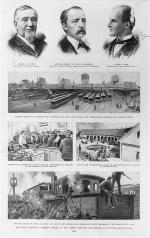
The timing of Labor Day's federal recognition was closely connected to one of the most significant labor disputes in American history.

During the economic depression of 1893, the Pullman Company reduced wages at its railroad-car factory near Chicago. However, the company did not reduce the rent it charged workers living in its company-owned town.

Pullman employees walked off the job on May 11, 1894. The dispute expanded into a nationwide railroad boycott involving an estimated 250,000 workers across 27 states.

1788644483888.png

Scenes from the Great Railway Strike in and around Chicago, 1894. Library of Congress.
 
Screenshot_20260905-160710 (1).jpg

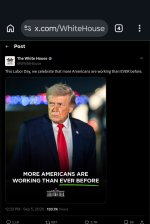
This Zionist Jew does not care about the working people here in America.

Looking forward to seeing him get impeached again.
 
1788775747316.png

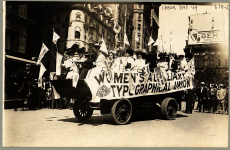
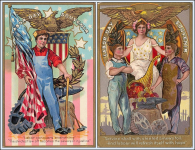
Labor Day Souvenirs. Left: “Labor conquers everything.” Right: “Labor will refresh itself with hope.” Postcards circa 1910.
 

The First Walk Across the Mackinac Bridge​

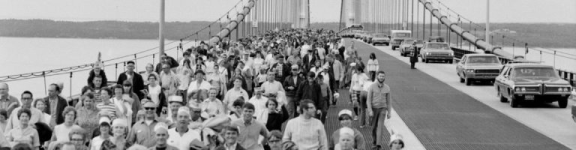
On this day in history, June 25, 1958 Michigan celebrated one of its greatest engineering achievements with four days of dedication ceremonies for the newly completed Mackinac Bridge. At the heart of those festivities? A ceremonial walk led by Governor G. Mennen “Soapy” Williams, marking the very first time pedestrians crossed the mighty five-mile span.


1788776033866.png

Bridge Walk Moves to Labor Day​

The walk officially moved to Labor Day in 1959, where it has become an annual tradition ever since. In most years, the sitting Michigan Governor leads off the event. Until 1964, walkers alternated starting on either side of the bridge, north one year, south the next.

Participation has grown immensely. From those humble 68 first walkers, the event now averages 40,000 to 65,000 participants. The record was set in 1992 when President George H. W. Bush joined in and 85,000 people followed. In 2007, during the 50th anniversary celebration, roughly 60,000 people made the crossing. Even in more recent years, like 2022, over 26,000 joined the tradition.


Essential Folk Songs for Labor Day​

1788784649169.png
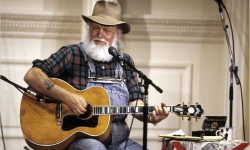
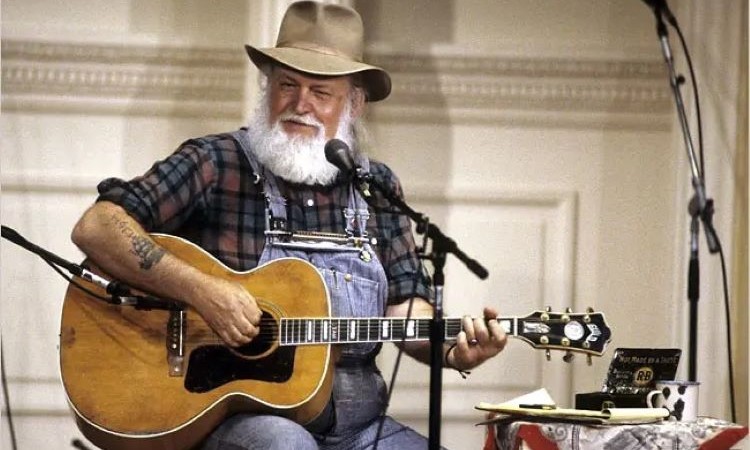
Photo by Jack Vartoogian

August 31, 2024
BY Kim Ruehl


Throughout history, wherever people have organized for a fair wage and a safe workplace, there has always been music involved. In early folk song collecting, in fact, “labor music” was so prevalent that it was believed to be a separate category of music from “folk.”

Though the federal holiday of Labor Day was signed into law in 1894 by Grover Cleveland, efforts to make a national holiday that recognized the successes of the labor movement go back even further.

Yet, it wasn’t until the early 20th century that folksingers like Woody Guthrie and Pete Seeger—and their cohorts in the Almanac Singers (Bess and Alan Lomax, Sis Cunningham, Butch Hawes, Millard Lampell, Lee Hays, sometimes Lead Belly and others)—began working labor songs into their repertoire and recordings.

Guthrie, especially, enjoyed singing for labor unions and saw labor songs as equivalent to all the other kinds of songs he sang: love songs, historical songs, children’s songs, and so on. Seeger was heavily influenced by him and also by their mutual friend Zilphia Horton from the Highlander Folk School in Tennessee. She was intentionally using folk songs and labor songs side by side for the purpose of organizing within the labor movement during the 1930s and ‘40s.

The Almanacs were among the first to record a full album of just labor music, but many others have come along since. In fact, throughout the 20th century, the intertwining of folk and labor songs became so tight that labor songs like “We Shall Not Be Moved” and “Solidarity Forever” defied the understanding of the early folklorists and became part of the American folk canon.

To celebrate Labor Day and this rich history of labor songs in folk music, the first hour of this week’s Folk Alley Radio Show will be all labor songs. You can hear the full hour by tuning into your local public radio station throughout Labor Day Weekend, listen on-demand via FolkAlley.com or our mobile app, or scroll down for a taste of what host Elena See will be spinning.

 
Last edited:
Utah Phillips – “There Is Power in the Union”

There have been few greater champions
of the legacy of Joe Hill than the late Utah Phillips. Hill was the IWW (Industrial Workers of the World) songwriter and song leader whom many believe was framed on a murder charge. His contributions to the IWW’s Little Red Songbook were toted around with Wobbly workers from jungle camp to worksite for many years. Phillips brought them to the stage.

 
Last edited:
Pete Seeger – “Solidarity Forever”

This song, originally written by Ralph Chaplin
and collected in Horton’s 1939 songbook for the Textile Workers Organizing Committee, was set to the tune of the Battle Hymn of the Republic. Seeger certainly knew the song’s history and origins. His booming baritone certainly gave power to its refrain.

 
Hazel Dickens – “The Rebel Girl”

This song is another from Joe Hill’s contributions to the Little Red Songbook. Indeed, the Industrial Workers of the World was far ahead of its time in the fact that it welcomed women, immigrants, and people of color into its ranks while many other unions were segregated. The tune was reportedly written for—or at least dedicated to—Elizabeth Gurly Flynn.


Users who are viewing this thread

  • Pakistan Defence Latest

    Latest Posts

    Back
    Top