Another IMF Condition Met: Govt Exits Wheat Procurement

Some people don't understand this issue. I'm using your perspective to further guide people in analyzing this problem in more detail.

Please pay attention to the specific details of wheat production in countries such as the United States, China, India, and Pakistan:
1. Yield per unit area. How much wheat is produced per hectare? This is related to factors such as agricultural science (crop genetic engineering, fertilizers and irrigation, etc.) and land conditions.
2. The ratio of farmers to wheat output. How much wheat does each farmer produce on average? This is related to the degree of agricultural mechanization.
This data can be obtained through AI.

If the wheat market were completely liberalized, the landed price of wheat imported by India/Pakistan from other agriculturally advanced countries could be significantly lower than the production costs of their own farmers.

What consequences will this have?

As for national strategic reserves, I would say this is not an economic issue. From an economic perspective, national grain reserves are a project that incurs absolutely huge losses.
As I indicated earlier and you point out, the impact of this will not initially show up in strategic macro indicators. However, in a country like Pakistan, where successive de jure and de facto military dictatorships have repeatedly failed the common people, this will cause great socioeconomic upheaval and force more marginalised people towards crime and extremism.
 

IMF Managing Director Kristalina Georgieva, speaking at a conference in Saudi Arabia, also said that 141 million people across the Arab world are exposed to food insecurity.
 
Wheat for F16 ...if anyone remember.... lolll....seriously ..
 

Another IMF Condition Met: Govt Exits Wheat Procurement​

By Business Desk Published Dec 24, 2025 8:05 pm
Rice.jpg

The federal government has decided to exit the wheat procurement process in line with another condition of the International Monetary Fund (IMF) program, ending state-led purchases and the support price mechanism, according to a national daily.

The federal and provincial governments will now maintain only emergency wheat stocks, with total annual reserves capped at 6.2 million metric tons. Strategic reserves will no longer be procured by the government; instead, a private company will handle wheat purchases for both the federation and the provinces.

Under the new arrangement, the federal government will hold 1.5 million metric tons of wheat, Punjab 2.5 million metric tons, Sindh 1 million metric tons, Khyber Pakhtunkhwa 0.75 million metric tons, and Balochistan 0.5 million metric tons.

The private company will be responsible for purchasing wheat on behalf of the federation and provinces.

Sources said the Ministry of Industries and Production has confirmed that the private company will also arrange financing and storage. The government will only pay service charges, a move expected to save an estimated Rs. 570 billion annually.

The Ministry of National Food Security has allocated Rs. 30 billion for service charges. There will be no wheat support price, and prices will be determined in line with global market trends, using international benchmarks set by the ministry.

The IMF has also prohibited the federal government from fixing a support price for wheat. Previously, the government provided bank guarantees for wheat purchases, while the Pakistan Agricultural Storage and Services Corporation (PASSCO) carried out procurement.

Delays in payments to PASSCO contributed to food sector circular debt, which has now reached Rs. 270 billion.

1767705684459.png

 
New condition for $5.5B loan: IMF limits Bangladesh’s foreign loan intake

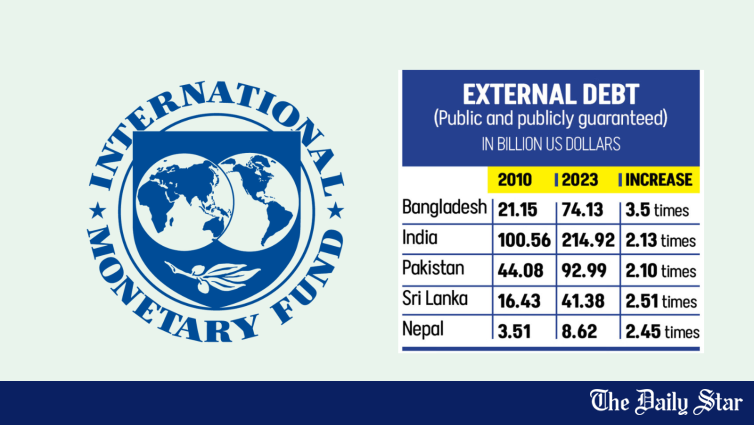
The International Monetary Fund has, for the first time, set a ceiling on how much Bangladesh can borrow from abroad, citing rising risks in the country's external debt.

The lender introduced the new condition for the next instalment of its $5.5 billion loan package during the fourth and fifth tranche review in June this year.

Under the terms, Bangladesh will be allowed to borrow a maximum of $8.44 billion during the ongoing 2025-26 fiscal year, with a cap of $1.91 billion in the first quarter and $3.34 billion in the first half. The IMF will closely monitor foreign borrowing every quarter.

No such ceiling was there when the IMF originally approved a $4.7 billion programme in 2023. It approved the fourth and fifth instalments, a top-up of the original credit by about $800 million with a six-month extension in June. So far, Bangladesh has received $3.6 billion.

A senior finance ministry official said the newly introduced ceiling on foreign loans is based on the IMF's latest Debt Sustainability Analysis (DSA), which reclassified Bangladesh as a "moderate-risk" country for two years in a row in FY23 and FY24.

The downgrade from a "low-risk" country reflects the growing pressure of repayments against export earnings and revenues.

According to the DSA, Bangladesh's debt-to-export ratio jumped to 162.7 percent in FY24, up from the IMF's earlier projection of around 116-118 percent. The debt service-to-revenue ratio has also risen, squeezing the government's fiscal space for fresh borrowing.


Another IMF Condition Met: Govt Exits Wheat Procurement​

By Business Desk Published Dec 24, 2025 8:05 pm
Rice.jpg

The federal government has decided to exit the wheat procurement process in line with another condition of the International Monetary Fund (IMF) program, ending state-led purchases and the support price mechanism, according to a national daily.

The federal and provincial governments will now maintain only emergency wheat stocks, with total annual reserves capped at 6.2 million metric tons. Strategic reserves will no longer be procured by the government; instead, a private company will handle wheat purchases for both the federation and the provinces.

Under the new arrangement, the federal government will hold 1.5 million metric tons of wheat, Punjab 2.5 million metric tons, Sindh 1 million metric tons, Khyber Pakhtunkhwa 0.75 million metric tons, and Balochistan 0.5 million metric tons.

The private company will be responsible for purchasing wheat on behalf of the federation and provinces.

Sources said the Ministry of Industries and Production has confirmed that the private company will also arrange financing and storage. The government will only pay service charges, a move expected to save an estimated Rs. 570 billion annually.

The Ministry of National Food Security has allocated Rs. 30 billion for service charges. There will be no wheat support price, and prices will be determined in line with global market trends, using international benchmarks set by the ministry.

The IMF has also prohibited the federal government from fixing a support price for wheat. Previously, the government provided bank guarantees for wheat purchases, while the Pakistan Agricultural Storage and Services Corporation (PASSCO) carried out procurement.

Delays in payments to PASSCO contributed to food sector circular debt, which has now reached Rs. 270 billion.

@Hamartia Antidote
@Beijingwalker

good day gentlemen

as per the topic of this thread, we wont certainly have Food/Cloths subsidies from OECD economies (n)

=>
OECD (Organisation for Economic Co-operation and Development) economies comprise 38 member nations, primarily developed democracies. As of mid-2026, these nations account for about 58% of global nominal GDP and operate with high standards of human development. [1, 2, 3, 4]
🇯🇵 🇰🇷
 
Last edited:

Users who are viewing this thread

Back
Top