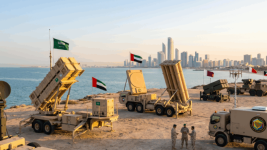
Arab Gulf states… a strategic victory without war

Those visit by GCC to Iran right before the war was part of their strategic deception. GCC-Israel-US went in for the kill a second time on Iran, their first attempt was via Saddam in the 1980.

Perhaps GCC will change their behavior now as Iran pierced their luxurious bubble and made them taste the wars they have been exporting to the rest of the region.
You keep blabbering about some imaginary "GCC" as if it was one single country. Be specific.

KSA, as I already wrote many times in this thread and which every source confirms, was hardly ever targeted by Iran to begin with let alone damaged in any way whatsoever. In fact KSA was mostly attacked by Iraqi terrorist militia proxies using mostly useless drones - later for KSA to carpet bomb several Iraqi terrorist militia strongholds - aside from attacking Iran itself directly.

KSA and the GCC proudly supported a fellow Arab neighbor in Iraq and a brotherly nation against a hostile foreign regime. We would do it 1 billion times over again if necessary.

KSA/GCC has nothing to change - we are not the failed, sanctioned, impoverished, now largely destroyed entity - Iran is that. Moreover with their head of state killed and large parts of their leadership.

We have no need for Iran at all. We can live with a hostile Iranian regime as in the past 50 years or a more friendly one.

And indeed, GCC is one of the wealthiest, safest and most prosperous regions on the planet (by far in the Muslim world) and a few drones and missiles (90% of them not targeting KSA - by far the largest country in the region) is never going to change that.

No, it was Iranians being fooled by cunning GCC diplomats.
Maybe the Iranian regime should not be meddling in internal Arab affairs (our historical and current sphere of influence and region and homeland), while sponsoring non-state terrorist actors, if they are so desperate to have cordial/non-hostile ties with KSA and the larger GCC.

As I said, karma is often returned tenfold. **** around and find out. They found out the hard way.

Sovereign investments in Gulf states have not slowed amid the Iran war

The war with Iran had little or no impact on the investment appetite of Gulf sovereign wealth funds, as most capital coming from sovereign investors in hydrocarbon-rich Gulf states continued to flow into developed market assets during the second quarter of the year.

According to a June report by Global SWF, most government funds in the six Gulf Cooperation Council countries, which manage total assets of about $5.7 trillion, maintained their usual quarterly investment pace.

The continued flow of investments contradicted the expectations of markets and analysts, who expected a tightening in sovereign spending as a result of the economic uncertainty associated with the war.

The institution said that these funds “have not shown any signs of slowing down so far, but rather achieved a stronger average investment pace during the past quarter compared to the average of the five years prior to the outbreak of the war.”

The report indicated that four of the five largest sovereign investors in the region, namely: Abu Dhabi Investment Authority, Mubadala Investment, and Al Emad in the UAE, in addition to the Public Investment Fund in Saudi Arabia, continued to maintain the high investment levels they recorded during the past five years.

The Qatar Investment Authority was the only exception, as the pace of its investments declined by about two billion dollars per quarter since March 1, according to the report.

View attachment 202227

The US and Israeli strikes on Iran, and Tehran's military responses that began on February 28, have led to business disruptions and affected the travel, tourism and hospitality sectors in the region.

Iran's closure of the Strait of Hormuz, through which about a fifth of global oil trade usually passes, has also sparked a global energy crisis, raising fears of rising inflation and a slowdown in the global economy.

Continued investment momentum

Despite these circumstances, cross-border deal-making and investment flows within and outside the region continued, and long-term capital commitments remained unaffected.

The Gulf region is home to some of the world's largest sovereign wealth funds, which invest on behalf of governments to achieve long-term returns.

The UAE, the second largest Arab economy, is home to a number of the most prominent sovereign investors, including the Abu Dhabi Investment Authority and Mubadala Investment and Development in Abu Dhabi, in addition to the Investment Corporation of Dubai.

The UAE is ranked as the largest sovereign investor in the Middle East and the fourth largest country globally in terms of total sovereign assets, which amounted to $3.08 trillion in March according to Global SWF.

The Abu Dhabi Investment Authority is considered the largest sovereign wealth fund in the Gulf, with assets estimated at about $1.1 trillion, although it does not officially announce the size of its assets. This year, the fund celebrates its 50th anniversary, and invests directly and indirectly in stocks, bonds, infrastructure, private capital and real estate around the world.

Capital flows

According to the report, while most Gulf funds continue to direct their investments towards developed markets, the Abu Dhabi Investment Authority and the Saudi Public Investment Fund more prefer investment opportunities in emerging markets.

The report noted that “capital continued to flow towards American companies and funds, while both the Abu Dhabi Investment Authority and the Public Investment Fund showed a preference for China and other emerging markets.”

Since the outbreak of the war, the Saudi Public Investment Fund has invested $6.1 billion in emerging markets, more than double the $2.43 billion it pumped into developed markets.

The Abu Dhabi Investment Authority also invested $3.32 billion in emerging markets, compared to $1.58 billion in developed markets.

As for Mubadala Investment, the strategic investment arm of Abu Dhabi, whose managed assets amounted to 1.4 trillion dirhams ($385 billion) at the end of last year, it invested more than $5.6 billion in developed markets, compared to only $330 million in emerging markets.

Al-Emad followed the same approach, directing $1.42 billion to developed markets, compared to $1.15 billion to emerging markets.

As for the Qatar Investment Authority, it invested $3.39 billion in developed markets during the same period, while its investments in emerging markets amounted to only about $60 million, according to the latest Global SWF data.

https://www.thenationalnews.com/bus...-in-gulf-sovereign-investments-amid-iran-war/
KSA continues to be the fastest growing G-20 major economy and credit ratings increased in fact. As have all other economic indicators.

KSA just hosted one of the largest, most succesful and effortless Hajj and Umrah seasons as well.

Record tourism numbers and revenue too.

KSA's aviation rise has also been tremendous as well as once again confirm itself as the logistical heart of the region.

Record oil revenues too thanks to the great Saudi Arabian infrastructure (massive underground oil pipelines - largest in the world built and continuously kept afloat since the 1980's). As well as water pipelines and soon to be gas pipelines.

To view this content we will need your consent to set third party cookies.
For more detailed information, see our cookies page.
 
Last edited:
It is going to be quite amusing to see when the reality sets slowly within the GCC. They have been clobbered by Iran and got duped by their so called Ally. And Iran will get a deal soon and will be more belligerent towards them. Fun times.

The Iranian Sistan-Balochistan, just like Pakistani Balochistan, has lots and lots and lots and lots of natural treasures including the rare earth minerals the USA/West is dying for.

The USA will make a deal with Iran for those minerals just like with Pakistan.

Oil/gas/hydrocarbons are important but the USA needs those rare earth minerals for their next 6th, 7th, and 8th gen tech stuff including quantum technology. Without access to those minerals the USA will stagnate technologically and the Americans will not let that happen.
 
They are screwed economically today as well. 300 + billion in infrastructural damage apparently after this "war" (air bombing campaign rather - no boots on the ground at all) .

Their current GDP is almost 2 times smaller than tiny UAE. 10 times smaller than the GCC currently.

Trump just recently said today (saw the short clip of his on X where he also threatened to drop bombs on Iran's head) that they will not give them anything. KSA for sure will not and likewise no other GCC states too.

Frozen Iranian assets (read Iranian, not Arab, American or Martian) somehow stored in UAE or Qatar, could be realesed. That is most likely all.

Iran GDP can jump to $1 trillion in a year without sanctions. Thats not a problem for country with huge oil/gas reserves and 90 million population.

Problem is will mullahs take this opportunity?
 
Gulf interception record under fire: How did the defenses of the Gulf Cooperation Council countries withstand the heaviest missile barrage in their history?

1782002905523.png

The American-Israeli war on Iran, which broke out on February 28, 2026, revealed the unprecedented performance of the air defense systems in the Gulf Cooperation Council countries, which for the first time found themselves the simultaneous collective target of a barrage of Iranian ballistic and winged missiles and drones. The official figures issued by the Gulf defense ministries provide a rare picture of the effectiveness of these systems, and of their limitations at the same time.

The area turned into the largest living operational laboratory for air defense systems in decades. According to what was announced by Bahrain’s Permanent Representative to the United Nations, Jamal Fares Al-Ruwai’i, on March 12, 2026, the GCC countries together intercepted more than 954 Iranian missiles, 2,500 drones, and 17 aircraft. This toll later exceeded much higher thresholds as the war continued for more than five weeks.

The UAE: the heaviest burden in the coalition

The United Arab Emirates bore the greatest burden among the GCC countries. The UAE Ministry of Defense announced, according to Gulf News on April 4, 2026, that its air defenses had responded to 475 ballistic missiles, 23 cruise missiles, and 2,085 drones since the start of the attacks. The Ministry indicated in a later update that the cumulative toll amounted to 498 ballistic missiles, 2,141 drones, and 23 winged missiles.

On April 3, the UAE recorded a daily peak of 69 targets intercepted by its defenses: 18 ballistic missiles, 4 winged missiles, and 47 drones. These numbers confirm that the UAE faced, according to what its authorities announced, more than 2,400 projectiles, that is, more than any other Gulf country or even Israel, according to the International Crisis Group report issued on March 31, 2026.

The UAE paid a human and material price for the same interception: the authorities confirmed deaths and dozens of injuries as a result of falling fragments of the intercepted projectiles, while the fragments caused fires in civilian facilities in Abu Dhabi and Dubai, in addition to a fire in the industrial zone in the port of Fujairah.

Kuwait: Exceptional operational load with limited infrastructure

Kuwait was the most notable surprise in terms of density. The Kuwaiti Air Defense Forces announced the interception of 97 ballistic missiles and 283 drones since the start of the war, according to what American media reported, citing the Kuwaiti government. Colonel Saud Al-Atwan, spokesman for the Ministry of Defense, stated that the country responded in a 24-hour window during the beginning of April to 9 ballistic missiles, 4 winged missiles, and 31 drones.

This performance is considered exceptional compared to the depth of the Kuwaiti defense system, which is estimated at only 4 Patriot batteries. The Iranian strikes targeted vital civilian infrastructure, including two power generation and water desalination plants, facilities related to the oil sector, and the government ministries complex, according to the Kuwait Times.

Bahrain: High density on a small area

The Kingdom of Bahrain, which hosts the headquarters of the US Fifth Fleet, announced that it shot down 45 Iranian missiles and 9 drones, including Shahed-136 suicide planes, in the early stages of the war. At least 32 citizens, including children, were injured as a result of a drone attack on the Sitra area, south of Manama, according to official media reported by Al Jazeera on March 9, 2026.

Qatar: An interception that included fighters and ground systems

On March 2, 2026, the Qatari Ministry of Defense announced that its fighters shot down two Iranian Sukhoi Su-24 planes that approached Qatari airspace, in a remarkable incident in which the fighters participated alongside ground systems. Later data stated that Qatar intercepted dozens of projectiles, while about 16 people were injured by falling shrapnel. The depletion of the Qatari “Patriot” stock is estimated at only about 40%, which is the lowest in the Gulf, as Doha faced the relatively lighter barrage, according to an analysis by the Center for Strategic and International Studies (CSIS).

Saudi Arabia: A cumulative total exceeding 890 threats

Saudi Arabia did not publish detailed daily figures at the beginning of the war, but it later released its first cumulative tally: 894 threats intercepted and destroyed within 35 days. The Royal Saudi Air Defense Forces announced the interception of missiles directed at Prince Sultan Air Base in Al-Kharj, and 6 drones heading towards the Shaybah oil field, according to Al Jazeera.

The Saudi cumulative toll exceeded 460 drones and 43 missiles, according to reports. Iran targeted the giant Shaybah field in the Empty Quarter with 20 drones that were monitored and intercepted in 5 waves, according to what was reported by Argus Media.

For the decisive equation: the stock of interceptions, not the number of missiles

The numbers reveal a truth that goes beyond success rates: the real battle is not in the number of what Iran launches, but in the number of what the GCC countries can stop before the stock runs out. Together, the GCC countries consumed about 2,400 interceptor missiles, most of them the PAC-3 and GEM-T models, within 35 days.

The Royal United Services Institute (RUSI) summarized the equation clearly in its March 2026 report on Munitions Sustainability, stating that the decisive advantage goes to those who replenish their critical stocks faster than others.

A structural shift in Gulf defense doctrine

The GCC countries have demonstrated an interception capability that is equal to, and in some indicators even exceeds, countries with more combat experience such as Israel and Ukraine. But the deeper lesson lies in the fragility of the supply chain: a successful interception does not mean victory if stocks are depleted faster than they can be replaced. This reality is pushing the GCC countries towards completely restructuring their defense doctrine: more low-cost interceptor missiles, anti-drone systems, and diversifying sources of supply away from exclusive dependence on Washington, a shift that will redraw the map of the air defense market in the Middle East for years to come.
 
Iran GDP can jump to $1 trillion in a year without sanctions. Thats not a problem for country with huge oil/gas reserves and 90 million population.

Problem is will mullahs take this opportunity?
At the end of the war there will be oil glut in the world markets , price of crude may drop to below 40 $ a barrel....
Do you think other oil producing countries will willingly give away their market share to Iran ?....think 🤔
 
Just being defensive is not enough, gotta have the guts to fight back as well……so far it appears only 1-2 times the gcc actually counter-attacked during the war, but just suffered hits and the affects of war…..

Airspace closures, airlines cancelled, chaos during war……that safety aspect disappeared during war
Tourism hit bigtime, now uae paid iran money not to attack it
Can everything be solved with money alone???
 
Gulf interception record under fire: How did the defenses of the Gulf Cooperation Council countries withstand the heaviest missile barrage in their history?

View attachment 202560

The American-Israeli war on Iran, which broke out on February 28, 2026, revealed the unprecedented performance of the air defense systems in the Gulf Cooperation Council countries, which for the first time found themselves the simultaneous collective target of a barrage of Iranian ballistic and winged missiles and drones. The official figures issued by the Gulf defense ministries provide a rare picture of the effectiveness of these systems, and of their limitations at the same time.

The area turned into the largest living operational laboratory for air defense systems in decades. According to what was announced by Bahrain’s Permanent Representative to the United Nations, Jamal Fares Al-Ruwai’i, on March 12, 2026, the GCC countries together intercepted more than 954 Iranian missiles, 2,500 drones, and 17 aircraft. This toll later exceeded much higher thresholds as the war continued for more than five weeks.

The UAE: the heaviest burden in the coalition

The United Arab Emirates bore the greatest burden among the GCC countries. The UAE Ministry of Defense announced, according to Gulf News on April 4, 2026, that its air defenses had responded to 475 ballistic missiles, 23 cruise missiles, and 2,085 drones since the start of the attacks. The Ministry indicated in a later update that the cumulative toll amounted to 498 ballistic missiles, 2,141 drones, and 23 winged missiles.

On April 3, the UAE recorded a daily peak of 69 targets intercepted by its defenses: 18 ballistic missiles, 4 winged missiles, and 47 drones. These numbers confirm that the UAE faced, according to what its authorities announced, more than 2,400 projectiles, that is, more than any other Gulf country or even Israel, according to the International Crisis Group report issued on March 31, 2026.

The UAE paid a human and material price for the same interception: the authorities confirmed deaths and dozens of injuries as a result of falling fragments of the intercepted projectiles, while the fragments caused fires in civilian facilities in Abu Dhabi and Dubai, in addition to a fire in the industrial zone in the port of Fujairah.

Kuwait: Exceptional operational load with limited infrastructure

Kuwait was the most notable surprise in terms of density. The Kuwaiti Air Defense Forces announced the interception of 97 ballistic missiles and 283 drones since the start of the war, according to what American media reported, citing the Kuwaiti government. Colonel Saud Al-Atwan, spokesman for the Ministry of Defense, stated that the country responded in a 24-hour window during the beginning of April to 9 ballistic missiles, 4 winged missiles, and 31 drones.

This performance is considered exceptional compared to the depth of the Kuwaiti defense system, which is estimated at only 4 Patriot batteries. The Iranian strikes targeted vital civilian infrastructure, including two power generation and water desalination plants, facilities related to the oil sector, and the government ministries complex, according to the Kuwait Times.

Bahrain: High density on a small area

The Kingdom of Bahrain, which hosts the headquarters of the US Fifth Fleet, announced that it shot down 45 Iranian missiles and 9 drones, including Shahed-136 suicide planes, in the early stages of the war. At least 32 citizens, including children, were injured as a result of a drone attack on the Sitra area, south of Manama, according to official media reported by Al Jazeera on March 9, 2026.

Qatar: An interception that included fighters and ground systems

On March 2, 2026, the Qatari Ministry of Defense announced that its fighters shot down two Iranian Sukhoi Su-24 planes that approached Qatari airspace, in a remarkable incident in which the fighters participated alongside ground systems. Later data stated that Qatar intercepted dozens of projectiles, while about 16 people were injured by falling shrapnel. The depletion of the Qatari “Patriot” stock is estimated at only about 40%, which is the lowest in the Gulf, as Doha faced the relatively lighter barrage, according to an analysis by the Center for Strategic and International Studies (CSIS).

Saudi Arabia: A cumulative total exceeding 890 threats

Saudi Arabia did not publish detailed daily figures at the beginning of the war, but it later released its first cumulative tally: 894 threats intercepted and destroyed within 35 days. The Royal Saudi Air Defense Forces announced the interception of missiles directed at Prince Sultan Air Base in Al-Kharj, and 6 drones heading towards the Shaybah oil field, according to Al Jazeera.

The Saudi cumulative toll exceeded 460 drones and 43 missiles, according to reports. Iran targeted the giant Shaybah field in the Empty Quarter with 20 drones that were monitored and intercepted in 5 waves, according to what was reported by Argus Media.

For the decisive equation: the stock of interceptions, not the number of missiles

The numbers reveal a truth that goes beyond success rates: the real battle is not in the number of what Iran launches, but in the number of what the GCC countries can stop before the stock runs out. Together, the GCC countries consumed about 2,400 interceptor missiles, most of them the PAC-3 and GEM-T models, within 35 days.

The Royal United Services Institute (RUSI) summarized the equation clearly in its March 2026 report on Munitions Sustainability, stating that the decisive advantage goes to those who replenish their critical stocks faster than others.

A structural shift in Gulf defense doctrine

The GCC countries have demonstrated an interception capability that is equal to, and in some indicators even exceeds, countries with more combat experience such as Israel and Ukraine. But the deeper lesson lies in the fragility of the supply chain: a successful interception does not mean victory if stocks are depleted faster than they can be replaced. This reality is pushing the GCC countries towards completely restructuring their defense doctrine: more low-cost interceptor missiles, anti-drone systems, and diversifying sources of supply away from exclusive dependence on Washington, a shift that will redraw the map of the air defense market in the Middle East for years to come.
Yet Iran is the victor though her butts are bleeding.
 

Users who are viewing this thread

Pakistan Defence Latest

Back
Top