ArsTechnica: China reveals a new [Long March 9] heavy lift rocket that is a clone of SpaceX’s Starship

like China makes its space station like a five stars hotel while US astronauts are wasting away being stuck in the international space station.

LOL

"but whatabout"...okay....how about this "but whatabout":

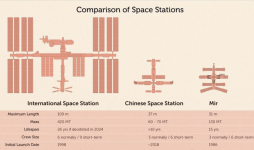
ChineseSpaceStationVsISS.png
 
Last edited:
Lol, 2018? Almost a decade ago,

Are you saying the pic is wrong? Please clarify what you feel is in error in terms of the size of your "luxury hotel" compared to the ISS...other than some new solar panels.

SEI_181884485.jpg


s132-e-012212.jpg


"but whatabout..."
 
Last edited:
Are you saying the pic is wrong? Please clarify what you feel is in error in terms of the size of your "luxury hotel" compared to the ISS...other than some new solar panels.

SEI_181884485.jpg


s132-e-012212.jpg


"but whatabout..."
I m saying if that is yours? we have our own space station, why do you bring out international space stateion? do you also claim UN is yours?
 
I m saying if that is yours?

Hey I'm sorry China has no friends in the world who are interested in adding modules to your station...that's not our fault.

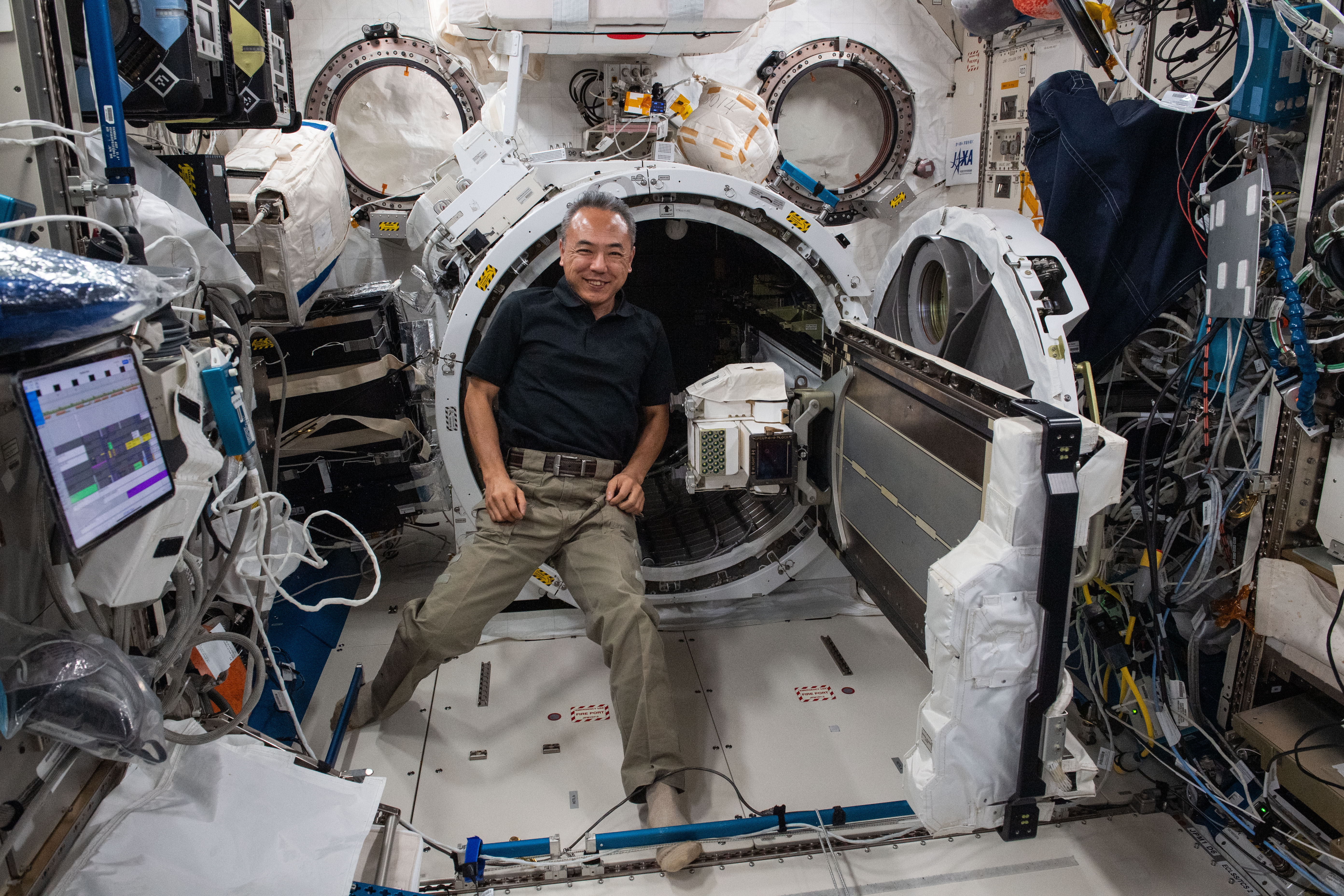
iss070e002150.jpg

Astronaut Satoshi Furukawa works in the Kibo laboratory module​


Kibō (Japanese: きぼう, lit. 'Hope'), also known as the Japanese Experiment Module (JEM), is a Japanese science module for the International Space Station (ISS) developed by JAXA.


columbusmodule.jpg
Columbus is a science laboratory that is part of the International Space Station (ISS) and is the largest single contribution to the ISS made by the European Space Agency (ESA).
 
Last edited:
Hey I'm sorry China has no friends in the world who are interested in adding modules to your station...that's not our fault.

iss070e002150.jpg

Astronaut Satoshi Furukawa works in the Kibo laboratory module​

There's nothing to brag about having partners in space station. China can do it alone.
 
Hey I'm sorry China has no friends in the world who are interested in adding modules to your station...that's not our fault.
Having friends or not, is that International space station yours? do you also claim UN is yours just because you have some friend there?
 
As of September 2024, at least 14 countries have signed agreements to participate in the International Lunar Research Station (ILRS):
China: The leader of the ILRS initiative
Russia: The initial partner in announcing the ILRS in 2021
Venezuela: A partner in the ILRS
Pakistan: A partner in the ILRS
South Africa: A partner in the ILRS
Belarus: A partner in the ILRS
Nicaragua: A partner in the ILRS
Egypt: A partner in the ILRS
Thailand: A partner in the ILRS
Serbia: A partner in the ILRS
Kazakhstan: A partner in the ILRS
Asia-Pacific Space Cooperation Organization: A partner in the ILRS
Arab Union for Astronomy and Space Sciences: A partner in the ILRS.
 
There's nothing to brag about having partners in space station. China can do it alone.

So can we...we have done it before..and then decided to open space up to the world.

To view this content we will need your consent to set third party cookies.
For more detailed information, see our cookies page.


To view this content we will need your consent to set third party cookies.
For more detailed information, see our cookies page.


What has your joke asian country done in space that you feel you can speak up? :ROFLMAO:
 
  • Haha
Reactions: FHN
So can we...we have done it before..and then decided to open space up to the world.

To view this content we will need your consent to set third party cookies.
For more detailed information, see our cookies page.

China built its own space station after being excluded from the International Space Station. You can thank the US policy makers for that
 
China built its own space station after being excluded from the International Space Station. You can thank the US policy makers for that

LOL! What's your excuse for nobody interested in joining the Chinese space station program to do any long-term space research. Is that because of US policy too? :rolleyes:

Meanwhile over 20 countries have sent researchers to the ISS.

Apparently being open to other countries researchers is a negative.

Good luck seeing anybody from your country being there for any extended periods of time.
 
Last edited:
LOL! What's your excuse for nobody interested in doing any long-term research on the Chinese space station. Meanwhile over 20 countries have sent researchers to the ISS.

Apparently being open to other countries researchers is a negative.
China is planning to allow foreign astronauts to participate in its space station program.just calm your tits. Whether china do it or not is none of your business. China led international lunar research station already have 14 partners. It's a step process. We go our own way we don't need you.
 
So fully reusable means the top half of the rocket needs to survive re-entry at orbital speed...which would be the version with the 4 fins.
Well, form follow function.

I think anybody that has basic understanding of technology would expect that if the second stage need to be recover or return, it would need fins to steer it back. But the details in the design might defer.

And for your information, SpaceX is well known of something called the interative design methodology.
From

The Traditional Design Methodology in Aerospace​

In conventional aerospace projects, a considerable amount of time and resources are spent on the design phase before the first prototype is built. This approach involves rigorous simulations, testing of individual components, and a meticulous review process that could last for years. The reason for such caution is understandable: space missions are high-stakes endeavors where failure can result in significant financial losses and, in the worst-case scenarios, loss of life. Therefore, exhaustive planning and validation are considered necessary steps before a full-scale prototype is built and tested.​

Iterative Design: A Different Approach​

However, SpaceX’s approach to Starship development diverges from this traditional pathway. Instead of extensive planning and design work upfront, SpaceX opts for a more dynamic, iterative design methodology. This involves building a prototype quickly, testing it, analyzing the results, and using the learned data to improve subsequent designs. The cycle of build-test-analyze-improve is repeated numerous times, allowing for accelerated development and real-world testing of design hypotheses.​

That is the reason why SpaceX would appear earlier, because it would construct and test Starship early with a not so mature prototype and test repeatedly.

While China that use traditional design methodology will work out a more mature first prototype that take longer time to begin first test.
 
Well, form follow function.

yes, and so far the only 2 proven forms of successful re-entry from orbit of anything of significant mass are:

1) heatshield (or heat tiles) + parachute
vol1%2Fmedia%2Foriginal%2Fold%2F1%2F56%2F15664_hires_0%3A0%3A0%3A0_1400x1000_80_10_1_UklBIE5vdm9zdGkgIzE1NjY0_116%3A95_sputnik-15664-preview_07f027390bac2df8c62f0027b131349a.jpg

Vostok 1

2) heat tiles + horizontal winged glider landing
61a-s-0139~large.jpg


Everything else is unproven theory so your "form follow function" is not written in stone.

High potential way:
Heat tiles + bellyflop fins + powered vertical engine landing
To view this content we will need your consent to set third party cookies.
For more detailed information, see our cookies page.

Next landing will be in daylight to see if the ship was still in good shape
 
Last edited:
yes, and so far the only 2 proven forms of successful re-entry from orbit of anything of significant mass are:

1) heatshield (or heat tiles) + parachute
vol1%2Fmedia%2Foriginal%2Fold%2F1%2F56%2F15664_hires_0%3A0%3A0%3A0_1400x1000_80_10_1_UklBIE5vdm9zdGkgIzE1NjY0_116%3A95_sputnik-15664-preview_07f027390bac2df8c62f0027b131349a.jpg

Vostok 1

2) heat tiles + horizontal winged glider landing
61a-s-0139~large.jpg


Everything else is unproven theory so your "form follow function" is not written in stone.

High potential way:
Heat tiles + bellyflop fins + powered vertical engine landing
To view this content we will need your consent to set third party cookies.
For more detailed information, see our cookies page.

Next landing will be in daylight to see if the ship was still in good shape

Most of the technology that is required is pretty much known and has been utilized for so long already.

What is not known is the engineering when used in combination, and would involved things like reliability and cost.

After all, I think all the space faring nation or nations, of US, Russia, China and possibly European (Japan, India??) would be able to do it if they really wanted to, but either is considered not much use for themselves or too risky. Because the investment is huge with high engineering risk that might prove to be unworthy like the US Space Shutter program.

Therefore the choices are pretty much variation of those known and tried technology in order to achieve the objective of reducing launch cost per payload to orbit.

Combination using heatshield for reentry, rocket engine for deceleration (don't think parachute would be possible for something big), and using thrust vectoring + some sort of aerodynamic surface like fin or grid fin for altitude control is obvious and almost a given because these are technologies that has been in used and familiar.

That would left the landing mechanism that might vary because it is not so familiar.

China decided to explore the net capture technology that seem more complicated then the leg landing and the so called chopstick method. But it is probably selected because of certain advantage like the payload ratio mentioned.

Both China and SpaceX choice is still under development, SpaceX had one single success test. Only time would tell, which one is viable or better.
 

Users who are viewing this thread

Pakistan Defence Latest

Latest Posts

Back
Top