The Bangladesh Air Force risks becoming a paper tiger, if it isn’t already.
By Asif Al Hasan and Muhammad Rauhan Rasheed
May 01, 2026
On March 26, Bangladesh displayed its military might to the world during its
Independence Day parade. Although it was a power-projection spectacle, with jets soaring across the sky in a meticulously choreographed aerial display, contrary to the newly elected government’s expectations, the air show failed to mesmerize its audience – especially young Bangladeshis online.
Criticism spread rampantly on
social media about the lackluster combat aircraft inventory of the Bangladesh Air Force (BAF) compared with those of neighboring air forces. The disappointment was palpable regarding the BAF being out of step with the demands of modern warfare.
The roots of this criticism are not new. This frustration has been building for years, and the Independence Day parade just reignited it. As a matter of fact, Bangladesh’s air power was never designed to be expansive. It emerged haphazardly after 1971 with limited resources to meet urgent needs. Therefore, even the strategic culture matured in a way that it never placed air superiority at a pivotal position in the national defense structure. Dhaka faced immediate reconstruction challenges, leading to only incremental upgrades in the BAF fleet.
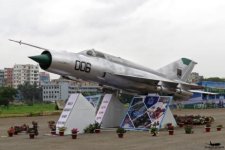
But incrementalism has limitations. Aircraft being kept in service longer than originally intended is a step toward irrelevance. In statistical terms, the BAF only boasts 44 combat aircraft, with 36 of its contemporary fleet still relying on the aged and outdated
Chengdu F-7 platform. The remaining eight aircraft are battle-tested
MiG-29s, but they’ve long since become legacy platforms. They’re clearly well past their prime, and with such a small number, they don’t even make up a full operational squadron anymore.
To make matters worse, modern air power no longer revolves around aircraft inventory alone. A modern air force’s real combat power isn’t defined by aircraft numbers; it rests on robust electronic warfare capabilities, seamless integration across platforms, and the ability to operate effectively within a broader joint-force framework. On that front, the BAF is not just behind the eight ball; it is struggling even to justify its potency in a region that isn’t standing still.
To illustrate, the
Bay of Bengal has become increasingly strategically relevant for Dhaka. The Bay of Bengal is witnessing rapid air and naval movements, not just by regional actors but also by external powers with growing stakes in the Indo-Pacific. In addition, relations with India, while not openly hostile, have
deteriorated. To the east, there lies an unstable Myanmar, which has repeatedly
violated Bangladeshi airspace. Amid such uncertainties, air power is a strategic necessity for Dhaka.
On paper, Bangladesh seems to have understood the gravity of the situation. Its military modernization vision, outlined in “
Forces Goal 2030,” has been around for years, and the thought of acquiring modern multi-role combat aircraft is hardly new. However, what is striking is not the absence of plans but the disappointing pattern that follows them. The government’s promises and announcements eventually lead to no concrete action.
The Eurofighter Typhoon episode is a case in point. A December 2025
letter of intent to purchase the Eurofighter Typhoon appeared to signal a serious shift from Dhaka. It suggested that the BAF might finally be ready to roar, but nothing substantial followed. The momentum eventually faded as no contract was signed, and not even a clear timeline of future discussions was drafted. The fact that this move surfaced during an interim period of government and then quietly receded only reinforces the impression that Dhaka’s defense planning lacks continuity.
Yet the main deterrent to the strengthening of the BAF remains external pressures. To put things in perspective,
India’s concerns about Chinese military involvement in the South Asian region are well documented, and Bangladesh inevitably carries this geopolitical weight, making procurement decisions for it rarely just a technical choice. Indian resistance does not always need to be in the form of open opposition. Often,
New Delhi employs a military build-up strategy at Bangladesh’s border to deter Dhaka. India also uses diplomatic channels to apply pressure. This eventually slows the process of procurement, causes bureaucratic delays, and leaves limited options for Dhaka’s decision-makers.
Bangladesh has at times tried to work around this. For instance, ignoring the Indian push to sell Hal Tejas to Bangladesh, Dhaka purchased Russian-made
Yak-130 trainers, acquired Turkish Bayraktar
TB2 attack-drones, and continued engagement with Chinese suppliers. These moves all point to an effort to diversify. In addition, recent discussions about purchasing
JF-17 Thunder fighter jets (a Sino-Pakistani venture) demonstrate an exploratory approach, flexibility, and departure from Indian influence.
But in practice, Dhaka’s efforts are fragmented. Diversification without integrating platforms and systems does not necessarily work well; it may simply create a chaotic patchwork. And therein lies the real worry: as other air forces in the region shift toward more networked and integrated forms of warfare, Bangladesh risks being left with capabilities that do not fully interoperate.
Over time, such a gap will be more difficult to bridge. Bangladesh is nearing a point where it will start paying the cost of delaying modernization. The question that looms is whether Dhaka’s new administration is willing to shift from intention to execution with sufficient consistency to make it count. Otherwise, the Bangladesh Air Force will become a paper tiger, and the widening gap will place it further out of step with contemporary air power requirements.





 Federal cabinet gives nod to imposition of emergency in KP; summary sent to president (28 Viewers)


