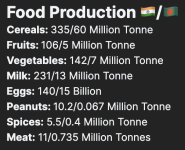
No, the degree of hunger problem and GDP does not correlate 100%. if this data is correct then it could be explained through potential higher income inequality in India.
But calculated higher GDP per Capita than BD would still be correct.
GHI is malnutrition focused rather than hunger per se.
I find it a useful measure to some degree only within a country (over time), as each country has different statistical standards and capacities in end.
I mean Ethiopia objectively has sadly had tremendous relapse in malnutrition (and actual hunger and even starvation too)..... one can look at the deaths that have happened in last 3 - 4 years made worse by the Tigray conflict and other conflicts going on....the large amount of food aid that the UN has gotten involved in with relief efforts etc.
Yet Ethiopia ranks 10 or so ranks better than India. In the end GHI has to rely on Ethiopia's internal surveying and so on (whatever Ethiopia's version of the Indian NFHS is etc).
So in the end it just shows Ethiopia has 2x, 3x or X times worse statistical capacity on this relative to say India (and its NFHS etc).
I mean past GHI, I can simply read NFHS directly in detail to begin with....and read debates about its pros and cons and improvements....and policy changes etc...and these are really just relevant to the country's context....rather than cross-country comparison relevance as they systems are not the exact same people and processes measuring everything.
These guys actually go into some of the issues (related to poverty and especially their criticism of Multi-poverty index):
These vary for different countries in the end. Regarding the stuff GHI focuses on.... NFHS for example samples about 600k households, BD DHS samples about 30k households in its latest one. Of course this doesnt imply anything qualitatively (that is a deeper dive to get into regarding methodology to minimise bias in the sampling etc)....but just to show there are differences between countries that give implied error bounds for each data point (well before you agglomerate into an index).
That said, the main culprit of the issue is vast hinterland between Delhi and Calcutta that has huge voids of governance/administration aptitude for delivery, that has built up a void this long for all kinds of reasons. BD has done better here overall in lot of areas (kind of like South India, which brings the Indian average higher in end).
But overall in end, given where south asia is on the GDP/capita range currently as whole, you can safely say 80% base of people everywhere in south asia are doing overall the same economically (whatever the social indicator delivery/situation...which ofc we want to be as good as possible even with very low incomes).... the 20% (or less) is tugged at vertically a bit more nowadays in India...and the hope is this tugs on the 80% larger mass to rise it too....but its slow process. But really the splitting hairs over any income level below 10k per capita is kind of redundant as that 80% base is largely the same in end in this range, its fully driven by the apex and their resources at hand (i.e its really only past 10k you get sizeable change in the 80% at a faster rate).


www.globalhungerindex.org